

TL;DR:
- Many dog owners mistake wagging tails for happiness, but they often signal stress or arousal.
- Proper dog communication requires understanding body language and practicing in varied environments for reliability.
- Building trust and consistent cues are more effective than gadgets, as dogs respond best to natural, emotionally present humans.
Most dog owners believe a wagging tail means their dog is happy. That single assumption causes more misunderstandings, stress, and bites than almost any other mistake in pet ownership. Dogs communicate through body language, scent, vocalizations, and touch, but owners routinely misread these signals, sometimes with serious consequences. Whether you have a new puppy, a rescue dog, or a trained service dog, the gap between what your dog is saying and what you think you hear is real and fixable. This article walks you through the most common pitfalls, the root causes, and the practical strategies that actually work.
Table of Contents
- Common misinterpretations in dog signals
- Core dog communication challenges: causes and context
- Solutions: Tools and training methods to overcome communication pitfalls
- Applying communication strategies: Real-world scenarios
- Fresh perspective: Why most training misses the mark and what really matters
- Need more support? Explore expert dog communication resources
- Frequently asked questions
Key Takeaways
| Point | Details |
|---|---|
| Read body language first | Dogs use posture, ears, and tail to signal emotions more reliably than vocal cues. |
| Consistency is vital | Clear, repeated signals prevent confusion and enhance trust in dogs of all breeds and ages. |
| Tech tools are supplementary | Buttons and whistles can help but should always support, not replace, natural communication. |
| Practice in varied settings | Training commands across multiple locations builds reliable communication with your dog. |
| Positive reinforcement works | Reward-based methods help dogs learn more quickly and reduce stress-related errors. |
Common misinterpretations in dog signals
After introducing how misunderstandings happen, let’s look at the specific signals most people get wrong. The truth is, most of us were never taught to read dogs accurately. We learned through casual observation, and that leaves huge blind spots.
Take tail wagging. A fast, low wag often signals anxiety or submission, not joy. A stiff, high wag can mean alertness or even aggression. A wagging tail is not always happiness; showing teeth is frequently a warning, not a smile. Yet owners approach a stiff, teeth-baring dog expecting a friendly greeting. That is how bites happen.
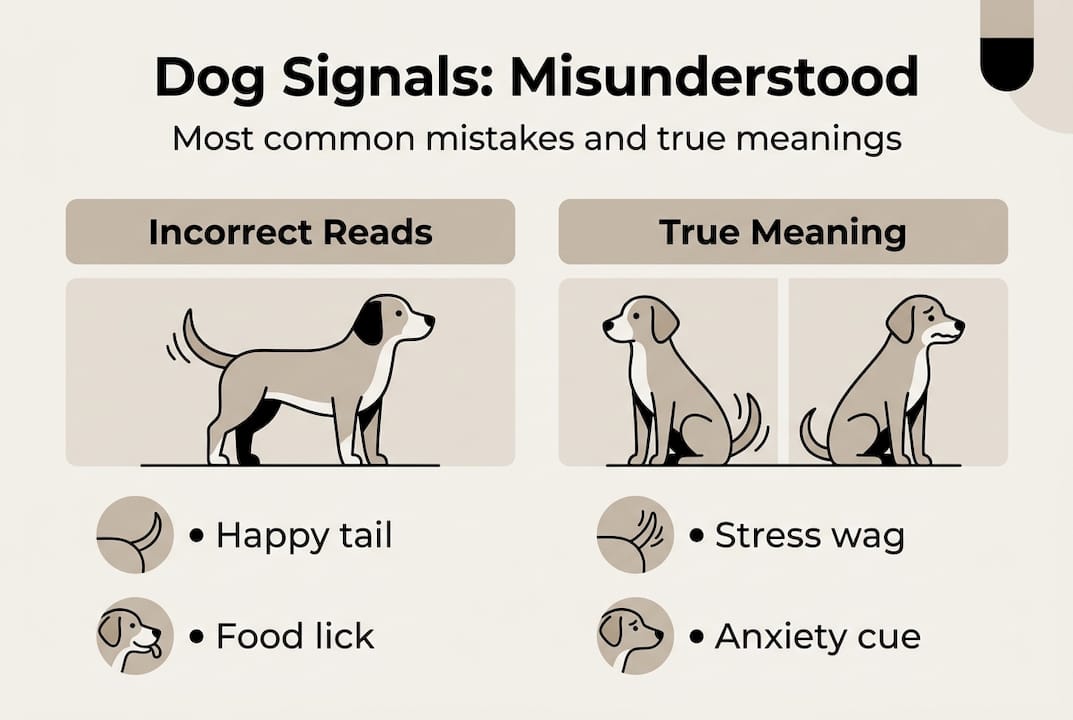
Lip licking is another misread signal. Most people think it means the dog wants food. In reality, it is one of the clearest stress signals a dog can give. Yawning in a non-tired context, turning the head away, and whale eye (where you see the white of the eye) are all calming signals that dogs use to say “I am uncomfortable.”
Here is a quick look at the most misread signals:
| Signal | What owners think | What it often means |
|---|---|---|
| Wagging tail | Happy | Aroused, anxious, or alert |
| Showing teeth | Smiling | Warning or threat |
| Lip licking | Hungry | Stressed or uneasy |
| Yawning | Tired | Overwhelmed or calming down |
| Jumping up | Excited greeting | Seeking control or attention |
Key signals to observe together, not in isolation:
- Ear position: Forward means alert; flat means fearful or submissive
- Tail height and speed: High and stiff is different from low and fast
- Eye contact: Hard stare signals challenge; soft eyes signal comfort
- Body posture: Leaning forward is confident; hunching is fearful
- Mouth tension: Tight lips signal stress; loose, open mouth signals relaxation
“Reading a dog means reading the whole dog, not just one part. A wagging tail attached to a stiff body and hard eyes is a warning, not an invitation.”
Pro Tip: Before approaching any unfamiliar dog, spend five seconds scanning its full body from tail to ears. That quick scan could prevent a bite.
Research confirms that humans struggle to read dog emotions accurately, often relying on context rather than actual body language. Learning to decode dog body language takes practice, but it is a learnable skill. Start by watching your own dog in low-stress situations so you know their baseline. From there, stress detection through body language becomes much easier to spot.
Core dog communication challenges: causes and context
Having looked at specific misinterpretations, let’s explore what makes communication so challenging by age, breed, and context. Misreading signals is only part of the problem. The other part is what we do, or fail to do, on our end.
Key challenges include handler inconsistency, adolescent rebellion, breed differences, failure to generalize commands, and over-reliance on verbal cues. Each of these creates a different kind of breakdown.
Handler inconsistency is the most common culprit. If “down” sometimes means lie down and sometimes means stop jumping, your dog is not confused because they are stubborn. They are confused because the signal keeps changing. Dogs learn patterns, and inconsistent patterns produce unreliable behavior.
Adolescent dogs (roughly 6 to 18 months) go through a phase where previously learned behaviors seem to disappear. This is not defiance. It is a neurological shift. The brain is rewiring, and dogs in this phase need more patience and repetition, not harsher corrections.
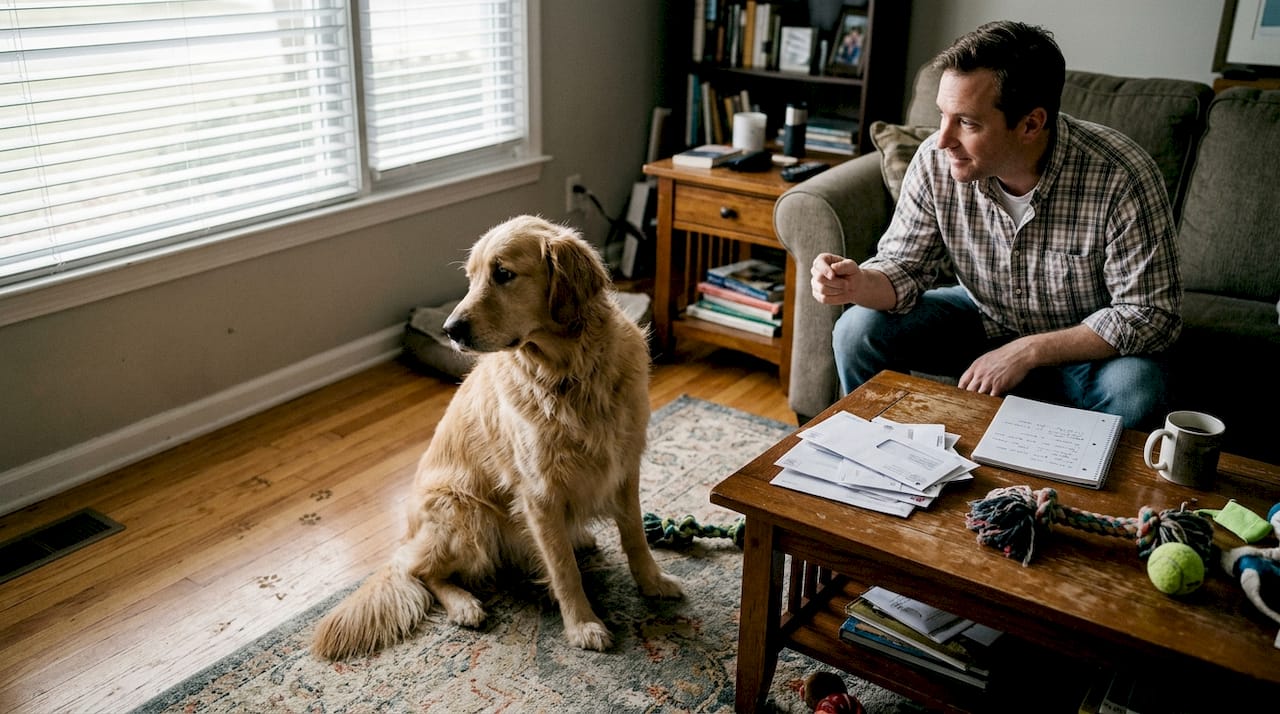
Breed differences matter more than most people realize:
| Breed type | Communication style | Training approach |
|---|---|---|
| Independent (Husky, Basenji) | Less handler-focused | Needs creative motivation |
| Eager to please (Golden, Lab) | Highly responsive | Responds well to praise |
| Herding (Border Collie) | Anticipates cues | Needs mental stimulation |
| Guardian (Akita, Rottweiler) | Reserved, observant | Needs trust-building first |
Four common causes of communication breakdown:
- Mixing verbal cues with conflicting body language
- Only practicing commands at home, then expecting them in new places
- Relying on verbal commands when dogs are primarily visual communicators
- Skipping the “generalization” phase of training
Generalization means teaching a command in multiple locations, with multiple people, and in varying conditions. A dog who knows “sit” only in the kitchen does not really know “sit.” They know “sit in the kitchen.”
Pro Tip: Once your dog reliably responds to a command at home, practice it in three new locations within the same week. This dramatically speeds up generalization.
Empirical data shows humans rely on context over body language when reading dogs, which means we often miss what the dog is actually doing. Pairing easy training methods with structured teaching commands helps close this gap. You can also review safer training tips to build a foundation that works across contexts.
Solutions: Tools and training methods to overcome communication pitfalls
Now that the causes are clear, let’s focus on the most effective solutions, what really works for both pet and service dogs.
The most reliable improvement comes from combining consistent verbal cues with hand signals. Dogs process visual information faster than auditory input, so a hand signal paired with a word gives them two chances to understand. Pair verbal and hand signals; train tasks separately; professional programs ensure reliability. This is especially critical for service dogs, where a missed cue is not just inconvenient but potentially unsafe.
Here is what an effective communication framework looks like in practice:
- Pair every verbal cue with a hand signal from day one, not as an afterthought
- Use positive reinforcement consistently: reward the behavior you want, ignore what you do not
- Train one task at a time, especially for service dog work, to avoid confusion between related commands
- Practice in at least five different environments before considering a command reliable
- Keep sessions short: 5 to 10 minutes is more effective than one long session
- Use your dog’s name only to get attention, not as part of a command
“Clarity is kindness. A dog who understands exactly what you want is a dog who can succeed. Vague signals create anxious, frustrated animals.”
Technology tools like communication buttons and whistles have gained popularity, but natural cues outperform tech, though tools like buttons and whistles can supplement when used wisely. Think of them as training aids, not replacements for the relationship and clarity that come from consistent human communication.
Pro Tip: If you use a clicker or button, always pair it with a reward within two seconds. Delayed rewards break the association and slow learning significantly.
For service dog handlers, task separation is non-negotiable. Teach each task as a standalone behavior before chaining them. This prevents the dog from skipping steps under pressure. Check out the dog signal training guide for a structured approach, and use training steps for safety to build reliability. You can also learn how to teach dogs communication through clear, step-by-step progressions.
Applying communication strategies: Real-world scenarios
With solutions in hand, here is how to put them into practice in your day-to-day life, structured for different dog stages and needs.
Different life stages call for different approaches. A 10-week-old puppy, a 2-year-old rescue, and a working service dog all need communication strategies tailored to where they are right now.
For puppies: Socialization is the priority. Expose your puppy to different sounds, surfaces, people, and animals during the critical window of 3 to 14 weeks. Education on signals and practice in varied settings reduces bites and misreads. Teach simple cues like “sit,” “look,” and “come” using luring and reward, keeping sessions under five minutes.
For adult dogs: Focus on command refinement and generalization. If your dog knows “down” at home but not at the park, that is your training gap. Practice in noisy environments specifically. Teaching “down” near a busy street is harder, but that difficulty is the point.
Step-by-step approach for a noisy environment:
- Start at the edge of the noisy area, not in the middle
- Ask for a known command and reward heavily for success
- Move slightly closer to the distraction and repeat
- Gradually reduce the reward frequency as reliability increases
- Add the verbal cue in a calm, clear tone without shouting
For service dogs: Task division is essential. Break complex tasks into individual steps and proof each one before combining them. Consistent daily routines reduce cognitive load and help the dog perform reliably under stress.
Practical adjustments for different situations:
- Use hand signals in loud environments where verbal cues get lost
- Keep a consistent feeding and training schedule to reduce anxiety
- Avoid training when either you or your dog is tired or stressed
- Rotate training locations weekly to build generalization
Consistent practice across varied settings lowers communication errors significantly, with some estimates pointing to a 40% reduction in misreads when owners train across multiple environments. Whether you are training a puppy for communication or focused on training service dogs, the principle is the same: repetition in context builds real reliability.
Fresh perspective: Why most training misses the mark and what really matters
Here is something the mainstream training world rarely says out loud: most communication problems between dogs and owners are not training problems. They are relationship problems.
We rush to buy gadgets, sign up for obedience classes, and look for quick fixes. But a dog who does not trust you will not respond reliably, no matter how many buttons you press or whistles you blow. Button tech underperforms compared to natural cues, and this finding points to something deeper. Dogs are wired to respond to living, breathing, emotionally present beings, not devices.
The owners who see the fastest progress are not the ones with the most tools. They are the ones who slow down, observe their dog without an agenda, and adapt their approach based on what the dog is actually showing them. That kind of attunement cannot be purchased.
For service dog handlers especially, the pressure to achieve perfect command response can actually work against the relationship. A stable, predictable environment matters more than drilling commands. Dogs in high-stress routines with inconsistent emotional climates show more errors, not fewer. Explore easy dog training methods that prioritize connection over compliance, and you will likely see better results faster.
Need more support? Explore expert dog communication resources
Building a stronger communication bond with your dog is an ongoing process, and you do not have to figure it out alone.
At iPupPee, we publish science-backed articles, step-by-step training guides, and practical tools designed specifically for dog owners, service dog handlers, new puppy parents, and seniors who want a safer, clearer relationship with their dogs. Whether you are troubleshooting a specific behavior or building communication from scratch, our dog communication resources are built to help you make real progress. Explore our blog, discover our innovative alert device, and join a community of owners who take their dog’s communication seriously. Your dog is already talking. We help you listen.
Frequently asked questions
What is the most common mistake owners make in reading dog signals?
Assuming a wagging tail means happiness is the most common mistake; it often signals arousal, stress, or uncertainty depending on the tail’s height and speed.
How can I improve communication with my dog across different environments?
Practice commands and signals in varied locations using consistent cues and rewards, since failure to generalize commands is one of the most common and fixable training gaps.
Are communication technologies like buttons effective for dogs?
Button technology shows some promise but underperforms compared to natural cues like hand and voice signals, making them best used as supplements rather than primary tools.
What is the best training approach for service dogs?
Pair consistent verbal and hand signals and train each task separately before combining them to ensure reliable, pressure-tested performance.
Why do some breeds present unique communication challenges?
Independent breeds like huskies are less responsive to standard cues and require creative, patience-based approaches that account for their lower handler-focus compared to eager-to-please breeds.