

Getting a service dog ready for daily tasks means more than basic obedience. Many handlers face the challenge of building reliable communication and independence with their dog. With new solutions like the iPupPee device, thoughtful training can bridge the gap between handler needs and service dog abilities. This guide spotlights clear, step-by-step methods and introduces innovative tools to strengthen your dog’s foundation for confident partnership.
Table of Contents
- Step 1: Assess Your Dog’s Suitability And Readiness
- Step 2: Set Up The Training Environment And Devices
- Step 3: Introduce Basic Obedience And Essential Commands
- Step 4: Teach Device Interaction For Communication
- Step 5: Test And Reinforce Reliable Responses In Real Scenarios
Quick Summary
| Key Point | Explanation |
|---|---|
| 1. Assess temperament and behavior | Evaluate your dog’s emotional stability, impulse control, and trainability to determine service dog potential. |
| 2. Set up distraction-free training | Create a quiet, consistent environment free from interruptions to facilitate focused learning and skill development. |
| 3. Teach core obedience commands | Focus on basic commands like “Sit” and “Stay” to ensure reliable responses and safety in various situations. |
| 4. Introduce communication devices gradually | Familiarize your dog with communication tools in low-distraction settings, reinforcing positive interactions for effective use. |
| 5. Test in real-world scenarios | Gradually increase exposure to diverse environments, rewarding success and observing responses to ensure reliability in public. |
Step 1: Assess your dog’s suitability and readiness
Determining whether your dog can become an effective service dog requires careful evaluation of multiple critical factors. Your goal is to objectively assess your dog’s potential through comprehensive temperament and behavioral assessments.
Begin by examining key characteristics that indicate service dog potential. Canine temperament assessment involves analyzing several essential traits:
- Emotional stability in unpredictable environments
- Strong impulse control and minimal reactivity
- Calm demeanor under stress
- High trainability and quick learning capacity
- Consistent focus on handler’s commands
- Minimal distractibility in public spaces
Age and health play significant roles in service dog selection. Typically, dogs between 12-24 months demonstrate the most promising developmental window for intensive training. Younger dogs might lack maturity, while older dogs could struggle with extensive learning requirements.
Not every dog will become a service dog, and that’s perfectly okay. The selection process prioritizes the dog’s well-being and potential for successful assistance.
Professional evaluations using standardized tools like the Clothier Animal Response Assessment can provide objective insights into your dog’s service dog candidacy. These assessments examine behavioral responses, social interactions, and adaptability across different scenarios.
Pro tip: Consider consulting a professional service dog trainer for a comprehensive evaluation to ensure an accurate and compassionate assessment of your dog’s potential.
Step 2: Set up the training environment and devices
Creating an effective training environment is crucial for successfully preparing your service dog. Your primary goal is to design a controlled, distraction-minimized space that supports focused learning and skill development.
Training environment setup involves several strategic considerations:
- Quiet dedicated training area with minimal external stimuli
- Consistent spatial layout to reduce cognitive load
- Specialized training equipment like harnesses and leashes
- Comfortable mat or designated training zone
- Communication devices tailored to specific assistance needs
Begin by selecting a calm, enclosed space in your home where your dog feels secure. This area should be free from household traffic, loud noises, and potential interruptions. Incremental environment exposure helps your dog gradually adapt to different training scenarios.
Consistency and positive reinforcement are more important than elaborate training setups. Your dog needs to feel safe and motivated to learn.
Introduce training devices gradually, allowing your dog to become comfortable with each new tool. Start with simple communication aids like signal buttons or alert devices in quiet settings before progressing to more complex interactions.
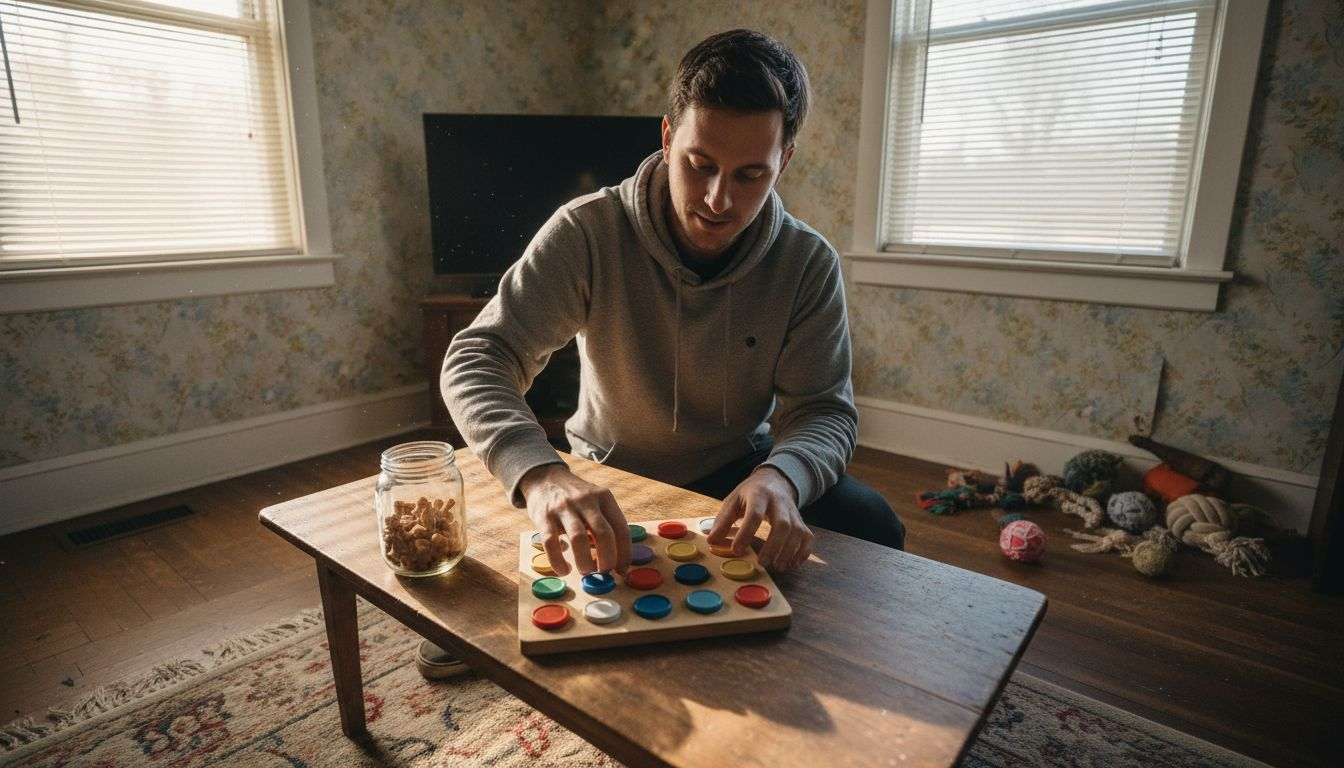
Pro tip: Document your training environment and device introduction process with short video recordings to track your dog’s progress and identify areas needing additional support.
Here’s a quick reference summarizing service dog candidate requirements versus training environment needs:
| Category | Candidate Requirements | Environment Needs |
|---|---|---|
| Emotional Stability | Remains calm under stress | Quiet dedicated training area |
| Age Range | 12-24 months optimal | Minimal external stimuli |
| Health Condition | Excellent physical health | Predictable, consistent space |
| Trainability Level | Quick to learn new commands | Safe and comfortable zone |
| Focus & Distraction | Maintains attention in public | Gradual exposure to settings |
Step 3: Introduce basic obedience and essential commands
Building a solid foundation of obedience is crucial for transforming your dog into a reliable service companion. Service dog training requirements emphasize mastering fundamental commands that ensure safety and responsiveness in various environments.
Focus on teaching these core commands:
- Sit - Fundamental control command
- Stay - Critical for maintaining position
- Come - Essential for immediate recall
- Down - Important for settling in public spaces
- Heel - Maintaining proper walking position
- Leave it - Preventing unwanted interactions
Start training in a quiet, distraction-free environment with short 5-10 minute sessions. Use positive reinforcement techniques like treats and praise to encourage learning. Consistent training routines help your dog understand expectations and build reliable response patterns.
Patience and consistency are more important than perfection. Every dog learns at their own pace.
Gradually increase difficulty by introducing distractions and practicing commands in different locations. This helps your dog generalize learned behaviors and remain focused regardless of the environment.
Pro tip: Record your training sessions to track progress and identify areas where your dog needs additional support.
Step 4: Teach device interaction for communication
Training your service dog to effectively use communication devices requires patience, consistency, and a strategic approach. Service dog communication training involves teaching your dog to reliably interact with specific tools that enhance communication and independence.
Start with these foundational steps for device interaction:
- Familiarize your dog with the communication device
- Reward initial interactions with treats and praise
- Shape precise button or signal activation
- Practice in low-distraction environments
- Gradually increase complexity of interactions
- Reinforce consistent communication behaviors
Device interaction techniques focus on creating positive associations between device activation and desired outcomes. Begin by introducing the communication tool during calm training sessions, allowing your dog to explore and investigate naturally.
Successful device training relies on making the interaction feel like a fun game, not a challenging task.
Use targeted reinforcement to help your dog understand that pressing a specific button or making a particular signal results in a predictable response. Consistency is key in helping your dog develop reliable communication skills.
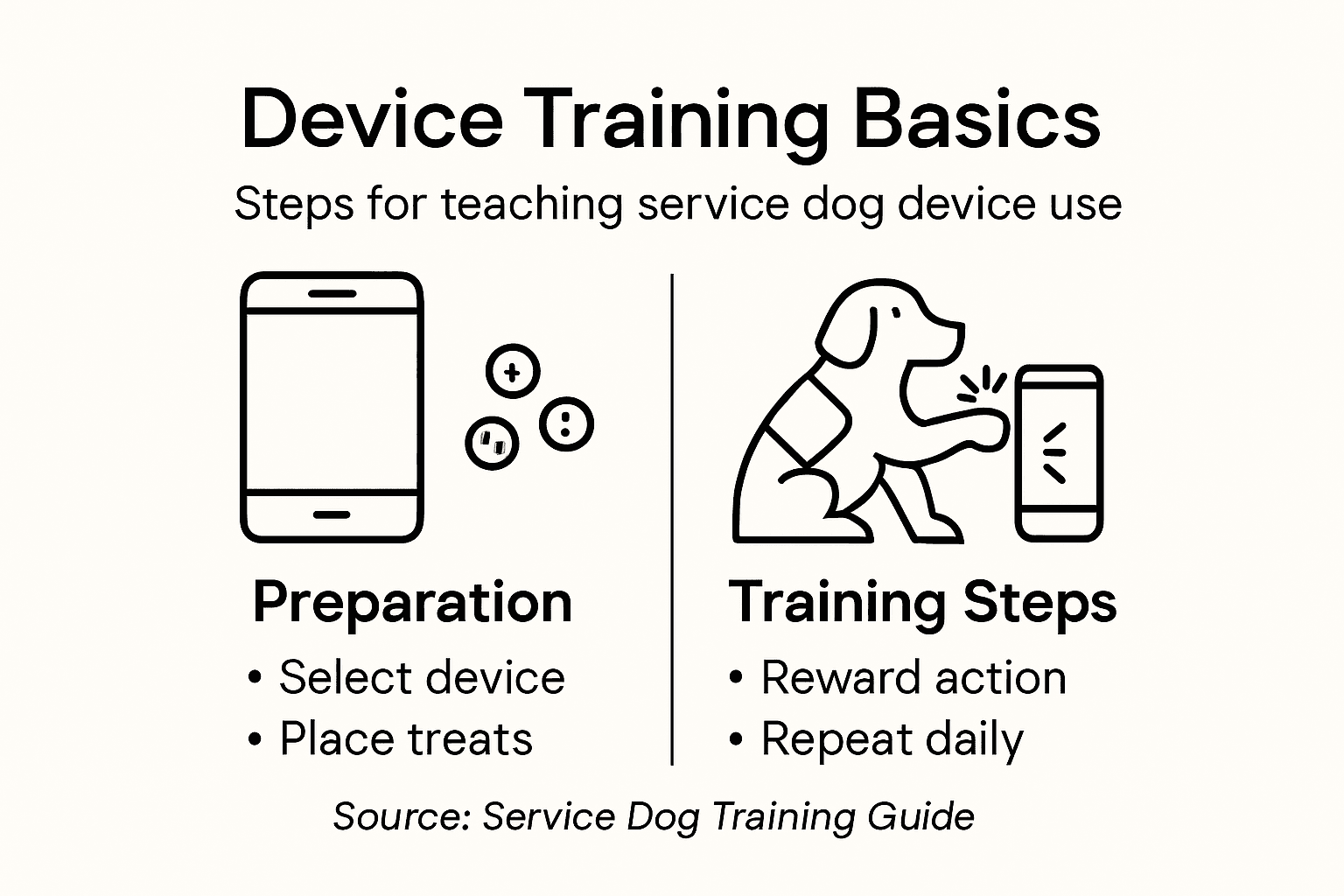
Pro tip: Create a training log to track your dog’s progress and identify patterns in device interaction learning.
Step 5: Test and reinforce reliable responses in real scenarios
Transitioning your service dog from controlled training environments to real-world scenarios requires strategic and methodical practice. Service dog readiness testing involves carefully designed challenges that confirm your dog’s ability to perform consistently under diverse conditions.
Develop a comprehensive testing strategy with these key approaches:
- Gradually increase complexity of training environments
- Simulate unexpected scenarios to test responsiveness
- Introduce mild distractions during training sessions
- Observe and document behavioral patterns
- Reward successful interactions immediately
- Correct subtle behavioral deviations promptly
Public access training requires systematic exposure to various stimuli. Start with controlled public spaces like quiet shopping centers or calm parks, allowing your dog to demonstrate learned skills while managing potential distractions.
Reliability comes from consistent practice, not perfection. Every challenge is an opportunity for learning.
Use positive reinforcement techniques to build confidence and maintain your dog’s motivation. Short, frequent training sessions in different environments help generalize learned behaviors and strengthen communication skills.
Pro tip: Record video documentation of your training sessions to track progress and identify subtle areas needing improvement.
Use this table to find the purpose behind key training activities:
| Training Activity | Main Purpose |
|---|---|
| Basic obedience commands | Ensure safety and reliable responses in public |
| Gradual device introduction | Build communication and independence |
| Real-world scenario testing | Confirm reliability under diverse situations |
| Consistent positive reinforcement | Strengthen learning and motivation |
Empower Your Service Dog Training with Innovative Communication Tools
Training a service dog to effectively communicate can be challenging with key tasks like device interaction, consistency, and reliability. The article highlights how important it is to teach your dog to use communication devices confidently and to maintain focus in real-life situations. This process requires patience and the right tools to transform your dog into a trustworthy service companion.
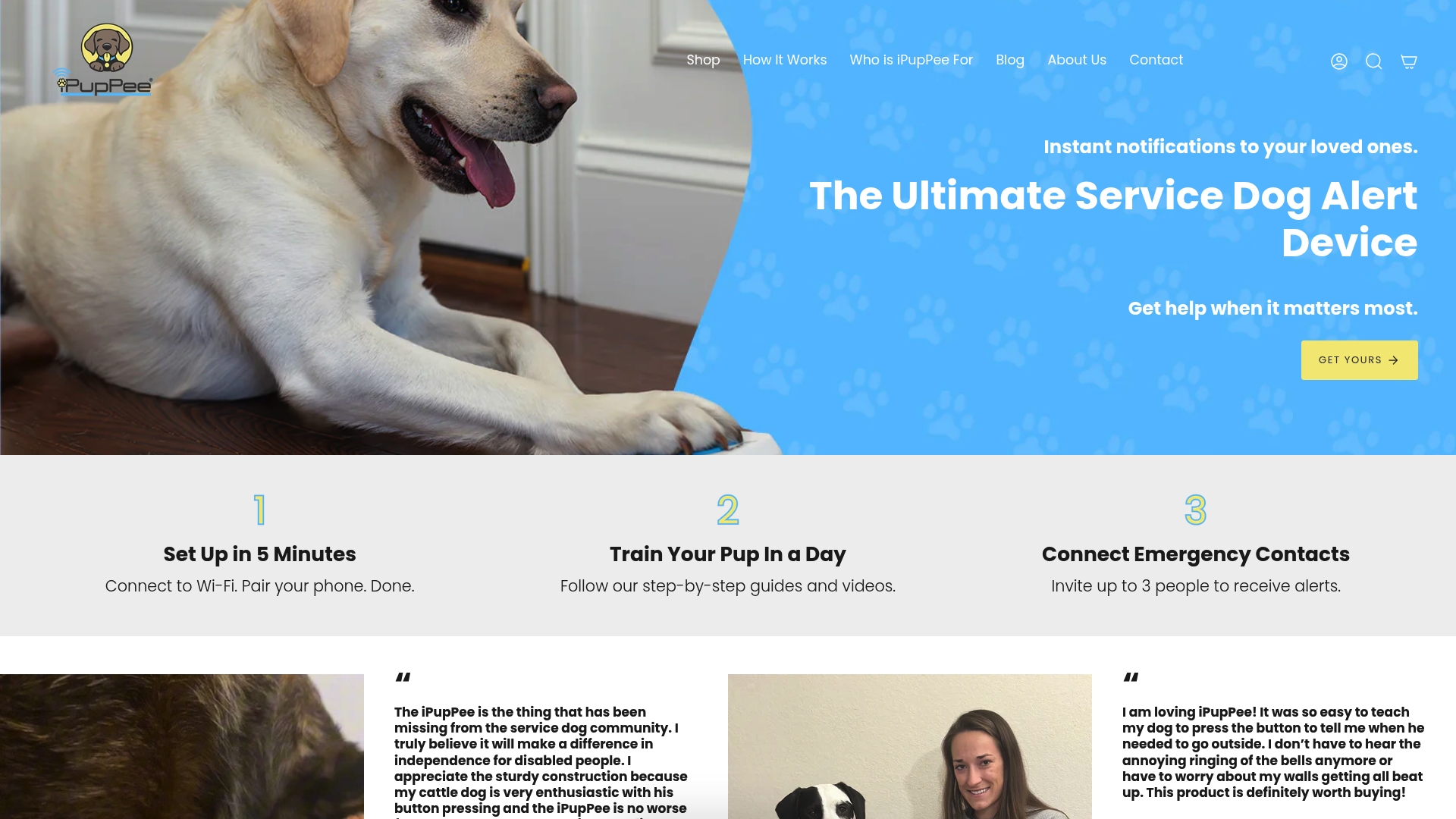
Take the next step in your service dog’s training journey with the iPupPee alert device from ipuppee.com. Designed to make communication clear and simple, this unique button press device supports your dog in signaling needs quickly and easily. Whether you are working on device interaction or preparing your dog for public environments, the iPupPee helps reinforce communication skills while promoting safety and independence. Discover how you can enhance training effectiveness and build stronger trust today. Visit https://ipuppee.com and explore training instructions and trusted customer testimonials that show why so many service dog handlers rely on this breakthrough product for success.
Frequently Asked Questions
How can I assess if my dog is suitable for service dog training?
Begin by evaluating your dog’s emotional stability, impulse control, and trainability. Conduct a comprehensive temperament assessment using standardized tools to determine your dog’s potential for effective communication as a service dog.
What basic commands should I teach my service dog for effective communication?
Focus on mastering core commands like Sit, Stay, Come, and Leave it. Train these commands in short sessions, progressively adding distractions to ensure reliability in real-world situations.
How do I introduce communication devices to my service dog?
Start by familiarizing your dog with the communication device in a quiet environment. Reward initial interactions with praise and treats to create positive associations, helping your dog to learn how to use the device effectively.
What steps can I take to reinforce my dog’s responses in real-world scenarios?
Gradually increase the complexity of training environments and simulate unexpected situations. Observe your dog’s behavior, reward successful interactions immediately, and correct any deviations to strengthen their responses.
How can I track my service dog’s training progress?
Create a training log to document each session, noting your dog’s improvements and areas that need further work. Recording video documentation can also help you visually track progress and refine your training approach.
Recommended
- Training Service Dog Signals: Easy Guide for Owners 2025 – iPupPee
- Dog Communication for Disabilities: Tools, Signals, and Impact – iPupPee
- 7 Solutions for Dog Training Challenges Disabled Owners Face – iPupPee
- Service Dog Obedience in 2025: Essential Training for Success – iPupPee
- Verstehen Sie Ihr Haustier: Tipps für erfolgreiches Tierverhalten und