

Pet tech began with simple, single-purpose gadgets and has become a connected ecosystem of trackers, cameras, feeders and alert devices. The biggest shift is that devices no longer only watch or feed your pet. They now let your pet reach you. Below is how we got here, what each generation added, and how to choose well today.
TL;DR
- Early pet tech was mechanical or one-way: radio experiments in the 1930s, then electronic flea collars in the 1980s, then livestock-style tracking ideas that shrank into pet products.
- Today’s devices cover location, activity, feeding, litter, video and two-way audio, mostly over Wi-Fi, Bluetooth or cellular.
- The next step is communication initiated by the dog: a press of a button that notifies a person, with video and audio attached.
- Privacy, fit and connectivity matter as much as features. Check them before you buy.
- We built iPupPee around that dog-to-human step, with no monthly subscription fee.
Table of Contents
- Where pet tech started: radios, transponders and flea collars
- The four generations of pet tech
- What pet tech looks like today
- Why the market keeps growing
- The shift from watching to communicating
- What to weigh before you buy any pet tech
- Who benefits most from the newest generation
- What is coming next
- A practical way to start
- Meet iPupPee
- FAQ
- Sources
Where pet tech started: radios, transponders and flea collars
The first wireless pet technology was not meant for pets at all. In June 1939, Popular Science reported on an Australian constable who strapped a shortwave radio to a dog to send remote commands. It was a working dog experiment, and it shows how long people have wanted a channel between themselves and their dogs.
The other root is agriculture. Livestock monitoring traces back to the 1970s, when electronic transponder collars were attached to cows to record data automatically. The same review notes that such devices have since become smaller and cheaper, which is what eventually put smart-home cameras for pets on ordinary shelves.
The consumer side arrived with gadgets people could buy at a pet store. A company called Biological Engineering, later rebranded as High Tech Pet, introduced an electronic flea collar in 1986, which became one of that decade’s best-selling pet products, according to the company’s own release. It was not connected to anything, but it established that owners would pay for electronics aimed at their animals.
The four generations of pet tech
Looking back, devices fall into four rough waves. Each solved a different problem, and each still exists today.
| Generation | Rough era | What it did | Typical example |
|---|---|---|---|
| Mechanical and electronic basics | 1980s to 1990s | Automated a single task | Electronic flea collars, timed feeders |
| Identification and tracking | 1990s to 2010s | Told you where a pet was or who it was | Microchips, early GPS collars |
| Connected monitoring | 2010s | Sent data to your phone | Wi-Fi cameras, activity trackers, app-linked feeders |
| Two-way and predictive | Late 2010s onward | Talks back, flags changes, learns patterns | Cameras with audio, smart litter boxes, AI health insights, dog-triggered alerts |
The eras overlap, and the dates are approximate. What matters is the direction: from the device doing something to your pet, to the device telling you about your pet, to the device letting your pet tell you something.
What pet tech looks like today
A 2026 survey of the category by the Los Angeles Times and other outlets describes a mature market. Here is how the main types work.
Trackers and smart collars
GPS trackers and smart collars use LTE-M cellular, Bluetooth or RFID to locate a pet. Internal accelerometers also report activity, and some models estimate heart rate, respiration and sleep. Activity trackers attach to a collar and, as Urban Asian’s 2026 guide explains, use motion sensors to estimate active minutes, rest, walk duration and changes from a dog’s normal level.
Location is the part owners worry about most, and accuracy varies by technology. If you are comparing tracking approaches, it helps to understand how accurate AirTags are compared with dedicated GPS hardware. For collar-based baselines, our own explainer on smart dog collar terms and the 7 to 14 day baseline shows why a device needs about two weeks to learn what normal looks like for your dog.
Smart feeders and fountains
Smart feeders use a motor or rotating compartment to release a programmed portion at set times. Depending on the model they log meals, missed dispensing events and remaining food, and some use cameras or RFID tags to recognize individual pets. Smart fountains add drinking volume and frequency to the picture, according to the same Urban Asian guide.
Cameras
Pet cameras stream 1080p video over Wi-Fi to a phone app, usually with two-way audio and sometimes a treat dispenser. They are the clearest example of the 2010s shift to connected monitoring. They are also still mostly one-directional in practice: you check on the dog, the dog does not call you.
Litter boxes and microchip doors
Smart litter boxes detect weight, track how often and how long a cat visits, and flag changes. The Los Angeles Times reports that recent clinical studies show AI embedded in these boxes can identify the reduced defecation frequency linked to feline chronic kidney disease. Microchip-reading pet doors scan a pet’s ISO 134.2 kHz chip so only the right animal gets through.
Why the market keeps growing
The numbers explain why so many products exist. Mordor Intelligence’s 2026 report projects the global pet tech market growing from USD 12.47 billion in 2025 to USD 14.17 billion in 2026, and reaching USD 26.32 billion by 2031 at a 13.19% compound annual growth rate. Wearables and trackers were the largest segment in 2025, at 36.78% of revenue.

Regulation is also pushing identification forward. The same report notes the European Parliament approved the first EU-wide dog and cat welfare standards in April 2026, including mandatory microchipping and registration in interoperable databases. It also notes that Bangkok’s mandatory pet microchipping and registration law took effect on January 10, 2026. Those rules are specific to their regions, but they point toward traceable, data-linked pet hardware.
The shift from watching to communicating
Most pet tech still answers the question “what is my pet doing?” A smaller, newer group answers a different one: “what does my pet need from me right now?”
Researchers have been working on this for some time. Since 2012, Georgia Tech’s Animal-Computer Interaction lab has explored touchscreen interfaces and instrumented vests so working dogs can communicate with their handlers. A 2023 scoping review of remote human-dog interaction found that sensors need to become smaller, sturdier and less power-hungry to suit dogs, and that coat density, body shape and breed can affect how well a message gets through. It also noted that harnesses and vests can be less comfortable because the electronics can be heavy and generate a little heat.

That research points to design priorities that we take seriously: a simple physical action the dog can learn, no worn hardware to manage, and a message that arrives reliably. Our overview of interactive dog tech covers the category in more depth.
Training is part of the story too. In January 2020 the SF SPCA said it had worked with Companion on automated training using video analysis and positive reinforcement, and describes automated training as a way for shelters to give individual attention despite limited resources. Technology that teaches, not only monitors, is a clear trend.
Our perspective
We started from a plain question: what is the most useful thing a dog can do with technology? Our answer is to ask for help. A service dog handler who falls, a senior living alone, or a new owner who is out when something goes wrong all need the same thing: a fast way for the dog to reach a person.
That is why iPupPee is designed around a button the dog presses. The press sends a Wi-Fi notification to your chosen contacts, and the device is designed to give them live video and two-way audio so they can see and speak to the dog and the person nearby. Dogs of all sizes can use it, and there is no monthly subscription fee.
We think the next chapter of pet tech belongs to devices that treat the dog as a participant, with training that makes the behavior natural. That is why we pair the hardware with training guides and an online psychology and training course.
Andrew
What to weigh before you buy any pet tech
Privacy and security
Connected devices collect data, and that data can leak. A 2023 Frontiers in the Internet of Things study found that 2 of 20 pet tech apps exposed login and account details in non-encrypted traffic, and 14 communicated with trackers before the user gave consent. Of 593 participants, 521 believed attacks could target their pet tech, yet they took fewer precautions with these devices. Practical steps: use a unique password, enable two-factor authentication if the app offers it, review app permissions, and keep firmware updated.
Fit and comfort
As the scoping review noted, body type matters. A small dog, a thick-coated breed and a large athletic dog all wear a collar or vest differently. A device that sits in the home and relies on a learned behavior avoids that issue entirely.
Connectivity
Wi-Fi devices need a stable home network, and cellular devices need coverage. Decide where your dog spends time and pick the connection that matches it. Think about who gets the alert: more than one contact is more robust than one phone.
Realistic expectations of AI
AI health features are growing quickly, but they are young. A 2026 systematic review in the journal Animals found that AI approaches for behavior and personality prediction remain limited because of small, varied datasets and a lack of external validation. It lists risks including misread health data, overreliance on automated advice and delayed veterinary visits. The safe way to use these tools is as a prompt to talk to your veterinarian, never as a replacement for one. Our own articles on AI in pet care and pet AI tools take that same practical view.
Welfare first
A good test for any gadget is whether it improves the dog’s day, not only the owner’s peace of mind. We expand on this in why premium tech needs a welfare test.
Who benefits most from the newest generation
Service dog handlers. A dog trained to press a button can summon help when a handler cannot reach a phone. See how iPupPee supports service dog teams.
Seniors and people living alone. Pet cameras show you what happens. A dog-triggered alert means someone is told when it matters, and can look and talk straight away.
New puppy owners and rescue adopters. Training that teaches a simple, rewarded action builds confidence and a shared language from the start. Rescue organizations and trainers can also look at our affiliate program for referrals.
Caregivers. Family members who do not live with the dog can be added as contacts, so one person is not the single point of failure.
What is coming next
Expect more AI, more sensors and more integration. At CES 2026, a company unveiled a pet health AI that analyzes activity, sleep and location against breed and age norms and offers nutrition advice and disease predictions. That is a good picture of the direction of travel. Many such features are new, and the research cited above shows validation is still catching up.
If you want a broader view, our pieces on where pet safety devices are heading, pet safety innovation in 2026 and what pet-tech means for dog safety go deeper. For health-focused devices, read why choose pet health tech and our dog tech guide on safety, communication and health.
A practical way to start
If you are building a pet tech setup from scratch, work in this order:
- Name the problem. Is it safety, health tracking, separation anxiety or communication? Pick one.
- Choose the least invasive device that solves it. A home-based device beats a worn one if the dog dislikes wearing gear.
- Check data practices. Look for clear privacy terms and account security options.
- Plan the training. Even the best hardware depends on a dog who understands what to do. Allow a few weeks of short, positive sessions.
- Add contacts. Set up more than one person to receive alerts.
Meet iPupPee
If the dog-to-human step is what you need, iPupPee is our answer. It is a Wi-Fi smart alert device: your dog presses it, and your chosen contacts are notified, with live video and two-way audio. It is designed for dogs of all sizes, and there is no monthly subscription fee. The device is $129.99, and our on-demand Psychology & Training Course is $119.
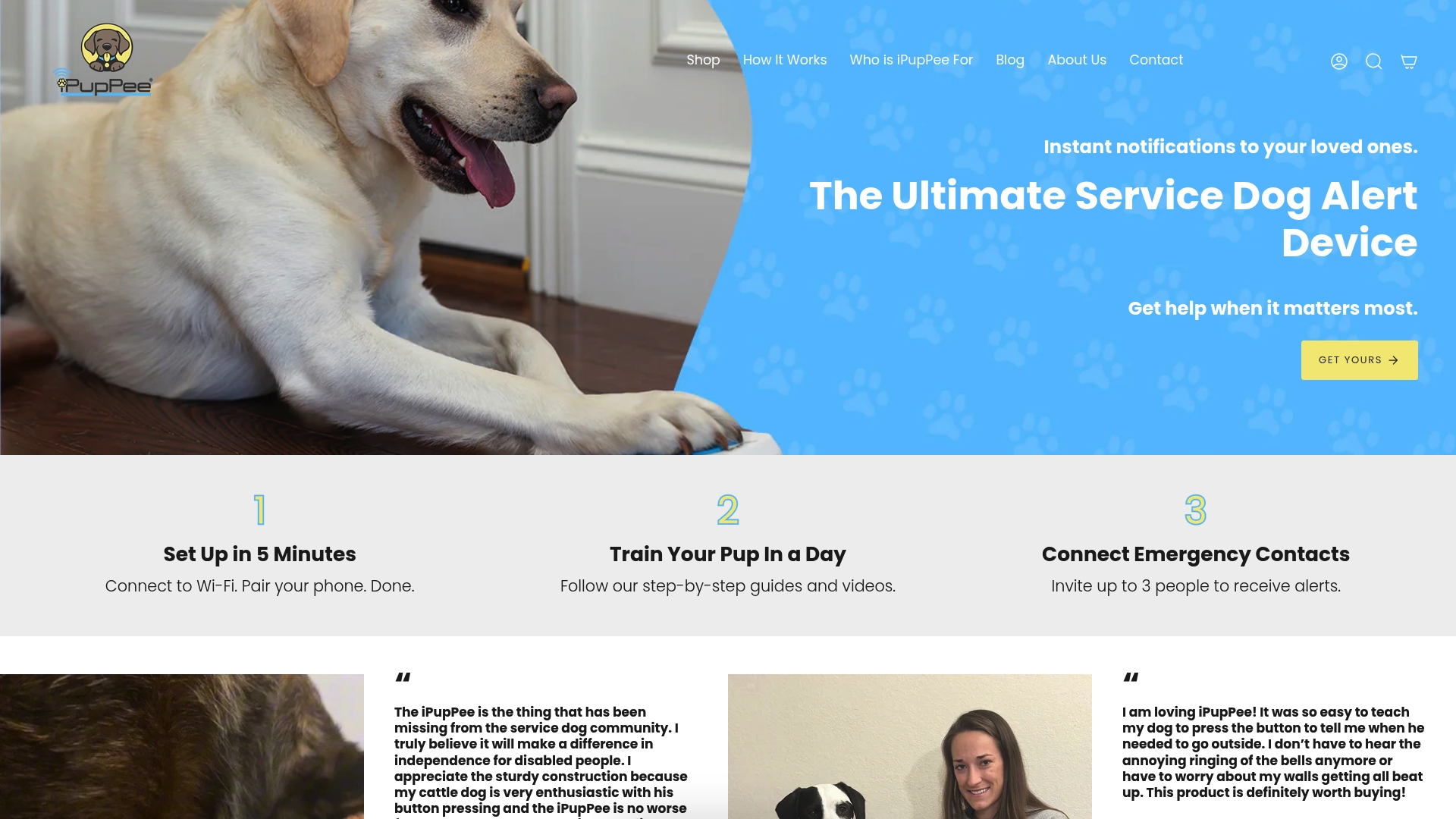
See how it works, or go straight to the iPupPee device and training system. If you want your order protected against damage, loss or theft, the shipping protection add-on is $5.00.
FAQ
What was the first pet tech device?
It depends on how you define it. A shortwave radio strapped to a dog was reported in 1939, and electronic flea collars became best sellers in the 1980s. Connected, app-based devices are mostly a product of the 2010s.
What is the most common type of pet tech today?
Wearables and trackers are the largest segment. Mordor Intelligence’s 2026 report puts them at 36.78% of 2025 pet tech revenue. Cameras, feeders and litter boxes follow as popular home devices.
Is pet tech safe for my data?
It can be, if you take care. A 2023 study found some pet apps exposed login details or contacted trackers before consent. Use strong unique passwords, review permissions and keep firmware current.
Can a dog really use technology to call for help?
Yes, with training. Researchers have explored dog-operated interfaces for working dogs since 2012, and iPupPee is built around a button press that sends a notification to your contacts. Our training guides and course teach the behavior step by step.
Does iPupPee need a monthly subscription?
No. We designed iPupPee to work without a monthly subscription fee. The device is a one-off $129.99 purchase on our product page.
Sources
- Popular Science: How to make a walkie talkie for your dog
- The Future of Artificial Intelligence in Monitoring Animal Welfare (PMC)
- PRWeb: New High Tech Pet Website Spotlights Biting-Edge Technology
- Los Angeles Times: Pet Health Monitoring Devices and GPS
- Urban Asian: Smart Dog Bowls and Other Smart Pet Products
- Mordor Intelligence: Pet Tech Market Share Analysis
- Georgia Tech: Technology for Working Dogs
- Digital Technology Supporting the Remote Human-Dog Interaction (PMC)
- SF SPCA: Partners with Companion on automated training
- Frontiers in IoT: Security and privacy of pet technologies
- MDPI Animals: The Expanding Role of Artificial Intelligence in Companion Animals
- Gadget Review: Pet health AI debuts at CES 2026