

Pet owner independence is the ability of you and your dog to each function with confidence, without either one being stuck to the other every minute. For the dog, that means feeling calm and secure when you are in another room or out for the afternoon. For you, it means keeping your own routines, health, work and relationships while still meeting your dog’s needs. The two sides depend on each other, and this guide explains both, with steps you can start today.
TL;DR
- Independence is not detachment. A dog can be closely bonded and still be relaxed when you are apart.
- Dogs gain confidence from choices, predictable routines and positive, force-free training.
- Build time apart in tiny steps, starting with seconds, and rewarding calm behavior.
- Sudden behavior changes, self-injury or severe distress call for a veterinarian or a credentialed behavior professional.
- Owners who live alone, have a disability or are seniors can add tools that keep them connected to their dog and their dog’s safety on their terms.
Table of Contents
- What independence means for a dog and its owner
- Confident, stubborn or disobedient: telling them apart
- How to help your dog become more confident
- Teaching a puppy to spend time apart
- Signs your dog is coping, and signs of distress
- Independence for owners: living alone, with a disability, or as a senior
- Perspective: why we built iPupPee around independence
- A device and a course built for this
- When to call a veterinarian or behavior professional
- FAQ
- Sources
What independence means for a dog and its owner
PetMD describes an independent dog as one that is comfortable and confident without constant interaction from a human companion. The same page is clear that every pet still relies on its owner to meet its needs, and that no dog should be left alone constantly.
So independence is not a dog that ignores you. Researchers writing in the journal Animals in 2025 argue that canine autonomy is not the same as independence or detachment. They describe a balance built jointly between the dog, the human and the pair as a team.
That framing matters, because it puts the owner in the picture. A dog’s illness or behavior problem can reduce its own autonomy and yours. The same paper notes a study of 1,693 owner and dog pairs in which many owners found meeting their dogs’ needs burdensome, which cuts into their own freedom to pursue daily activities and relationships.
In plain terms, pet owner independence has two halves:
- Dog independence: the dog can settle, make simple choices, handle short separations and recover quickly from small stresses.
- Owner independence: you can go about your life, ask for help when you need it, and trust that your dog is safe and your home is manageable.
When the first half is strong, the second becomes much easier. When the second half is supported, you have the patience to keep building the first.
Independent does not mean aloof
It is easy to confuse a self-sufficient dog with a cold one. A secure bond works the other way around: in behavioral science, a securely attached dog uses its owner as a source of safety and stability, which lets it stay relaxed when you are apart rather than needing constant physical contact.
Following you from room to room, often called “clingy” behavior, also isn’t a reliable sign of separation anxiety on its own. Researchers note that independence and closeness are not opposites. A dog can be affectionate, deeply bonded and still able to function well alone.
If you want a closer look at the behavior side, our article on signs it is normal when dogs prefer solitude covers what healthy alone time looks like.
Confident, stubborn or disobedient: telling them apart
Many owners label a dog “stubborn” when it simply doesn’t respond the way they expected. Often the cause is breeding. Behavior owners call disobedient is frequently the result of selective breeding for self-direction, which means the dog needs clear motivation and a partnership approach, not force.
Poor motivation, heavy distraction and inconsistent follow-through can also weaken a dog’s responses. The practical fix is better setup and better rewards, not more pressure.
There is also a high-level form of independence that people who work with assistance dogs know well. Trainer Ruth Hegarty explains that intelligent disobedience in guide dogs is a sophisticated communication of safety and trust, not a behavior problem. The dog declines a cue because it has judged the situation unsafe. That is independence working for the handler.
And leadership does not have to mean dominance. Animal Friends notes that many behaviors labeled “dominance” are signs of an untrained dog acting out, and that guidance should rest on respect and clear communication.
How to help your dog become more confident
Confidence comes from three things: choice, predictability and kind teaching.
Offer real choices
The American Kennel Club advises offering choices at home and on walks, using positive, force-free training and letting dogs disengage from interactions. More choice and control can help dogs handle stress. Certified trainer Irith Bloom points out that helplessness is stressful for animals while control is empowering.
Easy ways to start:
- Let your dog choose which direction to take at a safe corner on a walk.
- Offer two chews or two beds and let the dog pick.
- Let your dog walk away from petting. If it leaves, respect that.
- Allow sniffing time on walks rather than hurrying along.
Psychologist and animal researcher Marc Bekoff writes that dogs need freedom to express normal behavior, make choices and have safe zones. A quiet crate, mat or corner that is always the dog’s own is a simple version of that.
Make the day predictable
Cornell’s veterinary college notes that consistency and predictability help a dog become more confident, and that scheduling meals, walks, play, training and rest lets dogs know what to expect. A dog that knows what comes next can relax into the gaps.
A good daily and weekly dog wellness routine adds regular checks that catch small changes in appetite, energy or movement early, which is exactly when a behavior shift is easiest to read.
We have written more on this in why dogs thrive with routines and how to build a calming dog routine.
Teach with rewards, not punishment
Research on separation-related problems recommends avoiding punishment: dogs are less anxious when much of their training uses positive reinforcement. The Merck Veterinary Manual adds that structured interaction programs with consistent owner responses can decrease anxiety and build self-control by letting the dog learn to control its own consequences.
Our guide to dog training for independence walks through the key skills step by step.
Teaching a puppy to spend time apart
The earlier a puppy learns that your absence is safe and temporary, the easier everything else gets. The method is gradual.
- Set up a safe space. Use a confinement area, such as a pen or crate, with a chew toy.
- Leave the room and come right back. The American Kennel Club suggests leaving and returning immediately, then slowly increasing the time away, rewarding quiet, calm behavior.
- Start absurdly small. The ASPCA recommends systematic desensitization: begin with separations of just a few seconds and lengthen them only while the dog stays relaxed.
- Reward calm, not the goodbye. Keep departures and returns low-key so they carry little drama.
- Go back a step when needed. If the puppy gets worried, shorten the next session. Progress is not a straight line.
A sample first week might look like this: day one, three to five seconds out of sight, repeated a handful of times; day three, ten to twenty seconds; day five, a minute with a chew toy. The exact numbers matter less than staying under the point where your puppy gets upset.
Planning ahead also counts. The Dogs Trust and RSPCA ownership guide lists planning for times the dog is left home alone, along with enough exercise and enrichment and respect for the dog’s need for space, as part of responsible ownership.

Signs your dog is coping, and signs of distress
Healthy alone time is usually brief and voluntary, and the dog returns to its usual self afterward. Chewy’s veterinary education page notes that frequent or prolonged alone time can signal a medical or behavioral problem, especially alongside changes in appetite, low energy, limping, restlessness or sudden fearfulness.
| Likely coping well | Possible distress |
|---|---|
| Settles with a chew or nap when you leave | Barking, howling or whining that continues |
| Greets you warmly, then returns to normal | Destroying doors, windows or furniture near exits |
| Eats normally and shows usual energy | Refusing food or being unable to settle |
| Chooses short breaks away from the family | Toileting indoors, pacing, panting, drooling |
| Interested in favorite activities | Anxious behavior before you leave, or frantic greetings |
The RSPCA reports that research suggests 8 out of 10 dogs find it hard to cope when left alone, and half show no obvious signs. That is why watching your dog while you are away is so useful. Dogs Trust lists additional signs, such as placing themselves between you and the door, trembling and ignoring you on return.
Our article on how to handle dog anxiety naturally offers gentle day-to-day support, and how dogs reduce anxiety looks at the other direction, what dogs do for us.
Independence for owners: living alone, with a disability, or as a senior
For many people the keyword is really about the owner’s side. You want to keep living the way you choose, with your dog beside you, and you want to know that help is reachable if something goes wrong.
Assistance dog organizations frame this as a partnership. Assistance Dogs International and the International Guide Dog Federation say the success of a team rests on the bond and on viewing the dog as a co-partner whose physical, psychological and emotional needs are met at every life stage. They advocate the Five Domains model so dogs thrive, not merely survive.
For a handler, a senior or anyone who lives alone, that translates into a few habits:
- Keep routines simple and visible. Fixed times for meals, walks and rest reduce the mental load on you and the guesswork for your dog. Our piece on service dog daily routines shows one way to organize them.
- Teach one clear way for your dog to ask for help. A dog that has a reliable, rewarded signal for “I need you” is using its independence in a way that serves you both.
- Set up contacts in advance. Decide who should hear if your dog sends an alert, and make sure they know what to do.
- Protect the bond. Positive training and shared routines pay back in trust, as we describe in dog training and bonding and the emotional benefits of dog training.
- Keep your own life. The 2025 framework above reminds us that owner autonomy counts too. Plan breaks, backups and help so your dog’s needs never become your whole day.
Perspective: why we built iPupPee around independence
We started from a simple idea: independence should go both ways. A dog that can signal for help gets to take part in keeping its person safe, and a person who knows help is a button press away can live on their own terms.
In our experience with service dog teams, seniors and people living alone, the biggest worry is not the dog. It is the gap: the hour you cannot get up, the moment you cannot reach the phone. Our device is designed to close that gap. The dog presses a button, and the people you chose are notified over Wi-Fi, with live video and two-way audio so a contact can see what is happening and speak to you both.
We also believe the training matters as much as the hardware. Dogs learn best through choice, predictability and positive reinforcement, which is why we publish training guides and a psychology and training course alongside the device. And because there are no monthly subscription fees, you are not paying every month to keep your independence.
A confident dog, a calm routine and a way to ask for help: that is how we think about pet owner independence.
Andrew
A device and a course built for this
If you want a practical way to put this into action, the iPupPee device is a Wi-Fi alert system designed for dogs of all sizes. Your dog presses a button, and your chosen contacts receive a notification with live video and two-way audio. It costs $129.99 as a one-off purchase, with no monthly subscription fee.
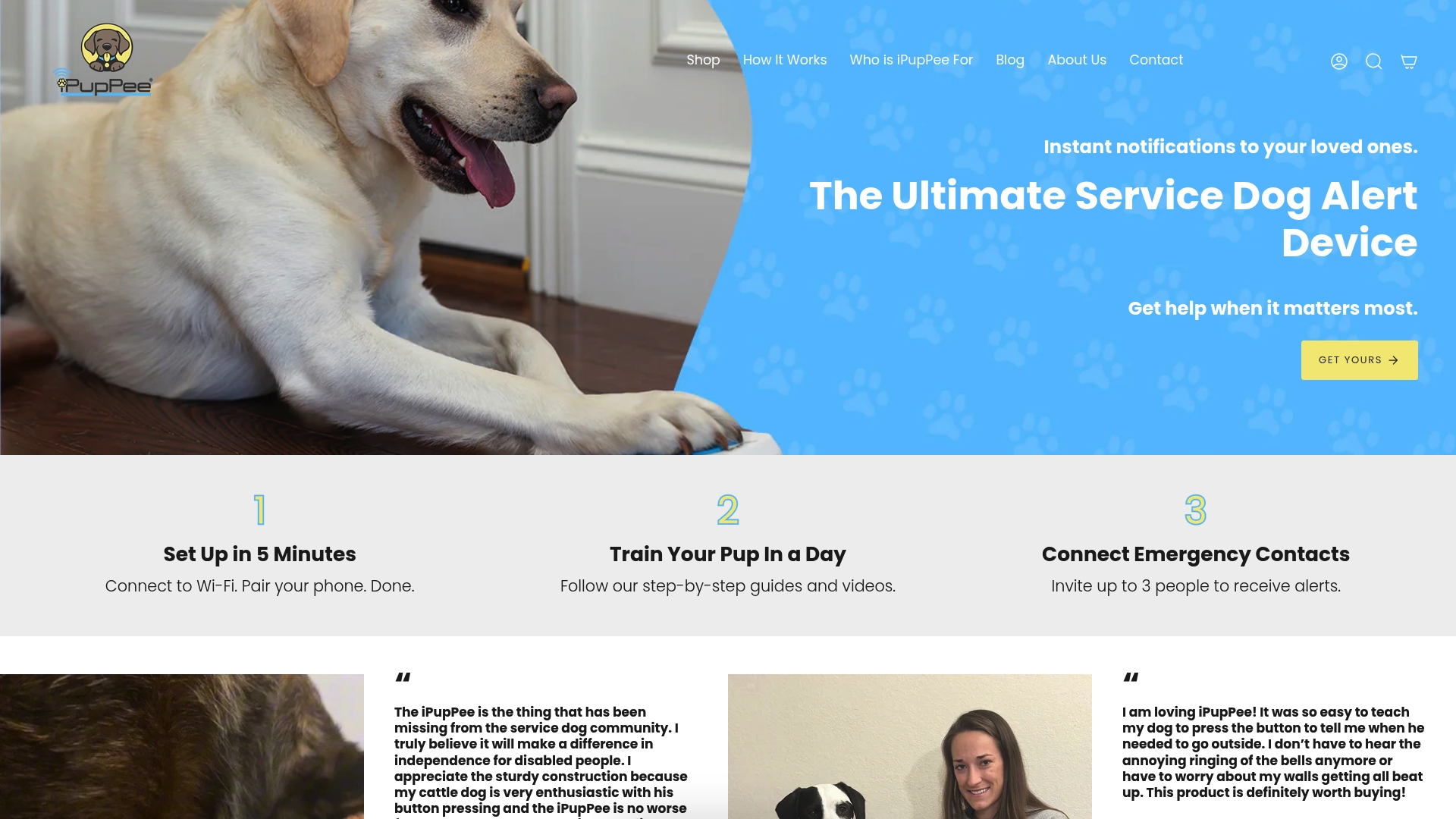
For the teaching side, our Psychology & Training Course is $119 one-off and gives you on-demand lessons on dog psychology and training. You can also add shipping protection for $5.00 at checkout. To see how the system works before you decide, visit our How It Works page, or start from ipuppee.com.
When to call a veterinarian or behavior professional
Some situations are beyond a home training plan, and they need the right professional quickly.
- A sudden change. The American Animal Hospital Association says a normally friendly pet that suddenly becomes aggressive, excessively fearful or withdrawn may be sick or injured, and needs a full veterinary exam. Dogs often hide discomfort, and a veterinarian quoted by Chewy notes that withdrawing from social interaction can be one of the first signs.
- Severe separation distress. AAHA advises contacting your veterinarian if a dog injures itself trying to escape, refuses to eat or settle when alone, or stays distressed despite gradual training. Video recordings made while you are away can help the veterinarian or certified veterinary behaviorist plan treatment.
- Safety concerns or intense behavior. VCA Animal Hospitals advises starting with a board-certified veterinary behaviorist (DACVB) or Certified Applied Animal Behaviorist (CAAB) when the intensity of behavior worries you, there is a safety risk, the pet seems physically unwell or the behavior changed suddenly.
Calling early is a sign of a responsible partnership, not a failure of independence.
FAQ
What is pet owner independence?
It is a two-sided balance. Your dog is confident and relaxed when you are apart, and you can keep your own routines, health and relationships while meeting your dog’s needs. Researchers describe it as autonomy built jointly between dog and human, not as distance between them.
Is an independent dog less bonded to its owner?
No. A dog can be securely attached, affectionate and still comfortable alone. Secure attachment lets the dog use its owner as a base of safety, so it can relax during separations instead of needing constant contact.
How do I teach a puppy to be alone?
Use a safe confinement area with a chew toy, leave the room and return right away, then lengthen the time slowly while the puppy stays calm. Start with seconds and reward quiet behavior. If your puppy shows distress, go back to a shorter step.
How can seniors or people with disabilities support a dog’s independence safely?
Keep routines predictable, use positive training, and give your dog a clear way to ask for help. Choose your emergency contacts ahead of time. Tools like our iPupPee device are designed to let a dog alert those contacts with a button press, with live video and two-way audio.
When is a dog’s alone time a problem?
When it is frequent, prolonged or paired with changes in appetite, energy, movement or mood. Brief, voluntary alone time followed by a return to normal is typical. Anything sudden or severe deserves a call to your veterinarian.
Sources
- 18 Independent Dog Breeds, PetMD
- A Conceptual Framework for the Co-Construction of Human–Dog Autonomy, Animals (MDPI)
- Canine Attachment vs. Independence
- What We Actually Know About Attachment
- How to Train an Independent or Stubborn Breed
- Intelligent Disobedience
- Animal Friends, Behavior and Care Tips
- Dogs & Autonomy: How to Give Your Pet More Choices, AKC
- Dogs, Captivity, and Freedom, Psychology Today
- Anxious behavior, Cornell University
- Canine separation anxiety: strategies for treatment
- Behavior Problems of Dogs, Merck Veterinary Manual
- When Can Puppies Be Left Home Alone? AKC
- Separation Anxiety, ASPCA
- Dog Ownership Guide, RSPCA
- Do Some Dogs Prefer Being Alone? Chewy
- Separation Anxiety in Dogs, RSPCA
- Separation Anxiety in Dogs, Dogs Trust
- Ethical Training and Care of Dogs, Assistance Dogs International and IGDF
- Help! Is This a Pet Emergency? AAHA
- Separation Anxiety in Pets, AAHA
- Do I Need a Trainer or a Behaviorist? VCA Animal Hospitals
- Dog wellness routine, PetGev