

A smart dog collar is a wearable that combines location, movement, and sensor data with connectivity to apps so you can monitor your dog and get alerts. The main terms you will run into fall into a few groups: GPS tracking, activity sensors like the accelerometer, health sensing, geofencing, connectivity, and battery or subscription details. Knowing these terms helps you read a spec sheet the way a trainer reads body language, with real understanding instead of guesswork.
TL;DR:
- For lost dog searches, choose updates every few seconds; trees and buildings weaken GPS, so test geofence boundaries in your dog’s usual setting.
- Independent testing classified walking and trotting correctly more than 95% of the time, but activity trends become more useful across weeks than in single readings.
- Treat heart rate, breathing, and temperature readings as estimates, not diagnoses; consult a veterinarian about concerning patterns rather than relying on collar alerts alone.
- Fit the collar snugly and low on the neck, then keep it on through a 7 to 14 day baseline before judging alert accuracy.
- Continuous GPS can reduce battery life to a day or two on some collars, and cellular tracking may require an ongoing subscription.
Table of Contents
- What do common smart collar terms actually mean?
- How do GPS, activity, and health features actually work?
- How do you decode battery, connectivity, and subscription claims?
- What does independent research say about collar accuracy?
- How should you set up a smart collar the right way?
- What actually matters when choosing between features
- A practical option for real-time alerts and communication
- FAQ
- Sources
What do common smart collar terms actually mean?
Product pages and apps throw around a lot of jargon that sounds technical but usually describes something simple. Here is a quick-reference list you can scan now and return to later.
- GPS fix: the moment a collar locks onto enough satellites to calculate a location; a weak fix means a delayed or inaccurate position.
- Ping rate / update frequency: how often the collar sends its location to the app, ranging from a few seconds to several minutes depending on the device.
- RTK (Real-Time Kinematic): a GPS correction method that improves precision, mostly found in high-end or professional-grade trackers rather than typical pet collars.
- IMU (Inertial Measurement Unit): the chip that bundles motion sensors together, usually an accelerometer and gyroscope, to detect movement and orientation.
- Accelerometer: a sensor that measures movement and speed changes, forming the basis of activity tracking like steps or active minutes.
- Gyroscope: a sensor that detects rotation and orientation, helping distinguish a shake from a run or a roll.
- Heart-rate proxy: an estimated heart rate derived from motion or optical sensors rather than a direct clinical reading.
- Temperature sensor: a component that tracks skin or ambient temperature shifts, often used as an early flag for discomfort.
- Respiratory proxy: an estimated breathing pattern inferred from movement data, not a diagnostic measurement.
- Geofence / virtual fence: a digital boundary you set on a map that triggers an alert if your dog crosses it.
- Warning zone: a buffer area inside the geofence boundary where the collar gives an early cue before the dog reaches the limit.
- BLE (Bluetooth Low Energy): a short-range, low-power connection used for syncing data to a nearby phone.
- LTE / cellular: a connection type that allows tracking anywhere there is mobile coverage, often tied to a subscription.
- Firmware: the built-in software running on the collar itself, updated periodically to fix bugs or add features.
- IP rating: a standardized code (like IP67) describing how resistant a device is to dust and water.
- Baseline period: an initial stretch, typically 7 to 14 days, during which the collar learns your dog’s normal activity pattern before alerts become meaningful. This one requires action on your part: keep the collar on consistently during this window so the data reflects a true baseline.
How do GPS, activity, and health features actually work?
Each feature group relies on different hardware, and understanding the mechanics helps you set realistic expectations.
- GPS tracking depends on satellite signals reaching the collar’s receiver. Some systems update location as frequently as every 6 seconds, which supports close to real-time tracking, while others ping every few minutes to save battery, which works fine for general activity logs but is slower for a lost-dog emergency, according to AKC’s explanation of GPS dog fences. Thick tree canopy, dense buildings, and bad weather can all weaken the signal and delay an accurate position.
- Activity monitoring runs on the accelerometer and gyroscope working together. They translate raw motion into categories like rest, quiet, active, and excited, and the real value shows up over weeks rather than a single day, since longitudinal trends reveal gradual shifts a single reading would miss.
- Health sensing typically relies on proxies rather than direct clinical measurements: changes in activity patterns, small temperature shifts, and estimated heart rate. These signals can flag something worth watching, but they are not a diagnosis, and any real health concern still needs a veterinarian.
- Geofencing uses the same GPS foundation to define a boundary, with warning zones that give dogs a tone or vibration cue before they reach the hard limit. This only works as training reinforcement when paired with consistent practice, not as a stand-alone containment tool.
One external validation study found accelerometer-based behavior detection correct more than 95% of the time for walking and trotting, and more than 90% for sleep and static states, which supports treating activity data as reliable when the collar fits properly (PLOS One).
Pro Tip: Fit the collar snugly, low on the neck, and commit to a full baseline period before judging whether the alerts feel accurate.
How do you decode battery, connectivity, and subscription claims?
Spec sheets often bury the details that actually matter day to day.
- Battery life depends heavily on use: standby drains slowly, while continuous GPS tracking can cut runtime to a day or two on some devices, so check whether the advertised number assumes constant tracking or occasional pings.
- Charging style varies between docked charging and swappable battery packs, which matters if your dog is never near an outlet for long.
- BLE works for short-range home syncing, Wi-Fi handles data uploads when you are near your router, and LTE or cellular connectivity supports tracking anywhere there’s coverage, usually tied to a monthly fee.
- Ping rates measured in seconds make sense for a lost-dog scenario, while rates measured in minutes are fine for general activity logging.
- IP ratings like IP67 indicate dust and short-term water resistance, which matters for dogs that swim, dig, or spend time outside in rain.
- Subscription models differ: some devices include cellular service and app features in the purchase price, while others charge ongoing fees for location tracking or data storage.
What does independent research say about collar accuracy?
Third-party testing and published research give a clearer picture than marketing copy alone. Environmental conditions matter: AKC notes that geofence reliability depends on satellite signal quality, which weakens under heavy tree cover or near large buildings. A small exploratory case series on continuous activity monitoring in dogs with osteoarthritis found that collar data detected activity deviations aligned with clinically relevant events in 8 of 9 cases, supporting the idea that longitudinal data can flag meaningful changes before they become obvious (exploratory case series).
| Study | What it measured | Key result |
|---|---|---|
| PLOS One accelerometer validation | Behavioral state classification accuracy | Over 95% correct for walk and trot, over 90% for sleep and static states |
| Osteoarthritis case series | Activity deviation detection | Flagged 8 of 9 clinically relevant events |
Accelerometer-based monitoring was correct more than 95% of the time for common behaviors in independent testing, which is a strong argument for favoring devices with published third-party validation over raw marketing claims (PLOS One).
How should you set up a smart collar the right way?
Andrew, writing for our blog, breaks the setup process into steps that match how the sensors actually learn your dog’s patterns. Start with proper fit, since sensor placement affects accuracy, then commit to a 7 to 14 day baseline before trusting the alerts.
- Fit the collar snugly, low on the neck, following the manufacturer’s placement guidance.
- Run a full baseline period of 7 to 14 days with your dog’s normal routine intact.
- Pair emergency contacts in the app before relying on alerts.
- Test the geofence boundary in a safe, enclosed area first.
- Bring unusual data patterns to your vet or trainer rather than acting on them alone; our training course can also help translate data into daily habits.
Pro Tip: Check sensor placement first. A loose or twisted collar is the most common reason activity data looks inconsistent.
What actually matters when choosing between features

The biggest mistake owners make is chasing the highest advertised accuracy percentage instead of asking how a device behaves in their own backyard. A number on a box means little if your yard sits under heavy tree cover or next to a tall building, both of which reduce GPS and fence reliability. Update frequency and boundary consistency, tested in your actual conditions, tell you more than a lab figure ever will.
Conventional advice tends to treat health sensing as if it were diagnostic, and that overstates what these devices do. Temperature shifts and activity changes are proxies, useful for noticing a pattern worth mentioning to a vet, not a substitute for one. What deserves more attention is the baseline period itself. Skipping it is the single most common reason owners feel their collar’s alerts are unreliable, when the real issue is that the device never had a chance to learn normal behavior first. Prioritize fit and baseline collection before judging any other spec.
— Andrew
A practical option for real-time alerts and communication
If what you want most from a smart collar is a direct way for your dog to reach you, our iPupPee device offers Wi-Fi notifications with real-time video and two-way audio, so your dog can send a direct alert to you or another contact with a simple button press. It works without a monthly subscription fee and comes with training guides to help dogs of any size learn the system quickly.
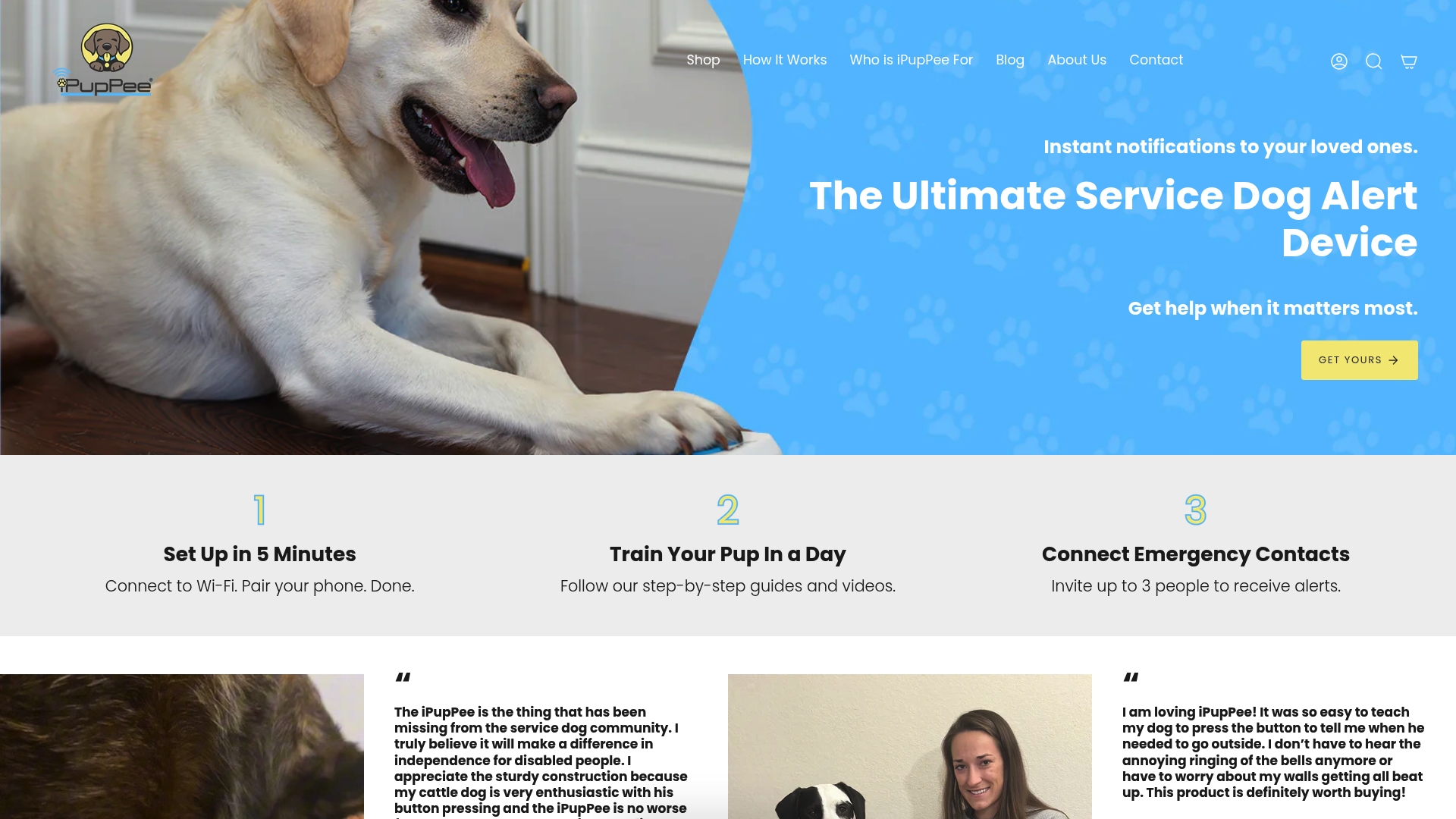
For service dog handlers, seniors, or anyone who wants a reliable backup to a traditional GPS collar, our Psychology & Training Course pairs well with the device to build consistent, confident use from day one. If you’re outfitting a new collar setup and need a plain replacement band to mount a device, sublimation-ready pet collars are a practical supply option worth knowing about. Take a look at the iPupPee product page to see if it fits your household’s needs.
FAQ
What are some smart collars for dogs?
Smart collars generally fall into categories based on their main function: GPS trackers for location, activity monitors for exercise and behavior patterns, and alert or communication devices that let a dog signal a person directly. Features like geofencing, health sensing, and cellular connectivity vary widely between devices, so the right choice depends on whether you need tracking, health insight, or direct communication.
What is the highest form of affection from a dog?
Dogs show affection in many ways, including leaning against you, sustained eye contact, and seeking physical closeness during rest. There is no single universally agreed “highest” form, since affectionate behavior varies by individual dog and breed temperament.
What do dogs hear when we talk?
Dogs pick up on tone, pitch, and rhythm more than specific words, which is why consistent cues and a steady tone matter in training. They can learn to associate certain sounds or words with actions, but their understanding relies heavily on vocal patterns and context rather than language comprehension.
Is AirTag or GPS better for dogs?
A dedicated GPS collar generally offers more reliable, near real-time location tracking outdoors, since it does not depend on nearby Bluetooth devices the way an AirTag-style tracker does. For active outdoor dogs or longer distances, a proper GPS or cellular-connected collar tends to be more dependable than Bluetooth-only tracking tags.
Can a smart collar replace a vet visit?
No single collar replaces veterinary care, since health sensors on collars rely on proxies like activity and temperature shifts rather than direct clinical measurements. Microchips, for comparison, provide permanent ID but do not track location at all, underscoring why collars, chips, and vet care all serve different purposes.
Sources
- What Is a GPS Dog Fence and How Do They Work? | AKC
- External validation of a collar-mounted triaxial accelerometer for second-by-second monitoring of eight behavioural states in dogs | PLOS One
- Continuous Activity Monitoring Using a Wearable Sensor in Dogs with Osteoarthritis: An Exploratory Case Series
- Microchipping: FAQs for pet owners | AVMA