

Pet-centric innovation means designing products around animal welfare, behavior, and measurable health outcomes instead of around what looks appealing to owners on a shelf. It matters because it shifts pet care toward prevention and earlier detection of problems rather than reaction after something goes wrong. Readers will see this approach in wearables that track vital signs, biosensing litter boxes that flag early disease markers, and smart feeders that personalize nutrition for each animal in a household.
TL;DR:
- Smart garment sensors classified canine respiration patterns with accuracy above 94.3%, while an AI dog health score matched veterinarian diagnoses 87.5% of the time.
- Biosensing litter boxes track feline glucose and hydration trends, but their readings should inform veterinary review, never replace a clinical exam.
- Before buying, seek independent validation, confirm a veterinarian can review exported trends, and check whether your health and location data may be shared.
- Collect 7 to 14 days of baseline readings before interpreting changes, then bring a trend summary to appointments because a device cannot diagnose your pet.
Table of Contents
- What pet-centric innovation means beyond owner-driven gadgets
- Key technologies and what they actually do
- Why this matters: pet benefits and market forces behind the trend
- How practitioners design pet-centric products
- Research highlights readers can trust
- A practical checklist before you buy or trial pet tech
- Historical evolution of pet-centric innovation
- Challenges unique to innovating for pets versus humans
- Impact on veterinary care and pet health outcomes
- Regulatory and ethical considerations in pet tech development
- Future outlook for pet-centric innovation
- A closing thought on responsible adoption
- Where iPupPee fits into pet-centric design
- FAQ
- Sources
What pet-centric innovation means beyond owner-driven gadgets
A gadget built for pets is not automatically pet-centric. Many products on store shelves solve a convenience problem for the owner (a self-cleaning bowl, a Wi-Fi camera) without ever measuring whether the animal’s experience improved. Pet-centric innovation sets a higher bar: the product must be validated against real welfare or health indicators, not just purchase intent.
A genuinely pet-centric product tends to share a few traits:
- It uses a non-invasive form factor that does not restrict natural movement or cause stress.
- It generates metrics that a veterinarian can act on, not just a novelty readout for the owner’s phone.
- It gets tested with the animals it is meant to serve, not only with human focus groups.
This thinking draws on Animal-Computer Interaction (ACI), a design discipline that treats animals as stakeholders in technology rather than passive accessories to human convenience. One of its guiding ideas, Welfare through Competence, argues that good design should help an animal build independent skill and agency, combining established welfare science with interaction design rather than guessing at what pets might enjoy.
Key technologies and what they actually do
The category spans several distinct types of products, each targeting a different kind of measurable signal.
- Wearables and smart garments: Fabric-based sensors track respiration, temperature, and activity continuously, feeding the data into machine learning models that flag abnormal patterns before symptoms become visible. Our guide to wearable health monitoring covers how owners use these devices day to day.
- Animal biosensing: Litter-box-based systems detect urine glucose and hydration levels in cats, giving an early read on diabetes risk without a trip to the clinic.
- Connected feeding systems: AI-enabled feeders use facial recognition to identify individual pets in multi-animal households and dispense personalized portions, with models trained on large datasets of feeding behavior, as described by Purina’s smart feeder launch.
- Home and multi-animal monitoring platforms: Smart-lid and sensor-based systems track litter box visits, weight, and behavioral metrics across several pets in one household, around the clock.
- Interactive enrichment and entertainment: Pet TV channels and robotic toys are built around engagement metrics rather than just novelty, aiming to reduce boredom-driven stress.
Smart garment sensors paired with machine learning have reached classification accuracies exceeding 94.3% for canine respiration patterns, a level of precision that makes continuous, non-invasive respiratory monitoring practical for everyday home use. For owners managing a dog with a known respiratory or cardiac condition, fabric-based tracking may provide additional information about respiration patterns to discuss with a veterinarian. For readers interested in how alerts from these systems reach an owner or caregiver, our piece on predictive pet safety walks through how handler notifications work in practice.
Why this matters: pet benefits and market forces behind the trend
Continuous, contextual data changes the timing of care. Instead of waiting for an annual exam to catch a problem, owners and vets can watch trends accumulate over weeks, which supports the idea of a pet’s “healthspan,” the stretch of life spent in good function rather than just the total years lived.
Market data backs up why companies keep investing here. NIQ’s 2026 pet industry outlook reports that pet parents continue prioritizing proven wellness outcomes even when household budgets tighten, a premiumization pattern that rewards products that can show real results rather than just marketing claims.
Patent filings for connected pet devices rose sharply between 2015 and 2024, with wearables, feeding stations, and litter boxes all seeing accelerated filing activity. That pattern, combined with investment analysis showing a shift toward recurring-revenue, health-focused platforms, points to a sector moving from novelty products toward integrated wellness ecosystems built to last.
How practitioners design pet-centric products
Building a product that genuinely serves an animal’s interests takes more than good intentions. Researchers and product teams working in this space tend to follow a few concrete steps.
- Define animal-centric goals before any engineering begins, using frameworks like Welfare through Competence to set what success looks like for the animal, not just the user interface.
- Structure development around welfare checkpoints and expert involvement from veterinarians, ethologists, and behaviorists working alongside engineers.
- Bring in veterinary and behavioral experts early, then prototype iteratively with real animals rather than relying on simulations or owner surveys alone.
- Measure welfare outcomes directly, tracking stress indicators or behavioral change rather than assuming a feature is beneficial because it tested well with humans.
Pro Tip: Ask any pet tech company whether a veterinarian or animal behaviorist was involved before launch, not after complaints arrived.
Research highlights readers can trust
A handful of published studies give a concrete sense of how accurate these systems are becoming. Smart garments for canine respiration monitoring have demonstrated classification accuracy above 94.3%, while an activity-sensor approach to generating a dog health score reached 87.5% concordance with veterinarian diagnoses in validation work. On the feline side, the DiabetiCAT project combined a biosensing litter box with a water-intake tracker to detect glucose and hydration trends at home, pairing the data with a veterinary-facing interface.
| Study | What it measured | Result |
|---|---|---|
| Smart Garment for Continuous Respiration Monitoring in Canines | Respiration pattern classification | Exceeds 94.3% accuracy |
| Dog Health Score AI Disease Prediction Algorithm | Concordance with veterinarian diagnosis | 87.5% concordance |
| DiabetiCAT | Feline urine glucose and hydration monitoring | Demonstrated feasibility with vet-facing interface |
These figures matter because they move pet tech out of the realm of marketing promise and into something closer to clinical evidence.
A practical checklist before you buy or trial pet tech
Before committing to a device, run it through a short evaluation.
- Confirm the product is non-invasive and does not restrict the animal’s natural movement or behavior.
- Look for peer-reviewed validation or independent testing behind the accuracy claims.
- Check whether the device integrates with a format your veterinarian can actually use, such as exportable trend reports.
- Ask whether your data stays portable if you switch products later.
- Plan for a baseline period of 7 to 14 days before drawing conclusions from the readings.
- Read the privacy policy to understand what happens to the data collected.
Pro Tip: Bring a printed or exported summary of trends to your next vet visit instead of describing the numbers from memory. Our article on AI in pet care covers how vets typically want this kind of data presented.
Historical evolution of pet-centric innovation
Pet technology started simply: id tags, basic collars, and mechanical feeders that solved logistics problems rather than welfare ones. GPS trackers arrived next, aimed mostly at preventing lost pets rather than understanding their health.
The shift toward genuine pet-centric design tracks closely with the maturing of wearable sensor technology in human health. Once fabric-based sensors and compact activity trackers became affordable, the same hardware started appearing in collars and harnesses, first as simple step counters, then as multimodal systems capturing temperature, respiration, and sleep patterns.
Academic interest followed the hardware. Animal-Computer Interaction emerged as a distinct research field, borrowing methods from human-computer interaction but insisting that animals could not simply be treated as users with different preferences. That reframing pushed design teams to bring in ethologists and welfare scientists rather than relying solely on engineers and marketers.
The most recent phase layers artificial intelligence on top of continuous sensor data, turning raw readings into health scores, disease predictions, and behavioral flags. Litter boxes that once just self-cleaned now screen for diabetes markers. Feeders that once just dispensed food now recognize individual pets by face and adjust portions accordingly. Each step added a layer of interpretation that moves the category closer to genuine health infrastructure rather than novelty gadgetry.

Challenges unique to innovating for pets versus humans
Designing for animals carries constraints that human-focused product teams rarely face. Pets cannot describe symptoms, rate their comfort on a scale, or consent to wearing a device, which means every design decision has to be inferred from behavior rather than confirmed through conversation.
Form factor becomes a much bigger constraint. A human wearable can rely on a wrist strap and a screen; a dog or cat wearable has to survive chewing, water exposure, and a body shape that varies enormously between a Chihuahua and a Great Dane. Sizing and comfort testing has to happen across breeds, coat types, and temperaments rather than one standard body type.
Validation is harder, too. Human clinical trials rely on self-reported outcomes alongside clinical measures; animal studies depend entirely on observed behavior, physiological markers, and veterinarian assessment, which makes building a dataset large enough for reliable machine learning models slower and more expensive.
There is also a stress consideration that has no human parallel: a device itself can become the source of anxiety if it is not introduced carefully, which is why practitioner frameworks emphasize gradual habituation and monitoring of stress indicators during testing, not just after launch.

Impact on veterinary care and pet health outcomes
Continuous monitoring data is starting to change what a veterinary visit looks like. Instead of relying on a single snapshot taken during an appointment, where a stressed animal may show misleading vital signs, a vet can review weeks of trend data collected at home in a calm environment.
This shift may support earlier investigation. The 87.5% concordance between an AI-generated health score and veterinarian diagnosis suggests that behavioral and activity data may help identify issues for veterinary review. For chronic conditions like feline diabetes, tools like the DiabetiCAT prototype aim to give vets a continuous glucose and hydration trend line rather than a single test result, which can change how a treatment plan gets adjusted over time.
None of this replaces a clinical exam, and no device result should substitute for a veterinarian’s judgment. The honest framing is that these tools extend a vet’s visibility between appointments, giving them more context to work with rather than a diagnosis to act on alone.
Regulatory and ethical considerations in pet tech development
Pet technology sits in a regulatory gray zone in most markets. Approval requirements may depend on how a device is marketed and the claims it makes. Check the relevant regulator’s guidance and product information.
Data privacy is a growing concern as well. A device that tracks a pet’s location, health metrics, and household patterns is also collecting information about the humans in that household, and policies on data retention and third-party sharing vary widely between companies.
Ethically, the central question practitioner frameworks keep returning to is consent by proxy: since animals cannot agree to wear a device or participate in testing, the responsibility falls on designers and researchers to define welfare-protective boundaries themselves, often guided by the Five Domains model referenced in Welfare through Competence research. That means testing protocols should include clear criteria for stopping or adjusting a trial if an animal shows signs of distress, not just metrics for whether the product works as intended.
Future outlook for pet-centric innovation
The next wave of pet tech looks likely to combine the sensor categories that currently operate separately. Instead of a wearable, a litter box sensor, and a feeder each reporting in isolation, expect more platforms to merge these data streams into a single health picture that a vet can review in one dashboard.
Patent activity already points this direction. The sharp rise in filings for connected pet devices between 2015 and 2024 increasingly includes multi-sensor systems rather than single-function gadgets, suggesting manufacturers are building toward integration rather than another standalone product.
Robotics and enrichment technology are likely to get more adaptive, adjusting play patterns based on a pet’s measured engagement rather than running the same routine regardless of how the animal responses. On the investment side, analysis of the veterinary and animal health sector points toward continued consolidation around platforms that combine health data with recurring services, which could mean fewer standalone apps and more integrated care ecosystems over the next several years.
A closing thought on responsible adoption
Optimism about pet tech is warranted, but only paired with real validation and animal-centered testing. Choose products with measurable benefits and genuine veterinary involvement, not just a well-designed app.
— Andrew
Where iPupPee fits into pet-centric design
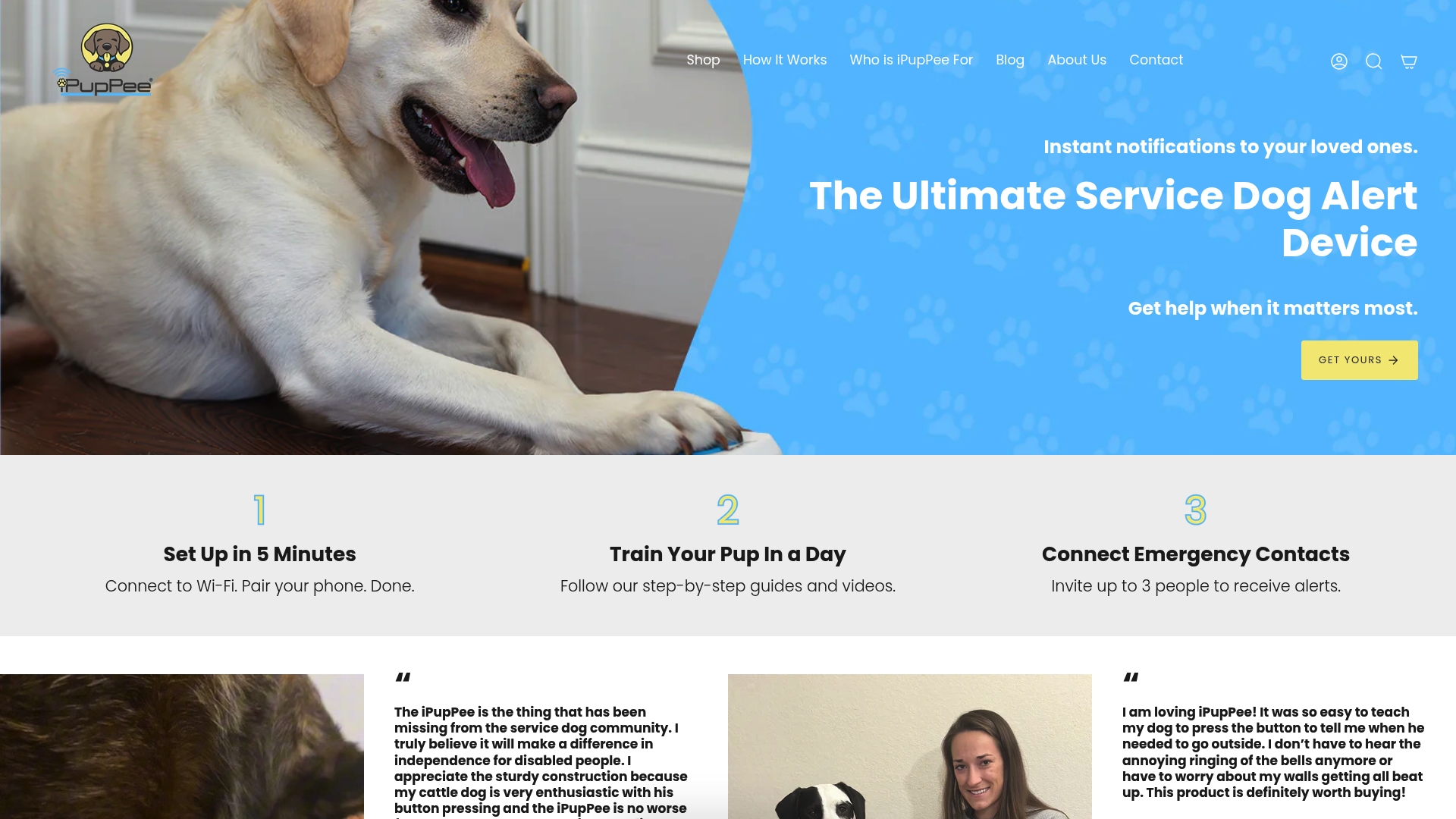
Communication-first design is one of the clearest expressions of pet-centric thinking: a device built around what the animal needs to convey, not just what the owner wants to monitor. The iPupPee device gives a dog a way to send a direct Wi-Fi alert with live video and two-way audio to an owner or emergency contact at the press of a button, a design aimed specifically at service dog teams, seniors, and people with disabilities who need a reliable line of communication.
- The device works with dogs of any size and does not require a monthly subscription.
- Our Psychology & Training Course provides dog psychology and training resources.
- Readers can add shipping protection at checkout to cover an order against damage, loss, or theft.
If you want a concrete example of pet-centric safety technology built around a dog’s ability to act independently, start with the iPupPee product page.
FAQ
What are the biggest companies in the pet industry?
The pet industry includes large multinational pet food and health companies alongside a growing group of pet tech startups focused on wearables, feeding systems, and biosensing devices. Rather than one dominant player, the sector spans food, veterinary services, and technology, with investment increasingly concentrated in health-focused, data-driven platforms according to industry analysis.
What are the trends in the pet care industry for 2026?
Premiumization and preventive wellness are the dominant trends, with pet parents prioritizing products that show proven health outcomes even under tighter budgets, according to NIQ’s 2026 outlook. Connected feeding systems, biosensing litter boxes, and multimodal wearables are expanding as manufacturers combine previously separate data streams into integrated health platforms.
What are some innovative products for pets?
Examples include smart garments that monitor canine respiration and temperature, biosensing litter boxes that detect glucose and hydration trends in cats, and AI-enabled feeders that recognize individual pets and personalize portions. Communication-focused devices like iPupPee represent another category, letting a dog send a direct alert with live video to an owner or caregiver.
How do I know if a pet tech product is actually effective?
Look for peer-reviewed validation, independent testing, and clear evidence that veterinarians or animal behaviorists were involved in development. A reliable product should also integrate with a format your vet can review, rather than keeping the data locked inside a single app.
How can pet owners use wearable and sensor data with their veterinarian?
Collect at least 7 to 14 days of baseline data before drawing conclusions, then bring a summary of trends, not raw numbers, to your veterinary appointment. Continuous data works best as context that extends what a vet observes during a single visit, not as a replacement for clinical judgment.
Sources
- Smart Garment for Continuous Respiration Monitoring in Canines
- DiabetiCAT: Animal Biosensing Computing with Feline Urine Glucose Biosensing and Hydration Monitoring | Proceedings of the ACM 12th International Conference on Animal-Computer Interaction
- State of the Pet, Veterinary, and Animal Health Industries - Hyde Park Capital
- Patent activity reveals healthy state of pet tech - GlobalPETS