

AI is already reshaping pet care through continuous health monitoring, imaging support, behavior analysis, and clinic workflow automation, with earlier detection of problems and more personalized tracking as the clearest payoffs. None of this replaces a veterinarian: every major professional and research body treats these tools as support for clinical judgment, not a substitute for it.
TL;DR:
- AI pet health monitoring devices can flag early warning signs but should prompt veterinary review rather than self-diagnosis due to variable accuracy.
- Diagnostic imaging AI is more developed and validated, but many tools lack transparency, validation, and cross-breed testing, requiring vet oversight.
- Behavior analysis AI shows promise but remains experimental, with current models heavily skewed toward dogs and limited evidence supporting real-world reliability.
- Administrative applications like transcription and triage chatbots can improve workflow efficiency but risk misdiagnoses if owners over-rely on automated advice.
- Ethical concerns include data ownership, privacy, informed consent, and the need for clear vet review processes before using AI-generated results clinically.
Table of Contents
- AI-enabled health monitoring and wearables
- Diagnostics and imaging: AI as decision support in clinics
- Behavior monitoring and training applications
- Practice workflows, telemedicine and admin automation
- Ethics, data privacy, informed consent and regulatory landscape
- Limitations, evidence gaps, and priority research directions
- Supportive pet tech in practice: where iPupPee fits
- What the evidence actually supports
- A practical safety option alongside veterinary care
- FAQ
- Sources
AI-enabled health monitoring and wearables
Smart collars, connected feeders, and continuous vitals monitors now generate a steady stream of data on a dog or cat’s daily life. Instead of a single snapshot at an annual checkup, owners get a running record that AI can compare against a pet’s own baseline.
The metrics tracked typically include:
- Activity levels and movement patterns throughout the day
- Sleep duration and restlessness at night
- Heart rate and respiration where sensors support it
- Eating and drinking frequency from connected feeders and bowls
- Gait changes that may signal joint pain or injury
Once a device has logged enough data to establish what is normal for an individual animal, the software can flag deviations, possible early warning signs that may be detected earlier than episodic vet visits allow, according to an overview of AI and pet health monitoring, though the same source stresses these alerts should prompt a veterinary evaluation rather than a self-diagnosis at home.
That caveat matters because monitoring accuracy varies by device, breed, and condition. A collar built for activity tracking may flag lethargy that turns out to be ordinary tiredness after a long walk, a false positive. While a subtle limp might not trigger any alert at all, a false negative. Owners who treat these tools as pet AI tools for smarter pet care tend to get the most value: using the data to decide when a call to the vet is worth making, not as a diagnosis in itself. The technology is best understood as an early warning layer sitting on top of, not instead of, regular veterinary care.

Diagnostics and imaging: AI as decision support in clinics
Inside veterinary practices, the most developed use of AI is in diagnostic imaging. Computer vision systems can scan radiographs, ultrasound images, and MRI scans looking for patterns that correlate with disease, a field sometimes called radiomics when it extracts quantitative features from those images for further analysis.
Beyond imaging, decision-support systems attempt something more ambitious: pulling together lab results, patient history, and imaging findings to suggest possible diagnoses or flag cases that need urgent attention. A systematic review of AI applications in companion animal care found that diagnostic imaging and clinical decision support are the most mature applications of AI in veterinary medicine, well ahead of behavior and personality prediction, which remains limited by small, inconsistent datasets.
That maturity gap is reflected in how imaging specialists talk about adoption. Common limitations include:
- Training datasets that are not representative across breeds, ages, or imaging equipment
- Limited peer-reviewed validation compared to human radiology AI
- Vendor products that do not disclose how their models were trained or tested
AI should be used with a veterinarian in the loop, and currently no commercially available diagnostic-imaging AI products meet transparency and validation standards.
ACVR and ECVDI position statement on AI in veterinary diagnostic imaging
That position statement is a useful filter for any clinic evaluating imaging software: ask for validation reports and peer-reviewed evidence before trusting a tool’s output over a radiologist’s read.
Behavior monitoring and training applications
AI-driven behavior analysis combines video, audio, and sensor data to pick up on patterns an owner might miss, from early signs of separation anxiety to subtle shifts in how a pet moves around the house. A Frontiers review of bioacoustic and multimodal frameworks describes strong potential in this area, paired with a clear caveat: the open datasets and real-world integration needed for reliable, everyday use are still catching up.
Here is where the technology stands today:
- Stress and anxiety detection from vocalizations and movement patterns is improving but still experimental outside research settings.
- Multimodal approaches that combine vision, sound, and sensor data outperform any single input type.
- Dataset coverage skews heavily toward dogs, leaving cats and exotic pets underserved by current models.
- Owners should treat behavior alerts as prompts to observe more closely, not as confirmed diagnoses of anxiety or distress.
Practice workflows, telemedicine and admin automation
Outside the exam room, AI’s biggest impact on veterinary practices may be administrative. Natural language processing tools can transcribe an exam conversation and generate a structured clinical note, often in SOAP format, cutting down the time vets spend typing after hours.
Other workflow applications include:
- Triage chatbots that help owners decide whether a symptom needs an urgent visit
- Predictive analytics that forecast clinic workload or flag disease trends across a patient population
- Automated scheduling and inventory systems that reduce manual coordination
Chatbots deserve a specific caution. A PMC article on AI chatbots in pet health care notes they can make health information more accessible, but warns that overreliance risks misdiagnosis and delayed treatment when owners substitute a chatbot’s answer for professional evaluation. They work best as a first-line screening step, not a clinical verdict.
Pro Tip: If a clinic uses an AI scribe during your visit, ask who reviews the generated notes before they go into your pet’s permanent record.
Adoption also requires staff training. A transcription tool is only as useful as the team’s willingness to check its output, and clinics that skip that step risk compounding small errors across many records.
Ethics, data privacy, informed consent and regulatory landscape
AI tools that record, transcribe, or analyze clinical encounters create new categories of protected data, and the responsibility for handling that data correctly sits with the licensed professional using the tool. Guidance from the AAVSB on AI use in veterinary medicine instructs veterinarians to verify AI outputs and obtain informed consent when AI contributes to a diagnosis or becomes part of a patient’s records.
For owners and clinics evaluating a new tool, a short checklist helps:
- Ask whether the vendor’s contract specifies who owns the data generated during a visit
- Confirm retention periods and whether data is ever sold or shared with third parties
- Check whether the clinic discloses AI use before or during an appointment
- Find out whether a human reviews AI-generated notes or imaging results before they are finalized
Transparency matters here because AI in pet care sits in a regulatory gray zone in most jurisdictions, which puts the burden on clinics and vendors to document how a tool was used rather than relying on a government standard to do it for them. Owners curious about this side of the technology can read more on why pet data matters.
Limitations, evidence gaps, and priority research directions
The research base behind AI in pet care is growing but uneven. Imaging and decision support have real peer-reviewed evidence behind them; behavior prediction, personality modeling, and many wearable algorithms do not yet have the same scrutiny.
Priority gaps identified across recent reviews include:
- No standardized benchmarks for comparing one vendor’s AI model against another
- A shortage of large, longitudinal datasets that track the same animals over months or years
- Limited cross-species validation, since most models are trained primarily on dogs
- Weak explainability in many commercial tools, making it hard for a vet to know why a model flagged a result
- Real-world usability testing that lags behind laboratory accuracy claims
Given these gaps, owners and vets alike should treat early-stage claims with proportionate skepticism: a tool backed by a peer-reviewed validation study deserves more trust than one backed only by marketing copy. The guide to pet safety innovation covers some of these emerging tools alongside their current limits.
Supportive pet tech in practice: where iPupPee fits
Not every useful pet technology is diagnostic. iPupPee is a Wi-Fi enabled alert device that lets a dog press a button to send a notification, along with live video and two-way audio, to an owner or emergency contact. It ships with training guides and an online course covering dog psychology and communication, aimed at service dog handlers, seniors, and owners managing disability or safety concerns. It is a communication and safety tool, not a diagnostic one, and it works best alongside, not instead of, regular veterinary attention. More on the thinking behind this category of device is available in what supportive pet technology is.
What the evidence actually supports
The strongest case for AI in pet care right now is narrow and specific: imaging support and administrative automation have real validation behind them, while behavior prediction and many consumer wearables are still running ahead of their evidence base. That gap gets lost in marketing, where a device’s confidence score is often presented as if it carries the same weight as a peer-reviewed diagnosis.

The conventional advice, “let AI catch what you might miss,” undersells the work owners still need to do. A baseline is only useful if someone is paying attention to it, and an alert is only useful if it leads to a conversation with a vet rather than a Google search for reassurance. The tools that matter most are the boring ones: consistent monitoring, clear records, and a habit of treating any AI output as a question for a professional rather than an answer in itself.
If you take one thing from all this, prioritize transparency. Ask what data a device collects, who reviews it, and what happens when it is wrong. A tool that cannot answer those questions plainly is not ready to be trusted with your pet’s health.
— Andrew
A practical safety option alongside veterinary care
iPupPee is not a diagnostic tool, and we don’t position it as one. What it offers is a direct line of communication: a button press that triggers live video and two-way audio to the people who need to know something is wrong, backed by training resources that teach owners how to build that habit with their dog.
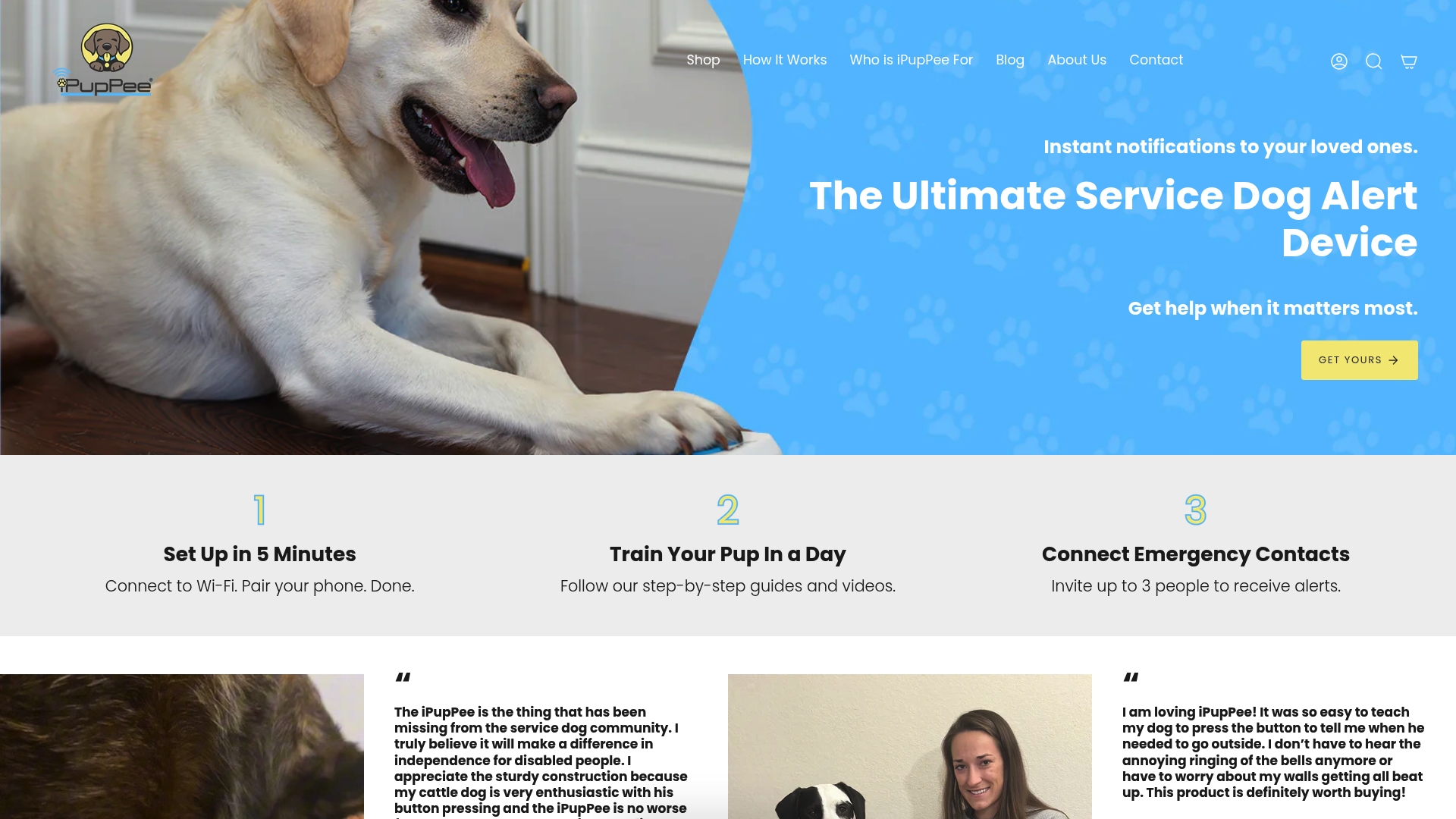
- The iPupPee device gives dogs a way to alert owners or emergency contacts with live video and audio, at a cost of $129.99 one-time
- The Psychology & Training Course walks owners through teaching the alert behavior, priced at $119 one-time
If AI-driven monitoring and diagnostics are the clinical side of this picture, a reliable alert system is the practical, everyday side. Visit the iPupPee product page to see whether it fits your household.
FAQ
Can AI diagnose illness in pets?
No commercially available AI tool is currently recognized as a standalone diagnostic authority. ACVR and ECVDI’s position statement states that imaging AI should be used with a veterinarian in the loop and currently no commercial diagnostic imaging AI products meet transparency and validation standards.
Are AI pet health chatbots reliable?
They can make basic health information more accessible, but a PMC review of AI chatbots warns that relying on them instead of a professional risks misdiagnosis and delayed treatment. Use them to decide whether a visit is needed, not to settle what is wrong.
Do wearable pet monitors actually catch problems early?
They can, by comparing an animal’s activity, sleep, and appetite against its own baseline and flagging meaningful changes, according to an overview of AI in pet health monitoring. The same source notes these alerts work best as a reason to call the vet, not as a diagnosis.
Who is responsible when AI is used in veterinary care?
The licensed veterinarian remains responsible for clinical decisions, even when AI tools contribute to a diagnosis or record. Guidance from the AAVSB ties this to existing professional standards and calls for informed consent when AI plays a role in care.
Does the iPupPee device use AI to detect health problems?
No. iPupPee is a communication and alert device that lets a dog trigger live video and two-way audio to a contact, built for safety and service-dog communication rather than diagnosis. It is meant to work alongside veterinary care, detailed on the iPupPee product page.
Sources
- Use of Artificial Intelligence in Veterinary Medicine – Professional Standard (Jan 2026)
- ACVR and ECVDI position statement on artificial intelligence in veterinary diagnostic imaging (JAVMA 2025)
- Systematic review: AI applications in companion animal care (PubMed, 2026)
- AI chatbots in pet health care: Opportunities and challenges for owners (PMC article)
- Bioacoustics and multimodal frameworks for precision behavioral intelligence in companion animals (Frontiers, 2026)