

TL;DR:
- Dog technology in 2026 includes biometric monitoring, machine learning alerts, and communication devices that enhance safety and independence. Successful adoption depends on clarifying goals, understanding device validation, and consistent training, not just hardware sophistication. Start simple, maintain devices regularly, and integrate technology thoughtfully to support your dog’s needs effectively.
Most pet owners think of a “smart collar” as little more than a GPS chip stitched into leather. The reality in 2026 looks nothing like that. Today’s dog technology spans real-time biometric monitoring, machine learning behavior alerts, and augmentative communication devices that help dogs signal their needs with a button press. For service dog handlers, seniors living alone, and anyone whose daily independence depends on their dog, choosing the right tool correctly can be genuinely life-changing. This guide cuts through the noise and shows you exactly what works, what doesn’t, and how to adopt it wisely.
Table of Contents
- How to set your goals: Safety, health, or independence?
- Wearables and smart collars: What’s real, what’s hype?
- Communication and cue technologies: Can tech help dogs ‘talk’?
- Real-world limits and planning for success
- Why most pet tech fails—and what actually works
- Explore next-gen dog tech solutions with iPupPee
- Frequently asked questions
Key Takeaways
| Point | Details |
|---|---|
| Start with goals | Clarify whether you want to improve safety, health tracking, or communication before choosing tech. |
| Trust, but verify | Look for devices backed by real-world research and hands-on testing, not just marketing claims. |
| Expect limitations | Every dog tech tool—including GPS and virtual fencing—has practical limitations in real-world use. |
| Human training matters | You and your dog both need to learn, test, and maintain communication and health tech for best results. |
| Plan for updates | Choose AI-enabled or smart devices that support regular updates and post-market data monitoring. |
How to set your goals: Safety, health, or independence?
Before you spend a single dollar on dog tech, get honest about what problem you’re actually trying to solve. This sounds obvious, but most buyers skip it entirely and end up with a tracker that monitors sleep stages when they really needed a loud alert for nighttime emergencies. The clearest path forward starts with a single question: is your priority safety, health monitoring, or two-way communication?
Each priority maps to a different product category:
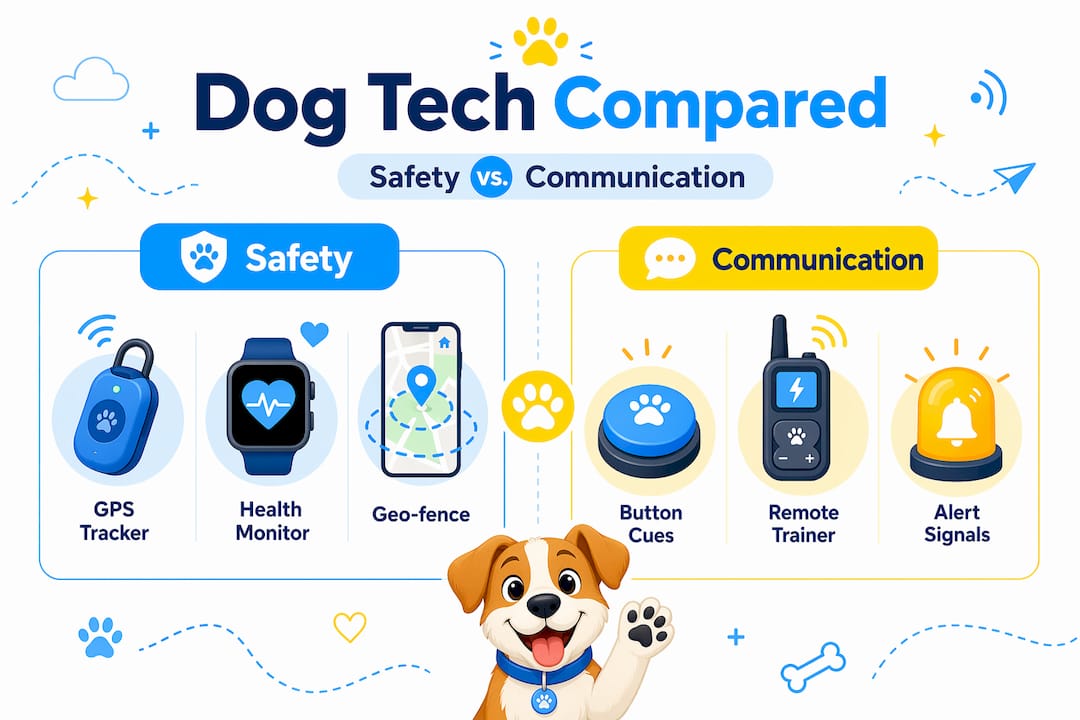
- Safety: GPS trackers, virtual fence systems, and behavior-alert collars designed to detect falls, wandering, or distress
- Health monitoring: Biometric wearables that track heart rate, respiratory rate, temperature, activity levels, and sleep patterns
- Communication and independence: Alert buttons, playback devices, and cue-based systems that let your dog initiate contact or signal a need
The good news is that these categories are starting to overlap. AI-powered pet collars now combine biometric monitoring with direct vet data sharing, meaning your dog’s vitals can land in your veterinarian’s dashboard automatically rather than waiting for the annual checkup.
For owners whose dogs serve a protective or alerting function, understanding the full range of alert device benefits is worth doing before you shop. Knowing the benefit structure helps you evaluate whether a product’s marketing actually matches a need you have.
Pro Tip: Write down your single most important use case before browsing products. If you can describe the specific situation where your dog’s alert or data would have made a difference in the past six months, you’ll make a smarter purchase in ten minutes than most owners make in an hour of reading reviews.
Wearables and smart collars: What’s real, what’s hype?
The wearable market for dogs has exploded, and so has the number of inflated claims. Breaking this category into three clear types makes comparison much simpler.

GPS trackers use cellular or satellite networks to report location. They’re the most proven category, and the market leaders have real coverage data to back them up. A smart collar coverage review of the Fi Series 3, for example, shows strong urban and suburban performance but real gaps in rural or heavily wooded terrain. Battery life and network coverage remain the two most important specs to verify for your specific geography.
Behavior-alert collars are newer and more scientifically interesting. These use accelerometers and gyroscopes to detect specific movement patterns linked to behaviors like seizing, scratching, or lying down for too long. The validation science matters here. One proof-of-concept study on behavior-alert collars evaluated wearable devices on six trained assistance dogs using a machine learning approach called a leave-one-dog-out protocol, which tests whether a model trained on some dogs can recognize behaviors in a dog it has never seen before. This kind of validation is far more rigorous than simple accuracy percentages and is a meaningful signal that a product’s detection algorithm has real-world durability.
Health monitors measure vitals continuously and can flag anomalies. The challenge is clinical validation. Many products report raw data, but few have published studies showing that their alerts correlate reliably with veterinary diagnoses.
Here’s a quick comparison to help you sort the landscape:
| Device type | Best for | Key limitation | Look for |
|---|---|---|---|
| GPS tracker | Location safety, roaming dogs | Coverage gaps, battery drain | Network coverage map |
| Behavior-alert collar | Service dogs, seizure detection | Limited clinical validation | ML validation study |
| Health monitor | Chronic condition tracking | Data interpretation skill needed | Vet integration feature |
| Communication button | Alert signaling, owner notification | Requires consistent training | Durable, loud speaker |
You can also learn more about wearable health monitoring specifically, which digs into what metrics are most clinically useful and how to read the data your device collects.
Pro Tip: Ask any wearable brand for their validation protocol before buying. If they can’t cite a peer-reviewed study or show you a methodology document, you’re buying marketing, not science.
Communication and cue technologies: Can tech help dogs ‘talk’?
This is the category that gets the most attention on social media and the least rigorous scrutiny. The short answer: yes, dogs can learn to use buttons and alert devices to communicate meaningfully. But the details matter enormously.
Augmentative interspecies communication (AIC) refers to devices that let dogs initiate a signal to a human, typically by pressing a button that plays back a recorded word or sound. The concept is solid. The implementation varies wildly. Research on playback cues and device quality found something that surprises a lot of owners: the quality of the audio output device itself changes how accurately dogs recognize and respond to cues. In plain terms, a tinny speaker that distorts your voice may reduce your dog’s ability to associate that sound with the intended meaning.
“Audio output device quality can materially change dogs’ recognition and response accuracy when using button-based communication systems.” — Scientific Reports, 2025
This has direct practical implications. If you’re setting up a button-based alert system for a service dog or a dog that lives with a disabled owner, the hardware quality of the speaker is not a cosmetic detail. It’s a functional one.
Here’s what the evidence supports for AIC systems:
- Human voice recordings outperform electronic or synthesized playback for cue recognition
- Consistent pairing of button press with real-world outcome is required for reliable learning
- Simple, high-contrast meanings (like “outside” or “alert”) are learned faster than abstract ones
- Button placement affects frequency of use. Dogs press buttons that are easy to find and reach under stress.
For a step-by-step approach, our creating dog communication signals guide walks through the training methodology that aligns with the behavioral science. If you’re comparing specific products, the best communication devices for disabled owners page covers the current top options with practical tradeoffs. And for a broader look at how this technology is evolving, dog communication technology explains where the field is heading.
One thing to avoid: treating commercial buttons as interchangeable with direct training. A button is only as effective as the association your dog has built with it. Without that foundation, even the best hardware produces random presses with no meaning.
Real-world limits and planning for success
Understanding the technology is half the job. The other half is setting up your environment and expectations so the tech can actually perform. Here’s a realistic picture of the most common adoption pitfalls and how to plan around them.
1. Map your connectivity before you commit to a GPS device. Many trackers rely on LTE or cellular networks. If you live in a rural area, walk your dog in a park with poor signal, or travel frequently to areas without solid coverage, verify the device’s network against carrier maps before purchasing. A virtual fencing system review of the Halo Collar 5 highlights that virtual fence boundaries can behave unpredictably in areas with spotty signal, which is critical safety information for anyone relying on this as a primary containment method.
2. Treat geo-fencing as a supplement, not a solution. Virtual fencing technology works by delivering a correction or alert when a dog crosses a digital boundary. A 2026 review of the Satellai collar notes clearly that these systems are containment aids, not absolute barriers. Physical fencing, direct supervision, and obedience training remain the primary tools. Tech fills gaps; it doesn’t replace the foundation.
3. Plan for software updates and algorithm changes. AI-driven collars and health monitors don’t stay static. When the underlying model updates, the device’s behavior can change. For devices that support health decisions, FDA guidance emphasizes a full lifecycle risk-management approach, including what the agency calls Predetermined Change Control Plans for AI-enabled software. This means the best manufacturers document in advance what kinds of algorithm changes are planned, how they’ll be validated, and how users will be informed.
4. Build a refresh and monitoring schedule into your routine. Don’t set up a collar or button system and forget it. Schedule a monthly review of battery health, software version, and alert accuracy. Devices drift over time. What worked perfectly six months ago may need recalibration.
“Smart adoption means expecting your tech to require ongoing attention, not just a one-time setup.”
For owners managing complex needs, reading up on advanced communication tools can help you layer devices intelligently rather than stacking redundant systems that create noise instead of clarity.
Why most pet tech fails—and what actually works
Here’s something most pet tech reviews won’t tell you: the hardware almost never causes failure. The human setup does. We’ve seen owners buy sophisticated behavior-alert collars, receive their first false alert, and immediately distrust the system permanently. We’ve seen button systems installed without any training plan, generating random presses that an owner starts ignoring within two weeks. In both cases, the technology was sound. The adoption approach wasn’t.
The owners who get lasting value from dog tech share a few patterns. They treat devices as tools that augment their attention, not replace it. They invest in understanding what their specific dog’s data looks like before trusting alerts at face value. They learn the signals their dog already sends naturally, which makes technology integration faster and more intuitive. Our guide on decoding dog signals is genuinely useful here, because technology works best when it amplifies something you already partially understand.
The other pattern we see in successful adopters: they pick one primary technology goal and execute it well before adding anything else. A GPS tracker that you check daily and trust completely does more for your dog’s safety than three overlapping systems you barely understand. Complexity adds friction. Friction reduces consistency. Inconsistency is where safety gaps appear.
The uncomfortable truth is that the best dog technology in the world underperforms in the hands of a distracted or undertrained owner, and a simple, well-maintained alert button outperforms an expensive AI collar that nobody reads the alerts from. Start simple. Start intentional. Build from there.
Explore next-gen dog tech solutions with iPupPee
Ready to put this research into practice? iPupPee was built specifically for pet owners who take safety and communication seriously, especially those working with service dogs, living with a disability, or caring for a dog with special needs.
Our blog and product guides go beyond generic reviews to offer evidence-grounded recommendations matched to real daily scenarios. Whether you’re exploring alert devices, building a communication system for your dog, or figuring out how to integrate health monitoring into your vet relationship, we’ve done the groundwork so you don’t have to start from scratch. Visit ipuppee.com to browse curated solutions, read owner stories, and find the tool that fits your dog’s life and yours.
Frequently asked questions
What’s the most reliable tech for keeping a service dog safe?
A layered approach combining GPS tracking with validated behavior-alert collars gives the strongest real-world protection, especially when both systems are regularly maintained and monitored.
Do communication buttons really help dogs talk?
Buttons can build meaningful signaling behavior, but audio device quality and consistent training matter more than the button itself. Dogs respond better to clear human voice recordings than to synthetic playback.
How should I handle AI or smart collars that get regular updates?
Track your firmware version, review alert behavior after each update, and follow the lifecycle monitoring approach that FDA guidance outlines for AI-enabled device software.
Are virtual-fence or geo-fencing collars a substitute for a real fence?
No. Virtual fencing reviewers consistently note these systems work as containment aids alongside supervision and training, not as a standalone replacement for physical barriers.
Can health data from wearables be shared with my veterinarian?
Yes, select collars and apps are built for direct vet data sharing. The PetPace V3.0 collar, for example, streams biometric data directly to a veterinary practice through its companion app and alert system.