

Pet safety devices are shifting from tools that tell you where a pet is to tools that tell you what a pet needs, and, increasingly, tools that let the dog start the conversation. Over the next few years, expect better health-trend tracking, AI that spots changes in behavior, tighter integration with the smart home, and more attention to privacy. Devices that let a dog send an alert on purpose are a fast-growing part of that picture, especially for service dog teams, seniors and people who live alone.
This guide separates what already works from what is still in the lab, so you can choose a device for your dog’s real situation.
TL;DR
- Today’s devices cover location (GPS and geofencing), activity and sleep, cameras with audio, and smart doors. The next wave adds AI that learns your dog’s normal and flags changes.
- Research on wearables is promising but mixed. Heart rate tracking can agree well with clinic monitors, while other readings are less dependable, so treat devices as an extra layer next to your vet.
- Dog-initiated alerts, where the dog presses a button to notify a person, are supported by early studies on assistance dogs and fit the way many handlers already live.
- Privacy and security are now a buying criterion: check what data a device collects, how it is encrypted and who it is shared with.
- Choose by your dog’s job and your household’s needs, not by feature count.
Table of Contents
- Where pet safety tech stands today
- From location to prediction: health monitoring
- Dogs that send the message: communication devices
- Assistance dogs, rescue work and seniors
- What is likely next, and what is still speculative
- Privacy and security: the new buying criteria
- How to choose a device that fits your dog and your home
- Put dog-initiated alerts to work with iPupPee
- FAQ
- Sources
Where pet safety tech stands today
The category is broader than most owners realize. A veterinary hospital guide lists GPS trackers with real-time location and geofencing alerts, activity monitors for movement, rest and sleep, smart litter boxes that track weight and bathroom habits, treat-dispensing cameras, and selective pet doors that admit only recognized pets.
A 2025 systematic review of 36 papers published between 2010 and 2024 concluded that the Internet of Pets is changing pet care through new ways of monitoring, feeding and protecting animal welfare. That is the academic view of what you see in stores: sensors, connectivity and apps converging around the pet.
The smart home is part of this too. A 2024 Verge piece on caring for pets with a smart home describes a contact sensor on a garden gate, animal-detection alerts from a video doorbell, and automations that switch on a fan or sprinklers when it gets hot. None of this is exotic. It is ordinary hardware used with the pet in mind.
If you want a plain-language primer first, our guides on pet safety devices explained and what pet-tech is cover the basics.
From location to prediction: health monitoring
The biggest shift is from reacting to predicting. Early GPS collars answered one question: where did my dog go? The newer question is: is something changing in how my dog moves, sleeps, scratches or drinks?
A 2026 article by veterinarian Dr. Heather Berst on a pet-care company’s blog lists what wearables can now track: daily activity, sleep duration and quality, scratching and licking, drinking, heart rate trends, respiratory rate changes, mobility patterns and GPS location with escape alerts. The same piece notes that accuracy varies between brands and that these devices should never be used to diagnose illness at home or replace veterinary advice.
The research agrees with that balanced view. A 2026 study covered by The Herd found strong agreement between a wearable’s heart rate readings in awake dogs and a veterinary patient monitor, but poor correlation for blood oxygen saturation. The same article notes that a 2025 study of a smart collar found it gave a useful estimate of 24-hour mean heart rate in healthy dogs, while short-interval readings were weaker.
The practical takeaway: trends over days and weeks are where wearables earn their place. A gradual drop in activity, a change in sleep or more night-time scratching is a prompt to call your vet, not a diagnosis.
A 2025 review of remote vital sensing in veterinary medicine covers where this is going: infrared thermography, radar, wearable sensors, and computer vision with machine learning. Some of these need no contact with the animal at all, which could suit dogs that dislike wearing gear.
We go deeper on this in daily wellness checks that don’t replace your vet and in our piece on monitoring your dog’s health with wearable tech.

Dogs that send the message: communication devices
Most pet tech watches the dog. A smaller, growing group lets the dog act. The idea is simple: a dog is often the first to know something is wrong with a person in the home, and a trained behavior, such as pressing a button, can turn that knowledge into an alert.
There is academic groundwork here. A 2023 scoping review of remote human-dog technology found studies of wearable sensors that let dogs send messages and vibrotactile wearables that let dogs receive commands, used for assistance and search and rescue. The evaluations were pilot studies with positive feasibility results, which is the honest description of the field: early, encouraging and growing.
A home-based example comes from a study that trained three medical alert dogs to operate a touchscreen. One dog in the longitudinal part completed the alert within 10 seconds of being cued and could find the screen from anywhere in the home, even with the handler in another room.
That is the logic behind the iPupPee device. It is a Wi-Fi alert device that lets a dog press a button to send a notification to you or to emergency contacts, with live video and two-way audio so a person can see and speak to the dog and the situation. It is designed for dogs of all sizes and works without a monthly subscription fee. Our article on wearable tech for dogs: safety, alerts and independence explains where this fits among other devices.
Assistance dogs, rescue work and seniors
The strongest case for the next generation of devices is where a dog is already doing a job.
Assistance dogs. Research from the Open University’s Animal-Computer Interaction Lab, summarized in an impact case, reports that dog-centred controls for operating appliances cut task completion time by 50 per cent and raised success rates by 20 per cent compared with the most accessible standard controls. The same source says more than 7,000 people with disabilities in the UK rely on mobility assistance dogs. The lesson carries over: equipment built around how a dog actually works is easier for the dog to learn.
Handlers who need another channel. Researchers behind a haptic vest reported in IEEE Spectrum that a dog followed vibration commands as well as or better than verbal ones, with training for each task taking under an hour. They suggested benefits for speech-impaired handlers and for communicating with deaf dogs. National Geographic covered the same work.
Search and rescue. A 2022 paper describes a smart vest for K9 units with two video streams, two-way audio, precise positioning and Wi-Fi connectivity, so the handler can focus on the mission while coordinators get near-real-time information.
Rescue organizations and animal welfare groups. Remote cameras are already in the field. HumanePro describes a cat-rescue group using cellular trail cameras during the Maui wildfire response to monitor more than 80 feeding stations in real time and prioritize trapping.
Seniors and people living alone. Here the future is less about novelty and more about reliability: an alert that reaches several people quickly, a camera and microphone that let a family member check in, and a dog that understands what the button is for. Our connected pet home guide walks through setting this up.

What is likely next, and what is still speculative
Likely soon: AI that learns your dog’s baseline. The 2025 MDPI review reports that AI is already used for behavioral analysis and anomaly detection in pets, tracking activity levels, emotional states and potential health risks. It expects future pet IoT to learn from data, adapt in real time and share information with other smart home devices. In practice, that means fewer raw numbers and more useful messages: “Max’s night-time activity has been unusual for four days.”
Likely: better integration. Alerts that trigger lights, unlock a door for a caregiver or start a video call are already possible with home hardware. Expect them to become easier to set up.
Possible: contactless sensing. Thermography, radar and computer vision are described in the veterinary literature, but moving them from clinics into living rooms will take time.
Still speculative: virtual reality for pets and “translating” dog emotions. Industry commentary mentions them, but no study in our research shows they work. Treat marketing that promises them with patience.
We look at the prediction side in predictive pet safety: from health trends to handler alerts, and at the 2026 landscape in our guide to pet safety innovation.
Privacy and security: the new buying criteria
As devices get smarter, they collect more. That makes data handling part of the choice, just like battery life.
A 2023 Frontiers in the Internet of Things study examined 20 popular pet tech apps. Two exposed login and account details in unencrypted traffic, and 14 contacted third-party trackers before users could consent. Participants in the survey also took fewer precautions with pet tech than with traditional computing.
The data is often about you as much as your dog. A 2019 academic analysis of pet wearable privacy policies found these devices capture far more data about owners than about pets. A 2026 SEC Consult analysis of GPS pet trackers points out that because pets are nearly always with their owners, a pet’s location can reveal a home address and daily routine. The researchers found no exploitable vulnerabilities in the four European trackers they tested, but said the privacy implications deserve attention.
Safe-use habits that follow from this:
- Use a unique, strong password and turn on two-factor authentication where offered.
- Share video and alert access only with people who need it, such as family or an emergency contact.
- Read what the app asks permission for and decline what it does not need.
- Keep the device’s firmware and app updated.
On radio exposure, a 2021 MDPI Animals study of 21 pet tracking devices found exposure well below international reference levels, so adverse effects on animals can be largely excluded. It still suggested using tracking devices only when pets have outdoor access, preferring a harness to a collar, and choosing newer 3G or 4G protocols.
Our perspective
We built iPupPee around a simple belief: the future of pet safety is not only about watching dogs, it is about giving dogs a way to speak up. Dogs notice things long before a person does, and a button a dog understands turns that awareness into an alert someone can act on.
That is why our device sends an instant Wi-Fi notification to multiple contacts and opens live video and two-way audio. A handler, a family member or a caregiver can see what is happening and respond in the moment. We designed it for dogs of all sizes and for the people who rely on them: service dog teams, seniors, people living alone, new puppy owners and rescue dogs finding their footing in a new home.
We also think training matters as much as hardware. A device only helps when the dog knows what it is for, so we pair it with training guides and a psychology and training course. And because safety should not come with a recurring bill, there is no monthly subscription fee.
The best pet safety tech will always sit next to good training, a strong bond and a good vet. We are building for that combination.
Andrew
How to choose a device that fits your dog and your home
Start from the situation, not the spec sheet.
- Define the job. Is it finding a dog that slips out, spotting health changes, or letting a dog call for help when you are in trouble? Each points to a different device type. Many households end up with one device from two categories.
- Match it to the dog. Size, temperament, comfort with wearables and trainability all matter. A dog that will never wear a collar sensor might do well with a button or a camera.
- Check the audio and video basics. VCA Hospitals advises weighing video quality, range of vision, one- or two-way audio, night vision, mounting options and privacy safeguards when choosing a monitoring system.
- Look at ownership costs. Ask whether a monthly plan is required and what the device does without one.
- Keep the human layer. Berst’s guidance is that wearables work best as one more layer of information. She also warns that too many notifications can bury the important ones and that skipped maintenance can cause failures. Set alerts for what matters and charge or update on a schedule.
- Plan for who gets the alert. An alert is only as good as the people who receive it. Add more than one contact, and agree who responds.
For a wider view of the benefits, see the real benefits of smart dog devices and why choose pet health tech.
Put dog-initiated alerts to work with iPupPee
If your priority is safety and independence, the iPupPee device is $129.99 as a one-time purchase. It lets your dog send a notification to you or your emergency contacts with a button press, with live video and two-way audio over Wi-Fi.
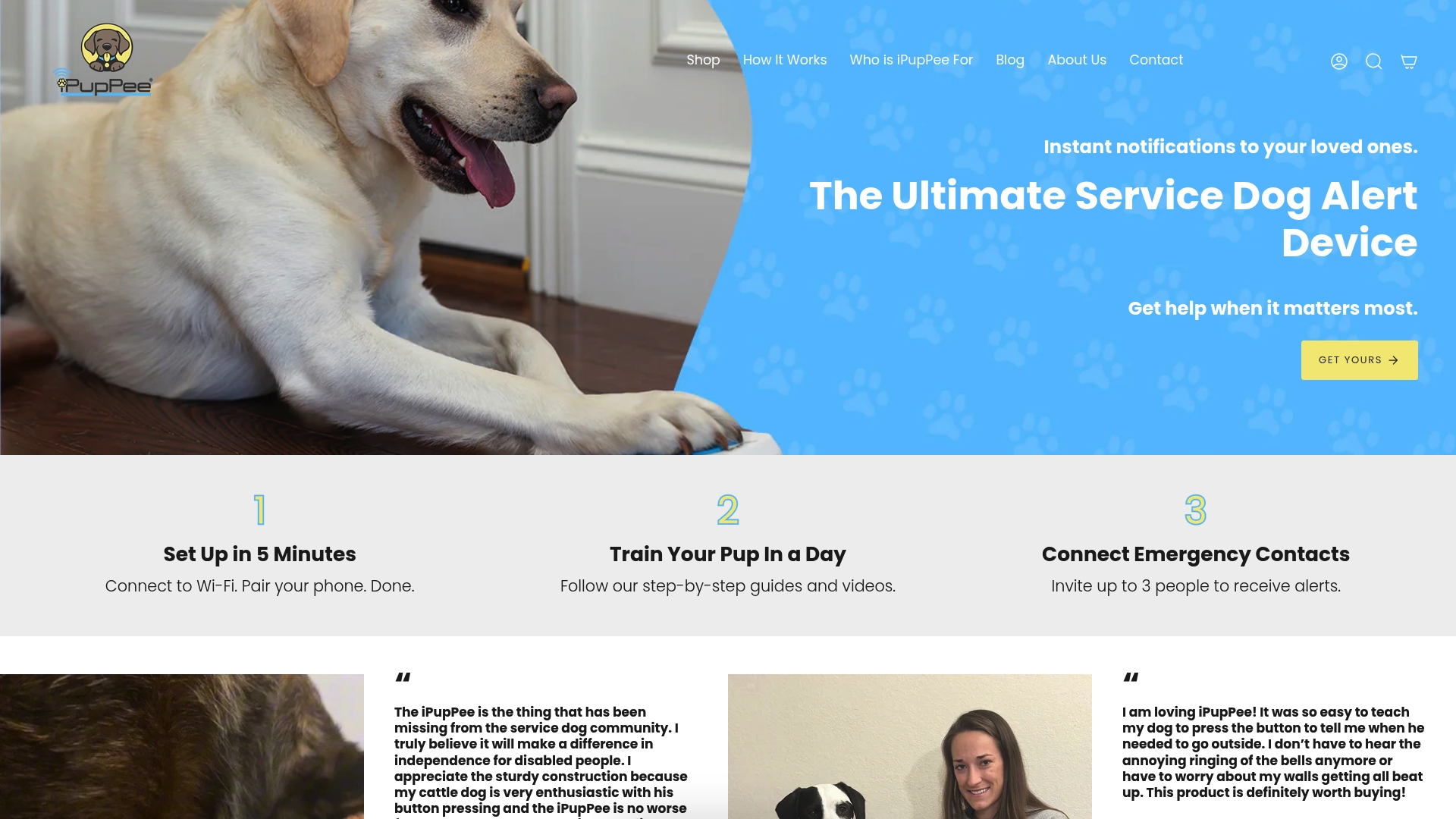
Training is what makes it work, so we also offer the Psychology & Training Course for $119, one time. You can see the steps in how it works, and learn more about the thinking behind the course on our dog psychology page. At checkout you can add shipping protection for $5.00 to cover damage, loss or theft in transit.
FAQ
What will pet safety devices be able to do in the next few years?
Expect more AI that learns your dog’s normal routine and flags changes, tighter links to smart home gadgets, and better health trend tracking. Research already describes AI-based anomaly detection for pets, and contactless sensing such as thermography and radar is being studied. Ideas like VR for pets are still speculative.
Can a wearable tell me my dog is sick?
It can show you trends that are worth a call to your vet, such as lower activity or changed sleep. Studies show strong results for some measures, like heart rate agreement in one 2026 study, and weaker results for others, like blood oxygen. Use readings as extra information and let your veterinarian make the diagnosis.
Are pet safety devices useful for service dog handlers and seniors?
Yes, in particular where the dog can take an active role. Studies on medical alert dogs using home touchscreens and on dog-centred controls for assistance dogs show that dogs can learn to operate interfaces designed for them. A device that sends an alert to several contacts with live video and audio also gives family members a way to check in quickly.
How do I keep my data safe with a pet device?
Use a unique password, turn on two-factor authentication if it is offered, and share access only with trusted people. Review the permissions the app requests and keep the app and device software updated. Research on pet tech apps shows data handling varies a lot, so it pays to read the privacy settings before you set up.
Does the iPupPee device need a monthly subscription?
No. iPupPee is a one-time purchase of $129.99 with no monthly subscription fee. It connects over Wi-Fi to send notifications and enable live video and two-way audio.
Sources
- Pet Safety Technology: Tech Options = Safer, Healthier Pet
- The Internet of Things Empowering the Internet of Pets (MDPI Applied Sciences, 2025)
- How my smart home helps care for my pets (The Verge, 2024)
- Study finds mixed results for wearable heart rate, SpO2 monitoring in dogs (The Herd, 2026)
- Remote Vital Sensing in Clinical Veterinary Medicine (PMC, 2025)
- Digital Technology Supporting the Remote Human-Dog Interaction (PMC, 2023)
- Dogs Using Touchscreens in the Home (2018)
- Developing new technologies which benefit mobility assistance dogs (Open University)
- Remote Control Your Dog with a Haptic Vest (IEEE Spectrum, 2019)
- Vibrating dog vest may let you talk to your pup (National Geographic, 2019)
- A Smart Integrated Vest for the Canine Companion of the K9 Unit (MDPI Informatics, 2022)
- Advanced trapping tips, Part 1: Applying technology to TNR (HumanePro)
- Security and privacy of pet technologies (Frontiers in the Internet of Things, 2023)
- Buddy’s wearable is not your buddy (2019)
- SEC Consult analysis of the consumer pet tracking ecosystem (2026)
- Tracking Devices for Pets: Health Risk Assessment (MDPI Animals, 2021)
- Watching Your Watch Dog: Home Pet Monitoring Systems (VCA Hospitals)