
Technology helps animal rescue at four points: running the shelter, matching animals with adopters, supporting the first weeks after adoption, and keeping a rescued dog and its person connected once they are home. The first three are mostly handled by software that rescues choose. The fourth is where a dog owner, a service dog handler or a senior adopter can act directly, and it is where our iPupPee device fits.
This guide walks through each layer with the evidence behind it, then shows what an adopter or rescue can do with it.
TL;DR
- Shelter management software centralizes records, intake and outcome tracking, and foster placement, so small teams spend less time on paperwork.
- AI matching and shared photo databases help animals find homes faster, and a 2025 case study found shorter shelter stays after a shelter adopted a digital platform.
- Post-adoption apps and check-ins aim to keep pets in their new homes, which is where most returns are decided.
- Cameras and sensors can monitor welfare, but they work best as a support for people, not a replacement.
- At home, an alert device with live video and two-way audio gives an adopter and their emergency contacts a direct line to the dog. iPupPee has no monthly subscription fee.
Table of Contents
- Why rescue needs technology at all
- Running the shelter: software that holds the whole operation
- Finding homes: AI matching and shared databases
- After adoption: where returns are decided
- Watching welfare: cameras, sensors and their limits
- The missing layer: connection at home
- How an adopter or rescue can put the layers together
- Where our device and course fit
- Our perspective
- FAQ
- Sources
Why rescue needs technology at all
Shelters and rescues are short of almost everything except animals. In an exploratory study with shelter officials in Israel, participants described their shelters as understaffed, overcrowded and running on limited budgets. They also named behavioral assessment and screening as some of the most important shelter tasks.
That is the real job of technology in rescue. It does not replace the person who sits with a frightened dog. It removes the data entry, phone tag and guesswork that keep that person from doing so. The sections below follow an animal’s path: through the shelter, into a home, and through the first months there.
Running the shelter: software that holds the whole operation
The foundation is shelter management software. The Humane Alliance’s training playbook says these systems increase efficiency and improve communication by putting all records, reportable metrics and care activity in one place. Before this, a dog’s vaccination date might live on a clipboard, its behavior notes in a volunteer’s text messages and its foster details in someone’s memory.
What a modern system covers:
- Intake and outcomes. Configurable forms record where an animal came from and where it went, which is the data funders and regulators ask for.
- Foster management. Platforms such as Shelterluv list foster management with capacity search, automatic to-do lists, automated reporting and free syncing of adoptable animals to large adoption websites.
- Municipal tools. Barcelona’s city pet rescue centre launched an animal-management application in February 2024 that, according to the city, cuts veterinary-care time and streamlines adoption paperwork for a centre handling more than 2,000 animals a year.
- Disaster response. Shelterly is built for emergencies, with real-time animal tracking, field dispatch on interactive maps and GPS capture for stranded animals.
- Field programs. Humane Society International’s HSIApps suite is used in India’s street dog sterilisation programs, and a 2022 paper describes dashboards that lower program cost and support follow-up of postoperative outcomes.
Everyday collaboration tools matter too. Best Friends Animal Society describes network partners using spreadsheets and databases to fast-track fosters, text messaging to get quick answers on neonatal kittens, and project boards that helped move 100 dogs in a week during a hoarding case in Florida. None of this is glamorous, and all of it saves lives by saving time.
If you run a small rescue, our guide on rescue organizations and pet tech covers where to start, and what belongs in rescue intake documentation shows the records worth capturing from day one.
Finding homes: AI matching and shared databases
The second layer is getting an animal in front of the right person quickly.
Lost and found. Petco Love Lost gathers photos from more than 3,000 US shelters and neighborhood platforms into one searchable database. Anyone can upload one photo and get AI matches, as the American Animal Hospital Association reports. Shelter software can add and remove pets in care automatically, so the database stays current without extra work.
Natural-language matching. In 2026, Best Friends reported that Amazon launched an AI adoption tool that reads requests like a low-energy dog for an apartment and matches them to animals at six Best Friends centers. This is the same shift people have already made in shopping: describe what you need rather than filter by breed and age.
Evidence that it moves outcomes. A 2025 case study of an Australian cat shelter in the Journal of Shelter Medicine and Community Animal Health found that after adopting a digital platform, off-site adoptions doubled compared with before the pandemic. Median stay fell from 6 to 5 days on site and from 28 to 24 days in foster care, even as intake rose by 467 animals. The authors conclude that pairing digital platforms with foster networks is a replicable model. A 2025 systematic review of 15 studies reached a similar direction, finding that a centralized mobile platform can improve adoption, donation and volunteer management and reduce stress in dogs.

For an adopter the practical lesson is simple. The platform gets you to the right dog, and the match works best when you describe your real life honestly: your schedule, your home, your health and who is around to help.
After adoption: where returns are decided
A match is not the end of rescue. The first weeks are when many placements succeed or fail, and technology is increasingly aimed at that window.
Maricopa County Animal Care & Control in Arizona began a post-adoption app partnership in March 2025. Adopters automatically receive medical records, recommended services and life-stage guidance, and the shelter uses the app to check in. Its 2025 annual report lists a 93% save rate and more than 11,500 pets adopted. Petszel, the app’s maker, reported in a 2024 press release that early partner shelters saw returns decline by up to 29%. That is the company’s own figure, so treat it as encouraging rather than settled.
What these tools share is timing: the right information, delivered when a new owner is most likely to feel overwhelmed. That is also the logic behind the popular 3-3-3 rule of thumb for rescue dogs, which says a dog may need roughly three days to decompress, three weeks to learn routines and three months to feel at home. It is a guideline, not a schedule, and individual dogs vary widely. Our dog rescue care tips adoption guide and rehabilitation guide walk through those early weeks in practical detail.
Watching welfare: cameras, sensors and their limits
A 2021 systematic review of technology used to monitor animal welfare found that cameras were the most common tool, followed by wearable sensors such as accelerometers and GPS. In shelters, the interest is in spotting stress, eating changes and early signs of separation anxiety, aggression or excessive vocalization.
Shelter staff in the Israeli study saw in-kennel video as a cheap, feasible place to start. They also raised fair cautions: dog behavior is not a yes-or-no output, and recording every decision can overload staff. A 2026 review of sensing technologies adds that hardware is only part of the cost, since power, networks, maintenance, software and labor all add up, and cloud data raises ownership and privacy questions.
The takeaway for rescues is to start with the simplest tool that answers a real question and keep a person in the loop. For individual owners, the same principle holds: a device that shows you what is happening, rather than guessing for you, is the practical one. We cover the owner side in AI in pet care.
The missing layer: connection at home
Shelter software ends at the door. Post-adoption apps send reminders and surveys. Neither one helps in the moment when a newly adopted dog needs to tell someone something and the person is in another room, asleep, or out of the house.
That gap matters most for three groups the rescue world serves every day:
- Seniors who adopt a companion. An older adopter living alone benefits from a way to reach family if something goes wrong, and from a way for the dog to ask for help.
- People with disabilities and service dog handlers. A dog trained to alert needs a reliable, simple way to send that alert to people who can respond.
- Rescue dogs with a history. Dogs that arrive anxious or untrained need a communication routine they can learn from day one. See our piece on dog communication for rescue and on dog mental health.
This is the layer our device addresses. It is a Wi-Fi smart alert device: the dog presses a button, and a notification goes straight to the owner or to emergency contacts. It also offers live video and two-way audio, and it can reach multiple contacts at once. It is designed for dogs of all sizes and does not require monthly subscription fees. The How It Works page shows the setup.
How an adopter or rescue can put the layers together
A practical sequence for a new adoption:
- Choose with a matching tool, then be specific. Use the adoption platform’s filters or natural-language search, and describe your real daily life.
- Set up the post-adoption support your shelter offers. If it has an app or check-in service, enroll on day one, since timely information is the point.
- Teach a communication routine early. A dog learns a button press the same way it learns any cue: short sessions, consistent rewards and patience. Our training course covers dog psychology and training.
- Add the home safety link. Place the alert device where the dog spends time, and choose emergency contacts who can actually respond.
- Share what you learn. Feedback to the rescue helps the next adopter and the next dog.
Rescues can also treat this as a service to adopters, particularly those who are older or have disabilities and who benefit from a clear safety plan. Our rehoming checklist is a starting point, and rescues and trainers can look at our affiliate program for referrals.
Where our device and course fit
The iPupPee device is priced at $129.99, one time, and the Psychology & Training Course is $119, one time. The device lets a dog send an instant notification, with live video and two-way audio for the people who receive it. The course gives handlers and adopters the dog psychology and training background to teach the behavior well. Optional shipping protection is $5.00 at checkout.
You can see the device on the iPupPee product page.
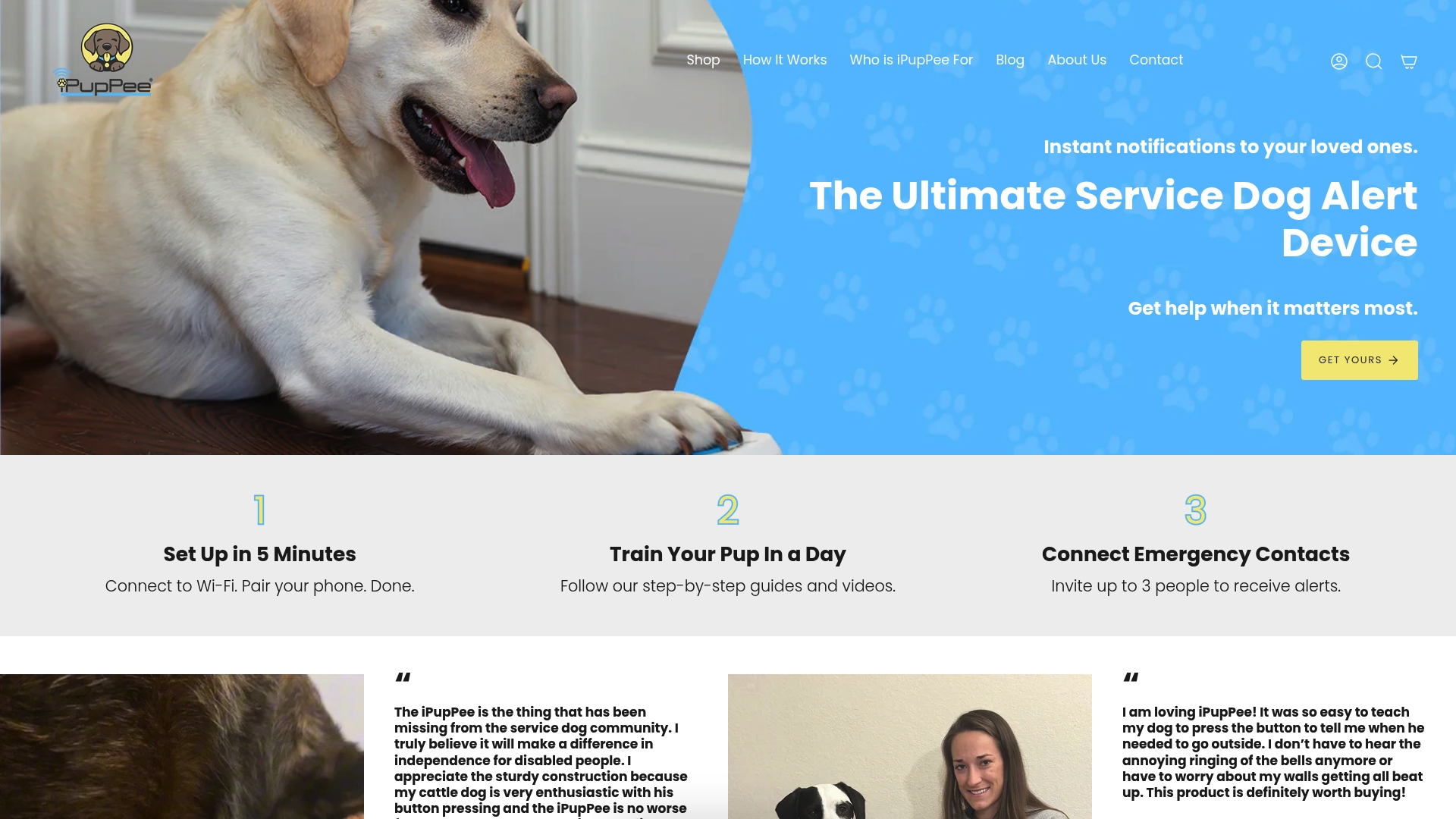
If you are bringing home a rescue dog or supporting someone who is, the iPupPee home page is the place to start.
Our perspective
Technology in rescue usually gets described from the shelter’s side: databases, dashboards, matching engines. Those matter, and the evidence says they save time and shorten stays.
But an adoption succeeds or fails in a living room. The person is learning the dog, the dog is learning the person, and there are hours when neither can reach the other. We built iPupPee for that gap. A dog presses a button and the people who care about it get the message, with live video and two-way audio if they need to see and speak.
We think this matters most for seniors, people with disabilities and service dog handlers, and for anyone adopting a dog who needs a clear way to ask for help. Training is half of it, which is why our course teaches the psychology behind the behavior, not just the button. And because there is no monthly subscription fee, the cost is a single purchase rather than a bill that follows you around.
The best rescue outcome is a dog who stays in the home it was matched to. Every layer of technology, from the shelter database to the button on your floor, serves that.
Andrew
FAQ
How does technology help animal rescue the most?
It saves staff time and speeds up placements. Management software centralizes records and foster tracking, and digital platforms get animals in front of adopters faster. A 2025 Australian case study found shorter shelter and foster stays after a shelter adopted such a platform.
Can AI really match a dog to the right adopter?
AI tools now match animals and people on lifestyle details such as home type and energy level, and some process plain-language requests. They narrow the field well, but the final choice still depends on honest answers from the adopter and a meeting with the dog.
What is the 3-3-3 rule for rescue dogs?
It is a rule of thumb: about three days to decompress, three weeks to learn the routine and three months to feel settled. Dogs differ, so use it as a guide for patience. Keeping a steady routine, including a communication routine, helps during all three stages.
How can a rescued dog tell me something is wrong when I am not in the room?
A dog can be taught to press a button on an alert device that sends a notification to you or to your emergency contacts. Ours also offers live video and two-way audio. Pairing it with our training course helps the dog learn the habit.
Sources
- HASS playbook: utilizing software to track organizational data
- Shelterluv features
- Barcelona CAACB animal management tool
- Shelterly disaster response
- Technology for improving street dog welfare
- Five types of tech to streamline your lifesaving work
- How AI facial recognition is bringing lost pets home
- AI-powered tool matches dogs and cats with potential adopters
- Optimising shelter outcomes using technology and foster care
- Digital strategies in dog adoption: a systematic review
- Maricopa County Animal Care & Control 2025 annual report
- Over 100 shelters and 300,000 annual adoptions supported by a post-adoption platform
- How can technology support dog shelters in behavioral assessment
- Smart animal welfare: a review of sensing technologies