

People use smart collars to know more about their dog without being beside it: where the dog is, how much it moves, how it sleeps, and whether something has changed. For owners who live alone, have limited mobility or handle a service dog, the most valuable step beyond passive tracking is letting the dog tell you when something is wrong. That is the idea behind the iPupPee device, a Wi-Fi alert the dog triggers with a button press, which sends a notification to you or your emergency contacts, with live video and two-way audio.
TL;DR
- A smart collar is a connected wearable that records data about your dog, such as location, activity, sleep and movement patterns.
- Research on dog activity trackers shows owners report more informed caregiving and more exercise for the dog, and the value lies in trends over days, not single readings.
- Collar data supports your vet’s judgment. It does not replace a hands-on exam.
- Many tracking collars charge a recurring fee, so check the running cost before you choose.
- If your main need is safety and communication, a dog-triggered alert with video and audio does what passive data cannot: it lets the dog call you.
Table of Contents
- What a smart collar actually is
- The main reasons owners use them
- What smart collars do well, and what they leave to you
- Using collar data wisely
- Smart collars and independence for people with disabilities and seniors
- What smart collars cost to run
- How to choose: start with the job you need done
- Where iPupPee fits
- Our perspective
- FAQ
- Sources
What a smart collar actually is
A smart dog collar is a connected wearable that records or sends information about a dog. Depending on the model, that can be location, activity, sleep, movement patterns, escape alerts or health-oriented measurements. It pairs with an app on your phone, so you read the data when you want it, or get an alert when something crosses a threshold.
The label covers several different tools, and that matters when you decide why you want one. A location tracker answers “where is my dog?” An activity monitor answers “how much did my dog move today?” A health-oriented collar tries to answer “is my dog’s normal changing?” None of these is the same as a device that answers “does my dog need me right now?” Knowing which question you are asking is the first step in choosing well.

The main reasons owners use them
Finding a dog that gets out
Location tracking and escape alerts are the most common reason. A collar with GPS works by determining its position from satellites and then sending that position over a cellular or Wi-Fi connection to your app. That connection is why many of these products need a data plan, and why coverage at home or on a trail affects how well they work. Safe-zone alerts can warn you when a dog leaves the yard, which is useful for owners who cannot chase a dog on foot.
Understanding exercise and daily routine
A 2019 University of Bristol study surveyed users of a popular dog activity tracker. Of 75 respondents, 36 reported increased activity of their pet as the largest lifestyle effect, and 21 reported more informed caregiving. The same paper found that 28% of responses pointed to increased activity of the owner too. When a number on your phone shows your dog moved less this week, you are more likely to take the extra walk.
The study also found that users cared most about usability and maintainability, and that consistency mattered more to them than absolute accuracy. That fits how the data is used in real life: you are comparing your dog with its own recent past, not with a lab standard. If you want to build the habit, our guide to dog exercise benefits covers what to aim for.
Noticing changes sooner
Health-oriented collars are most useful when they help you learn what is normal for your dog and notice meaningful change over time. Veterinary voices say the same: the value is in the trend, not a single reading. Fear Free founder Marty Becker, DVM, told dvm360 that wearable technology helps veterinarians reach a diagnosis, for example by showing why a pet was wetting at a certain time or whether a pet is lame. In practice, that means a week of data can give your vet more to work with than your memory of the last few days.
To build a baseline, you need a stretch of ordinary days first. Our explainer on why the 7 to 14 day baseline matters walks through the terms you will meet, and the canine health tracking overview shows what to log alongside the numbers.
Better communication with trainers and organizations
Smart collars are not only for pet owners. Researchers who studied activity trackers for puppy raisers found they can address a need unique to that community: efficient communication between raisers and guide dog centers, with just-in-time guidance and feedback instead of waiting for scheduled meetings with trainers.
NC State University went further, combining collar data with AI to build a system that gathers insights during guide dog training to help judge whether guide dog work suits a particular dog. The data could also help estimate how temperament traits pass between generations. For rescue groups and trainers, this points to a real role: objective records of how a dog behaves across days, not just in a single session.
Working dogs in the field
A 2023 scoping review in PMC found that remote interaction technology has been designed for search-and-rescue dogs. Some systems alert the handler when a dog finds something of interest, using a phone with GPS data, while others track position, motion and orientation and support remote tone and vibration commands. The common thread is that distance between dog and human is a problem technology can narrow.
What smart collars do well, and what they leave to you
A collar sees what the dog does. It does not know what the dog wants. A drop in activity shows up on the screen, but a dog that is trapped behind a door, has knocked over its water or feels unwell at 3 a.m. cannot make that known through a step count. Most of the data arrives after the event, and you have to be looking at it.
That is not a flaw to fix, just a division of roles. Passive monitoring tells you about patterns. A dog-triggered alert tells you about moments. Many households benefit from understanding both, and the second is where safety for an owner who lives alone or has a disability really comes from.
| What you want to know | Passive smart collar | Dog-triggered alert |
|---|---|---|
| Where is my dog right now? | Yes, if it has location tracking | No |
| How active was my dog this week? | Yes | No |
| Does my dog need me right now? | Only if the data shows an anomaly | Yes, the dog presses the button |
| Can I see and speak to the dog remotely? | Not usually | Yes, with live video and two-way audio |
| Who gets notified? | Usually the account holder | Multiple contacts |
Using collar data wisely
Data is a tool, and a few habits make it more useful.
- Wait for a baseline. Wear the device through a week or two of ordinary routines before reading anything into the numbers.
- Look at trends. A single odd reading is rarely meaningful. A change that holds across several days is worth noting.
- Log context. A heat wave, a houseguest or a new feeding schedule explains many changes.
- Bring the data to your vet. The GVMA notes that when a veterinarian has already seen the patient, wearable data serves as an extension of their care, because the vet’s knowledge of the animal allows more accurate interpretation. The same article states that wearables provide real-time data but cannot replace a hands-on physical examination.
- Do not hover. A veterinarian quoted in dvm360 cautioned that checking vitals every few minutes can lead owners to overreact to minor changes. Check in on a schedule that suits you.
If your dog seems unwell, whatever the collar says, call your veterinarian. They are the right person for any medical question, and they can use your collected data when they do.
Smart collars and independence for people with disabilities and seniors
For owners with limited mobility, the reasons for using connected tech are practical. If your dog gets out and you cannot run after it, a location alert helps. If you live alone and could fall, you want a way for the dog to bring help or at least bring attention. If you handle a service dog, you want to know the team is safe even when you cannot see each other.
This is where an alert the dog controls fits. The iPupPee device lets a dog press a button to send an instant Wi-Fi notification to your chosen contacts, who can then open live video and talk through two-way audio. It is designed to work for dogs of all sizes, and it does not require a monthly subscription. For a person who relies on a dog as part of their safety plan, that changes the picture: the dog is not just being monitored, it is taking part. Our pages on wearable tech for dogs and independence and the best dog communication devices for disabled owners go into the day-to-day detail.
What smart collars cost to run
Price is more than the sticker. Some tracking collars have a low or no upfront cost but a recurring plan: one widely sold smart collar, for example, charges a subscription of $3 to $4 a week, depending on whether you choose a six-month, one-year or two-year plan, according to Tom’s Guide in 2024. Cellular tracking needs a data connection, which is why such fees exist. Prices change, so confirm the current plan terms on the maker’s page before you buy.
When you compare options, add up the first year: hardware, any plan, any replacement. A device with no subscription has a different cost curve from one with a plan, and that is worth knowing before you pick based on the headline price.
How to choose: start with the job you need done
Do not start with features. Start with the situation.
- Your dog escapes and you worry about losing it. Look for location tracking and safe-zone alerts, and check the connection and plan it needs.
- You want to understand fitness and routine. An activity monitor with a clear app and consistent readings is enough.
- You want early warning about health changes. Choose a device built around baselines and trends, and plan to share what it shows with your vet.
- You need your dog to be able to get help or reach you. Look at devices designed for communication and alerts, with video and audio so you can see what is happening.
- You raise or train dogs for an organization. Data that can be shared with trainers helps, and so does a communication tool the dog can use independently.
The first question is whether you want information about the dog or a message from the dog. Our dog tech guide and the explainer on behavioral pet tracking can help you sort which you need, and the real benefits of smart dog devices explains what each type changes in daily life. For a view across the whole category, see how we monitor dog health with wearable tech.
Where iPupPee fits
The iPupPee system is a Wi-Fi alert device for dogs. Your dog presses the button, and you or your emergency contacts get a notification straight away. Contacts can see live video and speak to the dog through two-way audio. It is built for service dog teams, seniors, people with disabilities and any pet owner who wants a reliable way to hear from their dog. The device is $129.99 as a one-off purchase, with no monthly subscription fee. The full system is here, and the How It Works page shows the setup.
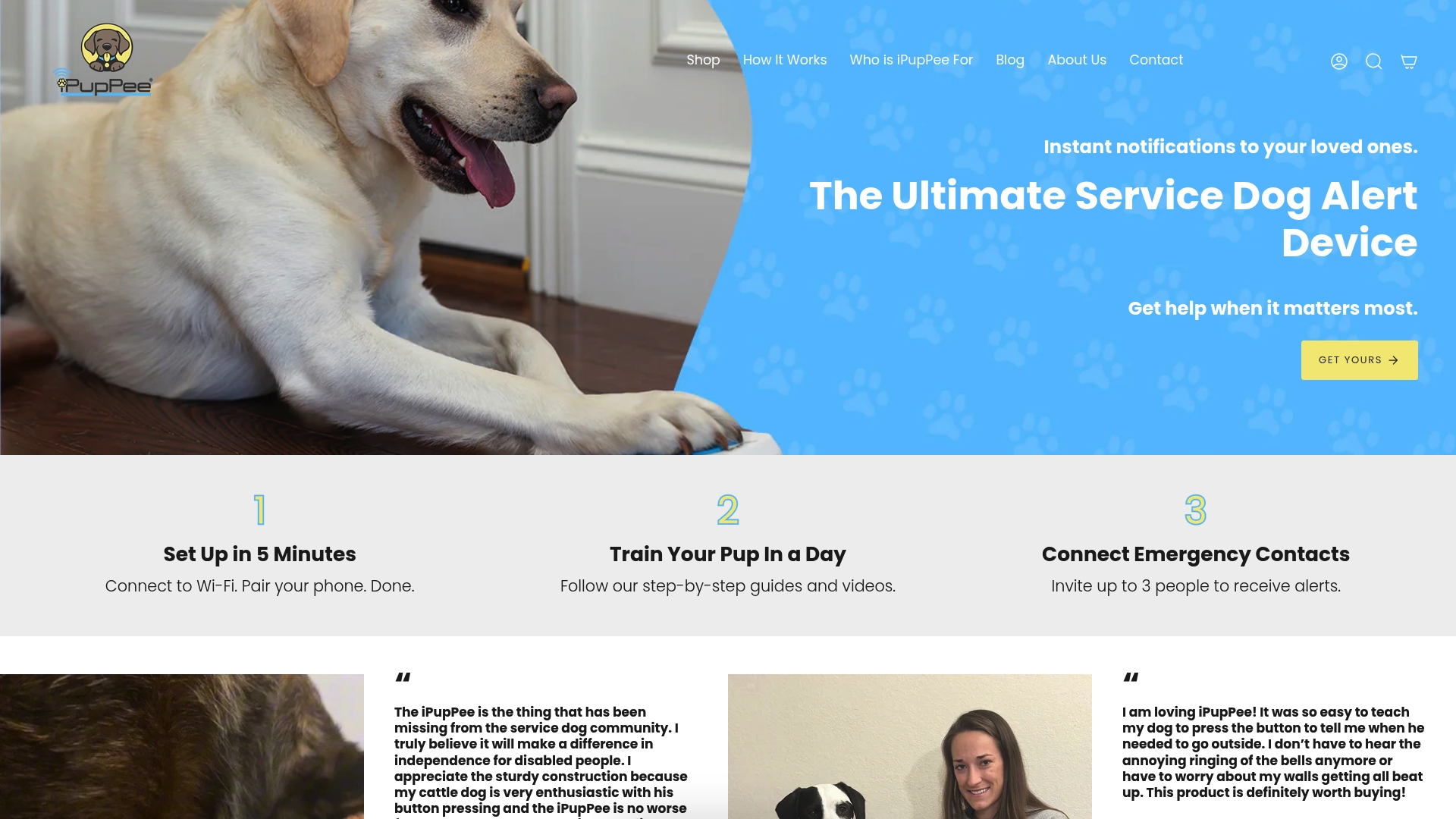
A button only helps if the dog knows what it is for. Our on-demand Psychology & Training Course is $119 as a one-off purchase and covers the dog psychology and training behind it, and we also publish a step-by-step puppy communication guide for owners starting from the beginning. Shipping protection against damage, loss or theft is available at checkout for $5.00.
Our perspective
We built iPupPee around a simple observation: dogs already know when something is wrong, and most tech never gives them a way to say so.
Passive monitoring has real value. It shows a pattern, and patterns help you and your vet. But if you live alone, handle a service dog or care for a dog as a senior, the moment you need most is the one where your dog wants your attention. A step count cannot tell you that. A button the dog presses can.
That is why we pair the device with training. A dog that understands what the button does becomes an active partner in your safety, with live video and two-way audio letting you respond in the moment, and with several contacts able to receive the alert. There is no monthly fee, so the protection does not depend on a plan you have to keep paying for.
If you already use a collar for activity or location, you do not have to choose. Use data to understand your dog’s normal, and give your dog a way to call you when it matters.
Andrew
FAQ
Why do people use smart collars on dogs?
Most owners want to find a dog that escapes, understand exercise and sleep, or notice changes in routine sooner. In a University of Bristol survey of activity tracker users, the largest effects reported were more activity for the dog and more informed caregiving. Others, like service dog handlers, want a way for the dog to alert them.
Do smart collars replace a vet visit?
No. The data can help your veterinarian understand what has been happening, and it is most useful when the vet already knows your dog. Medical decisions still rest on a hands-on exam, so contact your vet about any health concern.
Do all pet trackers have a monthly fee?
Not all, but many with cellular tracking do, because they use a data connection. Plans can run a few dollars a week, so compare the first-year total. The iPupPee device is a one-off purchase with no monthly subscription fee.
What can a smart alert device do that a tracking collar cannot?
A tracking collar shows you where your dog is and how it has behaved. An alert device like iPupPee lets the dog trigger a notification with a button press, so you or your contacts get a message when the dog wants attention, with live video and two-way audio to follow up.
Sources
- Smart Dog Collar Guide: GPS, Health & Activity
- Log my dog: Perceived impact of dog activity tracking, University of Bristol
- Activity Trackers for Raising Guide Dogs, University of Bristol
- A Smarter Collar, NC State College of Engineering
- Digital Technology Supporting the Remote Human-Dog Interaction, PMC
- Monitoring pet health in a digital world, dvm360
- Wearable Technology in Veterinary Medicine, GVMA
- Strava for dogs is here, Tom’s Guide