

Animal-assisted independence is the ability to do more of daily life on your own terms because a trained animal, most often a dog, handles tasks, signals danger or summons help. It is not a formal medical term. It is the practical result that service and assistance dog partnerships aim for: less reliance on other people, more confidence at home and in public. With a Wi-Fi alert device such as the iPupPee, a dog can also send a message to your chosen contacts when you need help, which extends that independence to the hours you spend alone.
TL;DR
- Animal-assisted independence means doing more for yourself, with less need for carers or family, because a trained animal supports specific tasks, safety and confidence.
- A 2023 US survey of 204 service dog handlers found large majorities reporting better community participation, wellbeing and quality of life, and fewer hours of paid or unpaid assistance.
- It differs from animal-assisted therapy, which is a structured treatment run by a health professional, and from emotional support animals, which are not task-trained.
- In the US, only dogs (and in some cases miniature horses) individually trained to perform tasks for a person with a disability qualify as service animals under the ADA.
- Alert technology adds a safety layer for people who live alone: the dog presses a button and your contacts are notified.
Table of Contents
- What animal-assisted independence means
- What the research shows
- Assistance animals, therapy animals and emotional support animals
- Everyday tasks that build independence
- When you are alone, safety is part of independence
- Our perspective
- Build the routine with iPupPee
- Keeping the partnership healthy for the animal
- Rules differ by country
- FAQ
- Sources
What animal-assisted independence means
The phrase combines two ideas. “Animal-assisted” describes a trained animal contributing to a person’s life. “Independence” describes the outcome: choosing where you go, when you go and whether you need another person to come with you.
For a person with a mobility impairment, that might be a dog that retrieves dropped items, opens doors or braces during transfers. For someone with epilepsy or diabetes, it might be a dog trained to alert before a seizure or a blood sugar change. For a person with a psychiatric disability, it might be a dog trained to interrupt panic or remind them to take medication. For a senior living alone, it may simply be the confidence that, if something goes wrong, the dog knows what to do.
An Australian government review of the evidence on assistance animals, written for the National Disability Insurance Scheme, concluded that assistance animals may increase owners’ independence, including by reducing dependence on formal and informal carers. The same review pointed to greater independence in daily tasks, a stronger sense of physical safety, better mental and physical health and more social interaction.
That last point matters. Independence is not only about tasks. A dog that gets you out of the house and into conversations changes how much of the world you take part in.
What the research shows
The most useful numbers come from people who live with service dogs. A 2023 survey of 204 individuals teamed with service dogs in the United States found that respondents agreed or strongly agreed that their dog improved:
- Community participation (97%)
- Quality of life (97%)
- Psychological wellbeing (98%)
- Emotional connection (96%)
- Physical activity (96%)
- Decreased paid or unpaid assistance hours (83%)
- Reduced prescribed medications (78%)
The same paper notes that more than 61 million people in the US live with disabilities, and fewer than 1% are teamed with a service dog. Most people who could benefit from this kind of partnership do not have one yet.
A controlled study adds weight. Rodriguez, Bibbo and O’Haire (2019) compared people with a service dog to people on a waitlist. Those with a dog showed significantly better psychosocial health, including higher social, emotional and work or school functioning.
There is also a physical side. The Johns Hopkins Psychiatry Guide describes cortisol reduction as the most robust and reliable biological effect of interacting with animals, especially when contact lasts longer than 15 minutes. It also reports that a recent meta-analysis found animal-assisted interventions support greater functional ability and independence in daily self-care tasks in people with Alzheimer’s disease.
Taken together, the evidence points the same way: a well-matched, well-trained animal helps people do more, feel safer and spend less time depending on others.
Assistance animals, therapy animals and emotional support animals
Searching this topic returns a lot of material on animal-assisted therapy, and the terms are easy to mix up. They describe different roles, with different training and different legal standing in the US.
| Role | What the animal does | Species | Public access rights (US) |
|---|---|---|---|
| Service or assistance animal | Performs specific tasks for one person with a disability | Dogs, and miniature horses under the ADA | Yes, under the ADA |
| Therapy animal | Takes part in a professional’s structured treatment or visits facilities | Mostly dogs and horses | No, access depends on facility approval |
| Emotional support animal | Provides comfort by presence | Various | No ADA public access; may be allowed in housing under the Fair Housing Act |
This summary follows the University of Michigan Disability Equity Office, which explains that service animals are dogs or miniature horses individually trained to perform disability-related tasks, while emotional support animals are not task-trained or covered by the ADA.
An international expert consensus led by Howell and colleagues in 2022 offers a cleaner definition of an assistance animal: one that performs at least one identifiable task or behavior to mitigate the impacts of a person’s disability, is trained to a high standard of behavior and hygiene for public access, and typically lives with the person it supports. The umbrella covers guide, hearing, mobility, psychiatric, autism and medical-alert animals.
The same consensus defines a therapy animal as one included in the work of a qualified health professional in structured, goal-directed treatment. The animal is not the therapist; interactions with it are built into the professional’s work.
The practical difference is this. Therapy happens in sessions, led by someone else. Independence happens every day, led by you, with a dog that lives with you and knows your routines.
How therapy research fits in
Animal-assisted therapy has its own growing evidence base. A 2026 meta-analysis of 35 randomized trials with 2,391 adults found reductions in depression, anxiety and stress after animal-assisted therapy. It is a useful companion to the independence story, since lower stress and anxiety make it easier to go out, make decisions and manage a household. If you want the therapy side in more depth, our guide to animal therapy benefits for mental health covers it.
Everyday tasks that build independence
Independence is built from small, repeatable behaviors. The Howell consensus lists guide, hearing, mobility, psychiatric, autism and medical-alert (seizure and diabetes) roles, and most of the working animals in these roles are dogs. Typical tasks include:
- Retrieving and carrying: picking up keys, phones, medication or a dropped cane.
- Opening and closing: doors, drawers, refrigerators.
- Alerting: to a doorbell, an alarm, a medical change or an oncoming episode.
- Interrupting: stopping repetitive behaviors or the escalation of anxiety.
- Guiding and stabilizing: helping with balance, stairs or crowded spaces.
- Fetching help: going to another person or pressing an alert when the handler cannot.
That last task is where many handlers feel the biggest change. Practical routines at home matter as much as the dog’s skills, and these accommodation tips for disabled pet owners cover steps that make daily pet care manageable. Our own pieces on how dogs empower daily living for seniors and the disabled and dogs and disability independence walk through further examples.
Why training decides the result
A dog’s tasks are only as reliable as its training. Because a service dog is defined by individual training to do work or perform tasks, the quality and consistency of that training is what turns a pet into a partner. Behavior in public, calm responses to distractions and dependable task performance all come from structured, repeated practice. Our article on why train service animals explains how safety and independence grow from that foundation.
When you are alone, safety is part of independence
Many people with disabilities and many seniors live alone by choice. The question that decides whether they can keep doing so is simple: what happens if something goes wrong and no one is there?
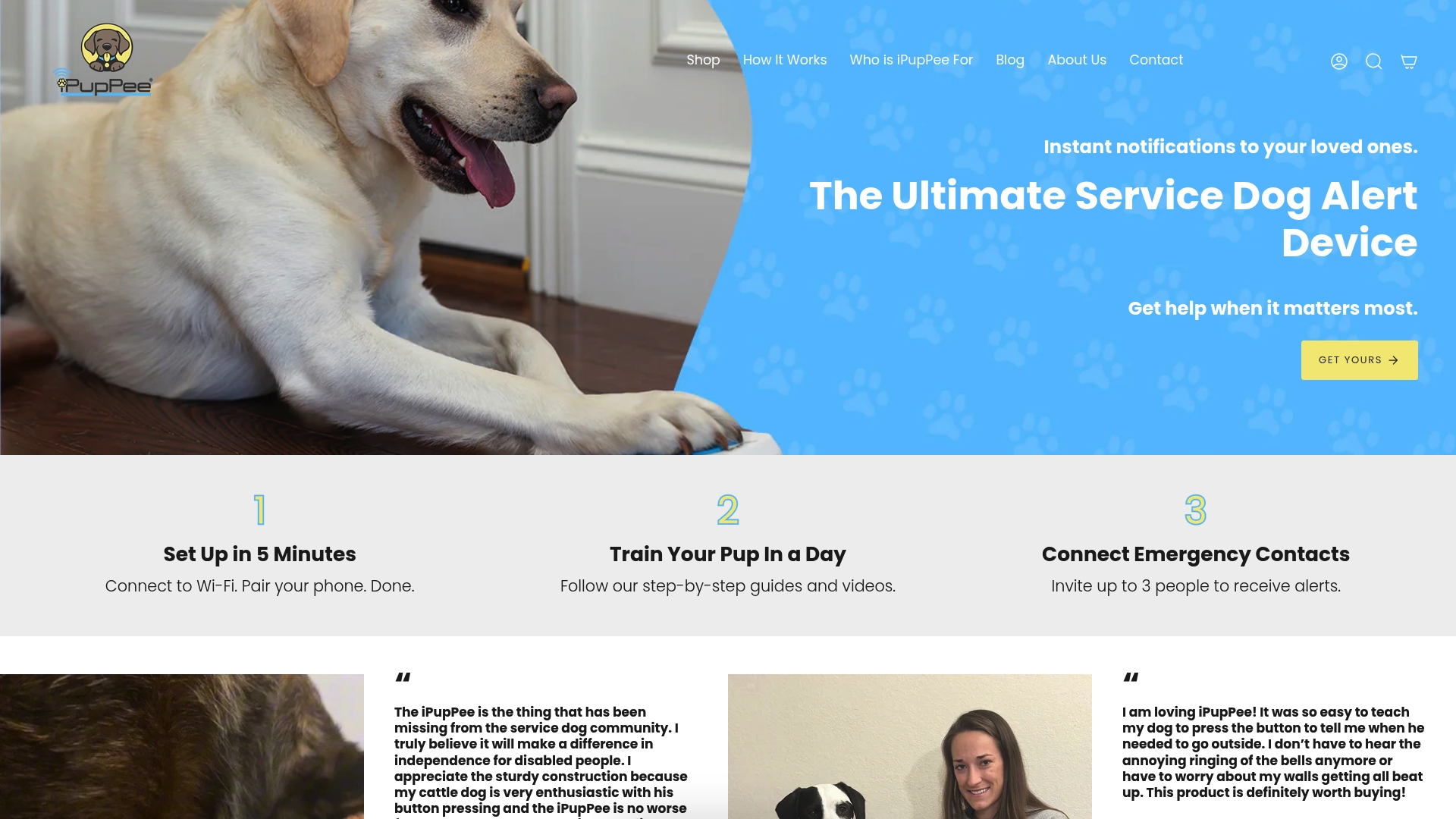
A dog may know that something is wrong. The gap is that a dog cannot dial a phone. Closing that gap is the idea behind the iPupPee: a Wi-Fi enabled alert device that lets a dog send a direct notification to the owner or to emergency contacts with a simple button press. It supports live video and two-way audio, so a contact can see what is happening and speak to the dog or the person. It is designed for dogs of all sizes and does not require monthly subscription fees.
The design principle is that the dog’s trained behavior stays at the center. The dog is taught to press the button when you need help. Contacts receive the alert, see the situation and respond. Our how it works page shows the process step by step, and the Psychology & Training Course gives handlers a structured way to teach the behavior.
For handlers, the effect is a larger safe radius: a longer time alone at home, an evening without a caregiver checking in, a quiet night for family members who would otherwise worry. That is independence in a form families can feel.
Our perspective
Independence is not about needing no one. It is about choosing who you rely on and when.
A dog already does a great deal for its person. What we saw missing was a way for the dog to reach other people when it matters. That is why we built a device a dog can press to send a notification, with live video and two-way audio, to the contacts the owner chooses.
We designed it for service dog handlers, seniors, people living with disabilities, new puppy owners and rescue dogs alike, because the need to be heard in an emergency does not depend on the dog’s breed or background. And because training is the foundation, we pair the device with training guides and an on-demand course in dog psychology and training.
Our aim is simple: more days lived the way you want, with the reassurance that help is one button press away.
Andrew
Build the routine with iPupPee
The iPupPee Medical Alert Device Training System for Service Dogs is priced at $129.99 as a one-off purchase. It lets your dog notify you or your emergency contacts through Wi-Fi, with live video and two-way audio, and it comes with training instructions so your dog learns what the button means.
If you want to go deeper on the dog’s side of the partnership, the Psychology & Training Course is $119 as a one-off purchase and is available on demand. At checkout you can also add shipping protection for $5.00, which covers your order against damage, loss or theft.
Keeping the partnership healthy for the animal
Independence works best when the animal is well too. A systematic review of 36 articles on animal-assisted intervention found that the literature suggested benefits outweighed risks by far, and that simple hygiene protocols were effective at minimizing the main risks, which are allergies, infections and animal-related accidents.
The international association IAHAIO’s guidelines on animal care and welfare set sensible standards worth borrowing at home: animals should be assessed by a veterinarian for health and temperament, should not be fed raw animal-origin diets, and should not have contact with people who have transmissible infectious diseases such as MRSA. For handlers, that means regular veterinary checkups, good grooming and breaks from work. A rested, healthy dog is a reliable one.

If you have allergies, a weakened immune system or a chronic condition, talk to your doctor about hygiene routines that suit your situation before you bring a new dog into the household.
Rules differ by country
The examples above follow US law. Elsewhere, the picture is different. A comparative review by Harpur and colleagues explains that overlapping federal and state laws in Australia and the United States create inconsistency and uncertainty about definitions, accreditation, training and use of assistance animals. Within the US, the ADA governs public access, the Fair Housing Act addresses housing and the Air Carrier Access Act addresses flights, each with its own definitions.
The practical advice for handlers is to check the rules where you live and travel, and to keep your dog’s training and behavior to a high standard, since that is the one thing that helps in every setting. For rights questions in a specific dispute, such as housing or a business refusing entry, an attorney or your local disability rights organization is the right contact.
For a wider view of how trained dogs support daily life, see our articles on service dog benefits, how service dogs help and the role of service dogs for disabilities.
FAQ
Is animal-assisted independence the same as animal-assisted therapy?
No. Animal-assisted therapy is a goal-directed treatment in which a qualified health professional includes an animal in structured sessions. Animal-assisted independence describes the daily outcome of living with a trained assistance animal: doing more for yourself, with less reliance on other people.
Who can benefit from an assistance dog?
People with a wide range of disabilities can benefit, including mobility, hearing, vision, psychiatric, autism-related and medical-alert needs such as seizures or diabetes. Seniors living alone, handlers training their own dogs and rescue dog owners also use trained dogs for safety and routine. The dog must be trained to perform tasks related to the person’s needs.
Does a service dog really reduce the need for human help?
In a 2023 US survey of 204 handlers, 83% agreed or strongly agreed that their dog decreased paid or unpaid assistance hours. Results depend on the person, the dog and the quality of training, but many handlers report meaningful gains in independence.
Is an emotional support animal the same as a service dog?
Not under US law. A service dog is individually trained to perform tasks for a person with a disability and has public access rights under the ADA. An emotional support animal provides comfort by presence and is not task-trained, though it may be allowed in housing under the Fair Housing Act.
Sources
- Reviewing Assistance Animal Effectiveness (NDIS, Australia)
- Benefits of Being Teamed with a Service Dog for Individuals (2023)
- The effects of service dogs on psychosocial health (2019)
- Animal-Assisted Interventions, Johns Hopkins Psychiatry Guide
- Assistance Animals, Disability Equity Office
- Defining Terms Used for Animals Working in Support Roles (2022)
- Animal-assisted therapy on psychological and physical outcomes (2026)
- Animal assisted intervention: A systematic review (2016)
- IAHAIO international guidelines on care, training and welfare (2021)
- Regulating Fake Assistance Animals: A Comparative Review