
Pet accessibility covers three different needs: a pet with a disability that needs a safer home, a person with a disability who needs to care for a pet, and a service dog team that needs public access. The right solution depends on which need you have. For owners who live alone, are older, or have a health condition, the most useful single tool is a way for the dog to reach a person when something goes wrong. That is what the iPupPee device is built to do: the dog presses a button, and your chosen contacts get a notification over Wi-Fi.
This overview explains the terms, the rules that apply in the US, the aids that exist for each need, and how to choose and introduce one safely.
TL;DR
- “Pet accessibility” means different things for a disabled pet, a disabled owner and a service dog team. Name your need first.
- In the US, the ADA defines a service animal as a dog individually trained to do work or tasks for a person with a disability. Other animals fall under different rules.
- There is no single universal pet accessibility standard in 2026. Rules and guidance vary by country, state and setting.
- For disabled pets, pain, elimination and mobility are addressed in that order. Sudden mobility loss needs a vet visit before you buy equipment.
- For owners who need help in an emergency, our iPupPee device sends Wi-Fi alerts, live video and two-way audio to several contacts, with no monthly subscription fee.
Table of Contents
- What pet accessibility actually means
- Terms you will see, and what they mean
- Are there pet accessibility standards in 2026?
- Solutions for pets with disabilities
- Solutions for owners with disabilities
- How to choose, fit and introduce a solution
- A note on vests and gear
- Get the alert system in place
- Our point of view
- FAQ
- Sources
What pet accessibility actually means
The phrase gets used for three situations that need different answers.

A person with a disability who has a pet. The goal is to keep caring for the animal and stay safe doing it: reachable bowls, manageable walks, a way to call for help. Our guide to dog care for disabled owners covers the daily routines.
A pet with a disability. The goal is comfort and mobility for an animal that is older, injured, blind, deaf or limited by a chronic condition. VCA Animal Hospitals describes the order of care as pain first, then elimination, then mobility, and notes that invisible conditions such as cognitive dysfunction and anxiety disorders need their own management.
A service dog team. The goal is the legal and practical ability to go where the handler goes. The National Park Service explains why this matters: for many people, separation from a service animal is like losing a wheelchair or communication device, and for others it can put them in danger. That is why service dogs are treated as working animals and not as pets.
Most households overlap. A senior with an arthritic dog is both a person with a need and an owner of a pet with a need. Treat them as two lists and solve each one.
Terms you will see, and what they mean
The vocabulary is a common source of mistakes, especially when buying gear or asking for housing or travel access.
| Term | What it means in the US | Source |
|---|---|---|
| Service animal (ADA) | A dog individually trained to do work or perform tasks directly related to a person’s disability, such as seizure detection or medication reminders. The handler, not the business, is responsible for the dog’s care and supervision. | ADA.gov |
| Emotional support, therapy and companion animals | Not service animals under the ADA. Public places treat them as pets. | National Park Service |
| Service dog in training | Not a service animal under the ADA. | National Park Service |
| Assistance animal (housing) | A broader term under the Fair Housing Act. It includes service animals and other animals that do work, perform tasks or provide therapeutic emotional support. | ASPCA policy statement |
| Miniature horse | Covered by separate ADA provisions when individually trained. Generally 24 to 34 inches tall at the shoulder and 70 to 100 pounds. | National Park Service |
Two points trip people up. First, the ADA’s main definition covers only dogs, while the Fair Housing Act’s “assistance animal” is wider. Second, researchers have argued that having both “service animal” and “assistance animal” is confusing. A 2022 academic paper recommends “assistance animal” for an animal that performs at least one identifiable disability-related task and is trained to a high public-access standard, and it recommends phasing out “service animal.” It also notes that US law makes that difficult. Until the law changes, expect both terms.
Outside the US the words shift again. Australia’s disability insurance scheme describes assistance animals as trained by accredited providers to a high standard of public behavior and to perform at least three tasks the person cannot do because of their disability. If you read overseas guidance, check which country it is written for.
Are there pet accessibility standards in 2026?
There is no single universal standard. What exists is a patchwork of national laws, housing rules and professional guidelines.
United States, public places. Under the ADA rule at 28 CFR 36.302, as summarized by a service animal registry, a service animal must be under the handler’s control and harnessed, leashed or tethered unless the handler’s disability prevents it or it would interfere with the dog’s work. The rule sets no requirement for a vest or specific marking.
United States, housing. The Fair Housing Act covers a wider group of assistance animals. The ASPCA notes exceptions where a specific animal poses a direct threat or would cause substantial physical damage. Housing rules and how they are enforced have been changing, so check HUD’s current guidance or a local fair housing office for your situation.
Queensland, Australia. The state’s Guide, Hearing and Assistance Dogs Act 2009 protects the right of certified teams to enter accommodation, public places and public vehicles. It requires a handler identity card and a harness or identifying coat for the dog.
Europe. The 2022 paper above notes that a European standard for assistance dogs is in development.
Training bodies. Some organizations set their own bar. One Australian training standard says a well-trained assistance dog needs only a flat collar or suitably fitted harness, and it does not accept rigid mobility harnesses at public access testing because they can physically damage undersized dogs.
The practical lesson: a standard is local. Before you travel, rent or enroll in a program, confirm which rule applies where you are.
Solutions for pets with disabilities
Start with the vet. WebVet’s mobility guide is clear that any new or sudden mobility loss needs a veterinary diagnosis before you buy equipment. After that, match the aid to the stage:
- Early arthritis or slipping: traction and ramps.
- Moderate weakness: lift harnesses.
- Advanced hind-limb loss: wheelchairs.
Around the home
The Australian handout from Pets and Their People recommends non-slip runners, mats or interlocking foam tiles in high-traffic areas and around beds and bowls. It also suggests short nails, trimmed hair between the footpads, and raised feeding platforms to reduce strain on the neck, back and forelimbs. For immobile pets it advises keeping beds off the ground and screened from insects.
Deaf and blind pets
The Ohlone Humane Society’s 2026 special-needs guide suggests hand signals, an ID tag that says the pet is deaf, microchipping and a bell on the collar for deaf pets. For blind pets it suggests keeping furniture and bowls in fixed places, steady routines, scent and sound cues, and safety-proofing stairs and pools. VCA adds that blind dogs should not have unsupervised access to stairs, and that deaf pets can live a normal life with a normal life expectancy.

For older animals specifically, see our piece on senior pet safety, and for mobility basics, what dog mobility support is.
Solutions for owners with disabilities
Owners face a different problem. The pet may be healthy, but the person needs to feed, walk, train and stay safe, sometimes alone for long stretches. Typical tools fall into four groups:
- Reach and handling aids for bowls, leashes and cleanup.
- Training aids that work with limited mobility, hearing or stamina. Our list of training challenges disabled owners face offers practical fixes.
- Communication and alert tools that let the dog or the person reach help.
- Home layout changes such as clear floors, accessible doors and consistent routines.
The third group is the one people overlook. If you fall, lose consciousness, or cannot reach a phone, a dog that sits beside you is useful only if someone else finds out. Our overview of essential safety solutions for disabled pet owners and the broader guide to dog disability aids cover this in more depth.
What the iPupPee does
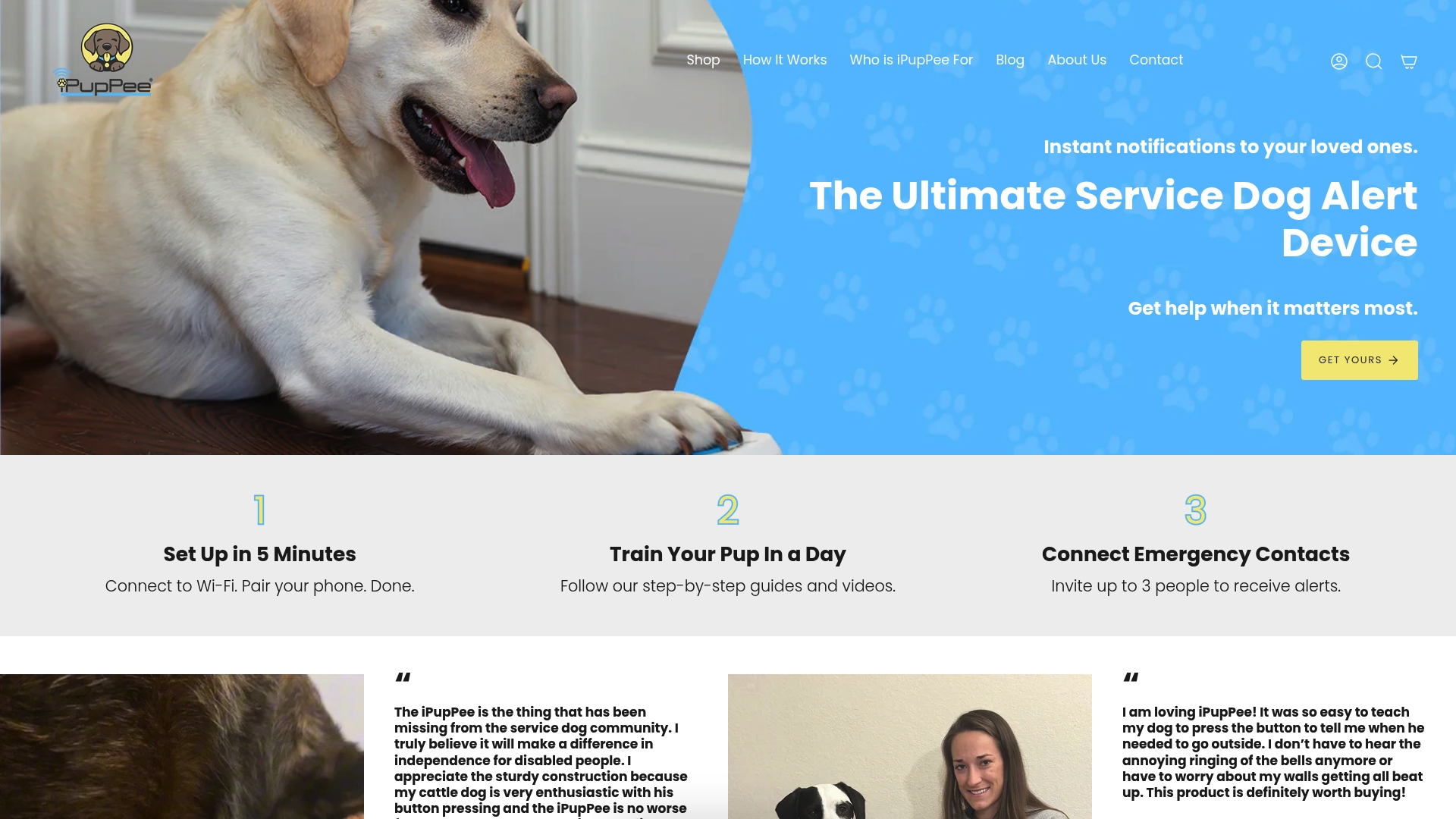
The iPupPee is a Wi-Fi alert device the dog presses to send a notification. It supports live video and two-way audio, and it reaches multiple contacts, such as family, a caregiver or an emergency contact. It is designed for dogs of all sizes and does not require a monthly subscription fee. Training instructions and video guides come with the system, so the dog can learn the press as a simple, rewarded behavior. You can see the setup on the How It Works page.
That makes it a fit for several readers in this audience:
- Service dog handlers who want a dependable way for the dog to summon help.
- Seniors living alone who want family to know quickly if something is wrong.
- New puppy owners and rescue adopters who are building communication from the start.
- Trainers and rescue organizations who want a tool to teach and place with clients. The company also runs an affiliate program for trainers and organizations who refer customers.
How to choose, fit and introduce a solution
The assessment steps are similar whatever you are buying.
1. Name the primary problem
WebVet’s framework suggests identifying whether the main issue is pain, weakness, incoordination or access, and then considering age, breed, size and temperament. For a person, write down the tasks you struggle with over a few weeks. Independent Age’s factsheet recommends this, and says to stay in charge of any assessment. It is written for the UK, but the habit works anywhere.
2. Get a diagnosis or professional view where health is involved
For a pet, that is your veterinarian. For you, it is your doctor or an occupational therapist. Equipment chosen without this step can mask a problem that needs treatment.
3. Check the practical terms
Before you pay for any equipment, look at guarantees, returns, running costs and what happens if it breaks. The same Independent Age list includes aftersales service, spare parts and the cooling-off period. With the iPupPee, the price is a one-time $129.99 with no monthly subscription fee, and a $5.00 shipping protection option covers damage, loss or theft in transit.
4. Measure properly for anything worn
WebVet advises measuring with the dog standing squarely: chest girth, belly girth, height to hip and paw width. Recheck monthly. Watch for rub marks, hair loss or chewing at the straps, which signal a poor fit.
If you are considering a mobility-assistance harness, the Mobility Dog Resource Group’s guidelines set size thresholds. Light assistance starts at 18 to 24 months, at least 50 lb and 22 in at the withers. Moderate assistance needs 2 years, 60 lb and 24 in. The group also says never to use load-bearing harnesses before 18 to 24 months, to protect a developing body.
5. Introduce it in short, positive sessions
Use high-value treats and keep sessions brief. This applies to a ramp, a harness or an alert button. For the iPupPee, the included training guides walk through teaching the press. If you want to go deeper on dog behavior, we offer a Psychology & Training Course for $119, a one-time purchase.
6. Re-evaluate on a schedule
Needs change as dogs age and as conditions progress. Put a monthly check on the calendar. Test stability, comfort and durability, and adjust.
A note on vests and gear
Many handlers ask whether a vest is required. In the US the ADA rule is about control, not appearance. A 2026 analysis from a service animal registry points out three narrow situations where a vest can cause problems: tasks that need unimpeded contact between dog and handler, heat risk in hot humid climates, and training in which the dog works only when the vest is on. Quick-release buckles, adjustable straps and reflective trim are practical features to look for in any gear.
Keep the setup simple. Some training standards, including the Australian one above, hold that minimal equipment is best because excess gear can distract a working dog.
Get the alert system in place
If your main concern is that the dog can get help when you cannot, the iPupPee is our answer. It is $129.99 as a one-time purchase, with no monthly subscription fee. It sends Wi-Fi notifications to multiple contacts, with live video and two-way audio, and it comes with training guidance. You can order the iPupPee here, or learn how it works first on the How It Works page.
For dogs that are still learning, pair it with the Psychology & Training Course, $119 one-time. Our assistive dog devices roundup shows how the different types of aids fit together.
Our point of view
Most pet accessibility advice starts with the animal’s body: ramps, harnesses, mats. That matters. But for the people we hear from, the harder question is what happens in the ten minutes after something goes wrong at home.
A dog already knows when its person is in trouble. What it lacks is a way to tell anyone else. We built the iPupPee around that gap. The dog presses a button, and the people you chose see the alert, can watch live video and can speak through two-way audio.
We think this should be affordable and simple. That is why the device is a one-time purchase with no monthly subscription fee, and why training guides come with it. Independence is not only about doing things alone. It is about knowing that help is one paw press away.
Andrew
FAQ
Is there one official standard for pet accessibility?
No. The US ADA defines service animals for public access, the Fair Housing Act covers a broader group of assistance animals in housing, and other countries have their own laws. Professional training bodies add their own standards. Check the rule for the place and situation you are in.
Is an emotional support animal a service animal?
Not under the ADA. The National Park Service says emotional support, therapy and companion animals are treated as pets in public places. Housing law is wider, so the same animal may be treated differently in a rental.
What should I do first for a dog that suddenly struggles to walk?
See your veterinarian. Sudden mobility loss needs a diagnosis before you buy a ramp, harness or wheelchair. Once the cause is known, your vet can help match the aid to the stage.
Can a dog of any size use the iPupPee?
Yes. The device is designed for ease of use by dogs of all sizes. Training guides are included to teach the dog the button press, and the training course adds depth on behavior.
Do I need a vest for my service dog?
The ADA does not require a vest or specific marking. It does require the dog to be under control and harnessed, leashed or tethered, unless the handler’s disability prevents it or it would interfere with the dog’s work.
Sources
- Service Animals - Accessibility, U.S. National Park Service
- Frequently Asked Questions about Service Animals, ADA.gov
- Service, Assistance and Emotional Support Animals, ASPCA
- Defining Terms Used for Animals Working in Support Roles, Animals (MDPI), 2022
- What are assistance animals, NDIS
- Guide, Hearing and Assistance Dogs Act 2009, Queensland
- The Training Standard, mindDog
- Do Service Dogs Need a Vest? (2026), USAR
- Pets with Disabilities, VCA Animal Hospitals
- Special Pets with Special Needs, Ohlone Humane Society
- Setting up the House for Dogs and Cats with Mobility Challenges, Pets and Their People
- Mobility Aids for Dogs: A Vet’s Guide, WebVet
- Choosing disability equipment, Independent Age
- Guidelines and best practices, Mobility Dog Resource Group