
IoT in pet care means everyday pet products that collect data, connect to the internet and let you see or act on that data from your phone. That covers GPS trackers, activity collars, scheduled feeders, litter systems and alert devices that let a dog contact a person. Their job is to give you information sooner, keep pets safer when you are not in the room, and make routine care more consistent. They add to hands-on care and veterinary exams and do not replace either.
This guide explains how the technology works, where it helps most, what to check before you buy, and how to use the data with your vet.
TL;DR
- IoT in pet care is a network of connected devices that collect and exchange data so you can monitor and control things remotely, even when you are not home.
- The main uses are location tracking, activity and health monitoring, automated feeding and water, and remote communication and alerts.
- Data is most useful as a trend over weeks or months, shared with your veterinarian, not as a one-off reading.
- Choose devices by reliability, privacy practices and cost over time, and set them up with strong passwords and updated apps.
- For dogs that need to reach a person quickly, such as service dogs and dogs of seniors, a button-triggered alert device with video and two-way audio is the most direct use of IoT.
Table of Contents
- What IoT means for pets
- Location tracking and safety
- Health and activity monitoring
- Smart feeders, water and litter systems
- Remote communication and alerts
- Perspective
- Risks, privacy and safe use
- Using IoT data with your veterinarian
- How to choose connected pet devices
- Add a direct line from your dog to you
- FAQ
- Sources
What IoT means for pets
Researchers describe the Internet of Things in pet care as a dynamic network of devices that collect and exchange data and perform remote actions, so people can monitor and control the real world that pets and owners share. In plain terms, a device has a sensor or a button, a way to connect, and software that turns the signal into something you can read or respond to.
Most consumer pet products follow the same chain:
- Sense: a collar sensor, a camera, a scale in a feeder, or a button the dog presses.
- Connect: Wi-Fi, Bluetooth, cellular or satellite positioning, depending on the product. Even research tags for animals use Wi-Fi and Bluetooth Low Energy to move data wirelessly.
- Process: an app or cloud service that records, filters and flags what happened.
- Act: a notification to you, a feeder opening on schedule, a video call, or a message to an emergency contact.
The last step is where IoT earns its keep. A reading that nobody sees changes nothing. A reading that reaches the right person at the right moment can change the outcome of a bad afternoon.
Standards matter too. Protocols such as IEEE 11073 help personal health devices exchange vital signs and measurements reliably with other systems. Pet products are still catching up with that interoperability, which is why many devices work best inside their own app.
The category is growing. The pet technology industry, connected devices included, was projected to reach $3.7 billion by 2026. That growth means more choice, and a greater need to know what separates a useful device from a gadget.
Location tracking and safety
Lost pets are the most familiar reason people buy connected devices. A 2021 study of radiofrequency trackers notes that roughly 3% of cats and dogs are lost each year. Even at that rate, a lot of households go through the worry of a missing animal.
The same study explains how trackers work. They use satellite navigation such as GPS to find a position, then send it by radio to a handheld device. Most of the devices the researchers analyzed offered geofences: when the pet crosses a boundary you draw on a map, the tracker wakes up and sends an alert to your phone.
A few practical points follow from this:
- Draw geofences around real exits. A yard gate and a front door matter more than a big circle around the neighborhood.
- Check coverage where you live. Location features depend on signal. Rural areas, dense buildings and basements can leave gaps.
- Keep batteries in the routine. A tracker on the charger is not tracking anything. Pick a day of the week to charge it.
On exposure, the same study found that total radiofrequency exposure for pets from these trackers stayed distinctly below ICNIRP reference limits, so adverse health effects were considered unlikely.
Location is only one kind of safety. Many risks happen inside the house: a senior owner who falls, a person who has a seizure, or a handler who cannot reach a phone. In those moments the question is not where the dog is, but whether the dog can tell someone that help is needed. That is a different use of IoT, covered below.
Health and activity monitoring
Connected collars and tags track exercise, sleep, scratching, and other daily patterns. Research on pet technologies describes wearables such as activity monitors that track exercise, activities and fitness, recording daily movements so that owners and veterinarians can follow changes over time.
The value is in the trend. VCA Animal Hospitals explains that these devices gather objective data that helps spot subtle, gradual changes over weeks or months that are easy to miss when you see your pet every day. A dog who has slowed down by a little each week looks the same to you on Tuesday as on Monday. A chart does not.
Researchers Pico-Valencia and Holgado-Terriza argue that this moves pet care from reactive to proactive, with constant tracking of physical condition and earlier detection of chronic disease. That is a perspective, not a promise for any single product, but it explains why veterinary professionals take an interest.
If you want a deeper look at what these readings can and cannot tell you, our guides on canine health tracking and monitoring your dog’s health with wearable tech go through the metrics one by one. For the daily routine side, see pet wellness monitoring without replacing your vet.
A simple way to use activity data
- Wear the device for a couple of weeks before you draw conclusions, so you have a baseline for your own dog.
- Note life events in the app or a notebook: a new walking route, a heat wave, a change in food.
- Look at weekly averages rather than single days.
- If a trend moves in the wrong direction for more than a short stretch, book a visit and bring the chart.
Smart feeders, water and litter systems
Automation covers the repetitive jobs. Smart feeders dispense food at set times and can dispense medication, and app controls let you change feeding times while you are away. Water dispensers and litter boxes follow the same pattern: sensors measure what was used, the app logs it, and you see changes in habits.

That log can be as useful as the automation. A cat who suddenly visits the litter box more often, or a dog who drinks much more than usual, is giving you information you can pass to a vet. Pair that with an automatic schedule and the routine stays steady on busy days.
Good habits for automated feeding:
- Measure portions with your vet’s guidance, then program them. The machine repeats whatever you tell it.
- Test the schedule on a weekend you are at home before relying on it for a work trip.
- Keep a backup plan, such as a neighbor or sitter, in case of a power or Wi-Fi outage.
Remote communication and alerts
The fastest-growing question in this field is how a dog can send information to a person, not only the other way around. A 2023 scoping review of remote human-dog interaction found that technologies include wearable sensors that generate messages and vibrotactile actuators that receive them, although two-way communication still leans heavily on video chats. The authors also stress that future designs need a better balance between the dog’s biological needs and the human’s digital needs.
That balance is the design test for anything a dog is asked to use. The dog should not have to learn a complicated routine. A single, simple action, with a reward the dog already understands, is easier on the animal.
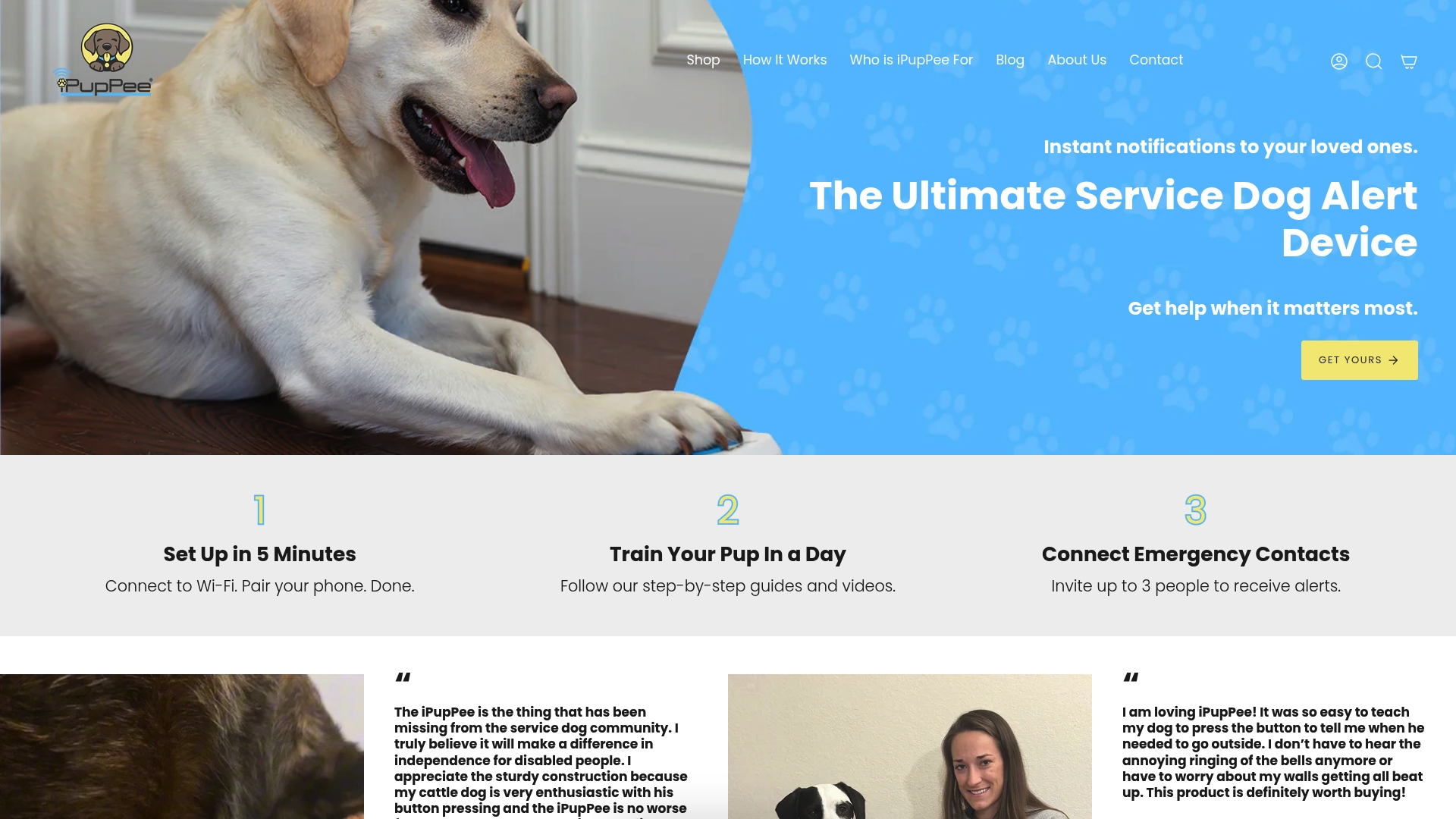
This is the space the iPupPee device is built for. It is a Wi-Fi smart alert device that lets a dog send a notification to an owner or emergency contacts by pressing a button, with live video and two-way audio so the person who receives the alert can see and speak to the dog and the room. It is designed to work for dogs of all sizes and does not require a monthly subscription fee. Our guides on wearable tech for dogs and independence and what digital pet interaction looks like in real homes explain the use cases in more depth.
Who benefits from a dog-triggered alert
- Service dog handlers who may need their dog to bring help when they cannot reach a phone.
- Seniors living alone who want a trusted contact to hear from them through the dog.
- People with disabilities or medical conditions who want one more route to help in the home.
- New puppy and rescue owners who want a clear communication channel while they build a bond and a routine.
Introducing any device takes patience. Our walkthrough on how to introduce communication devices to your dog covers the pacing, and the thinking behind connection and trust is in how tech strengthens the dog-owner bond.
Perspective
We built iPupPee around one idea: the most valuable thing a connected device can do for a dog and a person is shorten the time between “something is wrong” and “someone knows.”
Most pet IoT answers the owner’s questions: where is the dog, how far did it walk, did it eat. Those are useful. But a service dog handler or an older person living alone often has a different question: if I cannot get to my phone, can my dog get word to someone for me? A dog presses a button, the right people are notified at once, and they can see and talk to the dog and the room. No monthly fee gets in the way of that.
We also believe the device is only half the system. A dog that understands what the button means and has been taught calmly, with rewards, is the dog that uses it well. That is why we pair the hardware with training guides and a dog psychology course, and why we keep the action simple enough for a dog of any size.
Technology works best when it sits inside a relationship. Use trackers and wearables for the trend lines, use your vet for the judgment, and use a direct line from dog to person for the moments that cannot wait.
Andrew
Risks, privacy and safe use
Connected devices bring real conveniences, and a few habits keep them safe. A 2023 review of pet technology notes that the practical issues include device cost, maintenance, possible inaccuracies and poor signal coverage. It also flags that devices can leak personal data, reveal a home’s location, or be targeted by attacks that spoof tracking or interfere with systems such as automatic feeders.

The same research team analyzed 20 popular pet tech apps and found security gaps: two apps exposed login and account details in unencrypted traffic, and 14 contacted trackers before the user gave consent. The takeaway is to choose products carefully and set them up carefully, not to avoid the category.
A safe-setup checklist
- Use a unique, strong password for every pet app, and turn on two-factor sign-in where it is offered.
- Keep the app and device firmware updated.
- Read the privacy settings at setup and decline tracking or sharing you do not need.
- Put devices on your home Wi-Fi network with a strong router password, and share video access only with people you trust.
- Choose emergency contacts deliberately, tell them they are on the list, and make sure they know what an alert from your dog means and what to do.
- Test your alert path regularly, from the button press through to the contact’s phone, and keep Wi-Fi and power reliable in the room where the device lives. Our piece on the links in a digital alert chain that can break walks through each one.
For health data specifically, keep the expectations realistic. Wearables can supply real-time data that supports treatment planning once a veterinarian has seen the patient, and the Georgia Veterinary Medical Association is clear that they do not replace hands-on exams.
Using IoT data with your veterinarian
Good data makes a better appointment. VCA Animal Hospitals notes that owners can use monitoring data as a baseline to help evaluate, diagnose and treat a condition, and that monitors can alert owners and veterinarians to downward trends.
The 2021 AAHA/AVMA telehealth guidelines add that remote monitoring can track trends, identify warning signs and help manage chronic conditions such as diabetes, heart disease and arthritis. Those are conditions where your vet sets the plan, and your device provides the daily record between visits.
Before a visit:
- Export or screenshot the last month of activity, sleep and any alerts.
- Write down what changed at home: appetite, thirst, stairs, mood, accidents.
- Ask your vet which numbers matter for your pet’s age and condition, so you know what to watch.
- If your dog is showing signs of distress, call your vet or an emergency clinic. Do not wait for a chart.
AI is increasingly layered on top of this data, spotting patterns people miss. Our article on the role of AI in pet care looks at what that means for owners and vets.
How to choose connected pet devices
Match the device to the problem you are solving, not to the longest feature list.
| Need | Device type | What to check |
|---|---|---|
| Dog gets out or roams | GPS tracker with geofence | Coverage where you live, battery life, alert speed |
| Watch fitness or subtle changes | Activity collar or tag | Data export, how long history is kept, how your vet can see it |
| Consistent meals, medication timing | Smart feeder | Power and Wi-Fi backup, portion accuracy, easy cleaning |
| Dog must reach a person quickly | Button-triggered alert device | Ease for the dog, notification speed, video and audio, number of contacts |
| Check in while you are out | Camera with audio | Privacy controls, who has access, night view |
Then apply four filters to any product:
- Reliability: Does it keep working when Wi-Fi or power drops, and how will you know?
- Privacy: Does the company explain what it collects and why, and can you control it?
- Total cost: Look at the device price, any subscription, and replacement parts over a few years.
- Fit for the animal: Size, comfort and training. A device that a dog avoids does not help anyone.
We publish a broader look at the reasoning in why choose pet health tech for your pet’s wellbeing, and a plain explanation of dog lifestyle monitoring for every owner.
Add a direct line from your dog to you
If your priority is that your dog can reach you or an emergency contact, the iPupPee alert device is our answer. It is priced at $129.99 as a one-off purchase, uses Wi-Fi to send instant notifications to multiple contacts, and offers live video and two-way audio. Training guides come with the approach, so you and your dog learn it together.
If you want to understand why dogs respond the way they do before you begin, our Psychology & Training Course is an on-demand online course for $119, and a short overview is on our dog psychology page. You can start from our home page if you would like to see everything in one place.
FAQ
What is the role of IoT in pet care?
IoT connects sensors, buttons and cameras to apps so you can monitor and manage your pet remotely. The main uses are location tracking, health and activity monitoring, automated feeding, and alerts or communication between the pet and a person. It works best as support for your own care and your vet’s advice.
Do smart pet devices replace veterinary care?
No. Wearables and monitors give your vet a record of daily patterns, and veterinary professionals describe them as an extension of care for pets who have already been examined in person. Bring the data to appointments and call your vet when you see warning signs.
Are connected pet devices safe for my privacy?
They can be, with careful choices and setup. Research has found that some pet apps exposed account details or contacted trackers without consent. Use strong, unique passwords, review privacy settings, keep software updated, and share camera access only with people you trust.
Can IoT help a service dog or a senior’s dog get help?
Yes. A button-triggered alert device lets a dog send a notification to chosen contacts, and with live video and two-way audio they can see and speak to the dog. iPupPee is designed for this purpose. Train the dog patiently and test the alert path with your contacts regularly.
Do I need a subscription for IoT pet devices?
It depends on the product. Trackers with cellular service often charge ongoing fees, while other devices do not. iPupPee does not require a monthly subscription fee, and it is worth comparing the total cost over several years for anything you buy.
Sources
- The Internet of Things Empowering the Internet of Pets
- Internet on animals: Wi-Fi-enabled devices
- The future of human and animal digital health platforms
- Security and privacy of pet technologies (Frontiers)
- Tracking Devices for Pets: Health Risk Assessment
- Security and Privacy Concerns of Pet Tech Users
- Digital Technology Supporting the Remote Human-Dog Interaction
- Wearable Technology in Veterinary Medicine (GVMA)
- Pet Monitoring (VCA Animal Hospitals)
- Remote Monitoring & Artificial Intelligence (AAHA)