

TL;DR:
- Dog lifestyle monitoring involves continuous tracking of a dog’s health, activity, and environment to enable early intervention and better care. Utilizing wearable collars, AI apps, and environmental sensors, owners gain objective data that supplements veterinary visits, promoting a healthier, longer life for their pets. Owners should focus on establishing baseline metrics, limit data overload, and integrate manual observations to maximize monitoring effectiveness.
Dog lifestyle monitoring is the systematic tracking of your dog’s health, activity, and behavior using both manual observation and technology, giving you early insights that support smarter care decisions. The practice spans wearable collars like Fi and Pawhisper, AI-powered apps like LOKI, and environmental sensors that measure air quality and temperature. Together, these tools form what veterinary professionals increasingly call a canine lifestyle assessment. The core benefit is simple: you catch problems before your dog shows obvious symptoms, which means faster treatment, lower vet bills, and a longer, healthier life for your pet.
What is dog lifestyle monitoring and why does it matter?
Dog lifestyle monitoring is defined as the continuous or structured observation of a dog’s physiological signals, daily activity, behavioral patterns, and surrounding environment to proactively manage their health and well-being. It is not a replacement for veterinary care. It is the layer of data between vet visits that gives you and your vet a clearer, more objective picture of your dog’s daily reality.

The technology behind dog wellness monitoring has matured significantly by 2026. Wearable collars now carry photoplethysmography (PPG) sensors, accelerometers, and gyroscopes. AI apps analyze weeks of data to detect deviations from your dog’s personal baseline. Environmental sensors track indoor pollutants, humidity, and temperature. Each of these tools answers a different question about your dog’s health, and together they create a profile no single vet visit could replicate.
The practical value is real. A dog that normally sleeps eight hours but suddenly drops to five is signaling something. A dog whose resting heart rate climbs by 20 beats per minute over two weeks may be developing an infection or cardiac issue. Without monitoring, you would likely miss both signals until the dog showed visible distress. With monitoring, you act earlier, and earlier action almost always produces better outcomes.
What key health metrics are tracked in canine lifestyle assessment?
The most clinically significant metrics in dog health tracking fall into four categories: vital signs, movement, sleep, and environment.
Vital signs are the foundation. The American College of Veterinary Internal Medicine recommends a resting respiratory rate below 30 breaths per minute for dogs with heart disease, with normal ranges sitting between 15 and 30 breaths per minute and heart rate between 60 and 140 bpm. These numbers give you a baseline to measure against. Heart Rate Variability (HRV) is particularly telling. HRV drops can precede illness or stress by several days, giving you a window to intervene before your dog feels noticeably unwell.
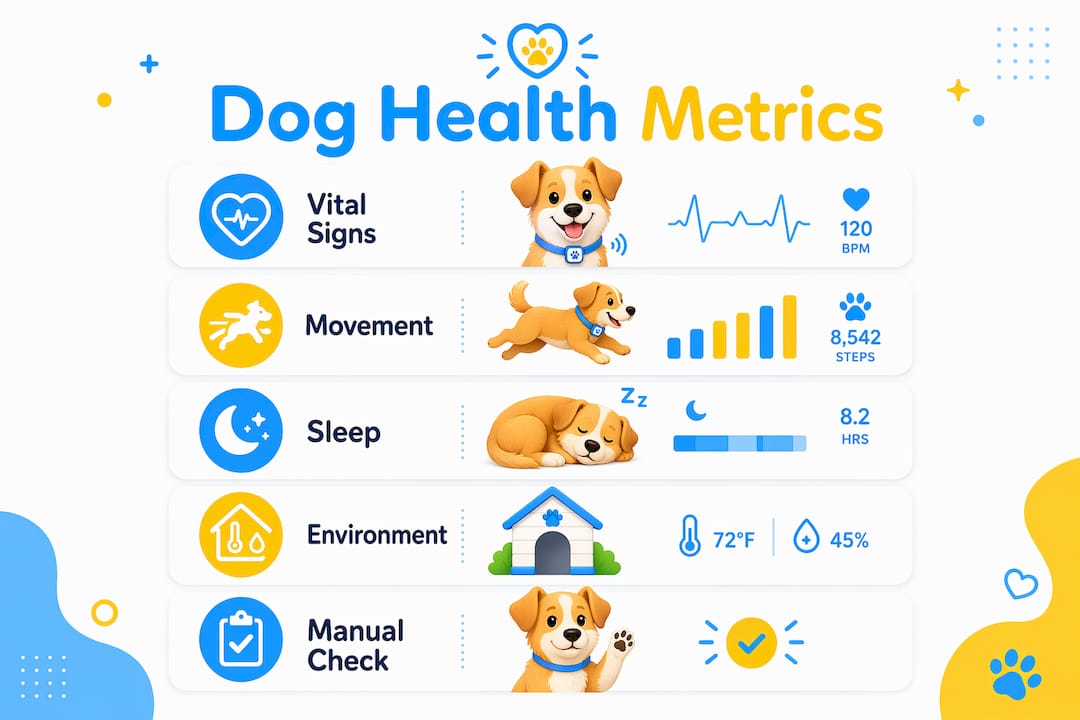
Movement and mobility metrics include daily step counts, gait symmetry, and weight-bearing patterns. A dog favoring one leg will show asymmetrical gait data before you notice a visible limp. Weight tracking integrated with smart feeders can reveal gradual weight loss that signals chronic disease earlier than routine vet checks, because the trend is visible in the data weeks before it becomes obvious to the eye.
Sleep quality is an underrated signal. Dogs with pain, anxiety, or early cognitive decline show fragmented sleep patterns. Monitoring rest cycles gives you a non-invasive window into your dog’s comfort and neurological health.
Environmental factors complete the picture. Indoor pollutants like PM2.5 and formaldehyde affect respiratory health directly, and dogs are more sensitive to these than most owners realize. Pairing biometric data with environmental readings explains anomalies that would otherwise look random.
Manual checks remain part of the equation. A quick daily scan of your dog’s eyes, coat, gum color, and posture takes 30 seconds and catches signals that no sensor currently replicates.
How do AI-driven wearables and apps monitor your dog’s health?
Modern dog activity trackers do far more than count steps. The best devices poll data every 30 seconds, which is the threshold that separates diagnostic-grade monitoring from basic consumer trackers. Low-frequency polling with smoothing algorithms misses subtle arrhythmias and short-duration behavioral events. If you are buying a tracker for health reasons rather than fitness curiosity, polling frequency is the specification that matters most.
AI is what turns raw data into useful information. Apps like LOKI use pattern recognition to compare your dog’s data against a large population of dogs, then flag deviations from your individual dog’s established baseline. LOKI’s AI can identify health abnormalities up to one to two weeks before clinical signs appear. That is not a minor advantage. Two weeks of early warning is the difference between a straightforward treatment and an emergency intervention.
The table below summarizes how leading monitoring tools differ in their approach:
| Tool | Primary function | Key technology | Best for |
|---|---|---|---|
| Fi collar | GPS and activity tracking | Accelerometer, LTE | Location and step monitoring |
| Pawhisper | Biometric health monitoring | PPG sensor, HRV analysis | Cardiac and respiratory tracking |
| LOKI app | AI-driven health analysis | Pattern recognition, AI alerts | Early illness detection |
| Environmental sensors | Air quality and climate | PM2.5, temperature, humidity | Respiratory health context |
Unified Pet Health Profiles, a concept gaining traction in 2026, aggregate data from wearables, apps, smart feeders, and environmental sensors into a single dashboard. The practical payoff is vet-ready reports that give your veterinarian objective trend data rather than your verbal summary of how your dog “seemed a bit off last Tuesday.” Vets diagnose faster and more accurately when they have weeks of biometric history in front of them.
Pro Tip: Before your next vet appointment, export a two-week data summary from your monitoring app and email it to the clinic in advance. Vets who review data before the appointment spend less time gathering history and more time on diagnosis.
What are the real challenges of dog behavior tracking?
The biggest practical obstacle is data fatigue. Owners tracking multiple detailed metrics often disengage within 6 to 12 months. The solution is not to track everything. It is to track the right things. Experts recommend anchoring your routine to a small set of core metrics: sleep quality, appetite, resting respiratory rate, and daily activity level. These four signals cover the most common early warning patterns without overwhelming you with dashboards.
Technology has real limits in pet lifestyle analysis. Sensors measure physical signals, but they do not interpret emotional context. A dog that is anxious because of a new baby in the house and a dog that is anxious because of early heart disease may produce similar HRV readings. Manual daily check-ins remain indispensable because attentive owners detect anxiety and pain through behavioral cues that no current sensor captures reliably.
Multi-dog households introduce a specific technical problem. Without individual identification, pooled data from two or three dogs masks individual health changes. AI fingerprinting and behavioral analysis per dog are necessary to avoid false alerts and missed signals. Systems with gait mapping or elimination tracking per individual dog perform best in these environments.
False positives carry an emotional cost that is easy to underestimate. An alert that suggests your dog may have a cardiac issue, followed by a clean vet visit, creates anxiety and erodes trust in the system. Balance your response to alerts by treating them as prompts for observation, not immediate emergencies, unless paired with visible symptoms.
“Lifestyle monitoring is a tool to augment, not replace, veterinary care, empowering owners with objective data to improve clinical conversations.” — The 2026 Unified Pet Health Guide
How can you implement a dog monitoring routine at home?
Setting up an effective monitoring routine takes about two weeks of calibration and then becomes largely automatic. Here is a practical sequence:
-
Choose your core device. Match the tracker to your dog’s size, coat type, and temperament. A dog that resists wearing a collar will not produce reliable data. Start with a lightweight option and let your dog wear it without activation for a few days to build comfort.
-
Set a baseline period. Run the device for 14 days before acting on any alerts. This gives the AI enough data to establish your individual dog’s normal ranges. Acting on alerts before a baseline is set produces a high false-positive rate.
-
Pick three to four metrics to watch. Sleep duration, resting respiratory rate, daily steps, and appetite are the most predictive for general health. Add HRV if your dog has a known cardiac history.
-
Schedule weekly review sessions. Spend 10 minutes each Sunday reviewing the week’s trends. Look for directional changes, not single-day spikes. A resting respiratory rate that climbs from 18 to 24 over three weeks is more significant than a single reading of 28.
-
Integrate monitoring with vet visits. Use your daily health guide to build a log that you bring to every appointment. Objective trend data shortens diagnostic time and improves the quality of your vet’s recommendations.
-
Adapt as your dog ages. A two-year-old dog and an eight-year-old dog need different monitoring priorities. Senior dogs benefit from more frequent respiratory and mobility checks. Puppies need behavioral and socialization tracking alongside physical metrics.
Pro Tip: Pair your tech data with a simple paper log. Write one sentence each evening about your dog’s mood, appetite, and energy. This behavioral context makes your device data significantly more useful during vet consultations.
Key takeaways
Dog lifestyle monitoring works because it combines continuous biometric data, AI pattern recognition, and owner observation to detect health changes days or weeks before clinical symptoms appear.
| Point | Details |
|---|---|
| Start with vital signs | Track resting respiratory rate, heart rate, and HRV as your primary health indicators. |
| Choose high-frequency trackers | Devices polling every 30 seconds detect subtle arrhythmias that basic trackers miss. |
| Limit your metric set | Focus on three to four core metrics to avoid data fatigue and sustain long-term monitoring. |
| Combine tech with manual checks | Daily 30-second owner scans catch emotional and behavioral signals sensors cannot measure. |
| Use data at vet visits | Sharing trend reports with your vet produces faster, more accurate diagnoses than verbal accounts. |
Why I think most owners are using monitoring tools backward
Most dog owners I speak with treat their monitoring app the same way they treat a smoke alarm. They ignore it until it screams. That approach wastes the entire value of the technology. The point of dog wellness monitoring is not to react to alerts. It is to build familiarity with your dog’s normal patterns so that small deviations register as meaningful before they become urgent.
I have seen owners with premium wearables on their dogs who cannot tell you what their dog’s average resting respiratory rate is. They bought the device for peace of mind, but they never learned the baseline that would actually give them that peace of mind. The device becomes a subscription they pay for and a collar their dog tolerates, with no real benefit to either of them.
The owners who get the most from wearable tech monitoring are the ones who spend the first two weeks actively learning their dog’s data. They know that their dog sleeps 7.5 hours on average, takes around 4,200 steps on a normal day, and has a resting respiratory rate of 18. When that respiratory rate hits 24 for three consecutive nights, they call the vet. Not because an app told them to panic, but because they understand what the number means for their specific dog.
The future of this space is genuinely exciting. Genomic-informed monitoring, where a dog’s genetic risk profile shapes which metrics the AI prioritizes, is already in early development. The integration of dog communication apps with biometric platforms will eventually let owners correlate behavioral signals with physiological data in real time. That is a meaningful leap. But none of it matters if owners do not first commit to understanding their dog’s baseline. The technology is only as useful as the attention you bring to it.
— Andrew
Start monitoring your dog’s health with Ipuppee
Ipuppee supports dog owners who want to move from reactive care to proactive health management. Whether you are just starting to explore monitoring tools or looking to build a more structured routine, Ipuppee’s resources cover the full spectrum of canine health tracking.
From wearable tech guides to communication devices designed for dogs and their owners, Ipuppee brings together the tools and knowledge you need to stay ahead of your dog’s health. The iPupPee alert device, in particular, gives dogs a way to signal their needs directly, adding a behavioral communication layer that complements biometric monitoring. Visit Ipuppee to explore the full range of products and educational resources built for owners who take their dog’s well-being seriously.
FAQ
What is dog lifestyle monitoring?
Dog lifestyle monitoring is the structured tracking of a dog’s health metrics, activity levels, behavior, and environment using wearables, AI apps, and manual observation. The goal is early detection of health changes before clinical symptoms appear.
How accurate are dog health tracking devices?
Accuracy depends on polling frequency and sensor quality. Devices that poll every 30 seconds with PPG sensors provide diagnostic-grade data, while basic step counters miss subtle physiological changes like arrhythmias.
Can monitoring apps replace vet visits?
No. Monitoring apps augment veterinary care by providing objective trend data that improves the quality and efficiency of vet consultations. They do not diagnose conditions or replace clinical examination.
What metrics should I track first?
Start with resting respiratory rate, daily activity level, sleep duration, and appetite. These four metrics cover the most common early warning patterns and are sustainable to track long-term without causing data fatigue.
How do I handle monitoring in a multi-dog household?
Use a system with AI fingerprinting or individual gait mapping to keep each dog’s data separate. Pooled data from multiple dogs masks individual health changes and produces unreliable alerts.