

TL;DR:
- Behavioral pet tracking uses AI-enabled wearables to monitor and interpret a dog’s emotional and health signals in real time. It provides early detection of issues by analyzing movement, vocalizations, and biometric data, distinguishing it from GPS location tracking. Effective device selection depends on sensor quality, connectivity, comfort, and user-friendly apps to ensure accurate, actionable insights.
Behavioral pet tracking is the use of AI-integrated wearable devices that collect sensor data to monitor and interpret your dog’s actions, emotional states, and health signals in real time. Unlike basic location tracking, this technology reads what your dog is doing and feeling, not just where they are. For dog owners who want to move from reactive care to genuinely proactive pet health management, understanding this technology is the first step. Ipuppee covers this topic because smarter monitoring tools directly support the safety and communication goals at the heart of responsible pet ownership.
What is behavioral pet tracking and how does it work?
Behavioral pet tracking is defined as the continuous collection and AI-powered interpretation of a dog’s physical movements, vocalizations, and biometric signals through a wearable device. The industry sometimes calls this “pet behavior monitoring,” and the two terms describe the same core function. The goal is to translate raw sensor data into readable behavioral states, such as resting, playing, anxious, or in discomfort, so owners can act before a problem becomes serious.

The hardware inside these devices typically includes a microphone, an accelerometer, a gyroscope, and in some cases a heart rate sensor. AI-integrated collars capture sensor data via microphones, accelerometers, and gyroscopes, classifying them into behavioral states for proactive health insights. Each sensor plays a specific role: the accelerometer measures body movement, the gyroscope detects orientation and rotation, and the microphone picks up vocalizations like whining or barking.
The AI layer is what separates behavioral tracking from a simple step counter. Behavior classification involves skeletal joint analysis and millisecond interval sampling to differentiate subtle behavioral nuances. That level of detail means the system can tell the difference between a dog shaking off water and a dog trembling from stress.
On-device vs. cloud data processing
Some devices process data directly on the collar using small machine learning models. Others send raw data to the cloud for deeper analysis. On-device processing delivers faster alerts and works without a constant internet connection. Cloud processing supports more complex pattern recognition over time. Many modern devices use both: the collar handles immediate classification, while the cloud builds long-term behavioral records.
Real-time alerts and long-term behavioral records are complementary. The former catches urgent events; the latter builds a health narrative your vet can actually use.
Pro Tip: Keep the device on your dog consistently, even during low-activity periods. Data gaps during non-wear undermine behavioral event detection accuracy, and even a few missed hours can skew your dog’s baseline.
How does behavioral tracking differ from GPS pet trackers?
GPS tracking and behavioral tracking solve different problems. Knowing where your dog is and knowing how your dog is doing are two separate questions, and confusing the two leads owners to buy the wrong device for their actual needs.
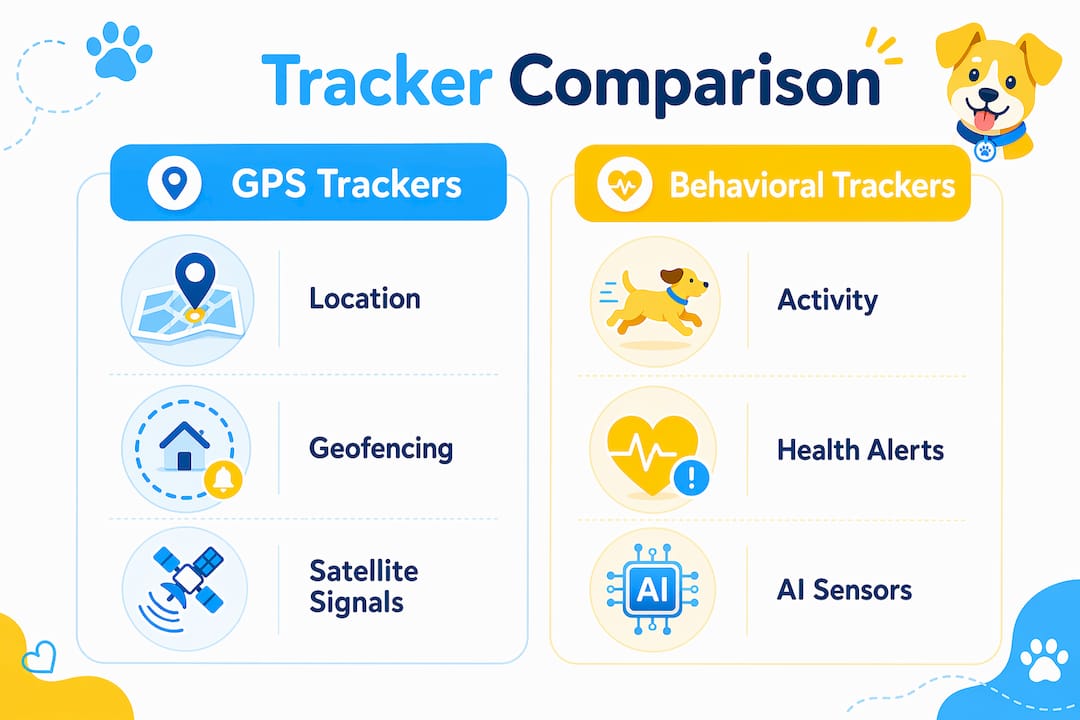
GPS trackers use satellite signals for location and cellular networks to transmit data. They help you find a lost dog, set geofence boundaries, and get exit alerts when your dog leaves a defined area. GPS accuracy typically falls within 10–50 feet. What GPS cannot do is tell you whether your dog is anxious, in pain, or showing early signs of illness.
Behavioral trackers interpret emotional and health signals based on movement patterns and vocalizations. They do not replace GPS for location emergencies, but they catch the kind of slow-building health changes that owners miss until symptoms become obvious. The two technologies work best together, and many advanced devices now combine both.
| Feature | GPS trackers | Behavioral trackers |
|---|---|---|
| Primary function | Location and geofencing | Behavior and health state monitoring |
| Core sensors | GPS chip, cellular modem | Accelerometer, gyroscope, microphone |
| Data output | Map position, exit alerts | Behavioral states, emotional cues, anomaly alerts |
| Best use case | Lost pet recovery, boundary alerts | Early health detection, training support |
| Connectivity | Cellular, GPS satellite | Bluetooth, Wi-Fi, cellular |
| Battery impact | High (GPS is power-hungry) | Moderate, varies by processing method |
The label “AI pet collar” is more marketing than a technical standard. Buyers should distinguish between simple GPS location trackers and true behavioral or health monitoring devices before purchasing. Read the sensor list, not just the product name.
What are the benefits of behavioral tracking for dog owners?
The core benefit of behavioral pet tracking is early detection. Continuous monitoring catches issues like anxiety or chronic discomfort long before owners notice visible symptoms. That window of early awareness is where the real value lives.
Here is what behavioral tracking delivers in practice:
- Early health alerts. Behavioral AI detects departures from your dog’s personal baseline, flagging restlessness, reduced activity, or unusual vocalizations before they escalate. PETKIT emphasizes early alerting before symptoms appear as the defining advantage of this technology.
- Proactive care through baselining. The system learns what “normal” looks like for your specific dog. Anomalies become meaningful because the AI has a reference point. Continuous data volume of 20–30 recognition cycles per second and 50–60 behavioral events daily underpins accurate baselines and anomaly detection.
- Real-time safety alerts. Unusual behavior during the night, while you are at work, or when your dog is alone triggers an immediate notification. This is especially valuable for owners of senior dogs or dogs with known anxiety disorders.
- Training support. Understanding your dog’s emotional state during training sessions helps you time rewards correctly and avoid pushing a stressed dog past their threshold. You can decode dog behavior signals more accurately when you have data to back up your observations.
- Smarter vet visits. A long-term behavioral record gives your veterinarian objective data instead of your memory of “he seemed off last Tuesday.” That record can shorten diagnosis time and reduce unnecessary testing.
Behavioral tracking enables pet care to become predictive. Owners and vets can intervene before visible illness, which is a meaningful shift from the traditional model of waiting for symptoms. For dog owners who want a deeper look at how this fits into daily routines, dog lifestyle monitoring covers the practical side of integrating wearable data into everyday care.
What should you consider when choosing a behavioral tracking device?
The device you choose determines the quality of data you receive. A poorly designed collar with weak sensors produces unreliable alerts, which is worse than no alerts at all because it trains you to ignore them.
Focus on these factors:
- Sensor quality. Look for devices that list specific sensors: accelerometer, gyroscope, and microphone at minimum. Devices that only mention “motion detection” are likely step counters, not behavioral trackers. The technical roles of microphones, accelerometers, and gyroscopes in collars directly determine what behavioral states the device can classify.
- Connectivity options. Modern tracking solutions combine behavioral AI with GPS, Wi-Fi, and Bluetooth to balance accuracy, coverage, and battery life. Wi-Fi and Bluetooth handle home environments within 100–800 feet. Cellular coverage extends tracking outdoors. Battery-saving features use Wi-Fi detection at home to switch trackers to low-power modes, which meaningfully extends runtime.
- Cellular network requirements. Cellular network coverage is essential for real-time behavioral and location alerts. Devices that require 4G/LTE will not function reliably in rural areas with weak coverage. Check your local network before buying.
- Device comfort and fit. A collar your dog refuses to wear produces no data. Look for lightweight designs with adjustable sizing. Some anti-bark collar hardware, such as the Breaker SOS 25, illustrates how specialized collar electronics can be packaged for daily wear without sacrificing comfort.
- App usability and data privacy. The app is where you actually use the data. A confusing interface means you will stop checking it. Review the privacy policy to understand how your dog’s behavioral data is stored and whether it is shared with third parties.
- Subscription costs. Many devices require a monthly plan for cellular connectivity or cloud storage. Factor this into the total cost of ownership before committing.
Pro Tip: Read user reviews specifically for mentions of false alerts. A device that cries wolf constantly trains owners to ignore notifications, defeating the entire purpose of behavioral monitoring. Look for reviews from owners of dogs with similar breeds and activity levels to yours.
How to interpret and act on behavioral tracking insights
Receiving data is only useful if you know what to do with it. Most dog owners who abandon behavioral tracking devices do so because the data feels overwhelming or unclear. A simple framework makes the information manageable.
- Establish your dog’s baseline first. Give the device two to three weeks before drawing conclusions. The AI needs time to learn your dog’s normal patterns. Alerts during this period may reflect the system calibrating rather than a genuine problem.
- Distinguish alerts from trends. A single alert for unusual nighttime movement may mean your dog heard a noise. A week of elevated nighttime restlessness is a trend worth investigating. Treat individual alerts as prompts to observe, not emergencies.
- Bring data to vet appointments. Export or screenshot behavioral summaries before each visit. Vets can use objective activity and sleep data to support or rule out diagnoses faster than symptom descriptions alone.
- Incorporate insights into training. If the device shows elevated stress signals during specific times of day, adjust training sessions to avoid those windows. A dog in a calm behavioral state learns more effectively.
- Respond to subtle changes early. A gradual drop in daily activity over two weeks matters more than a single low-activity day. Set a habit of reviewing weekly summaries, not just real-time alerts. Recognizing and responding to alert signals early is the behavior that separates proactive owners from reactive ones.
Key Takeaways
Behavioral pet tracking gives dog owners objective, real-time data on their dog’s health and emotional state, making proactive care possible before symptoms appear.
| Point | Details |
|---|---|
| Core definition | Behavioral tracking interprets sensor data into health and emotional states, not just location. |
| Technology foundation | Devices use accelerometers, gyroscopes, and microphones classified by AI into behavioral categories. |
| GPS vs. behavioral | GPS finds your dog; behavioral tracking tells you how your dog is doing. |
| Key benefit | Early anomaly detection allows intervention before visible illness or distress develops. |
| Device selection | Prioritize sensor quality, connectivity options, battery life, and app usability when choosing a device. |
Why behavioral tracking is the shift pet ownership needed
I have followed pet technology closely for years, and the honest truth is that most of it has been location technology dressed up as health technology. GPS collars are useful. They are not transformative. Behavioral tracking is different, and I say that with some conviction.
The shift from “where is my dog” to “how is my dog” mirrors what happened in human health wearables. Fitness trackers started as step counters. They became genuinely useful when they started detecting sleep disorders and irregular heart rhythms. Pet behavioral tracking is at that same inflection point right now.
What I find underappreciated is the veterinary angle. Owners who walk into a vet appointment with two weeks of objective behavioral data are having a fundamentally different conversation than owners describing symptoms from memory. That data shortens diagnosis time. It also builds a longitudinal health record that becomes more valuable the longer you use the device.
The challenge that remains is user education. The technology works, but most owners do not know how to read the data or when to act on it. Devices that invest in clear, plain-language app interfaces will win this market. Devices that dump raw graphs on owners will see high abandonment rates.
My advice: treat the first month as a learning period for both you and the device. Do not expect instant clarity. Expect a growing picture of your dog’s normal, and trust that picture when something changes.
— Andrew
Behavioral pet tracking tools and resources at Ipuppee
Ipuppee brings together educational resources and pet communication technology for dog owners who want more than a basic collar.
The Ipuppee blog covers the full range of pet AI tools for smarter care, from wearable health monitors to alert devices designed for service dog handlers, seniors, and owners living alone. If you are ready to go deeper on wearable tech for dog health, the site walks through specific features, use cases, and what to look for in 2026. For device options and product information, visit Ipuppee directly to see what fits your dog’s needs and your lifestyle.
FAQ
What is behavioral pet tracking in simple terms?
Behavioral pet tracking uses a wearable device with AI-powered sensors to monitor your dog’s movements, sounds, and activity patterns, then translates that data into readable health and emotional states.
How does behavioral tracking differ from a regular GPS tracker?
GPS trackers show where your dog is. Behavioral trackers interpret what your dog is doing and feeling, detecting anxiety, discomfort, or unusual activity patterns that location data cannot reveal.
Can behavioral tracking detect health problems early?
Continuous behavioral monitoring catches departures from your dog’s normal baseline, flagging potential health issues like anxiety or chronic discomfort before visible symptoms appear.
What sensors does a behavioral pet tracker need?
A true behavioral tracker requires at minimum an accelerometer, a gyroscope, and a microphone. Devices listing only “motion detection” are step counters, not behavioral monitors.
How long does it take for behavioral tracking to become accurate?
Most devices need two to three weeks to establish a reliable behavioral baseline for your specific dog. Alerts during that initial period may reflect the system calibrating rather than a genuine health concern.