

TL;DR:
- Interactive devices actively reshape a dog’s brain, improving cognition, response time, and safety.
- Effective enrichment requires problem-solving toys and rotation to prevent obsessive behaviors.
- Matching devices to a dog’s age, health, and temperament ensures safe and meaningful cognitive engagement.
Most dog owners believe a quick game of fetch or a chew toy covers their dog’s enrichment needs. The reality is far more nuanced. Research shows that targeted interactive devices do something basic toys simply cannot: they actively reshape how a dog’s brain works, how quickly they respond to cues, and how safely they communicate with you. For elderly pet owners and service dog handlers, these differences aren’t academic. They directly affect daily safety, independence, and the quality of the bond you share with your dog. This article walks through the evidence, the practical choices, and the honest tradeoffs.
Table of Contents
- How interactive devices impact dog cognition and safety
- Beyond simple toys: What makes enrichment truly effective?
- Choosing the right interactive device: Practical considerations
- Potential risks and how to avoid them
- Our perspective: Rethinking dog enrichment for real-world results
- Take the next step: Enhance your dog’s life with interactive devices
- Frequently asked questions
Key Takeaways
| Point | Details |
|---|---|
| Enrichment boosts dog cognition | Interactive devices help slow aging and preserve learning, especially for senior and service dogs. |
| Intentional device rotation is vital | Rotating and tailoring interactive devices increases engagement and prevents habituation. |
| Monitor for addiction risks | Overuse of toys can cause addictive behaviors—balance enrichment with observation. |
| Choose devices based on needs | Select devices by your dog’s age, temperament, and your own ability to participate. |
| Enrichment enhances communication | Interactive devices strengthen bonding and safety, supporting elderly owners and working dogs. |
How interactive devices impact dog cognition and safety
Think of play as more than fun. For dogs, especially older ones and those trained for service work, interactive devices are a form of structured brain training that has measurable effects on cognition and safety.
Cognitive decline in dogs looks a lot like it does in aging humans. Dogs develop a condition called canine cognitive dysfunction, which involves confusion, disorientation, disrupted sleep, and reduced responsiveness. For a service dog, reduced responsiveness is a safety issue, not just a behavioral inconvenience. For an elderly owner relying on their dog for companionship or alerting, any drop in the dog’s mental sharpness creates real gaps in daily care.
This is where interactive devices make a measurable difference. Enriched environments, including interactive toys and puzzle devices, increase levels of BDNF (brain-derived neurotrophic factor), a protein that supports the growth and maintenance of neural connections. Higher BDNF means stronger communication between brain cells, which translates to better learning, faster responses, and more reliable behavior.
The research is striking. A dog cognition enrichment study found that aged Beagles placed in enriched environments performed significantly better on cognitive tests than those in standard conditions. Specifically, enrichment slows cognitive decline in elderly dogs, improves reversal learning (the ability to adapt to new rules), and preserves neural pathways. Crucially, benefits appeared even when enrichment started in old age. It is never too late to begin.
| Outcome measure | Standard environment | Enriched environment |
|---|---|---|
| Cognitive test errors | Higher | ~30% fewer |
| BDNF levels | Baseline | Significantly elevated |
| Exploration behavior | Lower | Higher |
| Anxiety indicators | More frequent | Reduced |
For service dogs and senior dogs, reduced anxiety and improved exploration behavior have direct safety benefits. A calmer, more curious dog responds to commands more reliably and adapts better to new environments or emergencies.
“Environmental enrichment does not just slow decline. It actively rebuilds some of the neural capacity lost to aging, making it one of the most powerful tools available to dog owners who want to preserve their pet’s abilities.” — Adapted from research on environmental enrichment and aging
Understanding senior dog communication becomes easier when you realize that a cognitively healthier dog is better at reading and responding to your cues. Similarly, senior dog training works better when the dog’s brain is primed by regular enrichment. The science points in one clear direction: interactive devices are a foundational investment, not a luxury.
Beyond simple toys: What makes enrichment truly effective?
Understanding the science leads to an obvious question: if enrichment matters, why doesn’t any toy work? The answer is in what the brain actually needs to stay sharp.
A ball thrown across a yard gives a dog physical exercise and a brief burst of excitement. That has value. But it doesn’t require problem-solving, patience, or communication. The dog does not need to figure anything out. There is no puzzle, no nuanced interaction, and no real cognitive challenge.
Interactive devices are different. Puzzle feeders require a dog to manipulate levers, slide panels, or flip covers to earn a reward. Tug devices involve timing, reading body language, and responding to start-and-stop cues. Communication buttons teach dogs to associate pressing a specific button with a specific outcome, which is a genuinely complex cognitive task. Each of these devices demands active participation from the brain in ways that a simple throw never does.
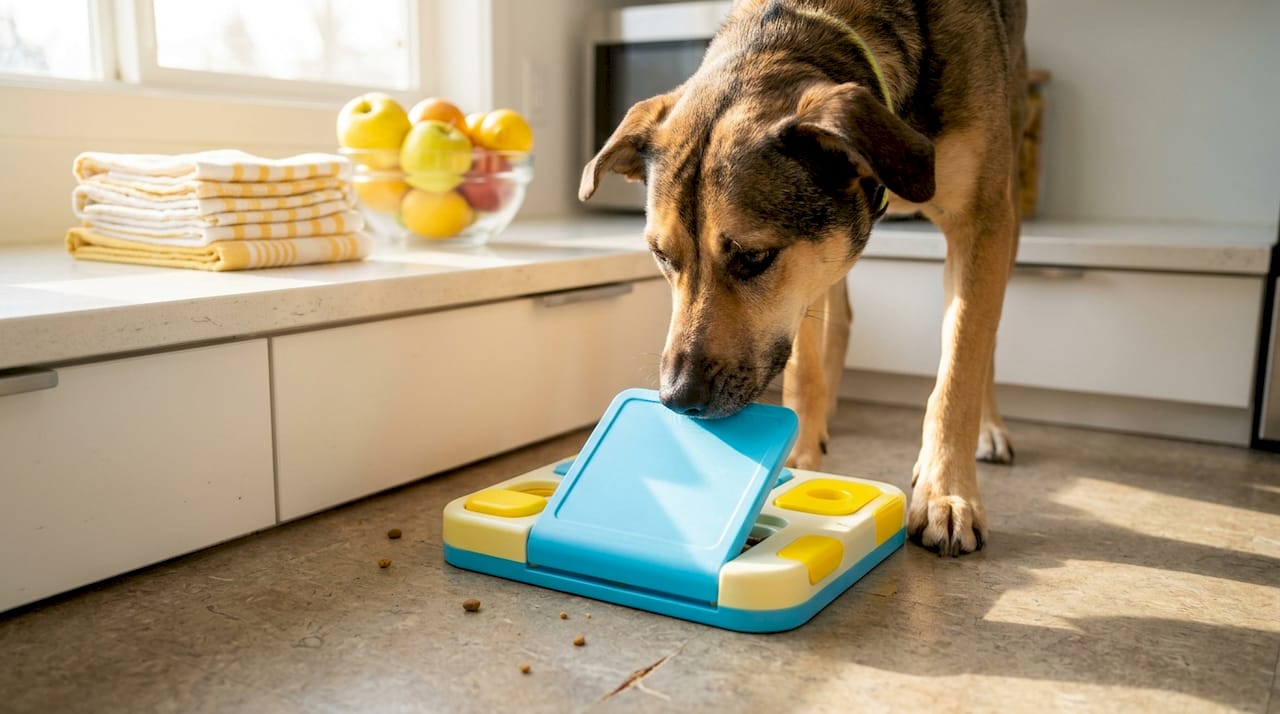
Research supports this distinction clearly. A fetch vs. enrichment analysis found that simple fetch is insufficient for a dog’s bonding and mental needs, while interactive play such as tug and puzzle games produces better outcomes for both cognitive health and the owner-dog relationship. Interestingly, the study also found that over-reliance on high-drive toys risks creating obsessive patterns in motivated dogs. Balance, not volume, is what matters.
Effective enrichment devices for elderly and service dogs include:
- Puzzle feeders: Require problem-solving and slow eating. Great for dogs with early cognitive changes.
- Communication buttons: Teach specific associations between pressing and outcomes. Build both language understanding and confidence.
- Tug and interactive pull devices: Require reading handler cues. Especially useful for service dog maintenance.
- Sniff mats and scent games: Low-impact physical demand, high cognitive engagement. Ideal for dogs with arthritis or limited mobility.
- Chew devices: Reduce anxiety and provide sustained, calming stimulation.
Pro Tip: Rotate devices every three to four days. Dogs habituate quickly to the same toy, which reduces its cognitive value. Variety keeps the brain working and maintains the dog’s interest over time.
Accessing a range of senior dog activities is one of the easiest ways to build a practical rotation schedule suited to your dog’s energy level and health status. The goal is not to overwhelm your dog with options but to introduce variety in a structured, intentional way that supports ongoing mental engagement.
Choosing the right interactive device: Practical considerations
With so many products marketed as “enrichment,” choosing what actually fits your dog requires knowing what to look for. Age, breed, health status, and temperament all shape what will genuinely help versus what will frustrate or exhaust.
Match the device to your dog’s profile:
- Older dogs with arthritis need low-impact options. Puzzle feeders with easy-to-manipulate parts or flat sniff mats work well. Avoid devices that require jumping or forceful pawing.
- Cognitively declining dogs benefit from familiar devices with gentle increases in difficulty. Sudden complexity can frustrate rather than stimulate.
- High-drive working dogs can handle more intensive puzzle devices, but require careful monitoring for obsessive tendencies (covered in the next section).
- Dogs with hearing or vision loss respond well to tactile and scent-based devices rather than toys that rely on sound or sight cues.
Research on toy preference in kenneled dogs found that toy provision increases physical activity and reduces time spent standing still, which is a key welfare indicator. The same research confirmed that interest in toys wanes significantly over time, underscoring the importance of rotation. Among the device types studied, the Nylabone chew toy retained interest longer than most alternatives, making it a reliable baseline option for dogs of most ages and sizes.
For elderly pet owners or handlers with mobility limitations, accessibility matters as much as the dog’s needs. Choose devices that:
- Do not require bending or stooping to set up or reset
- Have large, easy-to-grip parts if you need to handle them frequently
- Work on flat surfaces without requiring physical space that is hard to reach
- Provide clear feedback (a sound, a light, or a button click) so you can monitor your dog’s interaction without constant supervision
The iPupPee communication button, for example, is designed with exactly this kind of accessibility in mind. It requires minimal setup, sits flat on the floor, and gives both the dog and owner a clear, audible cue when activated.
Pairing the right devices with senior dog safety tips creates a practical framework that works in real households. Additional senior pet care tips can help you integrate enrichment into a broader daily routine that keeps both you and your dog engaged, safe, and connected.
Potential risks and how to avoid them
Interactive devices offer genuine benefits, but they are not without risks. Knowing what to watch for keeps enrichment healthy instead of harmful.
The most significant risk is what researchers call toy-related addictive-like behavior. A 2025 study published in Nature Scientific Reports found that among 105 highly motivated dogs, 33 showed patterns that mirrored addiction: addictive toy behaviors including craving, difficulty stopping play, and significant frustration when the toy was removed. These patterns were most common in high-drive working breeds, including Border Collies, Belgian Malinois, and German Shepherds.
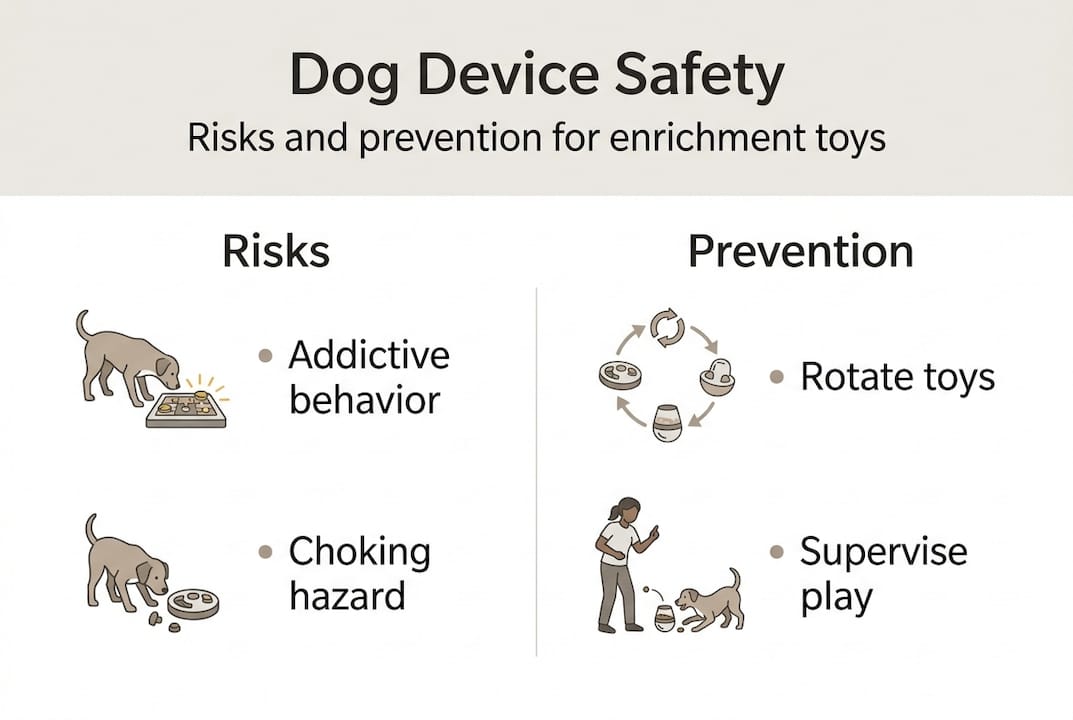
This finding matters because working dogs are also the most likely candidates for intensive enrichment programs. The very trait that makes them excellent service animals, their high drive and motivation, also makes them vulnerable to obsessive relationships with specific toys.
Signs your dog may be developing an unhealthy attachment to a device:
- Refuses to engage with other activities when a specific toy is present
- Shows anxiety or aggression when the toy is removed or out of reach
- Cannot settle between play sessions and repeatedly seeks the toy
- Loses interest in food, social interaction, or other rewards when focused on the device
- Escalates intensity of play to a point that looks frantic rather than joyful
If you notice any of these signs, the fix is straightforward: structured breaks, increased variety, and reintroducing other reward types like food puzzles, scent work, or calm social time.
Practical steps for safe enrichment management:
- Set clear play sessions with defined start and end times
- Rotate devices every three to four days to prevent fixation on any single item
- Always pair device play with social interaction and handler engagement
- Introduce new devices gradually, especially for dogs showing high drive
- Monitor behavior after play sessions, not just during them
Pro Tip: Use interactive play as one tool in a wider toolkit. A walk, a training session, a quiet cuddle, and a puzzle feeder each engage different parts of your dog’s brain and emotional needs. No single device should carry all the enrichment weight.
Following dog interaction tips that emphasize balanced engagement helps you build a routine that avoids over-reliance on any single stimulus while still delivering the cognitive and safety benefits enrichment offers.
Our perspective: Rethinking dog enrichment for real-world results
Here is something that does not get said often enough: buying more devices is not the same as providing better enrichment. We see many dog owners, often with the best intentions, accumulate a basket full of puzzle toys and gadgets that sit unused while the dog fetches the same ball for the hundredth time.
The research does not support “more toys equals better outcomes.” What it actually supports is intentional rotation, genuine owner engagement, and adjusting the approach as your dog ages or changes. A communication button used daily with real attention from you does more for your dog’s cognition and safety than ten dusty puzzle feeders in a closet.
We also think the trendy gadget problem deserves honest discussion. Not every “innovative” device delivers on its promises. The ones that work best share a common trait: they create a two-way interaction between dog and owner, not just solo dog entertainment. Enhancing senior dog companionship is ultimately about connection, and the best devices facilitate that rather than replace it.
Adjust your approach continuously. What works at seven may not work at twelve. Stay observant, stay flexible, and never confuse novelty with value.
Take the next step: Enhance your dog’s life with interactive devices
If this article has shifted how you think about enrichment, you are already ahead of most dog owners.
At iPupPee, we specialize in practical communication and safety devices designed for real dog owners, especially seniors and service dog handlers who need tools that actually work in everyday life. The iPupPee alert button is built to improve how your dog communicates with you while supporting cognitive engagement and daily safety. Explore our product resources and enrichment guides to find devices matched to your dog’s needs, your lifestyle, and your goals. Whether you are just starting an enrichment routine or refining an existing one, we have the tools and the information to help you do it well.
Frequently asked questions
How do interactive devices slow cognitive decline in senior dogs?
Interactive devices stimulate brain activity, increase BDNF, and help preserve neural pathways, which slows cognitive decline even when enrichment starts in old age.
What types of interactive devices work best for elderly or service dogs?
Puzzle feeders, chew toys like Nylabone, and communication buttons are most effective; Nylabone chew toys in particular retain a dog’s interest longer than most alternatives.
Are there risks to using interactive devices for dogs?
Yes, excessive toy motivation can produce addictive-like behaviors in highly driven dogs; rotating devices and monitoring behavior after play sessions reduces these risks significantly.
How often should I rotate interactive devices for my dog?
Rotating devices every three to four days maintains novelty because interest in toys wanes quickly without regular changes, keeping your dog mentally engaged.
Can interactive devices help with communication and companionship for elderly owners?
Absolutely. They improve dog communication for seniors, enhance safety, and strengthen the companionship bond, making the relationship more rewarding for both owner and dog.