

Nearly 53 percent of American service dog owners say their dog’s ability to understand commands can mean the difference between safety and danger. For seniors with disabilities, strong communication skills in dogs offer greater independence and peace of mind. This article reveals how cognitive skill development helps dogs interpret human cues, adapt to change, and respond in critical situations for improved safety and connection.
Table of Contents
- What Are Dog Cognitive Skills?
- Types Of Cognitive Abilities In Dogs
- How Dogs Communicate And Understand Humans
- Enhancing Safety With Cognitive Training
- Common Challenges In Developing Dog Cognition
Key Takeaways
| Point | Details |
|---|---|
| Dog cognitive skills are complex and multifaceted. | These skills include executive function, sensory discrimination, social intelligence, and memory, which develop early and are influenced by various factors. |
| Communication with humans is sophisticated. | Dogs use gestures, vocal tones, and facial expressions to interpret human cues, demonstrating a high level of interspecies communication. |
| Cognitive training enhances safety and behavior. | Techniques such as impulse control exercises and emergency response training improve dogs’ situational awareness and behavioral management. |
| Individual differences impact cognitive development. | Factors like genetics, environment, and age influence how dogs learn and develop their cognitive abilities, necessitating personalized training approaches. |
What Are Dog Cognitive Skills?
Dog cognitive skills represent the complex mental processes that enable dogs to understand, learn, and interact with their environment. Sophisticated cognitive abilities allow dogs to process sensory information, solve problems, and communicate effectively with humans and other animals.
These skills encompass several critical areas of mental functioning, including executive function, sensory discrimination, social intelligence, and memory. Cognitive skills develop early in a dog’s life and can be influenced by genetics, training, and environmental stimulation. Dogs utilize these skills to interpret human gestures, navigate social dynamics, learn complex commands, and adapt to changing situations.
Longitudinal research studies reveal that cognitive abilities are not static but can be enhanced through targeted training and mental stimulation. Dogs demonstrate remarkable capacity for learning, including understanding abstract concepts, recognizing emotional cues, and developing problem-solving strategies that go beyond simple stimulus-response behaviors.
Pro tip: Engage your dog in puzzle toys, training sessions, and interactive games to continuously challenge and develop their cognitive skills.
Types Of Cognitive Abilities In Dogs
Cognitive abilities in dogs are complex and multifaceted, encompassing several key domains that enable sophisticated mental processing. Research indicates dogs possess a general intelligence factor similar to humans, allowing them to demonstrate remarkable problem-solving and learning capabilities across different cognitive domains.
Dogs exhibit several primary types of cognitive abilities, which include:
- Executive Function: Involving complex mental processes like inhibitory control, working memory, and cognitive flexibility
- Sensory Discrimination: The ability to process and differentiate visual, auditory, and olfactory information
- Social Cognition: Understanding and responding to human communicative signals and emotional cues
- Problem-Solving Skills: Developing strategic approaches to overcome challenges and achieve goals
Longitudinal cognitive studies demonstrate that these cognitive abilities develop progressively, with individual dogs showing unique strengths and variations. Some dogs excel in social intelligence, while others might display exceptional problem-solving skills or sensory processing capabilities.

Pro tip: Regularly introduce novel challenges and interactive experiences to help your dog continue developing and refining their cognitive abilities.
Here is a summary comparing the main cognitive abilities found in dogs:
| Cognitive Ability | Main Focus | Practical Example |
|---|---|---|
| Executive Function | Decision making and self-control | Ignoring distractions when called |
| Sensory Discrimination | Distinguishing between sensory inputs | Finding treats by scent |
| Social Cognition | Understanding human cues and emotions | Responding to pointing gestures |
| Problem-Solving Skills | Overcoming challenges and obstacles | Opening a latch on a puzzle toy |
How Dogs Communicate And Understand Humans
Dog communication is a sophisticated system of interspecies interaction that goes far beyond simple commands and responses. Comprehensive communication signals involve multiple sensory channels, including visual cues, vocal sounds, body language, and even subtle physiological changes that convey complex emotional states.
Dogs have developed remarkable abilities to interpret human communication through:
- Gesture Recognition: Understanding pointing, hand signals, and body positioning
- Vocal Tone Interpretation: Detecting emotional nuances in human speech
- Facial Expression Reading: Identifying human emotional states through subtle facial changes
- Context-Based Learning: Inferring intentions from environmental and social contexts
Research investigating canine language comprehension reveals that while dogs do not understand language in a human linguistic sense, they possess an extraordinary capacity to process complex communicative signals. Their ability to alter behavior based on human cues demonstrates a sophisticated form of interspecies communication that has evolved through thousands of years of domestication.
Pro tip: Maintain consistent body language and use clear, calm vocal tones when communicating with your dog to enhance mutual understanding and trust.
Enhancing Safety With Cognitive Training
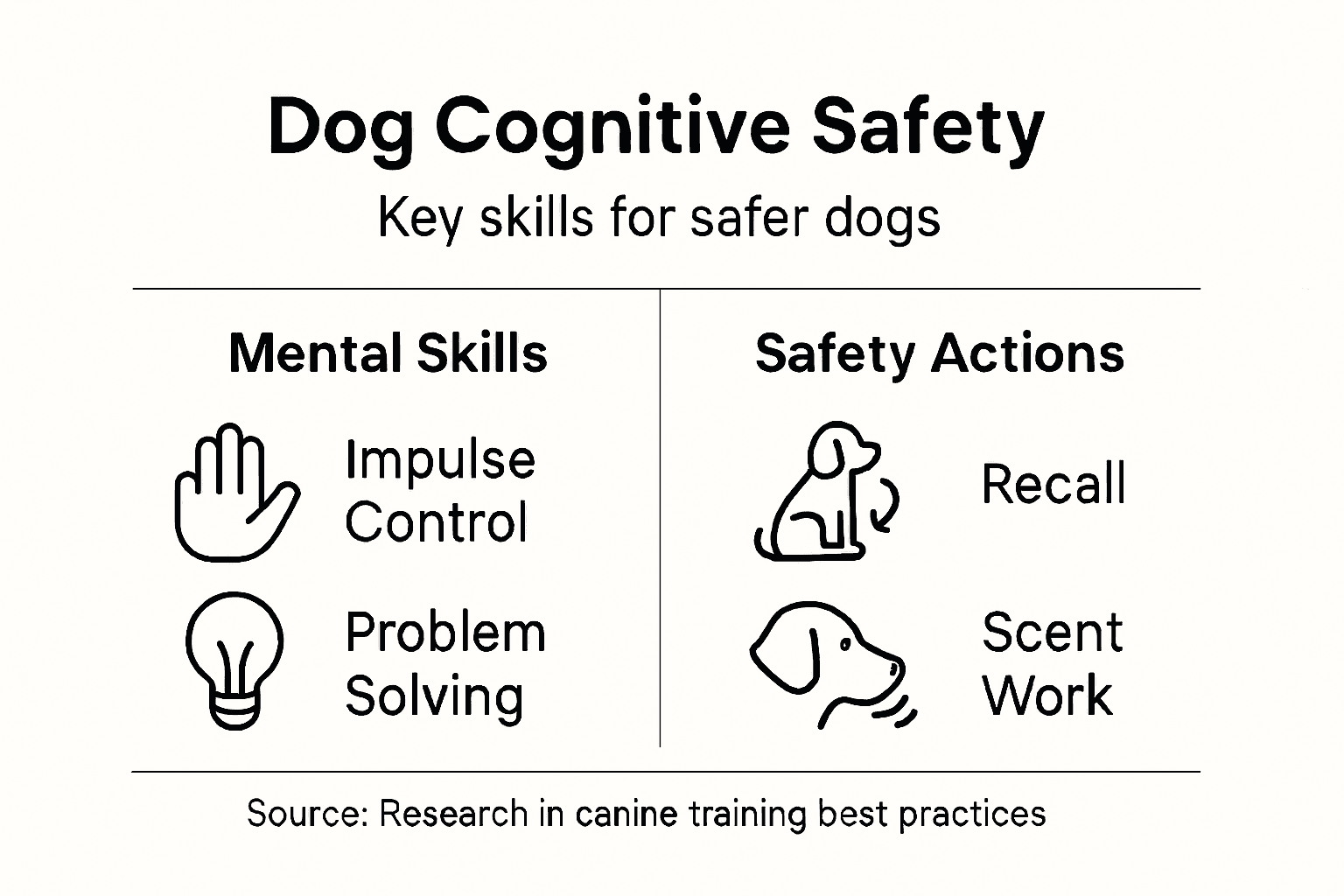
Cognitive training represents a powerful approach to improving dog safety and behavioral control. Modern working dog training techniques integrate advanced behavioral science to develop dogs’ problem-solving abilities, impulse control, and situational awareness.
Key cognitive training strategies for enhancing safety include:
- Impulse Control Exercises: Teaching dogs to pause and assess situations before reacting
- Distraction Management: Building focus and reducing reactive behaviors
- Emergency Response Training: Developing reliable recall and stop commands
- Environmental Adaptation Skills: Learning to navigate complex and changing environments
Specialized training disciplines like scent work and structured obedience programs can significantly improve dogs’ inhibitory control. These training methods help reduce impulsive behaviors, increase situational awareness, and create a more predictable, safer interaction pattern between dogs and their handlers.
Pro tip: Start cognitive safety training early and use positive reinforcement techniques to make learning engaging and effective for your dog.
Common Challenges In Developing Dog Cognition
Dog cognitive development is a complex process influenced by multiple intricate factors. Research reveals significant individual differences in how dogs develop cognitive skills, highlighting the importance of understanding the unique trajectory of each dog’s mental capabilities.
Key challenges in dog cognitive development include:
- Genetic Variability: Different breeds exhibit unique cognitive processing speeds and learning potential
- Environmental Influences: Social experiences and training quality dramatically impact cognitive growth
- Age-Related Cognitive Changes: Mental capabilities evolve and potentially decline throughout a dog’s lifespan
- Limited Standardized Assessment: Difficulties in measuring and comparing cognitive abilities across different dogs
Scientific studies face methodological limitations in understanding canine cognition, including challenges with statistical power and brain imaging techniques. These constraints make it challenging to develop comprehensive, universally applicable insights into dog cognitive development and potential.
Pro tip: Recognize that each dog is unique and requires personalized, patient cognitive training approaches tailored to their individual learning style and potential.
This table highlights common challenges in dog cognitive development and possible ways to address them:
| Challenge | Description | Supportive Approach |
|---|---|---|
| Genetic Variability | Cognitive skills vary by breed | Tailored breed-specific tasks |
| Environmental Influences | Home and training affect learning | Provide social enrichment |
| Age-Related Changes | Mental abilities change over lifespan | Adjust activities as dog ages |
| Limited Assessment Tools | Difficult to measure skills uniformly | Use diverse assessment methods |
Boost Your Dog’s Communication and Safety with Smart Solutions
Understanding your dog’s unique cognitive skills like impulse control and social cognition can transform everyday challenges into opportunities for safer, clearer communication. Many pet owners struggle with consistent signals or emergency recall commands that truly work in real life. The iPupPee device from ipuppee.com offers an innovative way to enhance your dog’s ability to communicate their needs instantly through a simple button press. This tool is especially valuable for service dog handlers, seniors, or anyone relying on improved safety and interaction with their dog.

Take the next step in empowering your dog’s cognitive skills and safety by exploring how precise communication can reduce frustration and boost independence. Visit iPupPee’s official site now and discover training instructions and benefits tailored for your dog’s development. Experience firsthand how integrating cognitive understanding with cutting-edge technology can make every interaction clearer and safer.
Frequently Asked Questions
What are the key cognitive skills that dogs possess?
Cognitive skills in dogs include executive function, sensory discrimination, social cognition, and problem-solving skills. These abilities allow dogs to process information, solve problems, and communicate effectively with humans and other animals.
How can I improve my dog’s cognitive abilities?
You can improve your dog’s cognitive abilities by engaging them in puzzle toys, training sessions, and interactive games. Regularly introducing novel challenges and experiences will help refine their skills and enhance their learning capacity.
How do dogs communicate with humans?
Dogs communicate with humans through various means including gesture recognition, vocal tone interpretation, facial expression reading, and context-based learning. They can understand human emotions and intentions through these signals, making interspecies communication quite sophisticated.
What are some effective cognitive training strategies for dogs?
Effective cognitive training strategies include impulse control exercises, distraction management, emergency response training, and teaching environmental adaptation skills. These strategies improve dogs’ problem-solving abilities and enhance their safety and behavioral control.