

TL;DR:
- Dogs have highly sensitive noses capable of detecting early chemical changes associated with medical emergencies.
- Training and technology combined improve reliability of dogs detecting conditions like seizures and blood sugar levels.
- Combining canine alerts with communication devices creates a layered safety system beyond dog-only detection.
Dogs carry roughly 300 million olfactory receptors compared to our 5 million, giving them a chemical sensitivity that borders on supernatural. That gap is not just impressive trivia. It means your dog may notice a seizure, a blood sugar crash, or even early-stage cancer long before any symptom appears to you or your doctor. Service dog handlers have known this for decades, but the science behind it is only now catching up. This guide walks through how canine detection actually works, what the research says about accuracy, and how pairing your dog with the right technology creates a genuinely safer environment.
Table of Contents
- How do dogs sense emergencies? The science explained
- Training dogs to recognize and alert to emergencies
- How accurate and effective are alert dogs?
- Nuances, limitations, and technology’s supporting role
- What most pet owners miss about canine emergency detection
- Ready to boost safety? How iPupPee can help
- Frequently asked questions
Key Takeaways
| Point | Details |
|---|---|
| Dogs detect emergencies naturally | Dogs use their advanced sense of smell to pick up sign changes before humans notice a problem. |
| Training boosts effectiveness | Structured reward-based training makes emergency alerts more consistent and accurate. |
| No system is flawless | Even trained dogs can miss or give false alerts, so backup plans are essential. |
| Tech amplifies safety | Adding communication devices to dog alerts creates a layered, reliable emergency response. |
How do dogs sense emergencies? The science explained
Your dog’s nose is not just more powerful than yours. It works differently. Humans smell in broad strokes. Dogs process scent in layers, identifying individual chemical compounds within a complex mixture the way a musician picks out a single instrument in a full orchestra.
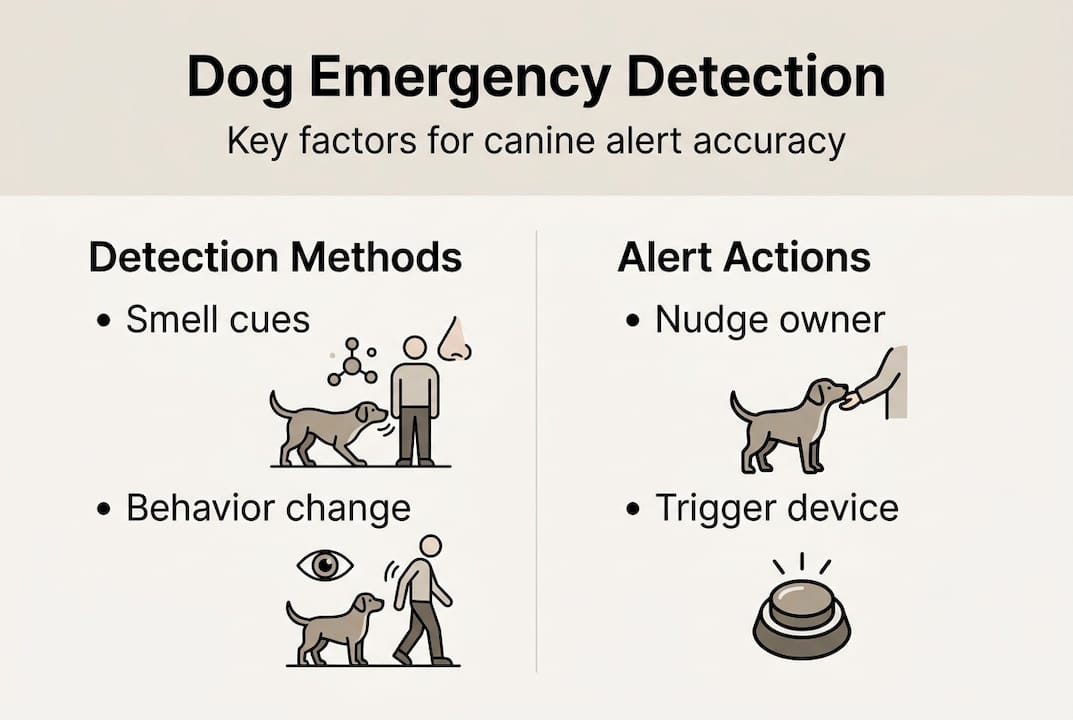
The key to emergency detection lies in volatile organic compounds, or VOCs. These are tiny chemical molecules released through sweat, breath, and skin during physiological changes. When your blood sugar drops dangerously low, your body chemistry shifts. When a seizure begins to build, electrical and chemical activity in the brain triggers measurable changes in the body’s scent profile. Dogs identify VOCs and isoprene released during these events, often detecting them minutes before any visible symptom appears.
Here is a quick look at the medical conditions where canine detection is supported by research:
- Epileptic seizures: Dogs detect pre-seizure odor changes, sometimes 20 to 45 minutes before onset
- Hypoglycemia (low blood sugar): Dogs alert to isoprene spikes in breath linked to glucose drops
- Hyperglycemia (high blood sugar): Chemical shifts in sweat trigger alert responses
- Certain cancers: Dogs have identified lung, breast, colorectal, and bladder cancers from breath or urine samples
- Cardiac events: Early evidence suggests dogs respond to chemical changes preceding heart attacks
| Condition | Detection method | Typical lead time |
|---|---|---|
| Seizure | Breath/skin VOCs | 5 to 45 minutes |
| Low blood sugar | Isoprene in breath | 5 to 20 minutes |
| Cancer (lung/breast) | Breath/urine samples | Variable |
| Cardiac event | Skin/sweat compounds | Early research only |
What makes this remarkable is that dogs often outperform electronic sensors in real-world, variable conditions. A continuous glucose monitor needs calibration and a power source. A well-trained dog adapts to environmental changes and still reads the person. That said, dogs’ medical scent detection research consistently shows that no dog is infallible, and understanding the biology helps you set realistic expectations. For a broader breakdown of how this works in practice, the dog alerts explained guide is a solid starting point.
Training dogs to recognize and alert to emergencies
Biology gives dogs the raw ability. Training turns that ability into a reliable, repeatable skill. Without structure, even the most sensitive dog may notice a scent change and simply wander off to investigate something else.

The gold standard for alert training is positive reinforcement combined with marker training, often using a clicker. The dog learns to associate a specific odor sample with a reward. Over time, the behavior becomes automatic: detect the scent, perform the alert behavior, receive the reward. Marker-trained dogs complete training in fewer trials with higher accuracy than dogs trained without a clear marker signal.
Alert behaviors fall into a few categories:
- Pawing or nudging the handler to signal an oncoming event
- Barking to draw attention from others in the room
- Pressing an alert button or device to trigger a notification
- Retrieving medication or a phone as part of a trained response chain
Service dogs trained for medical alerts go through months of structured work with certified trainers. Family pet dogs can learn basic alert behaviors too, but the depth of training differs significantly. Service dog training methods emphasize controlled scent exposure, proofing in different environments, and gradual increases in distraction levels.
Here is a comparison of service dog training versus family dog alert training:
| Factor | Service dog training | Family dog training |
|---|---|---|
| Duration | 6 to 24 months | Weeks to months |
| Trainer | Certified specialist | Owner or local trainer |
| Scent samples | Medical grade, diverse | Owner-provided |
| Reliability | Higher | Variable |
| Alert device use | Common | Increasingly common |
Breed matters too. Labrador Retrievers, Golden Retrievers, and Standard Poodles consistently perform well. Individual temperament and drive matter just as much as breed, though. A calm, focused mixed-breed dog can outperform an anxious purebred.
Pro Tip: Use scent samples collected at different times of day and during different activity levels. This teaches your dog to recognize the odor across a wider range of conditions, not just one specific scenario.
For practical guidance, the resources on how to train alert dogs and the step-by-step alert dog training guide break the process into manageable stages.
How accurate and effective are alert dogs?
This is where the conversation gets honest. The stories of dogs saving lives are real. But the data tells a more nuanced story.
For diabetes alert dogs, research shows meaningful real-world impact. Handlers report fewer paramedic calls and fewer unconscious episodes after training their dogs to alert. That is a significant quality-of-life difference, especially for people living alone.
For seizure alert dogs, one striking finding stands out: all 19 untrained pet dogs in a controlled trial responded to seizure odor samples, suggesting the ability may be more widespread than previously assumed. Trained dogs, however, are far more consistent in when and how they alert.
For cancer detection, sensitivity rates in research settings can reach above 90% for certain cancers. But specificity, meaning the ability to avoid false positives, is lower. In practical terms, a dog might alert to a cancer scent but also alert to other strong or unusual odors. High sensitivity with lower specificity means cancer detection by dogs works best as a screening tool, not a diagnosis.
Key performance realities to know:
- Detection rates vary widely by condition, dog, and training quality
- Real-world performance is typically lower than controlled study results
- Environmental distractions, handler stress, and the dog’s own health affect accuracy
- No trained dog has consistently hit 90% detection with under 10% false alerts across all conditions
“Alert dogs are a powerful first layer of warning. They are not a replacement for continuous monitoring technology or medical supervision.”
This is why the emergency dog skill guide emphasizes layered safety. And it is why understanding the dog alert device benefits matters so much for building a complete safety system.
Nuances, limitations, and technology’s supporting role
Even the best-trained alert dog has bad days. Understanding why helps you plan around the gaps instead of being surprised by them.
Breed and individual variation play a huge role. Labrador Retrievers consistently rank among the top performers in detection work. Belgian Malinois, despite their reputation for working dog excellence, show mixed results in scent-based medical detection. The individual dog’s drive, focus, and bond with the handler often matter more than breed alone.
Common reasons for missed alerts or false alerts include:
- Physical exertion: A dog that just ran hard has elevated stress hormones that can interfere with scent processing
- Environmental odors: Strong competing smells (cleaning products, food, smoke) can mask target scents
- Inconsistent training aids: Using only one type of scent sample limits generalization
- Handler anxiety: Dogs read human emotion, and a stressed handler can trigger alert behaviors unrelated to a medical event
- Health issues in the dog: Pain, illness, or fatigue reduce detection reliability
No team met the 90% detection benchmark with under 10% false alerts in independent testing. That is not a failure of dogs. It is a realistic ceiling that every owner and handler should understand.
This is where technology fills the gap. Connected collars, alert buttons, and communication devices act as a second layer. When your dog alerts, a device can simultaneously notify a caregiver, family member, or emergency contact. The dog catches what sensors might miss. The device catches what the dog might miss. Together, they cover far more ground than either alone.
Pro Tip: Track your dog’s alert patterns in a simple log. Note the time, context, and whether the alert was confirmed. Over weeks, you will spot patterns that help you distinguish reliable alerts from noise.
For more on how this works in practice, explore dogs and alert devices, dog communication technology, and the guide on enhancing dog safety with technology. The limits of service dog alerts are well-documented, and knowing them is the first step to working around them.
What most pet owners miss about canine emergency detection
Here is the uncomfortable truth: the viral stories of dogs saving lives are real, but they are also the outliers. Social media amplifies the miraculous and quietly ignores the misses. That creates a dangerous overconfidence in dog-only safety systems.
We have seen this pattern repeatedly. An owner trains their dog, the dog alerts a few times successfully, and the owner stops using their CGM or stops checking in with family as regularly. Then one night the dog is tired, or distracted, or simply off, and the alert does not come.
Mixed accuracy, especially for rare or unusual conditions, is well-documented across studies on canine reliability. The dogs are not failing. The expectation was wrong from the start.
The smarter approach is to treat your dog’s alert as a strong early warning signal, not a final verdict. Demand redundancy. Use your dog alongside technology, not instead of it. Healthy skepticism is not a sign of distrust in your dog. It is how you build a system that actually holds up under pressure. The guide on improving safety with tools lays out exactly how to structure that kind of layered approach.
Ready to boost safety? How iPupPee can help
You now understand the science, the training, and the real-world limits of canine emergency detection. The next step is putting that knowledge into action with tools built for exactly this purpose.

iPupPee solutions are designed to work alongside your dog, not replace them. The iPupPee alert device gives your dog a simple, trainable way to trigger notifications the moment they detect something wrong. Whether you are a service dog handler, a senior living independently, or a pet owner who wants an extra layer of protection, pairing canine instinct with a reliable communication device closes the gap that training alone cannot. Explore alert devices for owners and take the next step toward a genuinely safer home.
Frequently asked questions
What emergencies can dogs detect?
Dogs can sense seizures, high and low blood sugar, some cancers, and even heart attacks by detecting VOCs and isoprene that shift during medical events, often before any visible symptom appears.
How reliable are service dogs in detecting medical emergencies?
Service dogs are effective but not perfect, since no team met the 90% benchmark in independent testing, which is why pairing dogs with alert technology gives you the most dependable safety net.
Do all dog breeds detect emergencies equally well?
No. Labradors and Golden Retrievers consistently excel, while breeds like the Malinois show mixed results. Individual temperament and training quality often matter more than breed, as breed traits shape detection outcomes significantly.
Can pet dogs warn about emergencies without special training?
Many untrained pet dogs have shown spontaneous awareness of seizures and blood sugar changes, but all 19 untrained dogs in one trial responded to seizure odors, while trained dogs remain far more consistent and reliable.
How can technology increase the safety of emergency alerts?
Connected alert devices can notify caregivers or family the moment your dog signals a problem, and dog communication technology ensures a fast human response even when your dog’s alert goes unnoticed.
Recommended
- 7 Key Dog Alerts for Emergencies Every Owner Should Know – iPupPee
- Dog emergency preparedness guide for safe pet care in 2026 – iPupPee
- Improving dog safety: guide to advanced communication tools – iPupPee
- Dog Emergency Signals: How They Save Lives – iPupPee
- How to introduce your puppy to home: 7 expert steps
- Training help | Calm-Companions