

Predictive pet safety uses sensors and machine learning to warn owners of likely health or safety issues before they become emergencies. Instead of waiting for a visible symptom or an escape to trigger an alarm, these systems track small changes against a dog’s own baseline and flag a trend early. Owners managing chronic conditions, aging pets, or dogs that spend time away from direct supervision benefit most, since early alerts give more time to act alongside a veterinarian.
TL;DR:
- Let a device collect a few weeks of your dog’s normal activity before trusting alerts; individual baselines matter more than generic thresholds.
- A rising resting breathing rate, more scratching, or declining activity can prompt observation and a veterinary call, but none of these alerts provides a diagnosis.
- Accelerometer studies report 77% to 87% sensitivity and nearly 99% specificity for scratching detection, while broader behavior prediction still lacks standardized validation.
- Before buying, check how long location data is stored, whether companies share it, whether video is encrypted, and whether accounts support multifactor authentication.
- For service dog teams or people needing accessible alerts, iPupPee adds a pressable internet button with video, live audio, multiple contacts, and no monthly fee.
Table of Contents
- How predictive pet safety works: sensors, data, and models
- Key technologies and sensors owners will encounter
- What predictive systems can detect: owner-facing examples
- How owners and veterinarians put predictive data to work
- Research summary: peer-reviewed evidence that supports predictive monitoring
- Privacy and data security considerations in predictive pet safety systems
- Limitations and accuracy challenges of current predictive technologies
- Practical adoption advice and iPupPee’s relevance
- iPupPee: a direct option for owners who want notification and communication
- FAQ
- Sources
How predictive pet safety works: sensors, data, and models
Predictive systems combine several data streams at once rather than relying on a single reading. Accelerometers track movement and scratching, GPS marks location, environmental sensors note temperature or air quality, and some collars estimate vital-sign proxies like resting respiratory rate. Machine learning models pull these streams together to build a personalized baseline for each dog, then watch for deviations from that baseline rather than applying a fixed rule to every animal. This approach to sensor fusion for early detection is what separates predictive monitoring from older event-based alarms, which only trigger after a threshold is crossed.
The distinction matters in practice:
- Event alarms react after something happens, like a collar beeping once a dog crosses a fixed geo-fence line.
- Predictive trend alerts flag a gradual drift, such as activity slowly dropping over two weeks, before any single moment looks alarming.
- Personalized baselines let the same respiratory rate mean nothing for one dog and signal concern for another, based on that individual’s own history.
Research on predictive analytics and sensor fusion in animal health describes this shift from reactive, event-based alerts toward proactive forecasting built on movement and behavior anomalies.
Key technologies and sensors owners will encounter
Most predictive pet safety products on the market today combine a handful of core sensor types, each contributing a different kind of signal.
- Accelerometers and IMUs detect activity intensity, rest patterns, and repetitive motions like scratching or licking.
- GPS and geo-fencing track location and flag when a dog leaves a defined safe zone.
- Environmental sensors monitor temperature or air quality, useful for dogs left in cars, yards, or unfamiliar spaces.
- Resting respiratory rate (RRR) monitoring estimates breathing rate during rest, a marker long used in human and veterinary cardiac care.
A 2023 study found that IMU output can discriminate between dog activity types with high accuracy once the device is calibrated to the individual animal, supporting the case for activity-based predictive models. For a broader look at how these categories fit together, our guide to smart dog safety tech breaks down wearables, cameras, and sensors side by side. Owners who want a focused comparison of location tools specifically can also review this roundup of GPS tracker options, which walks through tradeoffs between tracking range, battery life, and fit.
What predictive systems can detect: owner-facing examples
Predictive alerts are only useful when they map to a clear next step. A handful of scenarios show how the data translates into action.
- Rising RRR trend: a gradual increase in resting respiratory rate can prompt a check for labored breathing or other respiratory and cardiac signs, followed by a call to the veterinarian.
- Increased scratching patterns: a sustained rise in scratching detected by an accelerometer often warrants a dermatology consult, with the device used afterward to track whether treatment is working.
- Gradual activity decline: a slow drop in daily movement over days or weeks can flag pain, joint disease, or a systemic illness that would be easy to miss day to day.
- Geo-fence drift or repeated escape attempts: a pattern of nearing or crossing a boundary repeatedly points to a fencing gap or a training need, not just a one-time incident.
In each case, the alert is a prompt to look closer, not a diagnosis. The value lies in catching the pattern early enough that a vet visit or training adjustment happens before the problem escalates.
How owners and veterinarians put predictive data to work
Predictive tools only work as well as the baseline behind them. Before trusting any alert, it helps to let the device collect a few weeks of normal data for that specific dog, since a healthy resting respiratory rate or activity level varies widely between individuals.
- Confirm a baseline period before treating any deviation as meaningful.
- Use alerts as a signal to observe the dog directly, not as an automatic diagnosis.
- Share trend data with a veterinarian rather than a single reading, since trends are more informative than isolated numbers.
- Expect some vets to use this data for remote triage or to track how a dog responds to a new medication or treatment plan over time.
Pro Tip: Export a few weeks of trend data before a vet visit rather than describing symptoms from memory: the pattern often says more than any single day.
Research summary: peer-reviewed evidence that supports predictive monitoring
A growing body of veterinary research backs the core pieces of predictive pet safety, though the field is still young.
- A retrospective analysis of 1,803 dogs showed that collar-mounted accelerometers can objectively monitor pruritic behavior, with reported sensitivities around 77 to 87% and specificities near 99% for detecting scratching in related work.
- A separate AJVR study on automated RRR measurement found that collar-based respiratory rate tracking closely agrees with manual counts and is useful for trending in dogs with cardiac disease, when read as a pattern rather than a single number.
- A 2026 systematic review of AI in companion animal care found that AI tools are currently most mature in diagnostic imaging and clinical decision support, while behavior and personality prediction remain promising but still fragmented, needing larger and more standardized datasets before they can be trusted at scale.
Together, these studies support the sensor types predictive products rely on, while also marking out where the evidence is still thin.
Privacy and data security considerations in predictive pet safety systems
Predictive pet safety devices collect continuous data: location history, activity patterns, and sometimes audio or video from a home. That data has to go somewhere, usually a cloud server tied to an app account, and the path it takes matters as much as the sensor reading itself.
Before trusting a device with this kind of monitoring, it helps to check a few basics. Look at whether the company states how long data is stored and whether it is shared with third parties such as advertisers or data brokers. Confirm whether video or audio streams are encrypted in transit, since location and camera feeds are the most sensitive data types a pet device typically handles. Check whether the account supports multi-factor authentication, particularly for devices that notify multiple contacts or allow remote video access, since that access point is also a potential entry for unauthorized users.

Research on data interoperability in companion animal diagnostics points out that connecting wearable or collar data with veterinary records is a likely next step for the industry, but one that still needs clear standards and consent frameworks before it becomes common. Until those standards mature, owners are better served by treating any pet safety app the way they would a home security app: checking permissions, limiting who has account access, and avoiding devices that are vague about where data lives.
Limitations and accuracy challenges of current predictive technologies
Predictive pet safety tools are genuinely useful, but they are not infallible, and understanding where they fall short helps set realistic expectations.
Anatomy is one obstacle. Fur and body shape make continuous skin-contact sensing harder in pets than in people, which is why many vital-sign estimates rely on movement patterns, acoustics, or computer vision rather than direct contact sensors. Commercial activity monitors also often lack standardization across brands, which is why the CDC’s pet emergency-preparedness guidance and veterinary researchers alike emphasize choosing systems that calibrate to an individual pet rather than comparing against a generic population benchmark.
The broader AI picture reflects this unevenness too. The same 2026 systematic review that found strong results for AI in diagnostic imaging also found that behavior and personality prediction tools are still fragmented and need more external validation before they can be relied on the way imaging tools already are. A related review of point-of-care testing and wearable sensors in companion animals notes that many next-generation sensors remain in early development, facing validation gaps before they reach the reliability of established veterinary diagnostics.
None of this makes predictive monitoring a false promise. It means alerts work best as an early-warning layer that prompts a closer look, not a replacement for a veterinarian’s exam or an owner’s own observation.
Practical adoption advice and iPupPee’s relevance
Start small: build a baseline, confirm what an alert is telling you with direct observation, and loop in your vet before changing anything. For service-dog teams and owners with accessibility needs, a communication-capable device adds a layer predictive sensors alone don’t cover: a way for the dog itself to signal for help. Our AI pet care resources go deeper on pairing monitoring tools with training.
— Andrew
iPupPee: a direct option for owners who want notification and communication
Predictive sensors are good at spotting trends, but they don’t let a dog actively call for help. That’s the gap the iPupPee device fills: a Wi-Fi enabled alert button a dog can press to send an instant notification, along with live video and two-way audio, to multiple contacts at once.
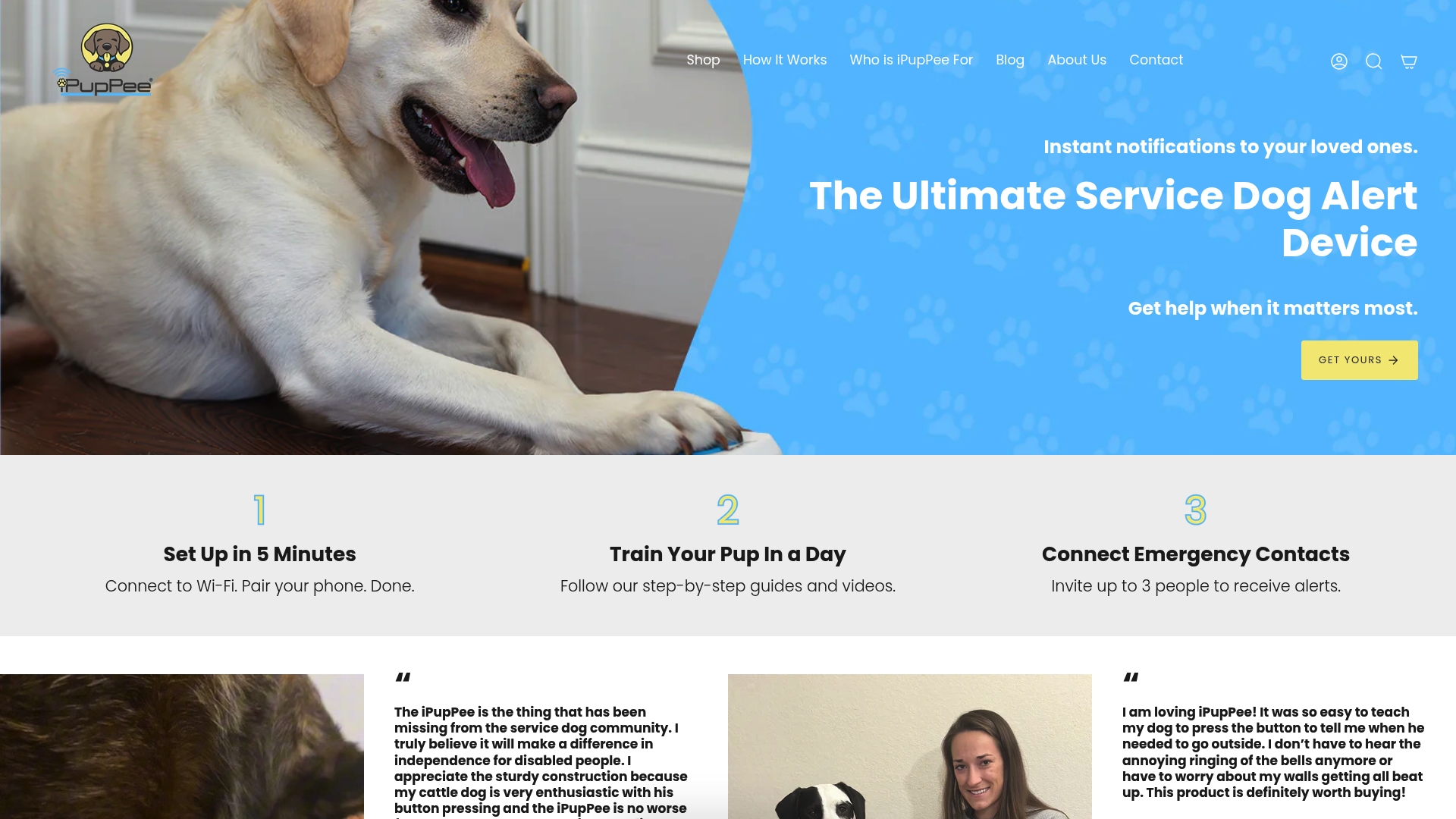
- Instant Wi-Fi alerts to several contacts the moment a dog presses the button.
- Real-time video and two-way audio so an owner or emergency contact can see and hear what’s happening.
- The device’s core notification features do not require monthly subscription fees.
- A companion Psychology & Training Course that teaches a dog how and when to use the alert button.
A predictive system tells you something is trending the wrong way; iPupPee gives your dog a direct line to tell you something is wrong right now. The two work well together, especially for service-dog teams, seniors living alone, or anyone who wants a safety net that doesn’t depend on a sensor catching a pattern in time. Visit the iPupPee product page to see sizing and setup details, or add shipping protection at checkout to cover your order against damage, loss, or theft in transit.
FAQ
What is the 3-3-3 rule for pets?
The 3-3-3 rule is a general guideline for newly adopted dogs, describing roughly three days to decompress, three weeks to learn a routine, and three months to feel fully settled. It’s a behavioral adjustment framework rather than a predictive safety metric, though a settling dog’s changing activity patterns are exactly the kind of baseline shift predictive monitoring is built to track.
What animal is best for anxiety and depression?
There isn’t one scientifically established “best” animal for anxiety or depression, since the right companion depends heavily on an individual’s lifestyle, living situation, and ability to care for the animal. Dogs and cats are the most commonly chosen companion animals for emotional support, and predictive monitoring tools can help owners track a companion animal’s well-being alongside their own.
What are the three toxic foods you should never feed your dog?
Chocolate, grapes and raisins, and onions and garlic are among the most commonly cited foods that are toxic to dogs. Environmental and ingestion-related sensors in some predictive safety systems can flag unusual activity or distress patterns after exposure, but they don’t replace immediate veterinary contact if ingestion is suspected.
Do dogs say goodbye before they pass away?
There’s no scientific consensus that dogs exhibit a universal “goodbye” behavior before death, though many owners report noticeable changes in activity, appetite, or affection in a pet’s final days. A gradual activity decline is one of the patterns predictive monitoring is designed to catch early, which is why vets often recommend tracking trends rather than relying on memory alone.
How accurate are predictive pet safety devices?
Accuracy varies by sensor type and by how well a device is calibrated to an individual pet. Peer-reviewed studies on accelerometer-based pruritus monitoring report sensitivities around 77 to 87 percent and specificities near 99 percent for detecting scratching, though broader behavior-prediction tools still need more standardized validation.
Sources
- Predictive analytics and sensor fusion in animal health (PMC article)
- The expanding role of artificial intelligence in companion animal care: systematic review (PubMed)