

What inclusive pet care really means
Inclusive pet care is the practice of delivering veterinary and pet services that are accessible, personalized, and respectful of the full range of needs that pets and their owners bring to the table. It is not a single policy or program. It is a philosophy that recognizes pets as family members and treats their care accordingly, regardless of the owner’s income, language, cultural background, disability status, or the pet’s breed, size, or medical complexity.
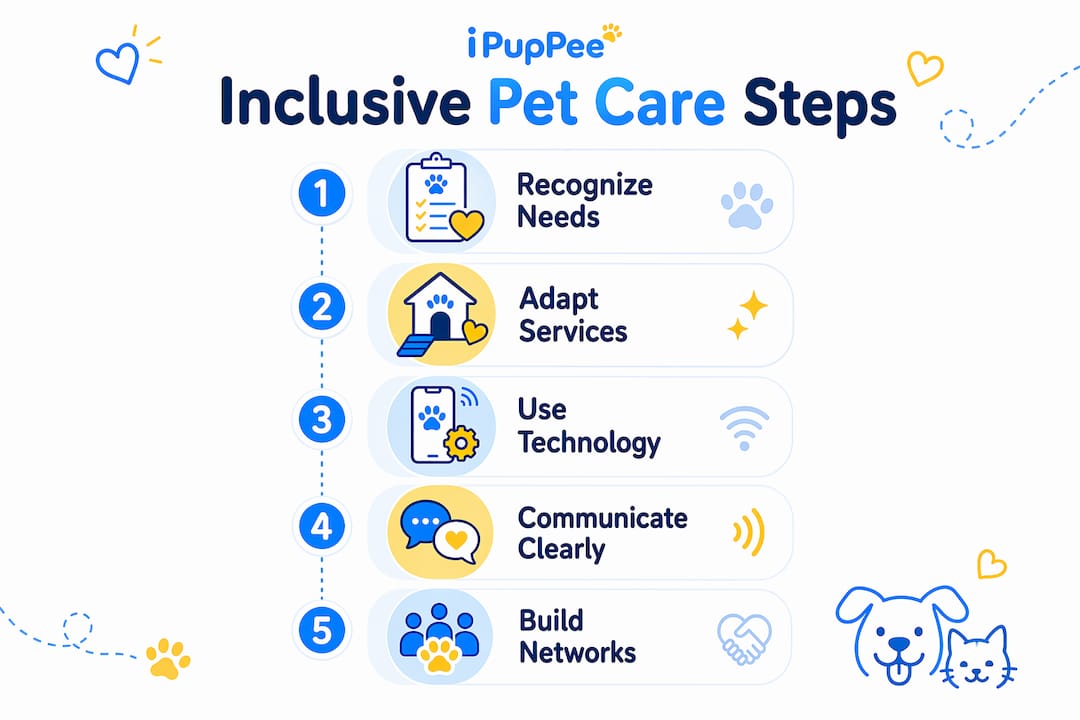
At its core, inclusive pet care rests on a few non-negotiable elements:
- Accessibility: Services that are physically reachable, financially workable, and free from arbitrary restrictions like breed or weight limits
- Communication: Clear, culturally respectful dialogue between caregivers and owners, including support for language barriers
- Personalization: Treatment plans built around what is actually feasible for each family, not a one-size-fits-all “gold standard”
- Safety and connection: Tools and practices that keep pets and owners connected, especially when disability, age, or distance creates gaps
- Collaboration: Networks of private and nonprofit providers working together rather than competing, so no family falls through the cracks
The AAHA Community Care Guidelines describe this as a “collaborative, noncompetitive paradigm” that places the family, both human and animal members, at the center of care delivery.
Table of Contents
- Why inclusive pet care principles matter for your dog’s well-being
- How veterinary practices and pet services put inclusive care into action
- Devices that improve how your dog communicates with you
- Cultural, financial, and emotional inclusivity in pet care
- Inclusive pet care in action: real-world examples
- Where to learn more about inclusive pet care practices
- Key Takeaways
Why inclusive pet care principles matter for your dog’s well-being
The guiding principles behind truly inclusive care go well beyond good intentions. They translate into measurable differences in how pets are treated and how owners experience the process.
The spectrum of care model is one of the most practical of these principles. Rather than defaulting to the most advanced and expensive protocol, veterinary teams discuss feasible treatment plans collaboratively with clients, factoring in financial constraints and lifestyle realities from the start. This approach reduces moral distress for both the veterinarian and the owner, who no longer has to choose between debt and guilt.
The One Health systems framework takes this further. Research published in the Journal of One Health Systems emphasizes that pet inclusion in family-centered health strategies directly addresses social determinants of health. When a senior living alone loses access to pet care, the ripple effects reach their own physical and mental health.
Key principles and their benefits at a glance:
- Family-centered practice: Treats the household, human and animal, as one interconnected unit
- Diversity, equity, inclusion, and belonging (DEIB): Ensures care quality does not vary by race, gender, ability, or income
- Spectrum of care: Matches treatment options to what each family can realistically sustain
- Reduced moral distress: Veterinary teams experience less ethical conflict when they have flexible tools to offer
- Stronger owner-caregiver relationships: Owners who feel heard stay engaged with care long-term
How veterinary practices and pet services put inclusive care into action
Knowing the principles is one thing. Watching them work in a real practice is another.
The most effective inclusive practices build collaborative service networks rather than operating in isolation. A private clinic that refers clients to a nonprofit low-cost clinic when needed, rather than simply turning them away, is practicing community care in its most direct form. Some US-based pet care providers offer $0 initial consultations specifically to let owners assess whether the caregiver is the right fit before any financial commitment is made.
Communication is where many practices fall short. Addressing language barriers and cultural respect is not optional in a diverse country like the United States. Practices that tailor their communication to different client backgrounds see stronger long-term engagement. Practically, this means using interpreters, offering multilingual intake forms, and training staff to ask open-ended questions rather than delivering top-down instructions.
For service dogs and pets with complex behavioral or medical needs, consistent caregiver teams are non-negotiable. Rotating staff disrupts the trust and routine these animals depend on. A service dog handler who arrives to find a different caregiver each visit is not receiving inclusive care, regardless of how well-intentioned the practice is.
Best practices for inclusive pet service delivery:
- Proactively discuss financial constraints early, before presenting a treatment plan
- Use reflective listening and open-ended questions to understand owner priorities
- Maintain stable caregiver assignments for service dogs and special needs pets
- Connect clients to community resources and nonprofit partners when needed
- Remove non-evidence-based breed and weight restrictions from service policies
Devices that improve how your dog communicates with you
Technology has become one of the most direct routes to inclusive pet care, particularly for owners whose disability, age, or isolation creates real communication gaps with their dogs.
The iPupPee device, developed by Ipuppee, is a clear example of what pet communication technology can accomplish in practice. Dogs are trained to press a button to signal their needs, whether that is a bathroom break, discomfort, or a request for attention. For a disabled owner, a senior living alone, or a service dog handler managing a complex daily routine, that simple button press can prevent accidents, reduce anxiety, and strengthen the bond between dog and owner. User testimonials on the Ipuppee site describe improved safety, greater independence, and a noticeably stronger sense of connection after introducing the device.
The broader category of inclusive pet technology includes GPS-enabled collars, AI-monitored health systems, and remote cameras, but the iPupPee stands apart because it puts communication agency in the dog’s paws rather than relying entirely on owner observation.
- Who benefits most: Disabled individuals, seniors, new puppy owners, rescue dog handlers, and anyone whose dog has anxiety or behavioral complexity
- Core function: Button-press alert system trained to specific signals the dog already uses
- Safety outcome: Reduces accidents and missed distress signals, especially for owners who cannot always monitor their dog closely
- Emotional outcome: Owners report feeling more attuned to their dog’s needs and less anxious about leaving them alone
Pro Tip: Start with one button and one signal. Training a dog to communicate “outside” before adding more commands keeps the process clear and builds confidence for both the dog and the owner.
Cultural, financial, and emotional inclusivity in pet care
Barriers to pet care are rarely just about money. They are about language, cultural trust, emotional capacity, and whether a system was designed with your life in mind.

Removing arbitrary restrictions like breed and weight limits from housing and pet services disproportionately affects diverse communities. A family whose large-breed dog is excluded from an apartment building or a grooming service is not experiencing inclusive pet care, even if the service considers itself welcoming. These restrictions rarely have an evidence base in safety, yet they persist.
Financial inclusivity means more than sliding-scale fees. It means proactively raising the cost conversation before a treatment plan is presented, offering phased care options, and connecting owners to assistance programs. Owners who feel judged for asking about cost are less likely to return, which ultimately harms the pet.
Emotional inclusivity is the piece most often overlooked. Pet owners facing grief, chronic illness, or caregiver burnout need practitioners who acknowledge the emotional weight of the relationship, not just the clinical facts. Pets and senior health are deeply intertwined, and a care model that ignores the owner’s emotional state misses half the picture.
Pro Tip: When choosing a vet or pet service provider, ask directly: “How do you handle clients with financial constraints?” A practice that answers confidently and without judgment is practicing inclusive care.
Practical steps for implementing inclusivity at home and in your service choices include choosing a pet friendly hotel Garda that welcomes all pets and supports inclusive care.
- Choose providers who ask about your budget and lifestyle before recommending treatment
- Seek out services that offer consistent caregivers, especially for dogs with anxiety or special needs
- Advocate for removal of breed and weight restrictions in your housing or community
- Use communication devices like the iPupPee to reduce guesswork and strengthen your bond
Inclusive pet care in action: real-world examples
The principles above are not theoretical. They show up in specific, recognizable situations.
A service dog handler with a mobility disability works with a pet care provider that assigns the same two caregivers to every visit. The dog knows them, trusts them, and maintains the behavioral consistency the handler’s safety depends on. That is disability-inclusive pet care working exactly as it should.
A low-income family with a senior rescue dog visits a clinic that participates in a community care network. The veterinarian presents three treatment options at different price points, explains the trade-offs honestly, and connects the family to a local nonprofit for follow-up care. Nobody leaves feeling ashamed or dismissed.
A senior living alone trains her dog with the iPupPee device. When the dog signals at 2 AM, she knows immediately rather than waking to an accident. Her independence stays intact. Her dog’s needs get met. That is what special needs pet care looks like when technology and inclusive principles work together.
Where to learn more about inclusive pet care practices
For practitioners and pet owners who want to go deeper, the resources below offer grounded, evidence-based guidance.
The AAHA Community Care Guidelines are the most comprehensive framework available for US veterinary practices. They cover spectrum of care tools, DEIB implementation, and community network building in practical detail, available through aaha.org/community-care.
The Journal of One Health Systems publishes ongoing research on the intersection of human health, animal health, and social determinants, directly relevant to anyone building or evaluating inclusive care programs.
For pet owners, Ipuppee’s blog covers communication barriers, disability and pet care, and technology-driven approaches to keeping dogs safe and connected. It is written for owners, not clinicians, which makes it genuinely useful for day-to-day decisions.
Veterinary nurses and technicians looking to implement spectrum of care in their practice will find Today’s Veterinary Nurse a practical resource, particularly its coverage of relationship-centered communication techniques that make inclusive conversations with clients feel natural rather than scripted.
Key Takeaways
Inclusive pet care works when services are built around the real lives of pets and their owners, not around what is easiest for the provider.
| Point | Details |
|---|---|
| Inclusive care is a philosophy, not a policy | It combines accessibility, communication, personalization, and collaboration across every touchpoint of pet service. |
| Spectrum of care reduces moral distress | Discussing financial constraints early lets veterinary teams offer feasible plans rather than defaulting to high-cost protocols. |
| Consistent caregivers protect service dogs | Stable caregiver teams are critical for service dogs and special needs pets who depend on routine and trust. |
| Technology closes communication gaps | Devices like the iPupPee give dogs a way to signal their needs, directly benefiting disabled owners, seniors, and service dog handlers. |
| Removing arbitrary barriers advances equity | Breed and weight restrictions without evidence bases disproportionately affect diverse communities and should be challenged. |