

An environmental cue is something in a dog’s surroundings, such as a curb, a door, a leash on a hook or a person standing up, that tells the dog which behavior is likely to pay off right now. Good trainers use these cues on purpose so a dog can act without a command from you. This guide explains how they work, how to teach them, and where they matter most: independent work, service dog tasks and everyday reliability.
TL;DR
- Every behavior your dog performs already has a cue. The only question is whether you chose it or the dog picked it up by accident.
- Environmental cues come from the setting (a curb, a door, a sound), not from your voice or hand, which lets a dog respond when you cannot give instructions.
- Teach one by pairing a verbal cue with the setting, repeating until the dog does the behavior on its own, then fading your prompt.
- Check your own body language on video. Unintended signals from you can override the cue you think you are using.
- Build reliability by changing duration, distance and distraction one at a time, in more and more places.
Table of Contents
- What environmental cues are
- How the environment shapes behavior
- Why training location matters
- How to teach an environmental cue
- Watch yourself: unintentional cues
- Environmental cues in service dog work
- Making cues reliable: duration, distance, distraction
- Our perspective
- Put it into practice with iPupPee
- Putting cues to work at home
- FAQ
- Sources
What environmental cues are
In behavioral science, a cue is a signal that tells the learner a particular behavior is likely to be reinforced. One dog trainer’s write-up describes a cue as a discriminative stimulus, a signal that reinforcement is available if a specific behavior is performed. An environmental cue is simply one that comes from the world rather than from the handler.
The American Kennel Club gives the classic example: a dog trained to sit when it reaches a sidewalk curb. Nobody says “sit.” The curb does the talking.
Cues are not limited to what a dog sees. A shelter dog play program points out that cues can be environmental, tactile, whole-body, compound or olfactory, and that anything the learner can perceive can become one. A rustle of a treat bag, the feel of a harness going on, the smell of a vet clinic: all of these are cues whether or not you meant them to be.
Cues you taught and cues you did not
Most of the environmental cues your dog responds to were never trained. One trainer’s list of examples includes sunlight through a window cueing a jump onto the bed, a textured curb ramp cueing a sit, and a full bladder cueing urination. The point of that list is that every behavior your dog does has a cue behind it, a stimulus that signals the behavior is likely to be reinforced right now.
That is useful in two ways. You can notice the cues already working, and you can decide which ones to build on deliberately.
How the environment shapes behavior
A veterinary learning resource divides the dog’s world in two. The physical environment covers perceived space, visual, olfactory and auditory stimuli, other animals, relevant objects and devices that change perception. The behavioral environment covers the social interactions that can affect the dog, including how you move, speak and react.
This explains why a dog that performs perfectly in your kitchen can fall apart in a parking lot. The behavior was never tied only to your word. It was tied to the whole picture: the room, the smells, the time of day, you standing in a particular spot. Change the picture and the cue may no longer be there.
An example from a shelter setting shows the other side. A leash presented at the kennel door can cue a high-arousal chain of behavior, while adding reinforcement to the ground can change the response toward something calmer. Same dog, same leash, different environment, different behavior.
When the environment cues fear
Not every environmental cue is welcome. The Merck Veterinary Manual lists common triggers for fear in dogs, including loud, unpredictable noises like fireworks and specific places like veterinary clinics. For these, the goal is to change what the cue predicts.
The American Animal Hospital Association describes desensitization and counterconditioning as ways to help dogs accept or ignore stimuli that currently trigger unwanted reactions. The same guidelines caution against flooding, prolonged exposure to a frightening stimulus at a level that causes fear, because it can sensitize a dog and lead to learned helplessness. If your dog is reacting strongly to a sound or place, a veterinary behaviorist or certified trainer can build a plan around your dog’s actual thresholds. Our guide to noise desensitization using short clips below threshold shows what small, controlled steps look like.
It also helps to understand habituation, the process of ignoring repeated stimuli. The Merck manual notes that habituation is a key idea in helping dogs adjust, but that it does not automatically carry over to different sounds or sights. A dog used to the vacuum may still react to a drill.

Why training location matters
If the environment is part of the cue, then where you train is part of the lesson. Training only in the living room teaches a living room behavior. Practicing in a range of places is what turns a trick into a skill, and a dog trainer explains in more detail why the training environment matters for how a dog learns and responds.
A practical way to think about it: start where your dog can succeed, then move one step harder. Quiet room, then the backyard, then a quiet street, then a busy sidewalk. At each step, expect the behavior to get slightly worse at first. That is normal, not failure.

How to teach an environmental cue
There are two routes. You can teach a verbal cue first and let the environment take over, or you can train the environmental cue from the start. The IAABC Foundation, a professional animal behavior organization, notes that it is often more efficient to train the environmental cue from the start using marker training, capturing the dog’s behavior at the curb and then adding the sit.
Here is the version most handlers can follow:
- Pick one cue and one behavior. For example, a curb and a sit. Keep it specific so the dog can tell what predicts what.
- Make sure the behavior is solid first. A dog that does not yet understand “sit” cannot connect it to a curb.
- Pair the verbal cue with the setting. Approach the curb, say “sit,” and reinforce. The One Tail at a Time method is to pair a verbal sit with the curb or curb ramp and repeat until the dog starts sitting at curbs without being asked.
- Wait before you prompt. Once the dog is reading the curb, pause. A special education training resource describes the same idea for people: teaching an environmental cue and then waiting before prompting builds independence. With a dog, a two to three second pause is a good place to begin.
- Mark and reward the self-started behavior. The first unprompted sit deserves your best reward.
- Fade the verbal cue. Say it less often, then not at all, while the environment keeps doing the work.
- Repeat in new places. Different curbs, different streets, different lighting.
Common mistakes
- Prompting too fast. If you always speak a half second after the curb appears, your voice becomes the cue and the curb becomes background.
- Skipping the reinforcement. A cue only works while the behavior still pays off.
- Changing three things at once. New place, new distraction and new distance together is how a reliable sit disappears.
Watch yourself: unintentional cues
Dogs read bodies better than words. The IAABC Foundation warns that handlers must be careful not to accidentally replace verbal cues with unconscious body language, and recommends having an experienced third party observe a session or recording video for self-review.
Try it this week. Film a short session and watch it with the sound off. Look for a lean toward the dog, a glance at the curb, a hand drifting toward a pocket, a shift in your weight. If the dog sits just as you glance down, your glance may be the real cue.
A dog trainer training academy guide makes a related point: if you do not teach the cue you want, the dog will learn another one. The same guide recommends verifying that your dog understands a cue before expecting it in harder settings, to avoid frustration.
If you want to get better at reading the dog’s side of this conversation, our guides to dog body language and stress signals and to decoding dog behavioral signals are good places to start.
Environmental cues in service dog work
This is where environmental cues matter most. The IAABC Foundation explains that service dog training emphasizes environmental cues to encourage independent behavior and reduce reliance on verbal cues. The reason is simple: a handler may not be able to speak, see, reach or respond at the moment the dog needs to act.
Their example is a guide dog that refuses a forward cue when a car is approaching. The dog is reading the situation and overriding the handler’s cue, and that is exactly what the training aims for. One shelter play program even calls service dogs the gold standard of understanding different types of cues, including olfactory, whole-body and environmental ones.
Examples of cue chains
| Situation | Environmental cue | Trained response |
|---|---|---|
| Crossing a street | Curb or curb ramp | Stop and sit |
| Approaching traffic while the handler gives a forward cue | Moving car | Refuses to go forward |
| Entering a building | Door threshold | Settle beside the handler |
| Handler in distress at home | Handler’s position or sounds | Fetch help or trigger an alert |
The first two rows come from the sources above. The last two illustrate how teams commonly design tasks, and the exact behaviors depend on your dog, your needs and your trainer’s plan.
For more on building these skills, see our pages on service dog training tips, essential service dog behavior cues and service dog obedience.
Making cues reliable: duration, distance, distraction
A behavior is under stimulus control when a dog reliably and predictably performs it on cue, regardless of environmental conditions. Getting there takes structure.
A service dog training manual recommends training duration, distance and distraction individually before combining them, and practicing in progressively more distracting places. The AKC advises that distraction training can build confidence by starting with a small distraction and slowly building to larger, more enticing ones.
A simple progression for a curb sit:
- Quiet cul-de-sac, one curb, no one around.
- Same curb with a person walking past at a distance.
- A residential street with a parked car running.
- A busier block with other dogs far off.
- A downtown crossing at a busy time.
Move up only after the dog succeeds several times in a row. If the dog starts missing, go back one step. The dog training academy guide describes the broader goal as practicing to fluency, covering precision, speed, duration, distance and distractions, so the dog responds in varied situations.
Our perspective
We built iPupPee around one idea: a dog should be able to reach its person without waiting for a command.
Most training starts with the human talking. Environmental cues flip that. The dog notices something, a situation or a need, and does a learned behavior in response. A button press that sends an alert is, in the end, just another trained behavior, and like any other it works best when the dog understands what it is for and when the moment to use it has come.
That is why we pair our device with training guides and an on-demand dog psychology course. Our device is designed so dogs of all sizes can use it, and it has no monthly subscription fee. We want handlers, seniors and people living alone to spend their effort on teaching the dog, not on paying a bill.
Our advice: choose one situation, build the cue around it, practice it in several rooms and places, and film yourself to catch accidental signals. Small, steady steps beat long sessions. For more on why the tool has to fit the dog, read why we train dogs for independence.
Andrew
Put it into practice with iPupPee
If you want your dog to be able to contact you or your emergency contacts on its own, the iPupPee alert device is $129.99. It is a Wi-Fi smart alert that lets your dog send a notification with a button press, with live video and two-way audio. You can see how the pieces fit together on the How It Works page. The Psychology & Training Course, $119, walks you through the learning principles in this article at your own pace.
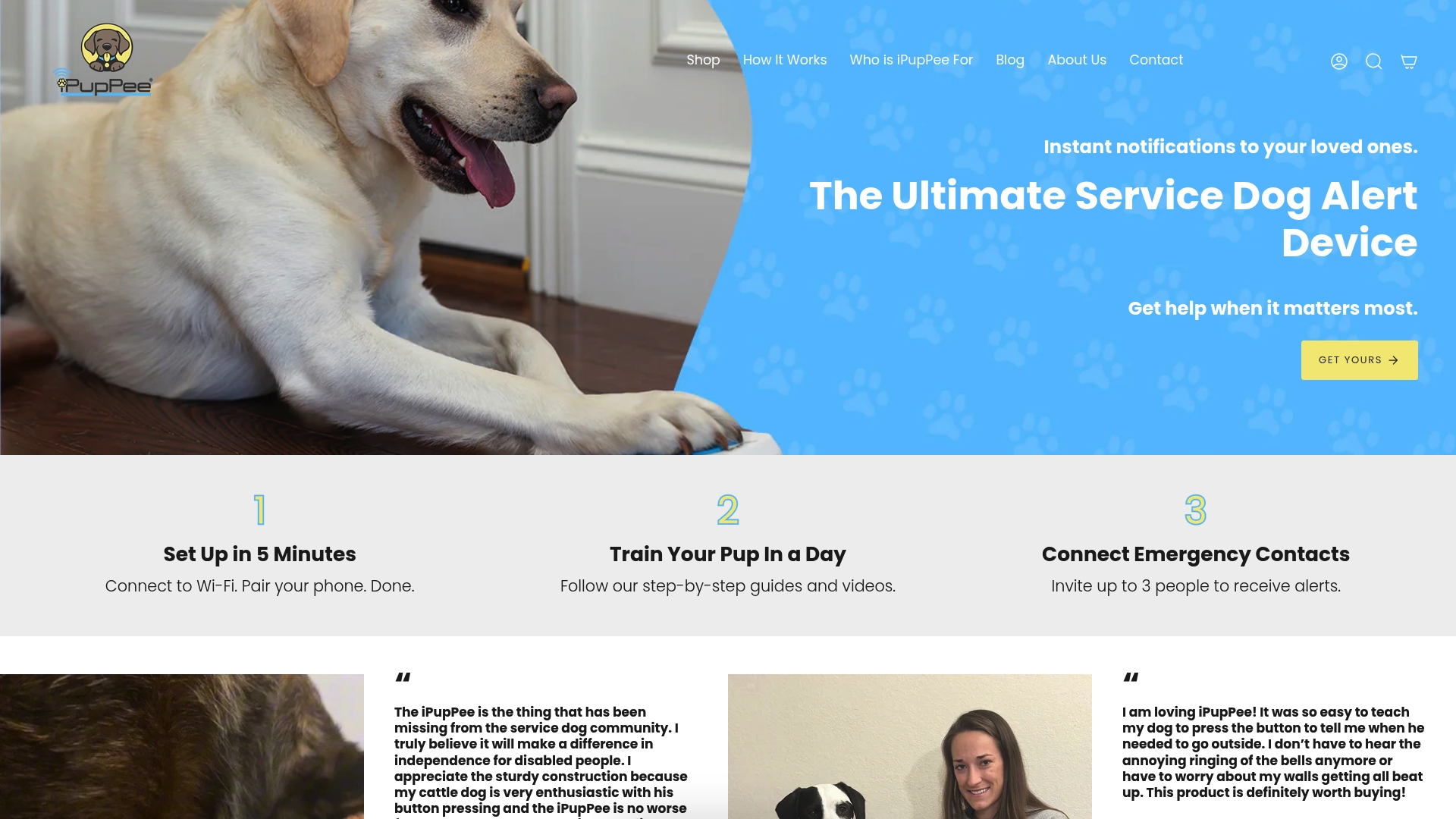
The course pairs well with the device, but you can start with either one. Shipping protection is available at checkout for $5.00 if you want your order covered against damage, loss or theft.
Putting cues to work at home
You do not need a service dog task list to use this. A few everyday ideas:
- Doorways: let the threshold cue a sit or a pause rather than repeating “wait” each time.
- Leash and harness: reward calm when the gear comes out so the cue predicts calm instead of frenzy.
- Mealtime: the bowl in your hand can cue a sit. Pick one and be consistent.
- Rest spot: a specific mat can cue settling. Reinforce there often.
For teaching commands that support all of these, our guide to teaching commands for better communication covers the basics, and our overview of service dog training challenges shows the common stumbling blocks.
FAQ
What are environmental cues in dog training?
They are signals from the surroundings, rather than from you, that prompt a trained behavior. A sidewalk curb prompting a sit is the standard example. Anything the dog can perceive, including sounds, smells and textures, can serve as a cue.
Can you give examples of environmental cues?
Common ones include a curb or curb ramp cueing a sit, sunlight through a window cueing a jump onto the bed, and a full bladder cueing urination. In service dog work, an approaching car can cue a dog to refuse a forward command. Many of the cues your dog follows were never deliberately taught.
What role does the environment play in behavior?
The environment supplies the context that tells a dog which behavior is likely to be rewarded. It includes physical factors such as space, sights, smells, sounds and objects, plus social interaction. That is why a behavior learned in one place often needs retraining in another.
How do I know if I am cueing my dog by accident?
Record a training session and watch it without sound, or ask an experienced trainer to observe you. Look for small body movements that happen just before your dog responds. If the dog acts on them, they have become the cue.
How long does it take to teach an environmental cue?
There is no fixed number, because it depends on the dog, the behavior and how often you practice. Expect many repetitions in each new place. Move to a harder setting only after your dog is consistently successful in the current one.
Sources
- AKC: Dog Training Terms & Lingo
- AKC: How to Train Your Dog to Stay Focused Around Distractions
- Shelter Dog Play: How and when do we add a cue to a behavior?
- Eileen and Dogs: Behavioral Cues I Didn’t Train
- One Tail at a Time: Making environmental cues work for you
- MSD Veterinary Manual: Behavior Problems of Dogs
- VIN: Understanding How Dogs Learn
- AAHA: Changing Behaviors
- Merck Veterinary Manual: Behavior Modification in Dogs
- IAABC Foundation: Environmental Cues in Service Dogs
- Freedom Service Dogs: Service Dog Manual
- VSA Learning Guide: Positive Training Tools and Methods