

Training a dog for independence means teaching it to reliably initiate help and complete practical tasks on its own, so the person it supports can live with more safety and less reliance on others. Research on service dogs links this kind of training to measurable gains in psychosocial health and daily functioning. We built iPupPee as a device and training system to support exactly this kind of work, and the steps below explain what the evidence shows and how the training actually happens.
TL;DR:
- One controlled comparison of 154 people found higher psychosocial wellbeing among service dog recipients than waitlisted people; a review of 24 studies found variable effects.
- Capture based training tends to produce more consistent alerts than cue based teaching because it rewards actions dogs offer naturally rather than waiting for prompts.
- Teach the trigger in a quiet room, then add distance, noise, people, and locations; move into public settings after activation on nine of ten tries.
- Choose a trigger that fits the dog’s size and natural reach, then confirm each activation with immediate feedback to prevent confusion and reduce false alarms.
- iPupPee sends wireless alerts, plus live video and audio that multiple contacts can use to respond, without a monthly subscription fee.
Table of Contents
- What independence training achieves for handlers
- Core tasks dogs can learn to enable independence
- How devices and trained behaviors work together
- Practical training roadmap: step-by-step to independence
- Welfare, caregiver effects, and what success looks like
- Author perspective: setting realistic expectations
- How iPupPee supports independence training
- FAQ
- Sources
What independence training achieves for handlers
Independence training changes what a handler can do without waiting on another person. A dog that reliably alerts to a medical event, fetches a phone, or presses a notification button closes a gap that used to require a caregiver standing nearby.
A study found that people paired with mobility or medical service dogs scored significantly better on psychosocial health measures, including social, emotional, and work or school functioning, compared with people on a waitlist for a dog. That is not a small effect on daily life. It shows up as:
- Fewer moments where immediate human assistance is required for routine tasks.
- Broader participation in work, school, and community activities.
- Faster response during a medical event because the dog can summon help directly.
A controlled comparison of 154 people found that those with a placed service dog scored significantly higher on psychosocial wellbeing than those still waiting for one, a gap tied directly to the dog’s trained tasks rather than companionship alone, according to a study on service dogs and psychosocial health.
Core tasks dogs can learn to enable independence
Independence tasks are different from comfort behaviors. A dog that leans against someone during anxiety is providing comfort. A dog that presses a specific button to alert a contact, retrieves a dropped medical device, or braces to support balance is performing a disability-linked task with a measurable outcome.
Trainers generally rely on two methods to build these tasks:
- Capture-based training, where the dog’s spontaneous behavior (a nose bump, a paw touch) is rewarded until it becomes a reliable, repeatable action.
- Shaping, where small steps toward a target behavior are reinforced in sequence until the full task is formed.
- Interface selection, choosing an ergonomic trigger such as a nose touch, a bite tug, or a paw press that fits the dog’s size and comfort, a design approach supported by animal-computer interaction research on wearable alert systems.
Capture-based methods tend to produce more consistent alerting behavior than purely cue-based teaching, since the dog is rewarded for an action it already offers naturally rather than one it must be prompted to perform.
How devices and trained behaviors work together
A trained task only becomes useful for independence when it connects to something the outside world can respond to. This is where a device bridges the dog’s action and the human response.

A well-designed alert device does three things: it gives the dog a clear, physical trigger to activate; it sends a configurable notification, whether that is a message, a live video feed, or two-way audio to one or more contacts; and it gives the dog immediate feedback that the activation worked, as detailed in the explanation of a GPS tracker with SOS. Pilot research on wearable interfaces for working dogs found that dogs can reliably activate sensors like bite, tug, or nose-touch triggers when the hardware is built around canine ergonomics rather than adapted from human tools, according to FIDO research on canine communication interfaces.
Good device design for this purpose shares a few traits:
- A trigger sized and placed for the dog’s natural reach and bite or paw strength.
- Immediate, consistent feedback (a sound, light, or vibration) so the dog knows the activation registered.
- A low false-positive rate, so accidental triggers do not erode trust in the system or overwhelm contacts with false alarms.
Pro Tip: Test a new device trigger in a calm, low-distraction room first, and only move to real-world settings once the dog activates it correctly on nine out of ten tries.
Our guide to how dogs alert owners using devices walks through specific device types and how training ties into each one.
Practical training roadmap: step-by-step to independence
A reliable alert behavior is built in stages, not taught in a single session. Rushing the sequence is the most common reason a trained task fails under real conditions.
- Foundation work: build focus, basic targeting, and a few rock-solid cues before introducing any device. A dog that cannot hold attention in a quiet room will struggle in a grocery store.
- Teach the exact interaction: use capture-based training where possible, rewarding the dog the moment it touches, presses, or tugs the actual device component it will use later.
- Proof the behavior: gradually add distance from the device, background noise, other people, and new locations, since a behavior learned in the living room does not automatically transfer to a parking lot.
- Chain the activation to the outcome: pair the physical trigger with the real consequence, a notification firing, a contact receiving video, so the dog associates the action with a completed result.
- Track milestones: cue-free activation (the dog acts without being prompted), context-appropriate activation (the dog only triggers when the situation calls for it), a low false-positive rate across varied settings, and visible comfort rather than hesitation around the device.
Pro Tip: Keep a simple log of each training session, noting correct activations, missed attempts, and any sign of stress, so progress is visible rather than guessed at.
Staged proofing, moving from home to room-to-room practice to public spaces, lets a handler or trainer catch problems early rather than discovering them during an actual emergency. Our training roadmap and milestone guide covers this sequence in more detail, and expert service dog training tips offers additional technique-level guidance.
Welfare, caregiver effects, and what success looks like
Independence training works best when it also protects the dog’s wellbeing. A task that causes stress or confusion will eventually break down, no matter how well it was taught at first.
A Swedish longitudinal study of people placed with certified service or hearing dogs reported small but measurable improvements in quality of life, wellbeing, and activity level after placement, with individualized training and caregiver preparation strongly predicting better outcomes, according to longitudinal research on service and hearing dogs. A systematic review of 24 studies found generally positive but variable effects on psychosocial domains, a reminder to set realistic expectations rather than assume uniform results, per a systematic review of assistance dog outcomes.
Handlers can track progress with a few concrete signals:
- Time spent outside the home without needing a second person present.
- Frequency of emergency calls or missed medical events before and after training.
- Self-reported confidence or autonomy in daily routines.
Our guide to service dog handler essentials covers how handlers can reduce their own workload while supporting a dog through this process.
Author perspective: setting realistic expectations
Three things matter most in this work: safety-first design, so a device never adds risk; dog welfare, so no task is forced past what the dog can comfortably offer; and measurable independence, so progress is tracked rather than assumed. Readers can explore our training course and device training guide for more detail on how these priorities play out in practice.
— Andrew
How iPupPee supports independence training
We built the iPupPee device to give dogs a simple, reliable way to call for help, sending Wi-Fi alerts along with live video and two-way audio to multiple contacts, without a monthly subscription fee. It pairs with our Psychology & Training Course, which walks handlers through capture-based methods and device-specific proofing steps.
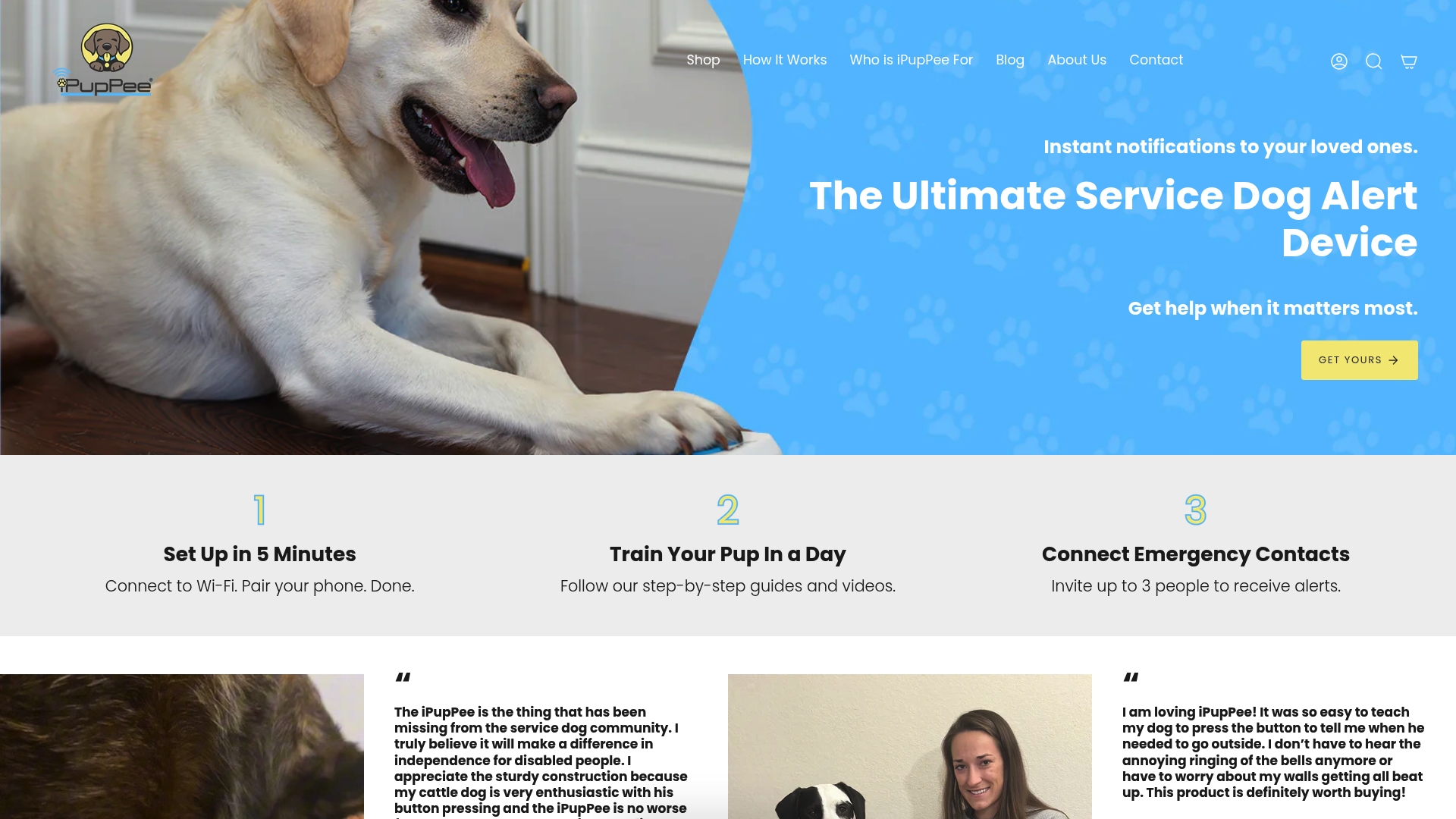
What this gets you:
- A device trigger sized for dogs of different sizes and strengths.
- Step-by-step training guides built around the same roadmap covered above.
- Direct alerts to multiple contacts without recurring fees.
Start with the iPupPee product page to see device details, or pair it with the training course if you want structured, guided instruction from day one.
FAQ
What does it mean to train a dog for independence?
Training a dog for independence means teaching it to reliably perform disability-linked tasks, like alerting to a medical event or activating a communication device, without constant handler prompting. This differs from general obedience because the dog’s action has to trigger a real, useful outcome for the handler.
How long does it take to train a dog to use an alert device?
The timeline varies by dog and task complexity, since foundation work, device-specific training, and proofing across different environments each take their own amount of time. Progress is better measured by milestones, such as cue-free and context-appropriate activation, than by a fixed calendar.
Can any dog learn to use a communication or alert device?
Most dogs can learn a basic trigger action like a nose touch or paw press when the device is ergonomically matched to their size and the training uses capture-based methods. Individual temperament and physical ability still shape which exact task and interface work best, as research on canine-activated interfaces points out.
Does training for independence actually improve quality of life?
Research links service dog placement to measurably better psychosocial health, including social and emotional functioning, compared with people still waiting for a dog, according to a study on service dogs and psychosocial health. A broader systematic review found generally positive but variable results across different quality-of-life domains, so outcomes differ by individual and by the specific tasks trained, per a systematic review of assistance dog outcomes.
How do I know if a training task is stressing my dog?
Watch for avoidance of the device, repetitive or obsessive behavior around the trigger, or changes in appetite and play, which can signal the task demand is too high. If any of these appear, reduce the task’s difficulty, re-check the device’s ergonomic fit, and consult a behaviorist before continuing.
Sources
- FIDO: Facilitating interactions for dogs with occupations — wearable communication interfaces for working dogs
- The effects of service dogs on psychosocial health and wellbeing for individuals with physical disabilities or chronic conditions
- The effects of assistance dogs on psychosocial health and wellbeing: A systematic literature review
- The impact of service and hearing dogs on health-related quality of life and activity level: a Swedish longitudinal intervention study