

Voice-activated pet gear is any product that connects your voice, or your pet’s own actions, to sound. Some products play your recorded voice to your dog. Others let a dog press a button that says a word, or sends a message to you. The category runs from simple recordable buttons and talking toys to Wi-Fi devices that alert you when your dog asks for help. This guide explains each type, how it works, what research says about it and how to pick the right one for your household.
TL;DR
- “Voice-activated” is a loose label. It covers recordable talking buttons, toys that play recorded voices, collar and app devices that play your voice, and button-triggered alert systems.
- Most products work through association: your dog learns that a sound or a press leads to something it wants.
- Evidence that talking buttons let dogs truly “speak” is still limited. They are best treated as a training and enrichment tool, not a translator.
- Choose by purpose: play, training, calming, or safety and alerts. Each purpose needs different gear.
- Never let any gadget replace learning your dog’s body language or a vet’s advice.
Table of Contents
- What voice-activated pet gear actually means
- How voice-activated gear differs from ordinary pet toys
- How talking buttons and voice toys work
- Do talking buttons really work?
- What dogs can learn to say with this gear
- Training your dog to use buttons or voice toys
- Choosing gear: five questions to ask first
- Where alert devices fit in
- Our perspective on voice-activated pet gear
- Getting started with iPupPee
- Mistakes to avoid
- FAQ
- Sources
What voice-activated pet gear actually means
There is no single product behind the phrase. Industry coverage of voice products for dogs describes a mix of recordable sound buttons that play the owner’s voice when pressed, plus toys or inserts that play recorded voices. The same reporting notes that apps and collar devices can play your recorded voice at set times to help with separation anxiety.
That tells you something useful: the category is defined by sound, not by a single technology. It helps to sort products by who starts the interaction.
| Type | Who triggers it | What it does | Best for |
|---|---|---|---|
| Recordable talking buttons | The dog presses | Plays a word or short phrase you recorded | Training, enrichment, curious dogs |
| Voice toys and inserts | The dog squeezes or moves the toy | Plays a recorded voice or sound | Play, comfort, mental stimulation |
| Voice-playback collars and apps | A schedule or you, remotely | Plays your voice to the dog | Separation anxiety, calm routines |
| Alert buttons with Wi-Fi | The dog presses | Sends a notification to you or contacts | Safety, service dogs, living alone |
The first three mostly send sound toward the dog. The last sends information from the dog to a person. That direction matters more than any feature list.
How voice-activated gear differs from ordinary pet toys
A regular toy is passive. Your dog chews it, chases it or tugs it, and nothing changes. A voice-activated product responds. It gives feedback, and that feedback is what makes it a teaching tool.
Industry reporting says voice products for dogs are used mostly for monitoring, training, calming, communication and play. Notice that only one of those is play. Most of the category is about routine and behavior, which is why a talking button can sit on a trainer’s shelf next to a clicker rather than in the toy bin.
There are three practical differences:
- Cause and effect. The dog does something and the product answers, so the dog can learn the link.
- Your voice is part of it. Many products rely on recordings of you, which can carry familiarity and routine.
- It asks something of you. A button that says “outside” is only useful if you respond reliably.
How talking buttons and voice toys work
The mechanism is simple. You record a word, usually one clear word per button, and place the button where your dog can reach it. Each time the dog presses, the word plays.
Why would a dog do this at all? Researchers explain that a dog could learn to press a button through operant conditioning, where a behavior followed by something the dog wants is more likely to continue. A pet soundboard is designed to let animals interact with recorded words, and through associative learning some animals learn that pressing a button brings a specific outcome.
In plain terms: press, hear “outside”, and the door opens. Repeat that enough times and many dogs start pressing on purpose. Whether the dog understands the word the way a person does is a separate question, covered next.
Voice toys work on the same principle without the word-learning goal. A squeeze triggers a recorded sound, which can make the toy more engaging for dogs that get bored with silent ones.
Do talking buttons really work?
The honest answer: dogs can learn to press buttons, and that is a real, useful behavior. Whether it amounts to language is still debated.
Here is what the sources say.
In favor. A UC San Diego-led study tested 30 trained pet dogs and found contextually appropriate responses to the words “play” and “outside”, whether spoken or played by buttons. A researcher quoted by the Templeton World Charity Foundation says pets use buttons intentionally, press some more than others and can combine them in non-random ways.
Caution. An earlier explainer in The Conversation noted that, at the time, evidence that buttons enable communication was limited and anecdotal. Dogs may be reading your body language, and button pressing may not carry over when a new pet-sitter gives a command. The AKC adds that dogs differ in how they learn soundboards and some may not learn to use them, so patience and modest expectations are sensible.
A deeper concern. An academic paper on talking dogs warns that button-based communication risks anthropomorphism and may make people less attentive to dogs’ nonverbal communication. It also raises the perspective that soundboards may quiet natural expressions such as barking, whining and posture by replacing them with human-like voices.
The practical takeaway is balanced. Buttons are a fun, structured way to teach choices and build a shared routine. They are not proof your dog is forming sentences, and they should never push you to ignore the signals your dog already sends. Parade Pets makes a similar point: buttons should not replace learning a dog’s natural communication, including body language and early signs of stress. If you want to sharpen that skill, our guide to decoding your dog’s body language is a good place to start.

What dogs can learn to say with this gear
Most successful setups begin with concrete, easy-to-honor requests, because the dog needs a reliable result each time.
- Needs: “outside”, “water”, “food”.
- Activities: “play”, “walk”, “treat”.
- Social cues: a name for a person in the household, if you consistently respond to it.
The common thread is consistency. If “outside” sometimes opens the door and sometimes gets ignored, the dog learns the button is unreliable. Start with two or three words you can always answer, and add more only when the first ones are solid.
A button can also do something a word button cannot: summon help. Instead of a word, the press sends a signal to a person who is not in the room. That is the safety category, and it solves a different problem than vocabulary.
Training your dog to use buttons or voice toys
Training guidance varies by trainer, and the method below follows the general operant-conditioning logic described above rather than any single study. Treat it as a starting framework and adjust to your dog.
- Pick one word and one outcome. “Outside” should always lead to a trip outside.
- Place the button near the place the action happens. A button by the door for “outside” makes the link obvious.
- Press it yourself, then do the thing. Say it, press it, open the door. Repeat across the day.
- Reward any interest. A sniff or paw touch can earn a press-and-respond at first.
- Respond every time. Reliability is what makes the behavior stick.
- Add a second word only after the first is steady. Rushing to a big board is the most common stall.
- Keep sessions short and stop on a success.
Expect differences between dogs. A food-motivated, attentive dog may pick it up quickly. A dog that finds the buttons uninteresting may need weeks, or may never take to it. That is normal and says nothing about your dog’s intelligence.
For more detail, our articles on teaching your dog to use buttons and button communication for owners and trainers walk through the process, and why train with button devices covers the reasoning behind it.
Choosing gear: five questions to ask first
Researchers reviewing smart-device use with pets conclude that usefulness depends on the device’s capabilities, the pet’s behavior and how well it fits the household. Integrating technology into pet care is not one-size-fits-all. These questions make that concrete.
1. What problem am I solving? Boredom, training, anxiety and safety each point to different products. Buying a talking button to fix separation anxiety, or a voice toy to fix an emergency-alert need, will disappoint.
2. Does it need Wi-Fi, and do I have reliable coverage? A simple button works anywhere. A connected device is only as good as the network where your dog spends its time.
3. Who receives the signal? If you live alone, or care for an older relative, a notification to several people is more useful than a sound in an empty room.
4. What does it cost over time? Check for monthly subscriptions, replacement batteries and add-ons, not just the sticker price.
5. Is it safe for my dog? Look for sturdy construction, sealed battery compartments and parts that cannot be chewed off, and supervise early use. Check the manufacturer’s guidance for your dog’s size and chewing habits.
One health note: the same review of voice assistant skills cautions that following medical advice from voice assistants is risky, and owners should rely on veterinary expertise. If your dog’s behavior changes suddenly, such as new anxiety, restlessness or constant requests, talk to your veterinarian rather than adding more gadgets.
Where alert devices fit in
Talking buttons send words to you. Alert devices send a message to someone who may be far away. For people who live alone, have a disability, or rely on a service dog, that second job can matter more than vocabulary.
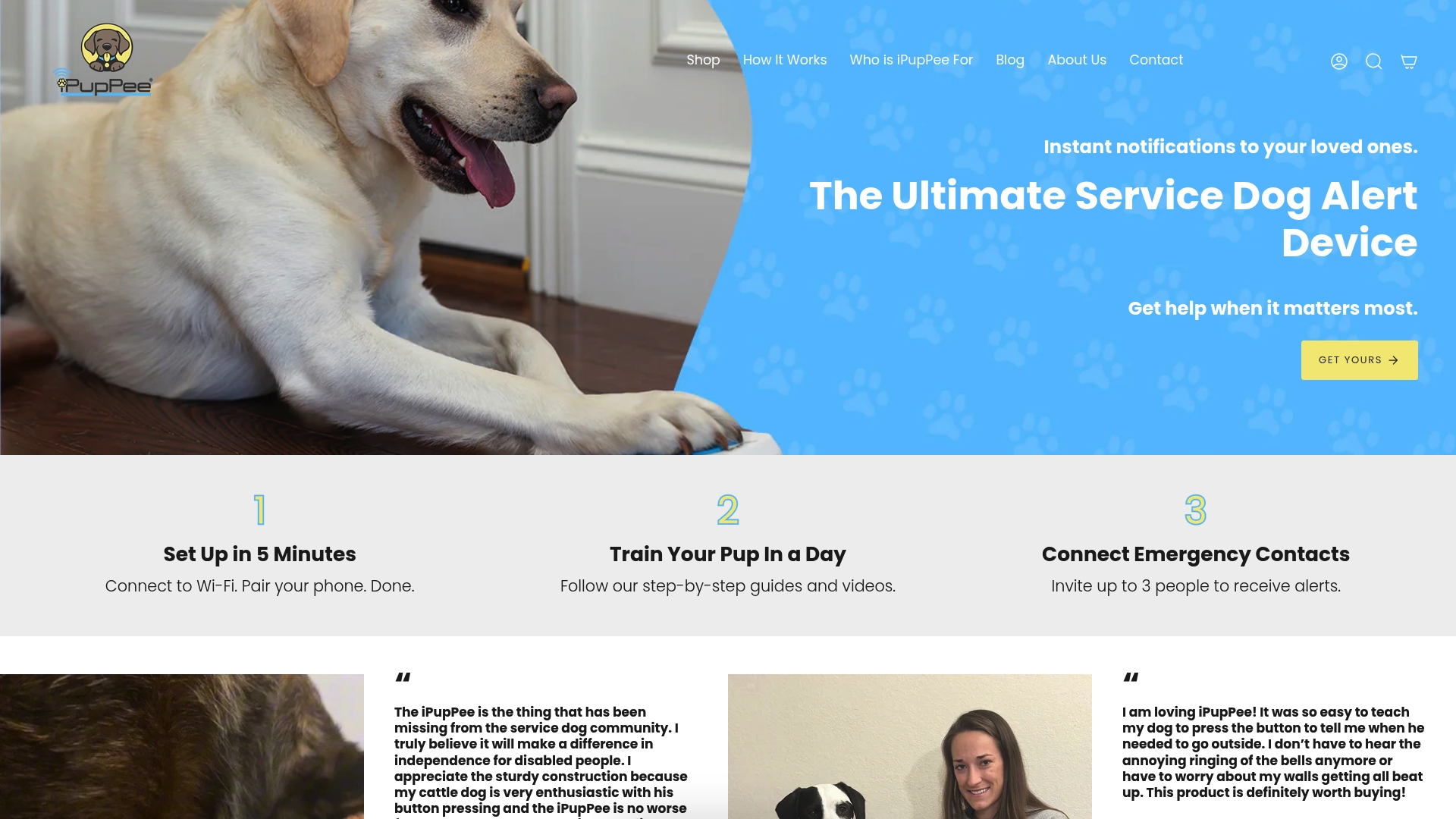
This is the space the iPupPee device occupies. It is a Wi-Fi enabled alert device: the dog presses it, and a notification goes to you or your emergency contacts, with live video and two-way audio so you can see what is happening and speak to your dog. It is designed for dogs of all sizes and does not require a monthly subscription fee.

What makes this different from a recordable button is the direction and the audience. A word button asks “what does my dog want?” An alert device asks “can my dog get help when I cannot reach the phone, or when I am in another room, or when I need someone to know something is wrong?” For handlers, seniors and people with limited mobility, that is a safety question first and a training question second.
If you want to see how interactive devices support both, read how interactive devices boost dog safety and cognition, or compare approaches in our overview of dog communication systems.
Our perspective on voice-activated pet gear
We build for a specific group: people who depend on their dogs, and dogs who may need to ask for help. From that vantage point, we see the same mistake repeatedly. Owners buy a gadget hoping it will do the understanding for them, and then the gadget sits unused.
The gear is the smaller half. The bigger half is a consistent routine and a person who pays attention. A button works when you respond the same way every time. An alert works when your dog has been taught, calmly and patiently, what pressing it does and when to use it. We would rather you spend a few weeks on gentle practice than a few minutes unboxing.
We are also careful about promises. Dogs are not little people, and a button does not turn a dog’s needs into perfect sentences. What it can do is give a dog a reliable way to get your attention, and give you a way to know when your dog is calling. For many of our customers, especially service dog handlers and those living alone, that reliability is the whole point. We built iPupPee around that idea, and we keep the training side honest through our dog psychology resources.
Our advice: start with the problem, not the product. Then pick the simplest tool that solves it.
— Andrew
Getting started with iPupPee
If your goal is safety, independence or a dependable way for your dog to reach you, the iPupPee alert device is $129.99 as a one-time purchase, with no monthly subscription fee.
Training is what makes any device work. Our Psychology & Training Course is $119, one-off, and covers how dogs think and learn so you can teach the press with confidence. An optional shipping protection add-on is $5.00 at checkout.
Mistakes to avoid
- Too many buttons too soon. A crowded board overwhelms most dogs and most owners.
- Inconsistent responses. If a press only sometimes works, it loses meaning.
- Reading too much into a press. A dog pressing “outside” might want to go out, or might want attention. Observe context.
- Ignoring body language. Stress signals still matter, and a button does not replace them.
- Skipping mental exercise. Talking gear is one tool among many. For ideas on calming and engaging your dog, see our list of mental stimulation ideas.
- Leaving electronics unsupervised with a heavy chewer. Introduce new gear while you are watching.
FAQ
Is voice-activated pet gear the same as a talking button?
Not exactly. A talking button is one kind of voice-activated gear. The category also includes toys that play recorded voices, collars and apps that play your voice at set times, and alert devices that send a message when your dog presses a button.
Do talking buttons for dogs really work?
Many dogs can learn to press a button to get a result, which is a real and useful skill. Whether they understand words the way people do is still unproven. A study of 30 trained dogs found appropriate responses to “play” and “outside”, but earlier reports were largely anecdotal.
How long does it take to teach a dog to use buttons?
It varies widely. Some dogs catch on within days of consistent practice, while others take much longer or never take to it. Start with one word you can always honor, keep sessions short, and be patient.
Can a button help if I live alone or use a service dog?
A word button will not call anyone for you. A connected alert device can notify you or emergency contacts when the dog presses it, which is the use case iPupPee is built for. Training your dog to use it reliably is essential.
Are electronic pet toys safe?
Safety depends on the product and your dog. Choose sturdy, well-sealed items, introduce them under supervision and follow the manufacturer’s size and age guidance. If your dog chews through plastic or swallows parts, talk to your veterinarian before using electronic toys.
Sources
- Voice products for dogs, GlobalPETS
- Do dog talking buttons actually work?, The Conversation
- Giving Pets a Voice: What Talking Buttons Can (and Cannot) Do, Templeton World Charity Foundation
- Can Dogs Talk With Buttons? Using Soundboards to Communicate, American Kennel Club
- Talking Dogs: The Paradoxes Inherent in the Cultural Construction of Canine Speech, PubMed Central
- 6 Expert-Backed Ways Dog Talking Buttons Build Your Bond, Parade Pets
- Alexa, Play Fetch! A Review of Alexa Skills for Pets, arXiv