

A simple, repeatable daily workflow is the fastest way to reduce canine anxiety: predictable cues, short activation, enrichment, and recovery cycles, and a daily settle practice. Start creating a calming dog routine workflow today with these five actions:
- Wake up and take your dog on a 15 minutes or more sniff walk before feeding.
- Feed meals at the same time every day, no exceptions.
- Run one short enrichment session (puzzle feeder, lick mat, or chew) mid-morning or at lunch.
- Practice a 5-minute settle or “go to mat” exercise once daily.
- Use a consistent bedtime cue (same phrase, same location, same time) every night.
Most dogs show measurable improvement within a few weeks of consistent repetition. The routine itself is the therapy.
Key Takeaways
A consistent daily workflow combining predictable timing, enrichment cycles, and settle training is the most effective way to reduce canine anxiety over a 4–8 week period.
| Point | Details |
|---|---|
| Predictability lowers stress | Consistent meal, walk, and rest times reduce cortisol and help dogs stop scanning for threats. |
| Enrichment cycles matter | Short activation, engagement, and recovery sequences work better than one long activity burst. |
| Settle training anchors the routine | Teach “go to mat” in a low-distraction environment first, then generalize over weeks. |
| Safe spaces support the workflow | A crate or dedicated rest corner, never used as punishment, gives dogs a reliable calm anchor. |
| Seek help at the right time | No improvement after 4–6 weeks of consistent effort, or any red-flag behavior, warrants a vet or behaviorist consult. |
Table of Contents
- Why a predictable daily schedule reduces your dog’s anxiety
- How to recognize anxiety in your dog before you start
- Sample daily calming routine templates you can use today
- How to teach the settle and “go to mat” cue step by step
- Which exercise and enrichment activities actually support calm
- How to set up a calming safe space and introduce the crate
- How to desensitize your dog to common triggers
- When should you call a veterinarian or certified behaviorist?
- How to measure your dog’s progress and adjust the workflow
- Common pitfalls that derail calming routines (and how to fix them)
- What I noticed in the first week of building a real routine
- Sources
Why a predictable daily schedule reduces your dog’s anxiety
Dogs are pattern-recognition animals. When they can predict what comes next, their nervous system shifts out of vigilance mode and into rest-and-digest. A predictable routine that schedules meals, walks, play, training, and rest helps dogs feel safer because daily events stop being surprises worth worrying about.
The mechanism is straightforward. Chronic unpredictability keeps cortisol elevated. Cortisol is the stress hormone that drives pacing, hypervigilance, and destructive behavior. Routine lowers the baseline. When days are similar, dogs can predict events and relax, which directly reduces the behavioral problems owners find most frustrating.
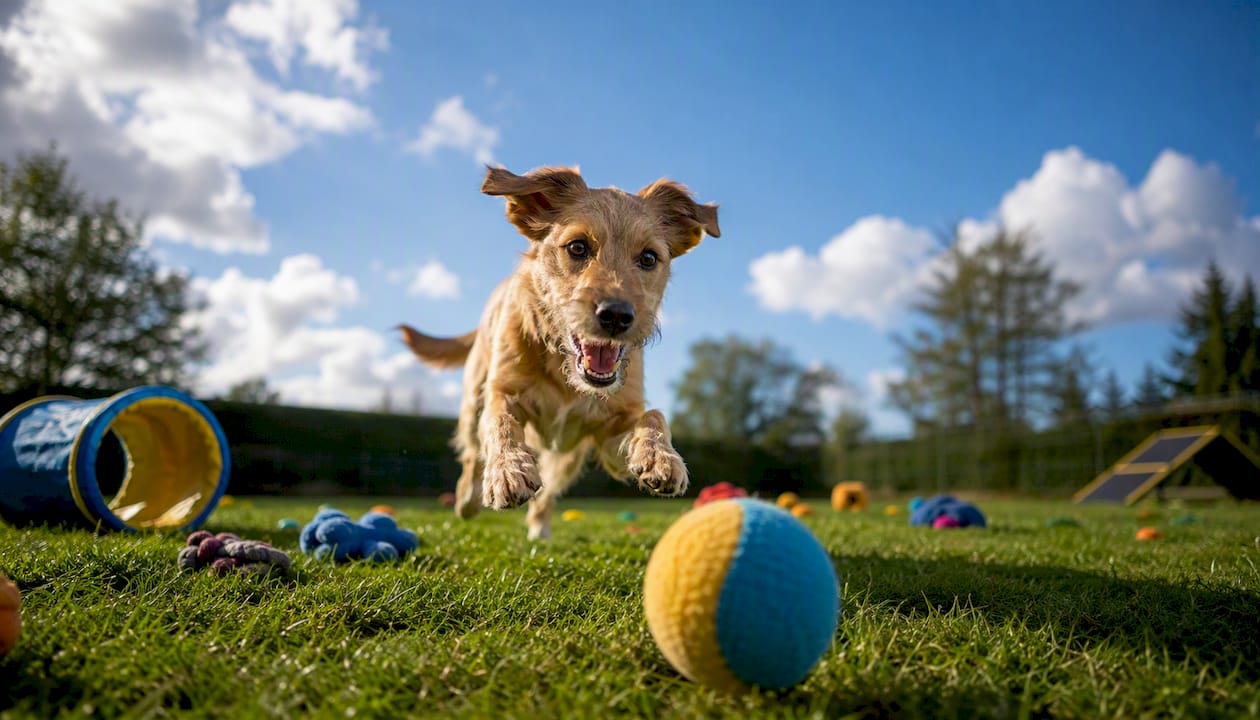
Enrichment cycles matter just as much as timing. A balanced daily enrichment cycle of activation, engagement, and recovery aligns with how the canine nervous system actually works. A dog that burns energy in a focused, structured way settles more reliably than one that gets a single long walk and then sits idle for eight hours. Short, purposeful activity followed by a clear rest signal is the pattern you are building toward.
Pro Tip: If your schedule is tight, protect the morning sniff walk and the bedtime cue above everything else. Those two anchors do more for predictability than any midday addition you might skip.
You can read more about why dogs thrive with routines and the behavioral science behind it on the Ipuppee blog.
How to recognize anxiety in your dog before you start
Before building any routine, you need a baseline. Knowing what you are working with tells you whether a structured schedule alone will do the job or whether you need professional support alongside it.
Common anxiety signs to watch for:
- Pacing or circling, especially before predictable departures
- Panting when not hot or post-exercise
- Hypervigilance (scanning the room, startling easily, unable to settle)
- Destructive behavior directed at exits (doors, windows, crates)
- Excessive vocalization when alone or during loud events
- Indoor elimination in a house-trained dog
- Yawning, lip-licking, or whale eye in low-stress situations
Severity matters. Mild anxiety looks like brief panting or restlessness that resolves within a few minutes of a trigger passing. Severe anxiety is different in kind, not just degree.
Red flags that indicate professional help is needed now:
- Self-injury during confinement or separation (broken nails, bloody paws, damaged teeth)
- Persistent pacing that lasts more than 20–30 minutes
- Aggression triggered by anxiety (redirected biting, snapping)
- Complete inability to eat, drink, or sleep during stressful periods
- Destructive escape attempts that risk physical harm
Sample daily calming routine templates you can use today
The templates below are starting points. Adjust times to your household, but keep the sequence consistent. Sequence matters as much as clock time because dogs read patterns, not clocks. Daily rhythm templates that include predictable feeding, walks, rest, training windows, and evening wind-downs create the foundation for calmer behavior.
| Time | Puppy (under 12 months) | Adult dog | Senior dog |
|---|---|---|---|
| 7:00 AM | Short sniff walk, breakfast | Sniff walk, breakfast | Gentle walk, breakfast |
| — | Chew or lick mat, nap | Puzzle feeder or training, brief | Lick mat, rest |
| 12:00 PM | Potty break, brief play, nap | Midday walk or enrichment, brief | Potty break, short sniff |
| 3:00 PM | Settle practice, snack | Settle practice, brief | Settle practice |
| 6:00 PM | Dinner, calm play | Dinner, moderate walk or play | Dinner, gentle interaction |
| 8:00 PM | Wind-down chew, crate/bed routine | Wind-down, mat cue | Wind-down, mat cue |
| — | Lights out, consistent bedtime phrase | Consistent bedtime cue | Consistent bedtime cue |
Owner home vs. owner away: The midday slot is where these two scenarios diverge most.
- Owner home: Use the 12:00 PM slot for a real walk or a 10-minute training session. This is your best window for settle practice repetitions.
- Owner away: Use a puzzle feeder or stuffed Kong in the crate at departure. A dog walker or neighbor covering the midday potty break makes a significant difference for dogs under two years old.
- Shifting timing: If your schedule changes, shift the whole block by no more than 30–45 minutes at a time. Abrupt schedule changes spike anxiety in dogs that have just started to stabilize.
For new owners building their first schedule, the step-by-step routine guide on Ipuppee walks through the onboarding process in detail.
How to teach the settle and “go to mat” cue step by step
Teaching a reliable settle behavior is the single most useful skill in a calming workflow. It gives your dog a job during high-arousal moments and gives you a tool that works when verbal commands alone fail. Settle training works best in a neutral, low-distraction environment first, with trainers progressively rewarding more relaxed postures and increasing the delay between rewards.
The Coaching Calm progression:
- Place a mat or folded blanket in a low-traffic area. Let your dog sniff it freely with no cue.
- The moment your dog steps onto the mat, mark with a quiet “yes” and drop a treat between their front paws (not hand-fed, which encourages movement).
- Reward any softening of body posture: weight shift back, elbows dropping, a sigh. Ignore soliciting or pawing.
- Once your dog is lying down reliably, begin adding a 2–3 second pause before the reward. Extend the pause by 1–2 seconds per session.
- Add mild distance: take one step back, return, reward. Build to 6–8 feet over several sessions.
- Introduce one mild distraction (a person walking past, a quiet sound) only after your dog holds the settle for 30+ seconds with no prompting.
- Once the behavior is solid in a quiet room, introduce the verbal cue (“settle” or “place”) just before the dog moves to the mat.
Practical tips for each session:
- Keep sessions to 3–5 minutes. Frequency beats duration: two sessions daily outperforms one long one.
- Use high-value treats (small pieces of chicken, cheese) for the first two weeks, then fade to lower-value rewards as the behavior strengthens.
- A light leash attached to a nearby anchor point helps during early stages if your dog wanders.
- Remote treat dispensers or tossed treats keep your body still, which reduces the dog’s tendency to orient toward you instead of relaxing.
Pro Tip: Introduce the verbal cue only after the dog is already moving toward the mat on their own. Adding the word too early pairs it with an uncertain behavior, which weakens the cue. Wait until the behavior is happening reliably, then name it.
For dogs that struggle with handling or touch during settle practice, the proven calming techniques guide on Ipuppee covers body-language-based approaches that complement this progression.
Which exercise and enrichment activities actually support calm
Not all exercise reduces anxiety. A 45-minute fetch session that ends with a dog still bouncing off the walls is activation without recovery. The goal is purposeful physical and cognitive work followed by a clear rest signal.
Activities that support calm:
- Sniff walks: Let your dog lead with their nose for 15–20 minutes. Sniffing activates the parasympathetic nervous system more effectively than brisk walking at your pace.
- Interval play: Two or three short play bursts (3–5 minutes each) with rest between them beat one long session for arousal regulation.
- Short obedience practice: 5–10 minutes of known cues (sit, down, stay) provides mental engagement without spiking physical arousal.
- Puzzle feeders and snuffle mats: Feed one meal per day from a puzzle feeder. The cognitive work tires a dog in a way that physical exercise alone does not.
- Lick mats: Licking activates calming physiology. A lick mat with peanut butter or plain yogurt works well as a post-walk recovery tool or a pre-departure buffer.
- Chew rotation: Rotate between two or three appropriate chews (bully sticks, raw bones, rubber chews) to maintain novelty. Chewing is self-soothing.
Frequency by age and energy level:
- Puppies need short, frequent bursts (3–4 times daily, 10–15 minutes each) with long naps between.
- Adult dogs with moderate energy do well with two structured walks and one enrichment session daily.
- High-energy breeds often need an additional mental enrichment session in the evening to settle reliably.
- Senior dogs benefit from shorter, more frequent gentle activity rather than one long outing. The Ipuppee senior dog care guide covers age-appropriate adjustments in detail.
For busy middays, a frozen lick mat or stuffed Kong left in the crate takes two minutes to prepare and gives your dog 20–30 minutes of focused, calming engagement.
How to set up a calming safe space and introduce the crate
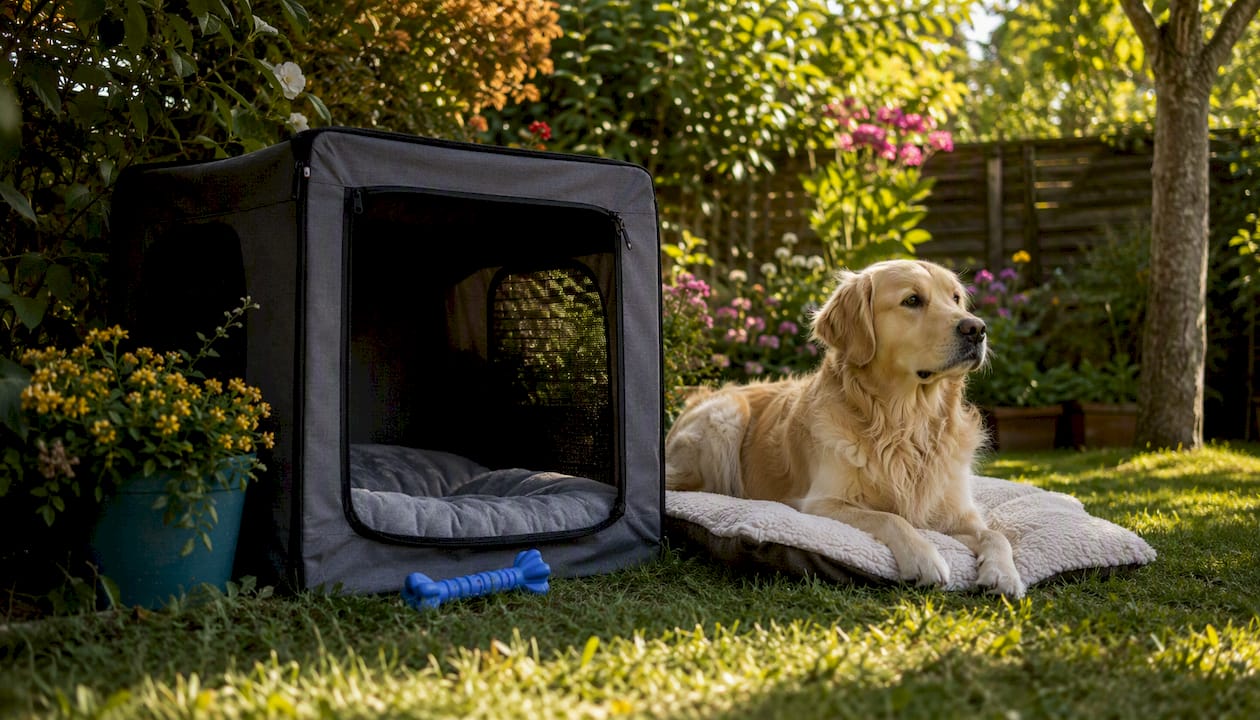
A crate is a rest zone, not a consequence. Dogs that associate their crate with punishment never fully relax in it, which defeats the purpose entirely.
Crate introduction steps:
- Place the crate in a low-traffic area with the door open and a soft blanket inside. Do nothing else for 24 hours.
- Toss high-value treats near the entrance, then just inside, over two to three sessions. Never push or lure the dog in.
- Feed one meal inside the crate with the door open. Once your dog enters freely, close the door for 30 seconds, then open it.
- Extend closed-door time by 30–60 seconds per session. Stay in the room initially.
- Begin brief absences: leave the room for 2 minutes while the dog is settled in the crate with a chew.
- Build to 30-minute crate sessions before attempting full departures.
Environmental setup for the safe space:
- Choose a corner with low foot traffic and no direct drafts or heating vents.
- Use consistent bedding that smells familiar. Wash it infrequently to preserve scent.
- White noise or a fan can mask sudden sounds that trigger startle responses.
- Keep the crate or bed in the same location. Moving it disrupts the spatial cue your dog has learned to associate with rest.
Never use the crate as a time-out for unwanted behavior. The moment it becomes associated with frustration or isolation, its value as a calming anchor drops significantly.
During high-stimulation events (holidays, guests, fireworks), proactively crate your dog with a high-value chew before the stimulation peaks. Waiting until they are already aroused makes crate entry much harder.
How to desensitize your dog to common triggers
Pattern-based fixes create automatic calming responses that are more reliable than verbal commands when arousal is high. Desensitization works by pairing a trigger with something positive at a low enough intensity that the dog stays under threshold.
Separation anxiety: a step-by-step plan
- Start with departures of 10–15 seconds. Pick up your keys, walk to the door, return. Reward calm behavior on your return, not at departure.
- Extend to 1 minute, then 3 minutes, then 10 minutes over one to two weeks. Predictable alone-time practice with progressively increased departures is the evidence-backed approach for separation-related anxiety.
- Vary the duration randomly (5 minutes, then 2 minutes, then 8 minutes) so your dog cannot predict the length and therefore cannot ramp up anticipatory anxiety.
- Never return when your dog is vocalizing. Wait for a 3-second pause, then re-enter calmly.
Doorbell and guest arrivals:
- Teach a “go to mat” response to the doorbell sound specifically. Ring the bell yourself, cue the mat, reward heavily.
- Practice with a helper outside 10–15 times before any real guest arrives.
- Ask guests to ignore the dog entirely on entry until the dog is calm and on the mat.
Loud noises (thunderstorms, fireworks):
- Play recordings of the trigger sound at very low volume during a calm activity (meal, lick mat). Increase volume over days, not hours.
- Never force exposure. If your dog shows distress at any volume level, drop back to the previous level.
Pro Tip: When a real trigger occurs before you have finished desensitization, redirect to an incompatible behavior immediately: cue “place” or offer a high-value chew. The goal is to interrupt the arousal spiral, not to train in that moment.
When should you call a veterinarian or certified behaviorist?
A structured routine helps most dogs with mild to moderate anxiety. Some dogs need more. Knowing when to escalate is not a failure of the routine; it is good judgment.
Red flags that warrant a professional consult:
- Self-injury during confinement or separation (raw paws, broken teeth, bleeding)
- Aggression that has escalated or is unpredictable
- Severe separation panic: the dog cannot eat, drink, or rest when alone
- No measurable improvement after four to six weeks of consistent routine
- Sudden onset of anxiety in a previously calm adult dog (rule out medical causes first)
Veterinary behaviorists recommend identifying the causes of anxiety and using behavioral modification first, with medications considered as adjuncts when needed. Medication is not a shortcut around training; it lowers the arousal baseline enough for training to work. The two together are more effective than either alone.
What to bring to your appointment:
- Your baseline behavior log (dates, triggers, duration, intensity)
- A short video of the behavior at its worst
- A written timeline of when the behavior started and what changed around that time
- Notes on what you have tried and how the dog responded
A certified applied animal behaviorist (CAAB) or a veterinary behaviorist (DACVB) is the appropriate specialist for severe cases. Your primary care vet is the right first call for sudden behavioral changes, which may have a medical root.
How to measure your dog’s progress and adjust the workflow
Logging does not need to be elaborate. A simple daily note takes two minutes and gives you the data to make good decisions.
What to log each day:
- Number of trigger incidents and their intensity (1–5 scale)
- Settle practice: did the dog reach a relaxed down? How long did it hold?
- Walk and enrichment duration
- Sleep and rest quality (restless, normal, deep)
- Any departures and the dog’s response
Review schedule:
- Daily: quick note in a phone app or notebook
- Weekly: look for trends (fewer incidents? longer settle holds?)
- 4-week milestone: compare week one to week four on trigger frequency and settle duration
- 8-week milestone: assess whether the dog generalizes calm to new environments or remains context-dependent
Adjustment rules:
- If settle duration is not increasing after two weeks, reduce distractions and shorten reward intervals.
- If trigger incidents are increasing, check for schedule drift (meals, walks shifting more than 30 minutes).
- If the dog regresses after a stressful event (travel, illness, new household member), return to the previous stage of the progression rather than pushing forward.
- If progress has plateaued for more than three weeks despite consistent effort, consult a professional before adding complexity.
Common pitfalls that derail calming routines (and how to fix them)
Most routines fail not because the method is wrong but because of predictable, fixable execution problems.
Common pitfalls checklist:
- Inconsistency across household members: If one person enforces the settle cue and another lets the dog jump and bark, the cue loses meaning fast. Every person in the house uses the same cues, the same rules.
- Rewarding excitement at greetings: Greeting an excited dog with matching energy teaches the dog that arousal gets attention. Greet calmly, wait for four paws on the floor, then acknowledge.
- Skipping recovery periods: Activation without recovery is just stimulation. After every walk or play session, give the dog 20–30 minutes of enforced rest before the next activity.
- Using the crate as punishment: Covered above, but worth repeating: one punishment association can undo weeks of positive crate conditioning.
- Raising treat value to manage a behavior problem: If your dog only settles for chicken, the settle behavior is not trained. It is bribed. Fade treat value gradually once the behavior is solid.
- Expecting linear progress: Dogs have bad days. A regression after a thunderstorm or a vet visit is normal. The trend over weeks matters, not individual sessions.
Practical fixes:
- Post a one-page household rules sheet in a visible spot. Keep cues to single words.
- Rotate treat value deliberately: high-value for new challenges, low-value for practiced behaviors.
- Use environmental patterns rather than verbal commands as the primary driver. The mat in the corner, the lights dimming, the same bedtime phrase: these cues work when your dog is too aroused to process words.
Pro Tip: Scale your expectations to your dog’s history, not your timeline. A rescue dog with two years of unpredictable living may take three months to show the stability a puppy raised on routine shows in three weeks. The workflow is the same; the timeline is not.
What I noticed in the first week of building a real routine
The first three days felt like nothing was working. The settle practice lasted about 90 seconds before my dog got up and wandered off, and the bedtime cue seemed to confuse him more than calm him. What changed by day five was subtle: he started going to his mat on his own around the time we usually practiced. Not because I cued him. Because the pattern had started to register.
That small, unprompted behavior was the signal that the routine was taking hold. The workflow was not changing his anxiety directly. It was changing his expectation of what came next, and that expectation was doing the calming work.
By week three, I reached out to a trainer for help with the doorbell response specifically. The routine had stabilized everything else, but that one trigger was still spiking his arousal in a way I could not manage alone. Getting targeted help for one piece of the puzzle while the rest of the routine held steady was the right call. You do not have to solve everything yourself.
Sources
The guidance in this article draws on veterinary and trainer-backed resources. Each link below goes to a specific, reliable source worth bookmarking.
- Anxious behavior: how to help your dog cope with unsettling situations | Cornell University College of Veterinary Medicine
- Dog Behavior and Training - Teaching Calm - SOFT and Handling Exercises | VCA Animal Hospitals
- Why your dog needs routine | AKC
- How to get your dog into a routine | Dogs Trust
- How to Build a Calming Daily Routine for Your Dog: Science‑Backed Structure – Zevapet
- Calming an Anxious Dog At Home: Why Predictable Routines Work Better Than Any Training Command - For Better For Dogs