

Not every dog safety device on the market is built with your service dog’s movement or your independence in mind. Some widely recommended options actually restrict shoulder extension, increase pulling force, or create communication gaps that put both handler and dog at risk. If you rely on your dog for medical alerts, mobility support, or daily independence, choosing the wrong device is not a minor inconvenience. It can compromise safety in real, measurable ways. This guide cuts through the noise to help you match the right technology to your specific needs, whether that means a better harness fit, a smarter alert collar, or a GPS solution that gives your dog safe off-leash freedom.
Table of Contents
- Understanding the types of dog safety devices
- Choosing the right harness or collar: Safety versus comfort
- Smart collars and sensor technology: Elevating communication and alerts
- GPS and escape prevention: Ensuring off-leash independence
- Why matching the device to the dog and handler matters more than any brand
- Explore trusted solutions for you and your service dog
- Frequently asked questions
Key Takeaways
| Point | Details |
|---|---|
| Personal fit is key | The best safety device matches your dog’s behavior, size, and your unique needs. |
| Tech boosts communication | Smart sensors and collars drastically improve accuracy and reliability for service dogs. |
| Harness choice affects movement | Front-clip and Y-shaped harnesses offer a balance of safety, reduced pull force, and comfort. |
| GPS devices safeguard independence | Modern GPS collars with virtual fences enhance off-leash safety for both dogs and handlers. |
Understanding the types of dog safety devices
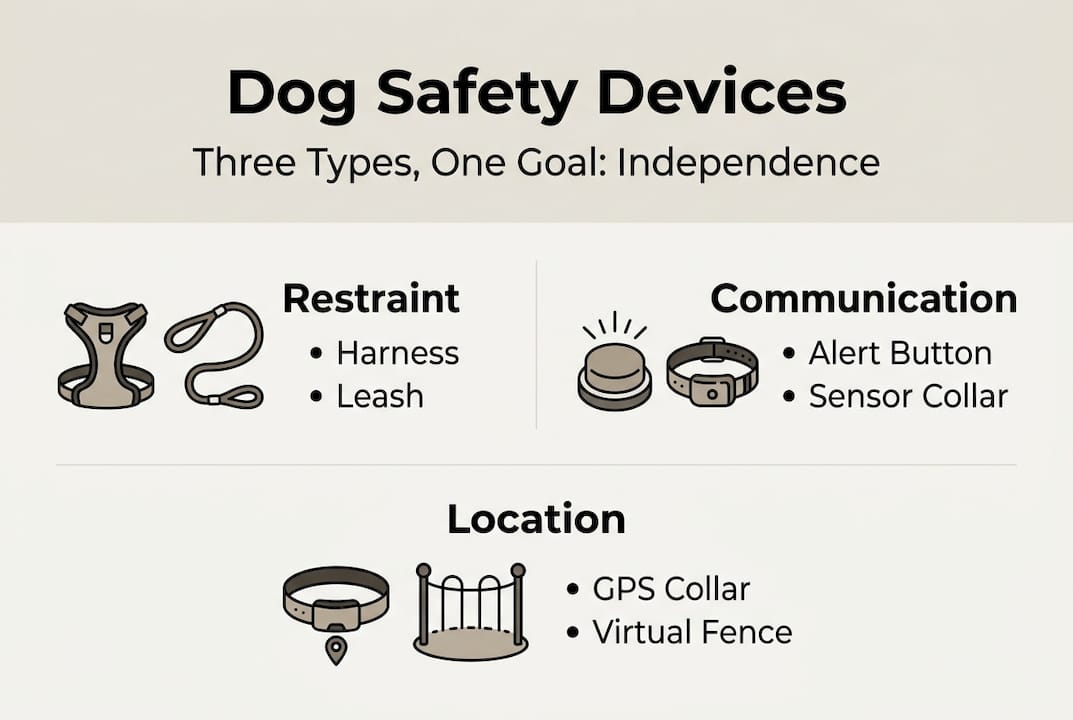
Before you can choose well, you need to know what you are actually choosing between. Dog safety devices fall into three broad categories, and each one serves a different purpose in the service dog and disability context.
Restraint devices include harnesses, collars, and leashes. These control movement and manage pulling, but their design directly affects your dog’s comfort and gait. A poorly fitted harness can limit shoulder extension and alter the natural walking pattern your dog needs to perform tasks reliably. You can explore the full range of dog safety device types to understand how each restraint option fits different roles.
Communication devices include alert buttons and IMU sensor collars (IMU stands for inertial measurement unit, a motion-tracking technology). These tools help your dog signal you in ways that go beyond a nudge or a bark. For handlers with hearing loss, seizure conditions, or anxiety disorders, these devices can be the difference between a timely response and a missed alert.
Tracking devices include GPS collars and virtual fence systems. For service dogs that need off-leash freedom to perform tasks, reliable location tracking is essential. Advances in dog safety technology have made these tools far more accurate and practical than they were even three years ago.
Here is a quick breakdown of the main device categories:
- Restraint devices: Harnesses, collars, leashes. Focus on control and comfort.
- Communication devices: Alert buttons, sensor collars. Focus on reliable signaling.
- Tracking devices: GPS collars, virtual fences. Focus on location safety and independence.
Matching the device to both the dog’s physical needs and the handler’s disability requirements is the real skill here. A device that works beautifully for one team can be counterproductive for another.
Pro Tip: Choose Y-shaped harnesses over chest-strap designs whenever possible. Harness designs affect gait, and chest-strap models impair shoulder extension more than Y-shaped alternatives, which keep movement natural and task performance sharp.
Choosing the right harness or collar: Safety versus comfort
Harnesses and collars are the most common starting point, and also the most misunderstood. The assumption that any harness is safer than a collar is not always accurate. Design matters enormously.
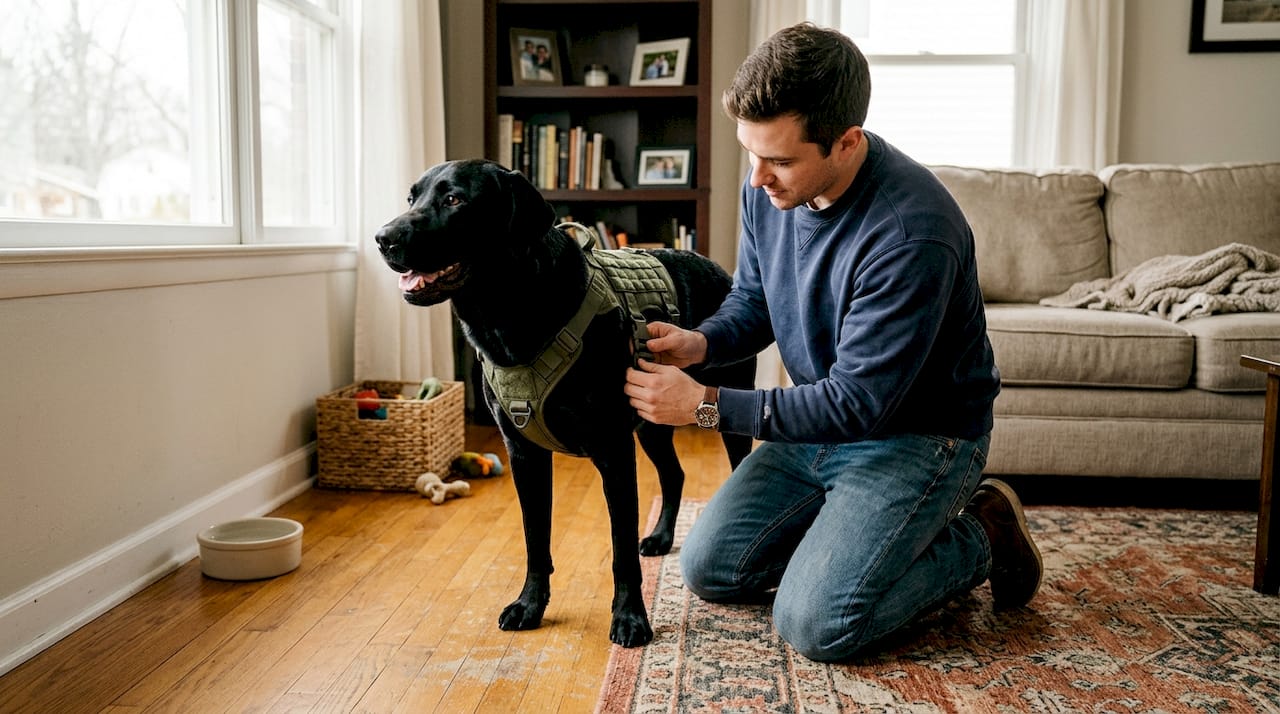
Front-clip harnesses attach the leash at the chest. This redirects a pulling dog toward you rather than allowing forward momentum to build. Back-clip harnesses attach at the spine, which sounds more natural but actually allows dogs to lean into the pull with more force. Research shows that dogs pull harder in back-clip harnesses, with a mean pull force of 60.5N compared to 37.8N with a collar, and peak forces reaching 198N versus 163N. For a handler with limited grip strength or balance issues, that difference is significant.
Head collars and tightening harnesses are sometimes recommended for strong pullers, but evidence suggests they can cause stress and physical discomfort, particularly around the neck and muzzle. Martingale collars, which tighten slightly when tension is applied, are better than standard slip collars but still require careful sizing.
For service dog applications, the priority is unobstructed movement. Your dog needs full shoulder extension to walk, retrieve, brace, or perform any physical task. Expert review confirms that non-tightening front-clip harnesses offer the best balance for dogs that pull, while back-clip designs suit non-pullers or brachycephalic breeds (dogs with flat faces, like bulldogs or pugs, that can be sensitive to chest pressure).
Here is a simple comparison to guide your decision:
| Harness or collar type | Best for | Key concern |
|---|---|---|
| Front-clip harness | Pullers, service dogs | Check shoulder clearance |
| Back-clip harness | Non-pullers, brachycephalic breeds | Increases pull force |
| Head collar | Strong pullers with training | Can cause stress if misused |
| Martingale collar | Dogs prone to slipping collars | Requires precise sizing |
Pro Tip: Watch your dog walk toward you after fitting a new harness. If the front legs swing inward or the stride shortens, the harness is restricting shoulder extension. Adjust or replace it before using it for service work. You can also review dog safety during walks and alert device training tips to build a complete safety routine.
Smart collars and sensor technology: Elevating communication and alerts
Physical restraints keep your dog close. But what about the moments when your dog is trying to tell you something critical? That is where smart collar technology steps in.
IMU sensor collars use motion-tracking chips to detect specific trained behaviors, like a spin, a nudge, or a repeated sit. For seizure alert dogs, cardiac alert dogs, or anxiety service dogs, these collars can catch a trained alert behavior even when the handler is asleep, distracted, or has limited sensory ability. The alert device benefits for handlers with disabilities are substantial, particularly in reducing the anxiety of wondering whether you missed a cue.
The accuracy of this technology is genuinely impressive. IMU sensor collars detect trained spin alerts for seizure dogs with 92.4% cross-dog accuracy using a Random Forest model. That means the system works reliably across different dogs, not just the one it was trained on.
“Sensor technology bridges the communication gap for handlers with disabilities.”
Key benefits of smart alert collars include:
- Early warning: Catches alert behaviors before the handler notices them manually.
- Consistent communication: Removes the guesswork from subtle or quiet alerts.
- Real-time monitoring: Sends instant notifications to a phone or paired device.
- Remote detection: Works even when the handler is in another room or asleep.
Here is a quick data overview of what current sensor collar technology delivers:
| Feature | Performance |
|---|---|
| Alert detection accuracy | Up to 92.4% cross-dog |
| Behavior types detected | Spins, nudges, repeated sits |
| Model type | Random Forest (machine learning) |
| Use case | Seizure, cardiac, anxiety service dogs |
For a deeper look at how these tools work in practice, the guides on how dogs use devices and dog alerts explained are worth reading alongside the research.
GPS and escape prevention: Ensuring off-leash independence
For service dogs that work off-leash, location safety is not optional. A dog that wanders, even briefly, creates a dangerous gap in the handler’s support system. Modern GPS collars have evolved to address this with speed and precision that earlier versions simply could not match.
The Halo Collar 5 represents the current standard for escape-proof GPS technology. It delivers 20 GPS updates per second and up to 48 hours of battery life, with virtual fence technology that uses positive reinforcement cues rather than aversive corrections. It also performs reliably in dense urban environments where GPS signal is typically weakest.
Setting up a GPS collar system for a service dog involves more than unboxing and charging. Here is a practical sequence:
- Set up boundaries: Define virtual fence zones that match your daily environment, home, yard, and regular outdoor areas.
- Train the dog: Introduce the collar gradually and use positive cues to teach the dog what the boundary signal means.
- Train yourself: Practice reading the app alerts and responding quickly during low-stakes situations before relying on it fully.
- Monitor regularly: Check battery levels and GPS signal quality as part of your daily routine.
- Respond to breaches: Have a clear plan for what you do when a boundary alert fires, including a recall cue your dog knows reliably.
For handlers exploring using technology for safety, GPS collars paired with trained recall behaviors offer the most complete off-leash safety solution available today. The 92% device accuracy standard across modern alert and GPS devices sets a high bar that benefits every handler.
Why matching the device to the dog and handler matters more than any brand
Here is the uncomfortable truth that most product guides skip: the brand rarely determines success. The fit does.
We see this pattern repeatedly. A handler invests in a premium harness with excellent reviews, but the dog’s shoulder extension is compromised because the chest strap sits too high. Or a GPS collar with every feature imaginable goes unused because the app interface is too complex for a handler managing a chronic condition. The device was not wrong. The match was.
Expert consensus confirms that individual fit is more critical than any single feature set. Most device failures in service dog contexts trace back to mismatched equipment, not defective equipment. A Y-shaped harness on the wrong breed, a GPS collar with boundaries that do not reflect the real environment, an alert button placed where the dog cannot comfortably reach it. These are fixable problems, but only if you are willing to reassess regularly.
Pro Tip: Set a quarterly reminder to reassess your device setup. Your dog’s weight, coat, and task demands change. Your own health and mobility needs shift too. The device usage guide walks through a structured reassessment process that takes less than 20 minutes and can catch fit issues before they become safety problems.
The handlers who get the most from their equipment are not the ones with the most expensive gear. They are the ones who treat device selection as an ongoing practice, not a one-time purchase.
Explore trusted solutions for you and your service dog
You now have a clear framework for evaluating restraints, communication tools, and GPS solutions based on evidence, not marketing claims. The next step is finding devices that actually fit your situation.
At iPupPee, we focus on practical tools that support real independence for service dog handlers, seniors, and individuals with disabilities. Whether you are starting fresh or upgrading an existing setup, the dog alert devices and independence guide is a strong next step. It covers device selection, training integration, and how to build a communication system that works reliably in daily life. Browse the full resource library and find the solution that fits your team.
Frequently asked questions
What is the safest harness for a service dog that pulls?
A non-tightening front-clip harness is the best choice for a service dog that pulls, as it redirects pulling without restricting movement or causing discomfort. Expert review confirms this design offers the strongest balance of control and comfort for working dogs.
How accurate are sensor dog alert collars?
IMU sensor collars can detect trained alert behaviors with up to 92.4% accuracy across different dogs, making them a reliable tool for seizure and cardiac alert service dogs.
Can GPS collars prevent service dogs from escaping?
Yes, advanced GPS collars like the Halo Collar 5 use 20 GPS updates per second and virtual fencing with positive cues to prevent escapes and maintain off-leash safety.
Do harnesses affect a service dog’s walking or gait?
Yes, harness design directly influences gait. Chest-strap harnesses restrict shoulder movement more than Y-shaped designs, which is a critical consideration for service dogs performing physical tasks.
Recommended
- Dog Safety Technology: Elevating Independence for Owners – iPupPee
- Dog alert devices: 92% accuracy for safety and independence – iPupPee
- Dog alert device benefits: safety and independence in 2026 – iPupPee
- Dog Training Safety Tips: Ensuring Independence and Security – iPupPee
- Senior Pet Supplements: 40% Safer with Vet Guidance 2026 | Mybestpharmacy.net | Online Pharmacy