

Many people assume disability support dogs are limited to guiding the blind, but these remarkable animals perform dozens of specialized tasks across physical, sensory, and mental health conditions. From retrieving dropped medications to detecting seizures before they occur, support dogs transform independence and safety for millions. This guide explores the evidence-based benefits of disability support dogs, the rigorous training methods that prepare them, cutting-edge communication devices that enhance handler-dog interaction, and the ethical considerations shaping responsible support dog programs.
Table of Contents
- Key takeaways
- Understanding the benefits of disability support dogs
- How disability support dogs are trained: methods and timing
- Communication devices and technology for disability support dogs
- Ethical considerations and regulations for disability support dogs
- Explore disability support solutions with iPupPee
- Frequently asked questions
Key Takeaways
| Point | Details |
|---|---|
| Functional and emotional benefits | Disability support dogs boost functional mobility and emotional well being, improving independence and reducing anxiety for many handlers. |
| Rigorous training stages | Training spans one to two years with puppy tests, basic obedience, task work, and public access proofing to ensure reliable performance. |
| Communication aids help but limited | Communication devices and cues enhance interaction but cannot replace the dog handler relationship or fix all challenges. |
| Access shaped by ethics | Ethical concerns and regulatory policies influence who can access these programs and how dogs are bred, trained, and placed. |
| Benefits vary by condition | Benefits vary by condition and by individual circumstances, with some diagnoses showing greater gains in independence and quality of life. |
Understanding the benefits of disability support dogs
Disability support dogs deliver measurable improvements in both functional capacity and emotional well-being across diverse conditions. Research demonstrates that service dogs improve functional mobility and occupational performance for people with spinal cord injuries, enabling greater independence in daily activities like opening doors, retrieving objects, and navigating public spaces. These dogs act as physical extensions of their handlers, compensating for limited mobility and reducing reliance on human caregivers.
Beyond physical assistance, support dogs provide profound psychosocial benefits that ripple through entire family systems. Studies show service dogs provide psychosocial benefits to veterans’ families, including reduced caregiver burden and higher family quality of life. Handlers report decreased anxiety, improved social connections, and greater confidence in public settings. The constant companionship and non-judgmental presence of a support dog can alleviate isolation and depression common among individuals with disabilities.
However, support dogs are not universal solutions for all conditions or symptoms. Research indicates no significant impact on autism spectrum disorder symptoms or broad physical health improvements in some populations. The benefits depend heavily on individual circumstances, the specific disability, and the quality of handler-dog matching and training.
Common benefits disability support dogs provide:
- Enhanced independence in daily living activities and reduced need for human assistance
- Emotional support reducing anxiety, depression, and social isolation
- Increased safety through medical alerts, balance support, and environmental awareness
- Improved social integration and public confidence for handlers
- Reduced caregiver stress and improved family dynamics
“The presence of a well-trained support dog transforms not just the handler’s capabilities, but their entire relationship with the world. Independence becomes possible in ways that assistive devices alone cannot provide.”
The measurable improvements in occupational performance and family quality of life make support dogs valuable interventions for carefully selected individuals. Understanding these evidence-based benefits helps potential handlers set realistic expectations and make informed decisions about pursuing support dog partnerships.
How disability support dogs are trained: methods and timing
Training a disability support dog requires a comprehensive, multi-stage process that typically spans 1 to 2 years. The journey begins with puppy tests, basic obedience, task-specific skills, and public access proofing to ensure dogs can perform reliably in diverse environments. Each stage builds on the previous one, creating a foundation of skills that enable dogs to respond consistently under pressure.
The training process starts with early behavioral assessments to identify puppies with the temperament and aptitude for service work. Research shows behavior tests and genomic breeding predict guide dog success and optimize outcomes, allowing programs to select candidates most likely to complete training successfully. These early evaluations assess traits like confidence, focus, sound sensitivity, and social responsiveness that correlate with later performance.
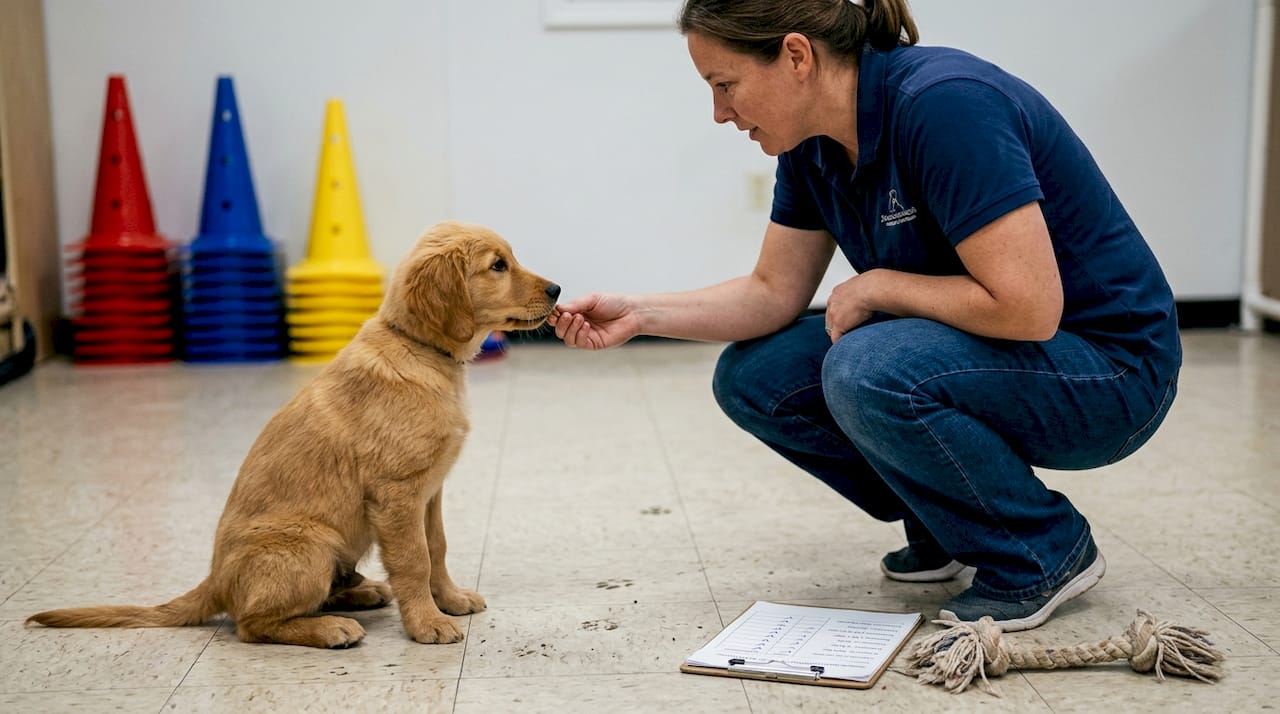
Positive reinforcement forms the backbone of modern support dog training. Trainers reward desired behaviors with treats, praise, and play, building strong associations between commands and actions. This approach creates enthusiastic, confident dogs who genuinely enjoy their work rather than performing out of fear or compulsion. The method proves especially effective for complex task chains where dogs must execute multiple steps in sequence.
Key training stages for disability support dogs:
- Puppy socialization and temperament testing (8 to 16 weeks)
- Basic obedience and impulse control (4 to 6 months)
- Task-specific skill development tailored to handler needs (6 to 12 months)
- Public access training in diverse environments (3 to 6 months)
- Handler-dog team training and bonding (2 to 3 months)
- Ongoing maintenance training throughout working life
Task-specific training varies dramatically based on the handler’s disability. Mobility assistance dogs learn to brace for balance, retrieve dropped items, and operate light switches. Hearing alert dogs recognize doorbells, alarms, and their handler’s name being called. Medical alert dogs detect changes in blood sugar, impending seizures, or other physiological signals through scent or behavioral cues.
Public access skills ensure support dogs remain focused and well-mannered in challenging environments. Dogs must ignore distractions like food, other animals, and crowds while maintaining attention on their handler. They learn to settle quietly in restaurants, navigate crowded sidewalks, and remain calm during unexpected events. This training separates true support dogs from pets and ensures handlers can rely on their dogs anywhere.
Pro Tip: Successful service dog training communication requires consistency across all handlers and environments. Use identical verbal cues and hand signals every time, and practice in progressively more distracting locations to build reliability. For disabled owners facing unique dog training challenges, breaking tasks into smaller steps and using high-value rewards can accelerate progress.
The extended training timeline reflects the complexity and reliability standards required for support dog work. Unlike basic pet obedience, support dogs must perform critical tasks flawlessly even when tired, distracted, or in unfamiliar situations. This level of reliability takes time, repetition, and careful generalization across contexts.
Communication devices and technology for disability support dogs
Communication technology offers promising tools to enhance interaction between disabled handlers and their support dogs, though each approach presents distinct advantages and limitations. Two primary device categories dominate the field: auditory interaction cues like button systems and haptic feedback vests that deliver tactile signals. Understanding how these technologies perform in real-world conditions helps handlers select appropriate tools for their specific needs.
Research reveals significant challenges with button-based systems. Studies show AIC buttons face sound degradation issues reducing recognition success to 30%, while haptic vests enable silent signaling that remains effective in noisy environments. The acoustic limitations stem from environmental interference, device wear, and inconsistent button activation pressure. When background noise increases or button membranes degrade, dogs struggle to distinguish commands from ambient sounds.
Haptic vests offer an alternative communication channel through vibration patterns delivered to specific body locations. Dogs learn to associate distinct vibration sequences with commands like recall, directional cues, or attention signals. This tactile approach works regardless of ambient noise and provides private communication invisible to bystanders. However, haptic systems require careful conditioning to ensure dogs respond reliably and don’t become desensitized to vibrations over time.
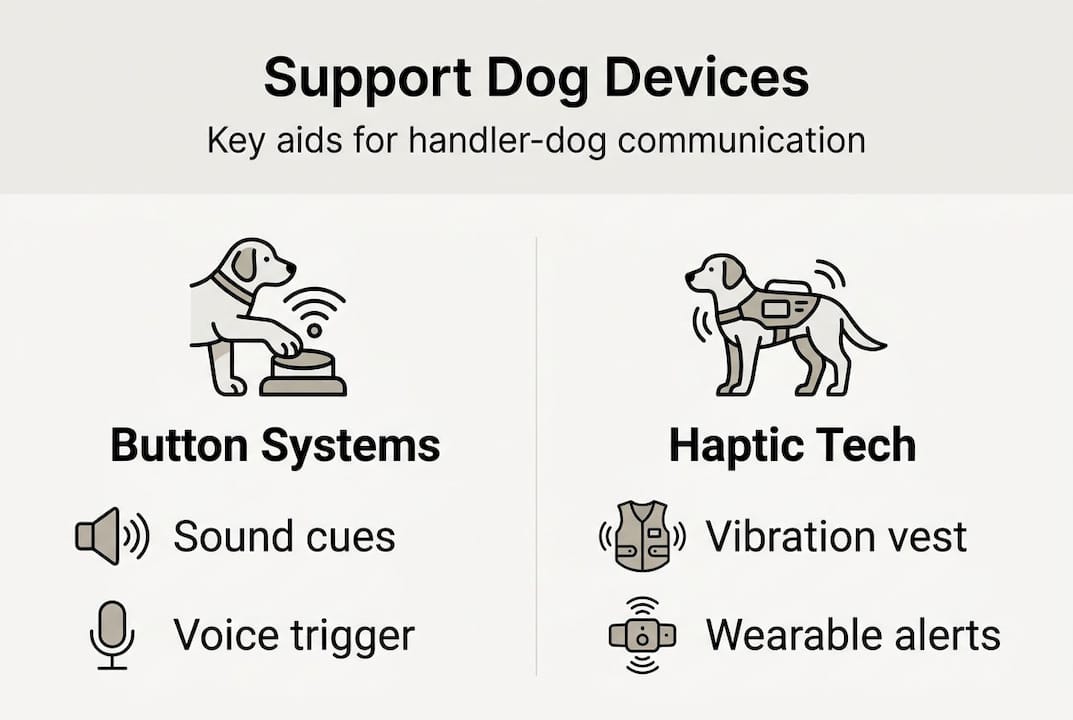
Comparison of communication device types:
| Device Type | Primary Advantage | Key Limitation | Best Use Case |
|---|---|---|---|
| AIC Buttons | Intuitive for handlers with speech | Sound degradation reduces reliability | Quiet indoor environments |
| Haptic Vests | Silent operation in noisy settings | Requires extensive conditioning | Public spaces and distance work |
| Visual Signals | No equipment needed | Limited range and line-of-sight requirement | Close-range indoor communication |
| Smartphone Apps | Customizable and multi-modal | Technology dependence and learning curve | Tech-savvy handlers with backup systems |
Handlers should consider their specific environment and communication needs when selecting devices. Those frequently in loud public spaces benefit from haptic systems, while handlers primarily working at home might find button systems adequate. Many successful teams use multiple communication methods, selecting the most appropriate tool for each situation.
Common communication device applications:
- Recall commands for off-leash work in safe environments
- Directional cues for guide work and navigation assistance
- Attention signals to redirect focus during distractions
- Emergency alerts requiring immediate response
- Positive reinforcement markers during training sessions
Pro Tip: When exploring dog communication tools, prioritize devices with durable construction and consistent signal output. Test equipment in various environments before relying on it for critical commands. Review comparisons of top dog communication devices to identify options matching your specific needs and budget.
The effectiveness of communication devices depends heavily on proper introduction and conditioning. Dogs need gradual exposure to new signals, starting in distraction-free environments and slowly increasing difficulty. Pairing device signals with familiar verbal cues during the transition period helps dogs understand the new communication method. Handlers should maintain backup communication strategies in case devices malfunction or batteries fail during critical moments.
Technology continues evolving, with emerging options including biometric monitoring systems that track dog stress levels and GPS-enabled devices for location tracking. As these tools mature, they promise to expand the capabilities of support dog teams while requiring careful evaluation of reliability and practical utility.
Ethical considerations and regulations for disability support dogs
The use of disability support dogs raises complex ethical questions about animal welfare, handler rights, and program standards that demand careful consideration. One contentious issue involves using disabled dogs for service work due to welfare risks, though certification protocols help ensure low stress when properly implemented. Dogs with physical limitations like limb differences or sensory impairments can sometimes perform service work effectively, but programs must rigorously assess whether the work causes pain, stress, or compromises the dog’s quality of life.
Welfare concerns extend beyond physical health to psychological well-being. Support dogs face demanding work environments with extended public access periods, unpredictable situations, and constant attention requirements. Ethical programs prioritize regular welfare assessments, adequate rest periods, and retirement protocols when dogs show signs of stress or declining enthusiasm for work. The dog’s needs must remain paramount, even when handlers depend heavily on their assistance.
Regulatory frameworks governing support dog certification and access vary dramatically across jurisdictions, creating confusion and sometimes discriminatory barriers. Research documents how regulatory issues like Ontario’s ADI certification requirement were ruled discriminatory for access to service dogs, as the policy excluded qualified teams trained through alternative methods. Such regulations often emerge from legitimate concerns about fake service dogs but can inadvertently restrict access for handlers with legitimately trained dogs from non-accredited programs.
The tension between ensuring high standards and maintaining access creates ongoing policy debates. Accreditation systems like Assistance Dogs International provide quality benchmarks but represent only one training approach. Owner-trained dogs can achieve excellent performance standards through different methodologies, yet face skepticism and access challenges in regions requiring specific certifications.
Common ethical and regulatory considerations:
- Welfare assessment protocols to monitor dog stress and job satisfaction
- Retirement planning and rehoming for dogs unable to continue work
- Certification requirements and their impact on handler access to public spaces
- Standards for breeding programs and genetic health screening
- Transparency about success rates and dog washout from training programs
- Handler education requirements and ongoing team evaluations
- Public access rights balanced against business owner concerns
The financial accessibility of support dogs presents another ethical dimension. Program-trained dogs often cost $15,000 to $30,000, placing them beyond reach for many disabled individuals who would benefit. While some programs offer subsidized or donated dogs, waiting lists stretch years long. This economic barrier raises questions about equitable access to a life-changing intervention and the role of insurance coverage or public funding.
For handlers navigating training challenges and ethics, understanding both welfare principles and legal rights proves essential. Responsible support dog partnerships prioritize the dog’s well-being while advocating for reasonable accommodation and access rights. Handlers should document their dog’s training, maintain current health records, and understand local regulations governing public access.
The evolving landscape of support dog ethics and regulation requires ongoing dialogue among handlers, trainers, disability advocates, and policymakers. Balancing animal welfare, handler needs, public safety, and equitable access demands nuanced approaches that recognize the diversity of disabilities, training methods, and support dog roles. As research expands our understanding of what makes support dog partnerships successful and sustainable, policies should adapt to reflect evidence-based best practices.
Explore disability support solutions with iPupPee
Now that you understand the comprehensive benefits, training requirements, and ethical considerations surrounding disability support dogs, you’re ready to explore practical tools that enhance communication and safety. iPupPee specializes in innovative devices designed specifically for handlers working with support dogs, offering solutions that address real-world challenges in handler-dog interaction.
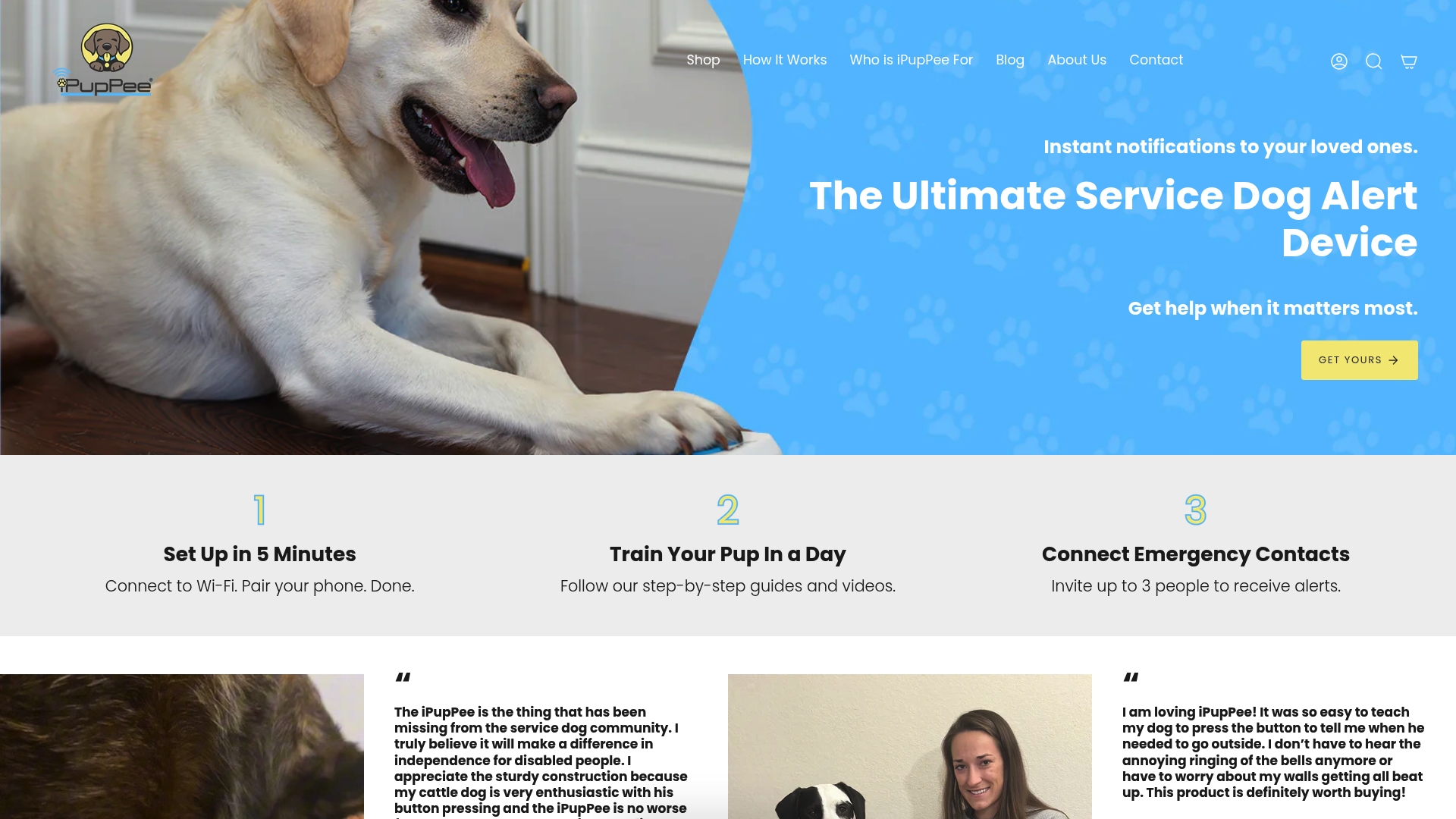
Our platform provides extensive resources covering everything from dog communication technology to detailed guides on the best communication devices available in 2026. Whether you’re training a new support dog or optimizing communication with an experienced partner, iPupPee offers the tools and knowledge to strengthen your team’s effectiveness and independence. Explore our blog for training tips, product comparisons, and insights from experienced handlers who’ve transformed their daily lives through better communication with their support dogs.
Frequently asked questions
What tasks can disability support dogs perform?
Disability support dogs can retrieve dropped items, provide balance and mobility assistance, alert to sounds like doorbells or alarms, and detect medical events such as seizures or blood sugar changes. They also offer emotional support and help handlers navigate public spaces safely. Specific tasks vary based on individual needs and the handler’s disability.
How long does it take to train a disability support dog?
Training typically lasts 1 to 2 years from puppy selection through full certification. This timeline includes basic obedience, task-specific skill development, public access training, and handler-dog team bonding. Some dogs require additional time depending on task complexity and individual learning pace.
Are communication devices reliable for all handlers?
Communication devices can enhance interaction but may face challenges like sound degradation in button systems, which can reduce recognition success to 30% in degraded conditions. Haptic vests offer silent alternative signals that work better in noisy environments. Reliability depends on device quality, proper conditioning, and environmental factors, so handlers should test equipment thoroughly and maintain backup communication methods.
What ethical issues relate to disability support dogs?
Key concerns include the welfare of disabled dogs used for work, as physical or sensory limitations may compromise quality of life. Certification and proper training protocols help mitigate stress and ensure dogs remain healthy and enthusiastic about their work. Regulatory barriers and certification requirements may also present discriminatory challenges to handler access, requiring ongoing policy evaluation.
Can I train my own disability support dog?
Yes, owner-trained support dogs can achieve excellent performance standards with dedication, proper guidance, and consistent training methods. However, self-training requires significant time investment, knowledge of training principles, and access to diverse environments for socialization. Some jurisdictions impose certification requirements that may affect public access rights for owner-trained teams, so research local regulations before beginning training.