

Navigating daily life with a service dog means balancing trust, responsiveness, and personal safety. Device-based training offers direct communication channels and real-time safety monitoring that strengthen the partnership between handler and dog. American handlers seeking enhanced independence and reliability can benefit from wearable sensors and haptic signals that make silent commands, health alerts, and bidirectional communication possible. Explore how integrating modern technology with traditional training improves confidence, measurable safety, and tailored interaction for handlers with disabilities across the United States.
Table of Contents
- Defining Device-Based Service Dog Training
- Alert, Communication, And Safety Device Types
- How Devices Facilitate Dog-Human Communication
- Training Methods For Device-Integrated Service Dogs
- Legal Standards And Safety Considerations
Key Takeaways
| Point | Details |
|---|---|
| Device-Based Training Enhances Communication | Integrating technology with traditional training methods improves communication between service dogs and handlers, making it measurable and proactive. |
| Types of Devices Offer Unique Benefits | Utilizing alert, communication, and safety devices can address specific needs, ensuring a comprehensive support system for handlers. |
| Foundation Training is Essential | Establishing a solid behavioral foundation before introducing devices is crucial for effective device-based service dog training. |
| Legal Compliance is Non-Negotiable | Adhering to the ADA requirements and understanding safety standards is essential for the legal legitimacy of service dogs, regardless of device use. |
Defining Device-Based Service Dog Training
Device-based service dog training represents a modern evolution in how handlers and their dogs communicate and work together. It combines traditional training methods with technology to enhance the dog’s ability to assist and respond to their handler’s needs. This approach creates a bridge between the dog’s natural capabilities and the handler’s specific requirements.
At its core, device-based training involves integrating technology—such as sensors, communication buttons, and wearable systems—into the dog’s training and working environment. Rather than replacing traditional methods, these tools complement them. The dog learns to interact with devices that facilitate better communication and safety monitoring.
Understanding the Technology Component
Devices used in service dog training serve several critical functions:
- Communication tools help dogs alert handlers to health changes, environmental hazards, or household events
- Wearable sensors track the dog’s location, health metrics, and stress levels during work
- Button-based systems allow dogs to directly communicate specific needs to their handlers
- Tracking devices ensure handler safety by keeping dogs localized during public outings
Wearable device technology in service work now includes vests equipped with geolocation and health monitoring capabilities, making dogs more effective in their roles while keeping handlers informed in real time.
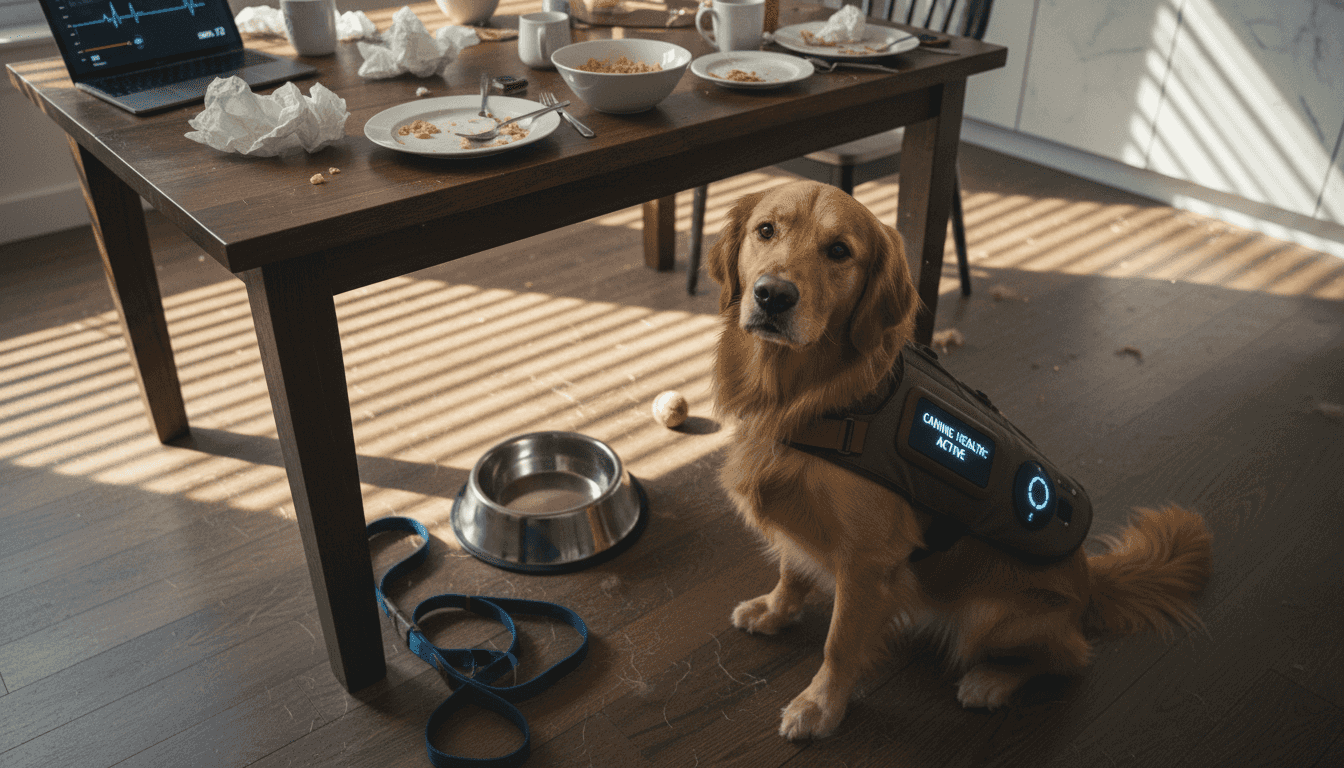
The goal is clear: technology amplifies what your dog already does naturally while creating measurable safety improvements.
How Device Integration Works in Training
When you introduce devices during training, your dog learns through the same reward-based methods that make traditional service dog work successful. The dog associates the device interaction with positive outcomes and praise from you.
This happens in stages. First, your dog becomes comfortable with wearing or touching the device. Next, they learn what happens when they interact with it. Finally, they understand when and why to use it—all tied to your specific disability or needs.
Reward-based methods tailored to individual disabilities remain central to device training, whether you’re working with a professional trainer or handling training yourself. The device simply becomes another tool in your dog’s toolkit.
Real-World Application
For handlers living alone or managing multiple medical conditions, device-based training creates independence. Your dog can alert you through a button press system about bathroom needs, or a wearable can monitor for seizure activity patterns.
This differs from traditional service dog work because the dog’s actions are now recorded and measurable. You get data about when alerts happened, how often your dog checked on you, and whether communication patterns changed.
Device-based training amplifies a handler’s independence by creating active, measurable communication between dog and person.
The technology doesn’t make your dog smarter or more capable. Rather, it translates your dog’s natural behaviors into communication your handler or caregiver can document and act on immediately.
Pro tip: Start device integration during basic obedience training rather than waiting until your dog masters all service tasks—this ensures your dog becomes comfortable with technology early and develops strong positive associations with it.
Alert, Communication, and Safety Device Types
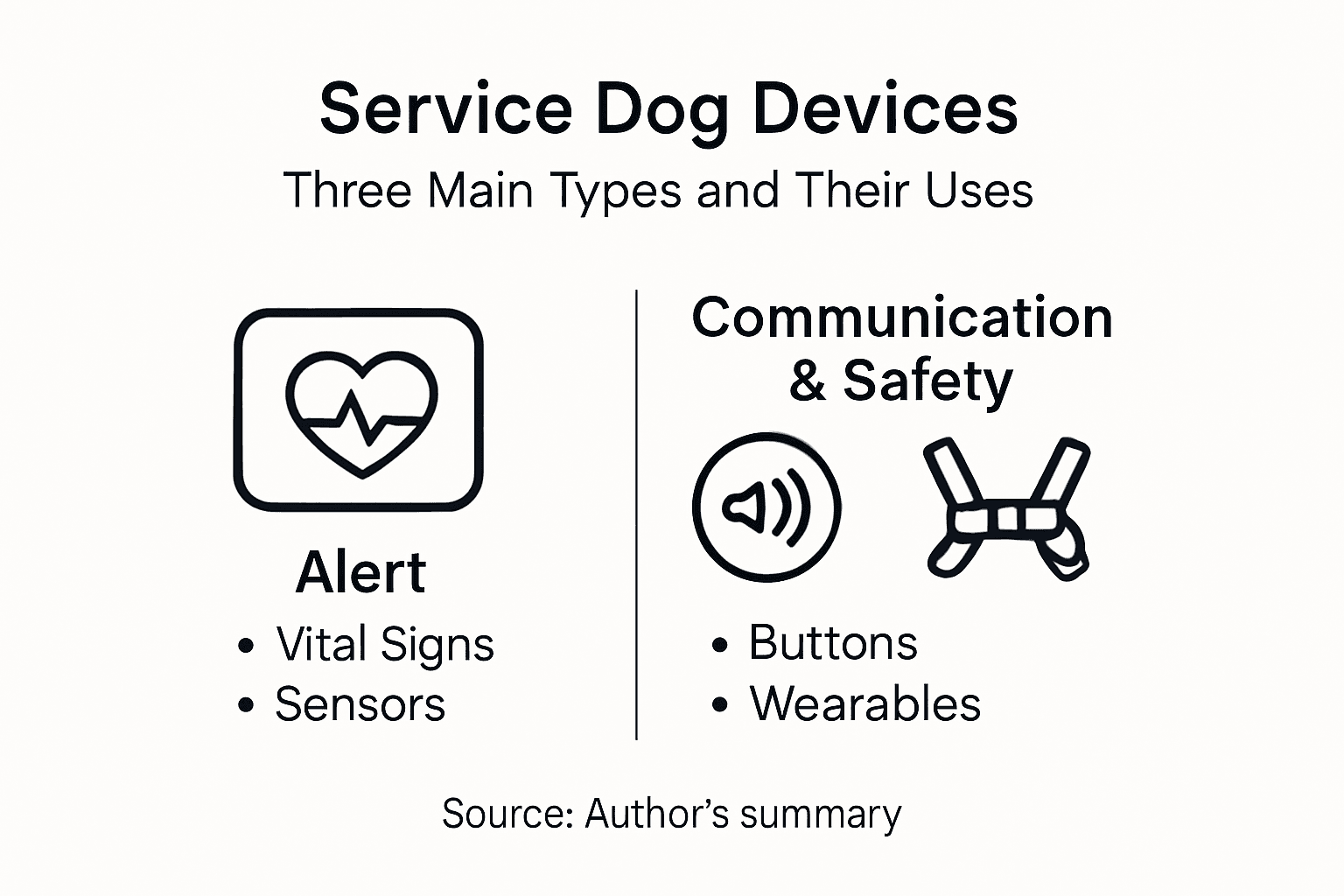
Service dog devices fall into three distinct categories, each serving a different purpose in your handler’s daily life. Understanding these categories helps you choose the right technology for your specific needs. Each type works independently or together to create a comprehensive safety and communication system.
Alert Devices
Alert devices monitor your dog’s environment or your physiological state, then prompt your dog to take action. These are the most direct safety tools available in device-based training.
The most advanced alert systems include collar-based vital sign monitoring, which wirelessly transmits heart rate and other health data to both dog and handler. When abnormal patterns appear—like elevated heart rate during a panic attack—the collar sends vibration signals to your dog, prompting trained responses such as grounding techniques or blocking behavior.
Alert devices excel at early detection, catching problems before they escalate into full episodes. Your dog doesn’t have to rely on noticing visible symptoms; the technology alerts them first.
Communication Devices
Communication devices give your dog an active voice in your household. Rather than waiting to alert you, your dog initiates contact through button systems or similar interfaces.
These devices work best for:
- Bathroom needs during the night or when you’re busy
- Anxiety signals when your dog senses stress from you or the environment
- Health updates like alerting you to changes in your dog’s condition
- Interaction requests when your dog wants engagement or playtime
Your dog learns to press a button or activate a system to directly communicate with you. The dog isn’t waiting for you to notice something is wrong; they’re telling you proactively. This creates genuine two-way conversation between dog and handler.
Safety Devices
Safety devices focus on location tracking, health monitoring, and handler protection during public outings or emergencies.
These include:
- GPS tracking to locate your dog if they become separated from you
- Geofencing alerts that notify you if your dog wanders beyond a safe zone
- Health sensors that monitor your dog’s temperature, activity level, and stress indicators
- Emergency response features that can alert contacts or emergency services
Safety devices are particularly valuable for handlers with mobility issues, cognitive disabilities, or those living in high-risk environments. They provide objective data about your dog’s wellbeing.
The most effective service dog systems combine all three device types, creating layers of protection and communication rather than relying on a single solution.
Many handlers use alert devices for health monitoring, communication devices for daily needs, and safety devices for peace of mind. This multi-layered approach ensures no critical need goes unaddressed.
Here’s a summary of the three main device types for service dog training:
| Device Type | Main Benefit | Key Example | Best For |
|---|---|---|---|
| Alert Device | Early problem detection | Vital sign monitoring collar | Seizure or health alerts |
| Communication | Two-way interaction | Button press interface | Expressing daily needs |
| Safety Device | Location & protection | GPS tracker with geofencing | Handler security in public |
Pro tip: Start with one device type matching your most pressing need, then add others gradually—this prevents overwhelming your dog during training and lets you refine each system before introducing new technology.
How Devices Facilitate Dog-Human Communication
Devices transform communication between handlers and service dogs by creating new channels beyond verbal commands. Traditional service dog work relies on the handler noticing subtle behaviors or the dog catching the handler’s attention. Device-based communication flips this dynamic, making interaction proactive, consistent, and measurable.
Silent, Discreet Commands
One of the most powerful advantages of device communication is the ability to work silently. Haptic vibration signals transmitted through wearables allow you to communicate directly with your dog without speaking, which matters enormously in sensitive settings.
Consider these real-world scenarios:
- Medical appointments where quiet communication prevents disruption
- Public transportation where silent alerts keep interactions discreet
- Emergency situations where verbal commands might attract unwanted attention
- Noisy environments where your voice can’t be heard clearly
Your dog learns to recognize specific vibration patterns as distinct commands. Research shows dogs reliably discriminate between different haptic signals, making this communication surprisingly accurate and effective.
Bidirectional Communication
Traditional service dog training creates one-way communication: handler gives command, dog responds. Devices enable two-way conversation where your dog initiates contact.
Wearable interfaces with touch or motion sensors activated by natural dog behaviors like nudging, tugging, or pawing allow your dog to send signals back to you. Your dog can communicate anxiety, health changes, bathroom needs, or requests for intervention without waiting for you to notice.
This bidirectional flow strengthens your relationship because your dog isn’t just following commands. Your dog is actively participating in the conversation.
Breaking Communication Barriers
Devices eliminate common communication obstacles that frustrate handlers and dogs alike.
They address:
- Sensory impairments in dogs with hearing or vision loss
- Handler disabilities affecting ability to speak or hear clearly
- Language barriers since vibrations don’t require shared verbal language
- Distance limitations where handler and dog can’t maintain visual contact
A handler with severe anxiety might struggle to give verbal commands during a panic attack. Device communication works regardless of the handler’s physical or emotional state. Your dog responds to the signal itself, not your tone or clarity.
Device-based communication removes the guesswork from dog-human interaction, creating a shared language that works consistently in any situation.
Your dog always knows what the vibration means. You always know what the button press indicates. No ambiguity. No missed signals.
Below is a comparison of traditional and device-based service dog communication:
| Aspect | Traditional Training | Device-Based Training |
|---|---|---|
| Communication Flow | Handler to dog only | Handler and dog, both ways |
| Command Style | Spoken or gestural cues | Silent signals and interfaces |
| Data Tracking | No data recorded | Alerts and actions measured |
| Accessibility Impact | Limited by environment | Adaptable to any situation |
Building Handler Confidence
When communication becomes reliable and measurable, handlers gain confidence in their dog’s abilities. You can see data about how often your dog alerts, when communication happens, and whether patterns shift over time.
This objective feedback helps you refine training and identify problems early. It also provides validation that your dog’s work matters and is being properly documented.
Pro tip: Begin with a single communication channel—either handler-to-dog or dog-to-handler—and master it completely before adding additional signals, as this prevents confusion and builds your dog’s confidence with the technology.
Training Methods for Device-Integrated Service Dogs
Training a service dog to work with devices requires a different approach than traditional service dog training. You’re not just teaching commands; you’re building your dog’s confidence with technology while maintaining all their core skills. The process combines foundational obedience with gradual device exposure.
Building the Foundation First
Every device-integrated service dog needs a solid behavioral baseline before introducing any technology. Your dog must understand basic commands, respond reliably in distractions, and trust your guidance completely.
Start with:
- Sit, down, stay in various environments
- Loose leash walking in public settings
- Focus work maintaining eye contact despite distractions
- Recall reliability responding to your call from distance
Positive reinforcement methods tailored to individual handler needs form the foundation of all device work. Your dog learns that following your guidance produces rewards, creating intrinsic motivation that transfers directly to device training.
Without this foundation, introducing devices creates confusion rather than capability.
Gradual Device Familiarization
Dogs don’t inherently understand technology. Your dog must first become comfortable simply wearing or being near a device before learning to interact with it functionally.
This phase involves:
- Introduction - Let your dog wear the device for short periods without expectation of use
- Positive association - Reward your dog heavily while wearing the device
- Familiarity building - Gradually increase wearing time over days or weeks
- Desensitization - Activate the device’s non-functional features (vibration, sounds) while rewarding calmly
Your dog should view the device as neutral or positive, never threatening. A dog anxious about equipment won’t perform reliably in real-world situations.
Training Specific Device Interactions
Once your dog is comfortable wearing technology, training begins with crystal-clear cue associations. Your dog needs to understand exactly what behavior produces what outcome.
For button systems:
- Lure your dog to press the button with their nose or paw
- Reward immediately when contact occurs
- Repeat until your dog presses deliberately
- Add a verbal cue like “alert” or “call”
- Practice in multiple locations
For wearable alerts:
- Start with high-value rewards when your dog receives a vibration signal
- Practice the response behavior immediately after the signal
- Build reliability through repetition across environments
Consistency matters more than speed—your dog learning one task perfectly in one month beats learning three tasks poorly in two weeks.
Rush this phase and you’ll face unpredictable behavior when your dog needs to perform under pressure.
Environment Expansion
Your dog learned the device in a quiet, familiar environment. Real life isn’t quiet or familiar. You must systematically train across different settings.
Progress through:
- Home environments with family present
- Quiet public spaces like parks
- Moderately busy locations like stores
- High-distraction environments like medical facilities
Your dog’s reliability should remain consistent across all environments. If performance drops significantly in busy settings, return to quieter training until confidence rebuilds.
Pro tip: Schedule device training sessions during times your dog is naturally calm and motivated—early morning or after exercise—rather than when your dog is restless, as mental state dramatically affects learning speed and retention.
Legal Standards and Safety Considerations
Device-based service dog training operates within a framework of legal requirements and safety standards that protect both you and the public. Understanding these standards ensures your dog meets legal definitions and performs reliably in all environments. Compliance isn’t optional—it’s fundamental to your dog’s legitimacy as a service animal.
ADA Requirements for Service Dogs
The Americans with Disabilities Act (ADA) defines what constitutes a legal service dog in the United States. Your dog must meet specific criteria regardless of what devices you use.
Under ADA guidelines, service dogs must be trained to perform specific tasks related to your disability. Your dog’s training must be task-focused, not simply emotional support. The law also requires your dog to behave appropriately in public settings—meaning reliable obedience, no aggression, and proper hygiene.
Devices cannot override these core requirements. A button system or alert collar doesn’t substitute for foundational training and public access behavior.
Handler Control and Public Safety
The ADA mandates that handlers maintain control of their service dogs, typically through a leash, unless your disability makes a leash impractical. Devices don’t replace this legal requirement.
Your responsibilities include:
- Leashing your dog except when disability prevents it
- Managing behavior in public spaces to prevent disruption
- Maintaining hygiene ensuring your dog doesn’t create sanitation issues
- Preventing aggression toward people or other animals
- Ensuring task performance demonstrating your dog performs trained work
If your dog cannot meet these behavioral standards, device integration won’t make it legally compliant. Training comes first; devices enhance training.
Professional Standards and Certification
Assistance Dogs International (ADI) establishes comprehensive global standards requiring rigorous training protocols, handler education, and ongoing support. These standards emphasize both dog welfare and public safety.
ADI-accredited programs require:
- Extensive socialization and obedience training
- Specific task training tied to individual disabilities
- Handler education on dog management and public access
- Documentation of training completion
- Post-placement follow-up and support
While not legally required, ADI accreditation provides verification that your dog meets professional standards.
Device-Specific Safety Standards
Any device you integrate must not impede your dog’s safety or performance. Collars, buttons, and sensors must be properly fitted, non-injurious, and worn only during appropriate times.
Safety considerations include:
- Proper fitting ensuring no pressure injuries or skin damage
- Battery safety preventing electrical hazards
- Durability testing confirming devices withstand daily use
- Regular inspection checking for wear or malfunction
- Removal protocols knowing when to take devices off
Legal compliance and safety aren’t separate goals—they’re inseparable. A device-trained service dog must meet all ADA and professional standards while safely wearing any technology.
Your dog’s legal status depends on task training and behavior, not on devices. Devices amplify capability but never replace fundamental training requirements.
Pro tip: Keep detailed records documenting your dog’s training progression, specific tasks trained, and dates of completion—this documentation proves legal compliance if your dog’s legitimacy is ever questioned in public spaces.
Empower Your Service Dog Training with Innovative Device Solutions
The article highlights the vital role that technology plays in enhancing safety, communication, and independence for service dog handlers. If you are facing challenges with reliable two-way communication, silent alerts, or consistent safety tracking, integrating device-based training tools can transform your partnership. Devices like alert collars and button-press communication systems bring measurable results and reduce uncertainty, making your dog’s assistance more effective and your daily life more secure.
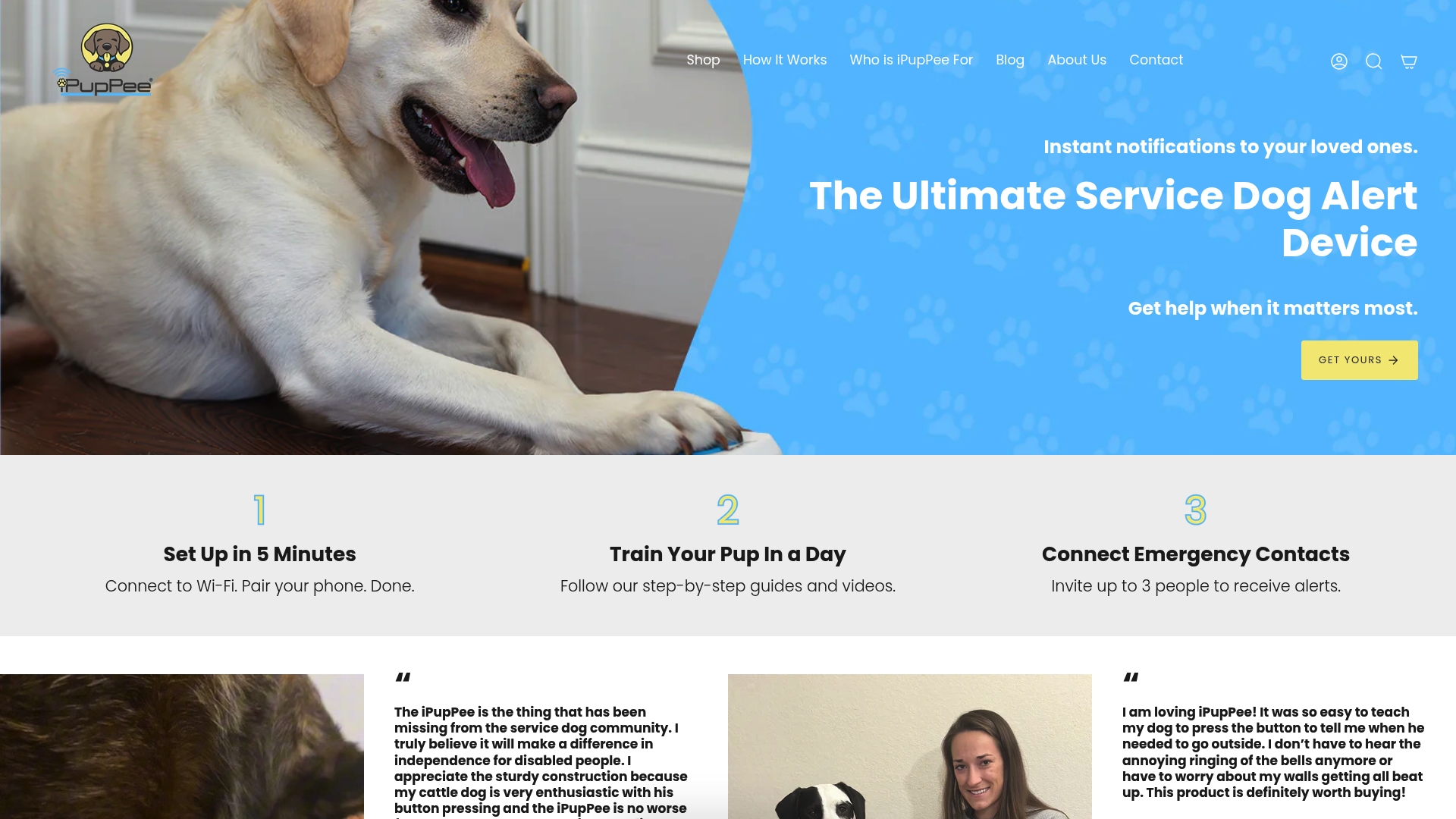
Discover how the iPupPee device at ipuppee.com offers user-friendly solutions designed specifically for service dogs and their handlers. Its simple button press system empowers your dog to communicate needs directly, providing real-time alerts that enhance your safety and independence. Learn about training strategies, read customer testimonials, and explore how this technology complements the foundational training methods described in the article. Take control of your service dog training today and build a stronger, more connected relationship using devices that truly work for you. Visit iPupPee official website to get started now.
Frequently Asked Questions
What are device-based service dog training methods?
Device-based service dog training methods integrate technology, such as sensors and communication tools, with traditional training methods. These devices enhance the dog’s ability to communicate and assist their handler, improving safety and independence.
How do communication devices work in service dog training?
Communication devices allow service dogs to actively inform their handlers about needs or alerts through button systems or other interfaces, rather than waiting for the handler to notice. This creates a two-way communication channel between the dog and the handler, improving responsiveness and interaction.
What are the benefits of using wearable technology for service dogs?
Wearable technologies, such as geolocation and health monitoring devices, help track a dog’s health metrics and location, providing real-time information to handlers. These tools enhance the dog’s capabilities, ensuring both safety and effective response to the handler’s needs.
How do you train a service dog to use devices?
Training a service dog to use devices involves building a solid behavioral foundation first, gradually familiarizing the dog with the device, and then training specific interactions based on clear cues. Consistent positive reinforcement is key to forming strong associations between the dog’s actions and device functions.
Recommended
- Dogs and Disability Independence: Enhancing Daily Life – iPupPee
- 7 Essential Dog Independence Tips for Service Dog Owners – iPupPee
- 7 Ways Dogs Impact Lives for Safety and Independence – iPupPee
- Benefits of Service Dogs: Independence and Safety – iPupPee
- 7 Smart Steps for a Home Safety Checklist Every Buyer Needs | ReVroom
- Role of Technology in Camping Gear: Enhancing Comfort – Hazli Collection
- Role of Locksmith in Accessibility: Complete Guide - A To Z Locksmith Inc