

TL;DR:
- Dogs use layered body language signals to communicate stress, relaxation, arousal, or displacement behaviors.
- Recognizing early stress signals prevents escalation and emphasizes responding without punishment.
- Dogs intentionally adapt signals for human understanding, highlighting the importance of consistent, multimodal communication.
Dogs speak constantly. The problem is most of us aren’t fluent yet. A wagging tail gets interpreted as happiness when it might signal anxiety. A yawn gets dismissed as tiredness when it’s actually a stress response. Dog body language is a rich, layered system, and misreading even one signal can lead to a bite, a breakdown in trust, or a missed cry for help. This guide walks you through the essential signals, what they mean in real life, how your dog actively shapes those messages for you, and how to respond in ways that build safety and connection.
Table of Contents
- How to recognize essential dog behavior signals
- Common dog communication signals: What they mean
- Intentional communication: How dogs adapt signals for humans
- Verbal and non-verbal cues: Integrating sound and behavior for best results
- Why most owners miss early danger warnings
- Next steps: Tools and resources for mastering dog behavior signals
- Frequently asked questions
Key Takeaways
| Point | Details |
|---|---|
| Early warning signs matter | Recognizing subtle cues helps prevent dangerous situations with your dog. |
| Body language is key | Most canine communication is nonverbal, so watch for postures and facial changes. |
| Signals are intentional | Dogs often adjust their signaling to get your attention or to communicate specific needs. |
| Pair sound with movement | Combining body signals and voice commands leads to clearer, more effective training. |
How to recognize essential dog behavior signals
Every dog owner has been there: your dog freezes, you assume they’re just distracted, and then something goes wrong. Early recognition of signals is the single most effective way to prevent escalation. The moment you learn to spot a stress cue before it becomes a growl, or a fear signal before it becomes a snap, you shift from reacting to preventing.
Understanding how dogs communicate starts with the basics. Dogs use their entire body to talk, and the signals layer on top of each other. A single cue in isolation might mean little. But two or three together paint a clear picture.
Here are the key signals every owner should know:
- Stress and fear signals: Tucked tail, ears back, cowering posture, lip licking, yawning, avoiding eye contact, and whale eyes (the whites of the eyes showing)
- Calm and relaxed signals: Soft, blinking eyes, a loose and neutral tail, relaxed mouth, weight evenly distributed
- Arousal or alertness: Ears forward, tail raised, body weight shifted forward, intense focus
- Displacement behaviors: Sniffing the ground suddenly, shaking off, scratching when not itchy
These signals show up everywhere: at the dog park when a stranger approaches, at home when a child gets too close, during training when frustration builds. The context matters as much as the cue itself.
“A dog that yawns when you lean over to pet them isn’t tired. They’re telling you they’re uncomfortable. That’s a gift. They’re giving you a chance to back off before things escalate.”
Pro Tip: Never punish a growl. Growling is your dog’s most honest warning. When owners correct growling, dogs learn to skip the warning and go straight to biting. The growl is information, not defiance.
The home is actually where subtle signals get missed most often. Owners are comfortable, distracted, and not watching. But that’s exactly where early stress cues appear. A dog that lip licks every time you hug them is telling you something important. Start watching.
Common dog communication signals: What they mean
Once you know what to look for, it’s vital to grasp what these signals truly mean and how to tell one mood from another. The biggest mistake owners make is treating all intense behavior as aggression. It’s not. Context, posture, and the direction of body weight change everything.
Aggressive signals include a stiff posture, raised hackles, hard stare, forward ears, bared teeth, and growling. But here’s the critical nuance: offensive aggression leans forward, while defensive aggression leans back. A dog lunging forward with a hard stare is very different from a dog growling with their body pressed against a wall.
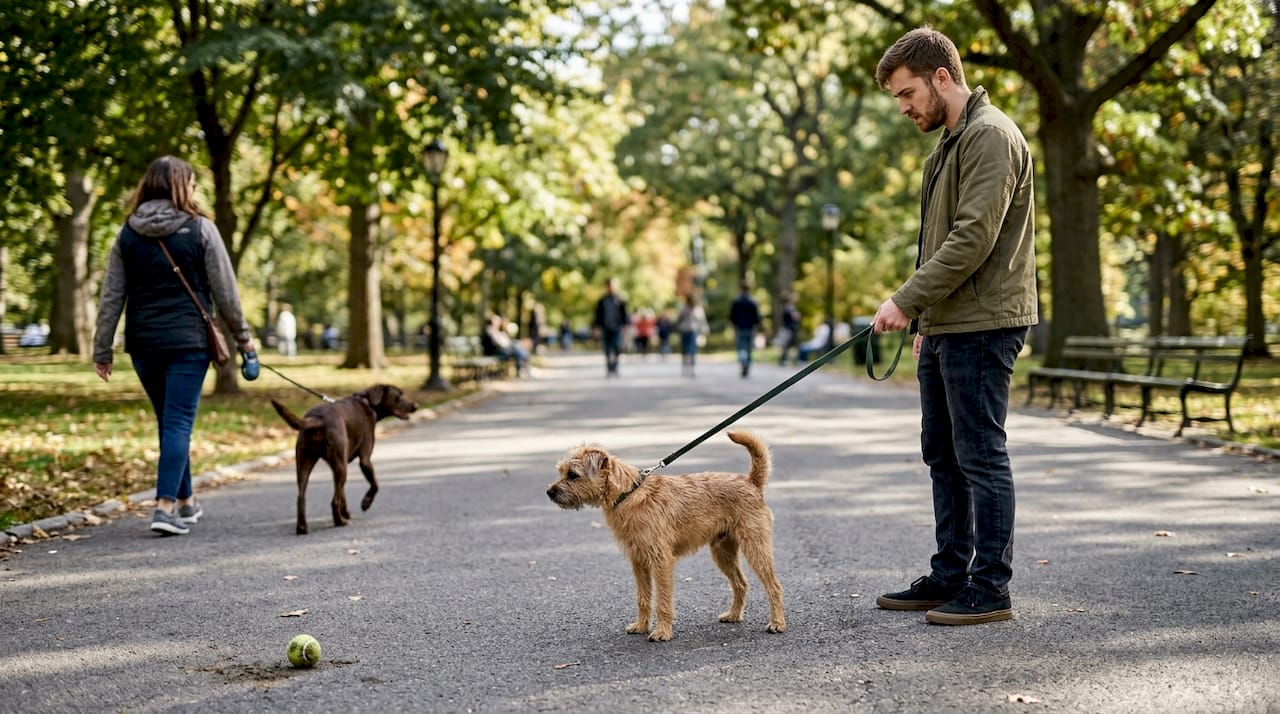
This matters enormously for understanding dog emotions in real situations like fence aggression or reactive behavior on leash.
| Signal | Calm | Warning | Aggression |
|---|---|---|---|
| Tail | Neutral or loose wag | Raised and stiff | Raised, rigid, or tucked (fear aggression) |
| Eyes | Soft, blinking | Hard stare | Unblinking, whale eye |
| Ears | Relaxed, neutral | Forward or pinned back | Pinned flat or rigidly forward |
| Mouth | Loose, slightly open | Closed or tense | Lips pulled back, teeth visible |
| Body | Loose, weight balanced | Stiff, weight shifting | Rigid, leaning forward or back |
Quick guide to reading signals in daily life:
- A dog that rolls over immediately isn’t always asking for belly rubs. It can be a submissive appeasement signal, meaning they feel threatened.
- Fence aggression often looks offensive but is frequently rooted in frustration and redirected fear.
- Fear aggression is one of the most misread behaviors. A fearful dog may growl or snap at a distance after learning that avoidance doesn’t work.
Knowing how dogs express their needs in these edge cases can prevent serious incidents. The dog isn’t “bad.” They’re communicating the only way they know how.
Intentional communication: How dogs adapt signals for humans
Interpreting signals isn’t just about reading moods, but recognizing how and why dogs shape their messages for us. Your dog isn’t just reacting to the world. They’re often actively trying to tell you something specific.
Empirical studies show that dogs adjust their showing behaviors, including gaze alternation and pointing toward food, based on whether their human partner is aware of the situation and willing to cooperate. That’s intentional communication. Your dog checks if you’re watching before signaling. They factor in what you already know.
Common intentional signals dogs use with people:
- Gaze alternation: Looking at you, then at the object, then back at you (“Look at this!”)
- Pawing: Physical contact to demand attention or signal a need
- Vocalization: Specific whines, barks, or groans aimed at getting a response
- Pointing behavior: Orienting their nose or body toward something they want you to notice
Here’s a practical example. Your dog needs water. They might stand near the bowl, look at you, then look back at the bowl. But if their favorite toy is stuck under the couch, they might paw at the ground and whine differently, because the urgency and the goal are different. They’re creating communication signals that are context-specific.
This is why building a richer communication system with your dog pays off so much. When you respond consistently to intentional signals, dogs get more precise. They learn that communication works, so they invest more in it.
Pro Tip: When your dog successfully communicates something to you, reward the attempt. A simple “good dog” and a response to their need reinforces that signaling gets results. Over time, this builds a dog that communicates clearly and calmly instead of escalating to barking or destructive behavior.
For a deeper look at understanding your dog as an active communicator, the research on intentional signaling is genuinely surprising, even to experienced handlers.
Verbal and non-verbal cues: Integrating sound and behavior for best results
Now that we’ve unpacked intentional signaling, it’s essential to combine visual and auditory cues for clear communication. Most owners rely almost entirely on words. But dogs are reading your body, your tone, and your movement simultaneously.
Sound symbolism in human speech actually helps dogs understand commands. Higher pitch sounds aid comprehension of upward actions like “up,” while lower tones work better for “down” or “stay.” Your voice is a signal, not just a word.
Steps to pair verbal commands with matching body signals:
- Choose a command word and commit to it. Inconsistency confuses dogs fast.
- Pair each word with a consistent hand signal or body movement every single time.
- Use tone intentionally: higher and lighter for encouragement, lower and calm for stay or settle.
- Fade food rewards gradually once the behavior is reliable, replacing them with praise and life rewards.
- Practice in different environments. A dog that sits perfectly at home may struggle at the park because the context changed.
| Traditional command | Multimodal signal approach |
|---|---|
| “Sit” (word only) | “Sit” + hand signal + neutral body posture |
| “Come” (word only) | “Come” + open arms + crouching down, inviting posture |
| “Stay” (word only) | “Stay” + flat palm signal + calm, still body |
| “Down” (word only) | “Down” + downward hand sweep + low tone of voice |
The biggest overlooked mistake is sending mixed signals. You say “come” in a frustrated tone while standing stiffly. Your dog reads the body language and tone, not the word, and decides it’s not safe to approach. Training dogs to communicate effectively means making your signals consistent and readable. Tools like clickers, buttons, and structured communication tips help you build that consistency faster.
Why most owners miss early danger warnings
Here’s the uncomfortable truth: most dog bites don’t come out of nowhere. They come after a series of warnings that were ignored, dismissed, or actively punished. The dog gave every signal they had. Nobody listened.
The pattern is almost always the same. A dog shows stress signals. The owner doesn’t recognize them or pushes through anyway. The dog escalates to a growl. The owner corrects the growl. The dog learns that suppressing warnings doesn’t stop the threat. So next time, they skip the warning entirely.
This is not a training failure. It’s a communication failure. And the fix isn’t stricter discipline. It’s better observation.
The most effective shift any owner can make is moving from reactive to proactive. Instead of waiting for a growl and then responding, start watching for the lip lick, the whale eye, the stiffening posture. Those are the real early warnings. By the time a dog growls, they’ve already been uncomfortable for a while.
When in doubt, give your dog space. Don’t force a greeting. Don’t let strangers rush up to your dog. Don’t push a dog to “get over it.” Respecting early signals builds trust, and a dog that trusts you communicates more openly. For advanced dog safety communication strategies, there’s a lot more to explore beyond the basics.
Next steps: Tools and resources for mastering dog behavior signals
You now have a solid foundation for reading your dog’s signals, understanding their intent, and responding in ways that build safety and trust. But learning doesn’t stop here.
At iPupPee, we’ve built a platform around exactly this kind of communication. From in-depth guides to innovative tools that help dogs signal their needs directly, everything is designed to make the bond between you and your dog clearer and safer. Whether you’re a new owner or an experienced handler, understanding the benefits of dog communication tools can transform how you and your dog interact every day. Explore the resources, find the right tools, and keep building.
Frequently asked questions
What is the most common sign a dog is stressed?
A tucked tail, ears back, and avoiding eye contact are among the most common signs of canine stress. Lip licking and yawning in non-tired contexts are also reliable early indicators.
How can I tell if my dog is being aggressive or just scared?
Check the body lean: offensive vs defensive aggression is distinguished by whether the dog leans forward or pulls back. Fear aggression often involves growling at a distance after a dog has learned that avoidance no longer works, and is frequently misread as offensive behavior.
Can dogs adapt their signals to communicate intentionally with people?
Yes. Dogs adjust their signals based on whether their human partner is aware of the situation, showing that their communication is deliberate, not just reactive.
Does a dog’s response to verbal commands depend on your voice?
Absolutely. Research confirms that sound symbolism in speech helps dogs process commands, with higher pitch tones aiding comprehension of upward actions and lower tones supporting calm or downward cues.
What should I do if my dog growls at me?
Stop the interaction immediately and give your dog space. Punishing growling removes a critical warning signal and increases the risk of biting without warning. Consult a professional if growling is frequent or escalating.
Recommended
- Dog Alert Signals: Recognize and Respond for Safety in 2025 – iPupPee
- Creating Dog Communication Signals for Effective Interaction – iPupPee
- Dog Emergency Signals: How They Save Lives – iPupPee
- Master dog communication methods for safety in 2026 – iPupPee
- Nose Work Training - Featured in What Pets Actually Want & Need | Dr. Karolina Westlund | Prodcast