

For every American service dog handler, successful teamwork depends on more than training—it hinges on understanding the subtle ways dogs express themselves. Recent University of California research shows dogs can comprehend specific words using soundboard buttons, demonstrating they strive to communicate intentionally with us. When you spot that unique tail wag or hear a particular bark, recognizing these signs becomes a foundation for your safety, confidence, and daily independence. Bold communication leads to a stronger, safer partnership.
Table of Contents
- Defining How Dogs Express Themselves
- Types of Dog Communication Signals
- Interpreting Common Dog Behaviors
- Enhancing Expression With Communication Devices
- Mistakes to Avoid When Decoding Signals
Key Takeaways
| Point | Details |
|---|---|
| Understanding Dog Communication | Dogs communicate through vocalizations, body language, and tactile signals, requiring handlers to recognize these diverse cues for effective interaction. |
| Individual Variation is Crucial | Each dog has unique communication styles, necessitating close observation to interpret their specific signals accurately. |
| Importance of Context | The same behavior can mean different things depending on the situation, so context is essential for accurate signal interpretation. |
| Communication Devices Enhance Clarity | Utilizing communication devices can improve clarity in interactions, allowing service dogs to express specific needs unambiguously. |
Defining How Dogs Express Themselves
Dogs are communicators by nature. They don’t speak English, but they have developed intentional ways to convey their needs, emotions, and reactions to their world. Understanding these signals is foundational for you and your service dog to work together safely and effectively.
Research from the University of California demonstrates that dogs can comprehend specific words through soundboard buttons and respond contextually, revealing that they process language intentionally rather than simply reacting to owner cues. This discovery is significant: your dog isn’t just responding to tone or routine. Your dog is actively trying to communicate specific things.
What Makes Dog Communication Complex
Your dog’s expressive abilities stem from thousands of years of evolution alongside humans. Studies in canine cognition highlight that dogs express themselves through varied social and cognitive behaviors that have become refined and sophisticated in both dog-to-dog and dog-to-human interactions.
This matters for handlers because your service dog likely relies on you to interpret multiple layers of communication at once:
- Vocalizations: Barks, whines, growls, and howls each carry different meanings
- Body language: Posture, tail position, ear placement, and muscle tension reveal emotional state
- Facial expressions: Eye contact, lip position, and mouth shape convey intent
- Behavioral signals: Specific actions like pawing, nuzzling, or alert stances communicate urgency
- Stillness and silence: Sometimes what your dog doesn’t do speaks louder than action
Your service dog might use a combination of these simultaneously. A single whine paired with a specific body posture means something entirely different from that same whine in another context.
Individual Variation Matters
Every dog communicates with a distinct personality. Your service dog might be a clear communicator who signals needs dramatically, or your dog might be subtle and require careful observation. Some dogs are vocal; others are quiet and rely on physical cues.
This individual variation actually strengthens your handler-dog partnership. As you learn your specific dog’s unique communication style, you become attuned to nuances others might miss. You’ll recognize when your dog’s “alert bark” differs from a play bark or a stress signal.
Your dog’s communication style is consistent within your relationship. The more you observe your dog across different situations, the clearer the patterns become.
For service dog handlers working in public spaces or with variable mobility, this clarity becomes a safety tool. You’ll recognize when your dog needs something versus when your dog is detecting a medical alert or threat.
Why This Matters for Your Independence
When you understand how your dog expresses needs and emotions, you gain independence. You don’t have to guess whether your dog needs water, exercise, a bathroom break, or is signaling an alert. Clear communication reduces stress for both of you and enables your service dog to work more reliably.
Many handlers with disabilities find that learning their dog’s communication system transforms their ability to manage daily life. Your dog becomes a clearer partner, not just a caregiver.
Pro tip: Keep a simple log for one week noting what your dog does before specific events (bathroom breaks, feeding time, alert situations). You’ll identify consistent patterns that clarify what each behavior actually means in your household.
Types of Dog Communication Signals
Your service dog relies on multiple channels to send you information. It’s not just one bark or one gesture—it’s a combination of signals working together. When you recognize these signal types, you can respond faster and more accurately to what your dog actually needs.
Dogs communicate through positive and negative signals such as tail wagging, body posture, growling, and playful behaviors. A wagging tail might suggest happiness, while growling signals a potential threat. Your dog uses a blend of body language, vocalizations, facial expressions, and tactile signals to express different emotions and intentions with both you and other dogs.
Body Language: The Primary Communication Channel
Body language is your dog’s most honest signal. When your dog’s body speaks, you’re seeing genuine emotion and intent without filter. This matters tremendously for handlers because body language rarely lies.
Key body language signals include:
- Tail position and movement: High and wagging suggests confidence; low or tucked indicates fear or submission
- Ear position: Forward ears show attention or interest; pinned-back ears signal stress or submission
- Posture: Stiff, forward-leaning body means alert or aggressive; relaxed stance indicates calm comfort
- Weight distribution: Leaning forward suggests offensive intent; backing away indicates retreat or fear
- Eye contact: Direct stare can be challenging; soft eyes with blinks show trust and relaxation
For service dog handlers, body language often precedes vocalization. Your dog might shift weight or stiffen muscles seconds before alerting you to something.
Vocalizations: The Audio Layer
Barks, whines, growls, and howls each carry different meanings. A single dog might have five different bark types, and each means something specific in context. Your job is learning which is which.
Common vocalizations include:
- Alert barking: Higher pitch, rapid repetition, directed at something specific
- Play barking: Lighter, shorter, often paired with play bows and forward motion
- Distress whining: High-pitched, continuous, paired with pacing or restlessness
- Demand barking: Rhythmic, persistent, usually directed at you for food or activity
- Growling: Low frequency, territorial or protective; can signal discomfort or play depending on context
Understanding your dog’s vocalizations means recognizing that the same sound in different situations carries completely different messages.
This is especially critical for service dog handlers who need to distinguish between alert signals and routine communications.
Facial Expressions and Subtle Cues
Your dog’s face communicates constantly. Lip position, eye dilation, and nostril flare all convey information. Many handlers miss these signals because they happen fast and seem minor compared to a full-body alert.

Watch for mouth and lip changes: Closed, relaxed mouth shows calm; pulled-back lips suggest stress or excitement; exposed teeth with wrinkled muzzle indicates growling or potential aggression. Notice eye changes: Dilated pupils can signal stress or high arousal; soft, slow blinking shows trust.
These subtle signals often come first. Learning to catch them means you can respond to your dog’s needs before they escalate into larger behaviors.
Tactile Communication
Physical contact is direct communication. Your dog might paw you, nuzzle your hand, lean against your leg, or push their nose under your arm. Each touch carries meaning specific to context and your dog’s personality.
A paw on your leg during a specific situation might mean “pay attention” or “I need something.” Leaning against you during a stressful situation signals seeking comfort. These tactile signals are incredibly valuable for handlers because they require close proximity—your dog is literally reaching out.
Pro tip: Document which signals your dog uses before specific events (alert situations, bathroom needs, anxiety). Create a simple reference chart with columns for “situation,” “signal,” and “response.” Review it weekly and you’ll spot patterns that clarify your dog’s individual communication system.
Here’s a summary of how to interpret different types of dog communication signals:
| Signal Channel | Key Insight | Typical Context |
|---|---|---|
| Body Language | Most honest, least filtered | Emotional state, intent |
| Vocalization | Adds urgency or specificity | Alerts, play, stress |
| Facial Expression | Subtle, early signs of feeling | Calm, stress, excitement |
| Tactile (Touch) | Direct, request for attention | Needs, comfort, urgency |
Interpreting Common Dog Behaviors
Not every behavior means the same thing. A dog jumping on you could mean excitement, anxiety, or demand for attention. Context changes everything. Learning to interpret your dog’s behaviors accurately is the bridge between confusion and clear communication.
Behavioral testing in dogs categorizes responses based on human-oriented, environmental, and motivator-oriented stimuli, enabling interpretations of traits such as fear, attention, aggression, and trainability. This framework helps you assess your dog’s emotional states and needs comprehensively, providing insight into typical expressions of stress, social interaction, and motivation.
Stress and Anxiety Behaviors
Stressed dogs show predictable patterns. Recognizing stress early lets you intervene before your dog escalates into problem behaviors. For handlers with disabilities, identifying stress in your service dog is critical for safety.
Common stress indicators include:
- Yawning excessively: Often misread as tiredness; stress yawning happens repeatedly in short spans
- Lip licking: Quick tongue flicks across the lips signal nervousness
- Panting: Heavy breathing without exercise or heat suggests anxiety
- Pacing: Repetitive walking in patterns indicates restlessness
- Whale eye: Visible whites around the eyes show worry or fear
- Tucked tail: Low or between-legs position indicates submission or fear
When you see these signals, your dog needs help. Remove the stressor if possible, or use calming techniques you’ve trained together.
Excitement and Engagement Behaviors
Excitement looks different from stress. A happy, engaged dog shows relaxed body language paired with intentional movement. Your service dog might show excitement before alert situations too.
Positive engagement signals include:
- Play bow: Front legs stretched forward, rear end in the air—classic play invitation
- Soft mouth: Relaxed jaw, slightly open mouth with no tension
- Forward-leaning posture: Weight shifted toward you or a target
- Gentle tail wagging: Mid-height tail, smooth circular motion
- Responsive eyes: Bright, alert eyes with soft expression
Context matters enormously. The same forward lean could signal excitement, aggression, or alert depending on what else your dog is doing.
For service dog handlers, learning to distinguish excitement from alert behaviors prevents false alarms.
Attention-Seeking Behaviors
Your dog uses attention-seeking behaviors constantly. These are communication attempts, not misbehavior. Understanding what your dog is trying to say helps you respond appropriately.
Common attention-seeking actions include pawing at you, gentle nudging, staring directly at you, whining softly, or positioning themselves in your line of sight. When your dog does these things, your dog is asking for something—water, bathroom break, play, or just interaction.
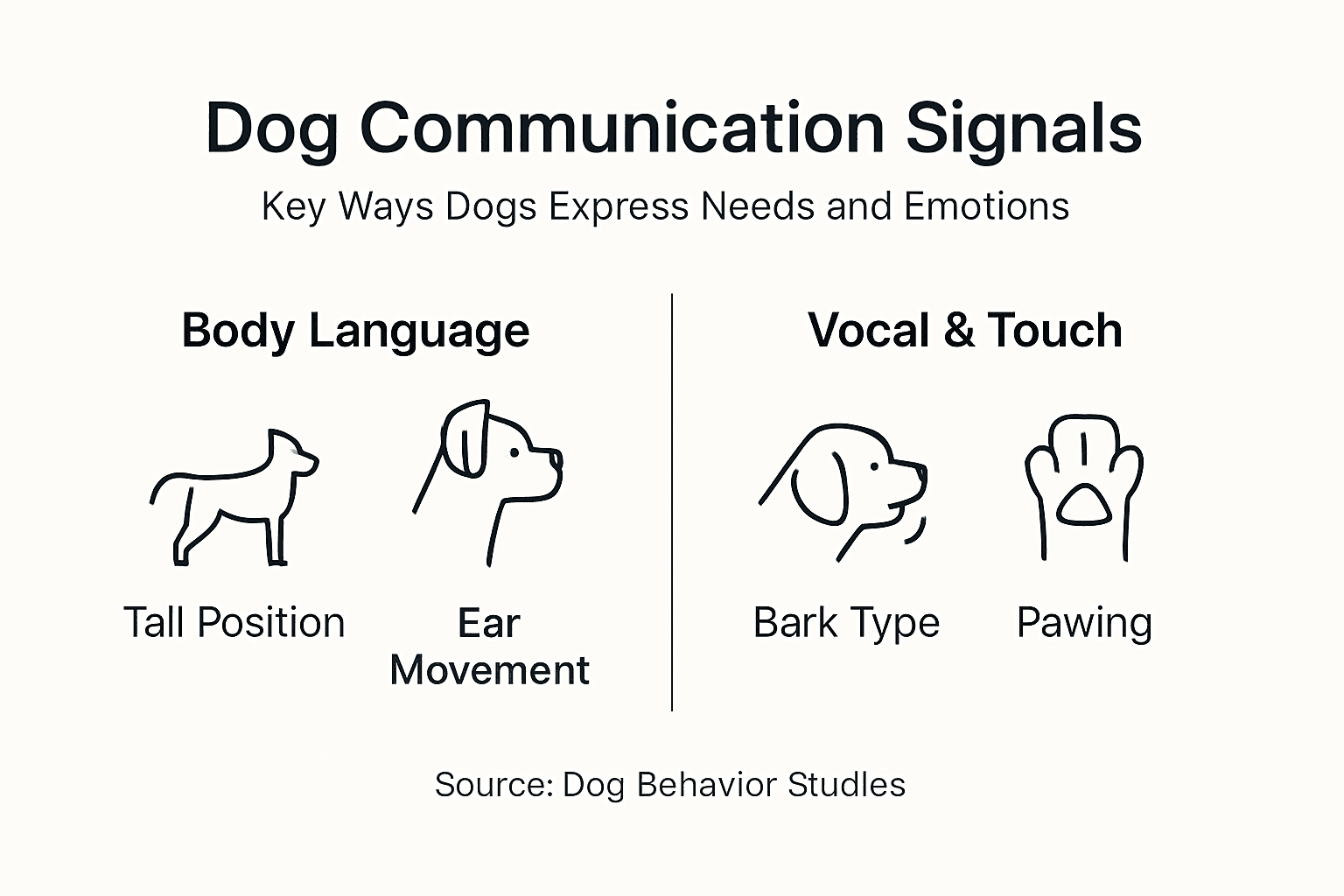
The key is responding to intentional communication and ignoring accidental behaviors. This teaches your dog which signals work.
Environmental Awareness Behaviors
Observing behaviors like vocalizations and stress-related actions offers valuable indicators of your dog’s emotional state and welfare. Dogs who notice their environment show alertness—ears forward, head turning, focused attention. This is especially relevant for service dogs detecting threats or changes.
Dogs who ignore their environment might indicate depression, illness, or extreme stress. Healthy dogs maintain awareness and respond to changes around them.
Notice whether your dog tracks sounds, responds to movement, or investigates new objects. These behaviors reveal how well your dog is processing the world around you.
Pro tip: When a behavior confuses you, write down what happened immediately before it and right after. Note your dog’s body language, the environment, and your response. After collecting three or four examples of the same behavior, patterns emerge that clarify what your dog actually means.
Enhancing Expression With Communication Devices
Your dog already communicates constantly. But what if your dog could express needs even more clearly? Communication devices bridge the gap between natural dog signals and precise human language, giving your dog an additional tool to tell you exactly what they need.
This is where technology meets partnership. Dogs trained to use soundboards and communication devices can associate specific words with outcomes and respond appropriately regardless of who triggers the word or how it is presented. This shows that communication devices expand your dog’s ability to express needs intentionally, opening entirely new possibilities for interspecies communication.
How Communication Devices Work
Communication devices are simple in concept but powerful in practice. Your dog learns to press buttons programmed with specific words or sounds. Each button represents a need, emotion, or request your dog can initiate independently.
The process follows basic learning principles:
- Association: Your dog learns that pressing a button produces a sound or word
- Repetition: Consistent pairing of the button press with outcomes reinforces the connection
- Independence: Your dog presses the button to communicate without waiting for you to interpret signals
- Clarity: No guessing required—the word says exactly what your dog wants
This matters enormously for handlers with disabilities. Instead of watching for subtle body language changes, you have explicit communication. Your service dog can tell you “bathroom,” “water,” or “alert” with a single button press.
Benefits for Service Dog Handlers
For you, communication devices eliminate confusion. Your dog removes the interpretation step entirely. This is especially valuable if you have limited mobility, vision, or hearing that makes traditional signal-reading difficult.
Key advantages include:
- Safety: Your dog can alert you to needs or threats even if you cannot see clear body language
- Precision: Words are unambiguous—no misinterpreting what your dog actually needs
- Independence: Your dog communicates needs without depending on your attention being focused on them
- Documentation: You track what your dog requests, revealing patterns about health and behavior
- Reduced stress: Both of you relax when communication is crystal clear
Many handlers find that introducing communication devices actually improves their dog’s natural communication too. Your dog becomes more intentional about all forms of expression.
Compare the main benefits of using communication devices with traditional dog signals:
| Feature | Traditional Signals | Communication Devices |
|---|---|---|
| Clarity | Relies on interpretation | Explicit word or phrase |
| Response Time | May require guesswork | Immediate understanding |
| Accessibility | May be challenging | Easier for disabled handlers |
| Behavior Tracking | Hard to document | Clear, trackable requests |
Building a Device Vocabulary
Start small. Your dog doesn’t need fifty buttons. Most working dogs function best with 5-10 core buttons covering essential needs and alerts. Begin with the most urgent communications.
Priority buttons typically include:
- Bathroom: Essential for daily management
- Water: Critical for health
- Outside: Broader request for environmental change
- Alert: For medical or safety alerts your dog detects
- Help: For urgent situations
The most successful handler-dog pairs start with two or three buttons and expand only after both partners are completely comfortable.
Adding buttons gradually prevents overwhelming your dog and lets you reinforce each association thoroughly.
Training Considerations
Training a dog to use communication devices requires patience and consistency. Your dog won’t understand immediately that the button press creates sound. The connection builds through repetition and reward.
Effective training involves:
- Choose motivating rewards (treats, play, or access to something your dog wants)
- Place your dog’s paw on the button while saying the word
- Immediately reward and provide the promised outcome
- Repeat dozens of times across multiple sessions
- Gradually fade your physical guidance so your dog presses independently
- Reinforce by always responding when your dog uses the button correctly
Consistency matters more than frequency. Five focused training minutes daily beats sporadic longer sessions.
Pro tip: Place the device in a location your dog naturally visits frequently, like near the door or water bowl. Your dog will discover the buttons accidentally, which creates natural learning opportunities without formal training pressure.
Mistakes to Avoid When Decoding Signals
Your interpretation of your dog’s behavior shapes every decision you make. When you misread a signal, you might respond incorrectly, reinforce the wrong behavior, or miss genuine needs. Understanding common decoding mistakes prevents these costly errors.
One fundamental mistake is assuming dogs perceive the world identically to humans. Research on canine cognition shows dogs focus more on actions than identities, meaning you risk serious misinterpretation if you project your own perspective onto your dog’s behavior. Your dog doesn’t think like you do. This simple fact changes everything about signal interpretation.
The Anthropomorphism Trap
Anthropomorphism is attributing human emotions or intentions inaccurately to dogs. It’s the most common decoding error handlers make. When your dog whines, you might assume guilt or sadness. Your dog might simply be frustrated or anxious.
Common anthropomorphic mistakes include:
- Assuming guilt: Your dog’s “guilty” face after chewing your shoe isn’t guilt—it’s a fear response to your angry tone
- Reading shame: Dogs don’t feel shame. A tucked tail means fear or submission, not embarrassment
- Projecting jealousy: Your dog’s reaction to attention given to another dog is territorial or status-related, not jealousy
- Interpreting spite: Dogs don’t act “out of spite.” They respond to incentives and learned patterns
- Assuming revenge: Your dog isn’t punishing you for leaving. Your dog is expressing separation anxiety or boredom
When you stop attributing human emotions, you see what’s actually happening. This clarity lets you respond appropriately instead of emotionally.
Context Blindness
The same behavior means different things in different situations. Your dog’s jumping could signal excitement, anxiety, demand for attention, or play invitation. Removing context strips away crucial information.
Always consider:
- When the behavior happened (time of day, situation, recent events)
- What preceded the behavior (triggers or antecedents)
- Your dog’s overall state (rested, hungry, anxious, excited)
- Other concurrent signals (body language, vocalizations, ear position)
- Your response pattern (does your dog repeat this when you react the same way?)
Context tells you what the behavior actually means. Without it, you’re guessing.
Every signal requires context. The identical tail wag in different situations communicates completely different messages.
Ignoring Individual Variation
Your dog has a unique communication style. Generic interpretations fail because they don’t account for your specific dog’s personality. One dog’s whine means bathroom urgency; another dog’s identical whine means “play with me.”
You learn your dog’s true meanings through observation across multiple situations. A behavior that always precedes the same outcome is consistent communication. Patterns matter more than any general rule.
Missing the Sequence
Dogs often signal escalation. They start subtle, then increase intensity if you don’t respond. Missing early signals means you only notice the dramatic final behavior.
Escalation often follows this pattern:
- Subtle signal (ear flick, weight shift, soft whine)
- Clear signal (direct stare, louder vocalization, intentional movement)
- Insistent signal (pawing, barking, physical contact)
- Extreme signal (growling, snapping, dramatic behavior)
By noticing signals at step one or two, you address your dog’s need before frustration builds. Waiting until step four means crisis management.
Pro tip: After documenting your dog’s behavior for two weeks, create a simple chart mapping each behavior to its consistent outcome or context. Compare your initial interpretation to what actually happened. You’ll discover which signals you’ve been reading correctly and which need reinterpretation.
Enhance Your Connection With Your Service Dog Through Clear Communication
Understanding how your dog expresses needs and emotions is key to building a strong partnership based on trust and clarity. This article highlights common challenges like misreading subtle signals or missing stress cues that many handlers face when interpreting dog communication. If you want to bridge the gap between your dog’s natural expressions and clear verbal requests, the solution lies in empowering your dog with tools designed for precise communication.
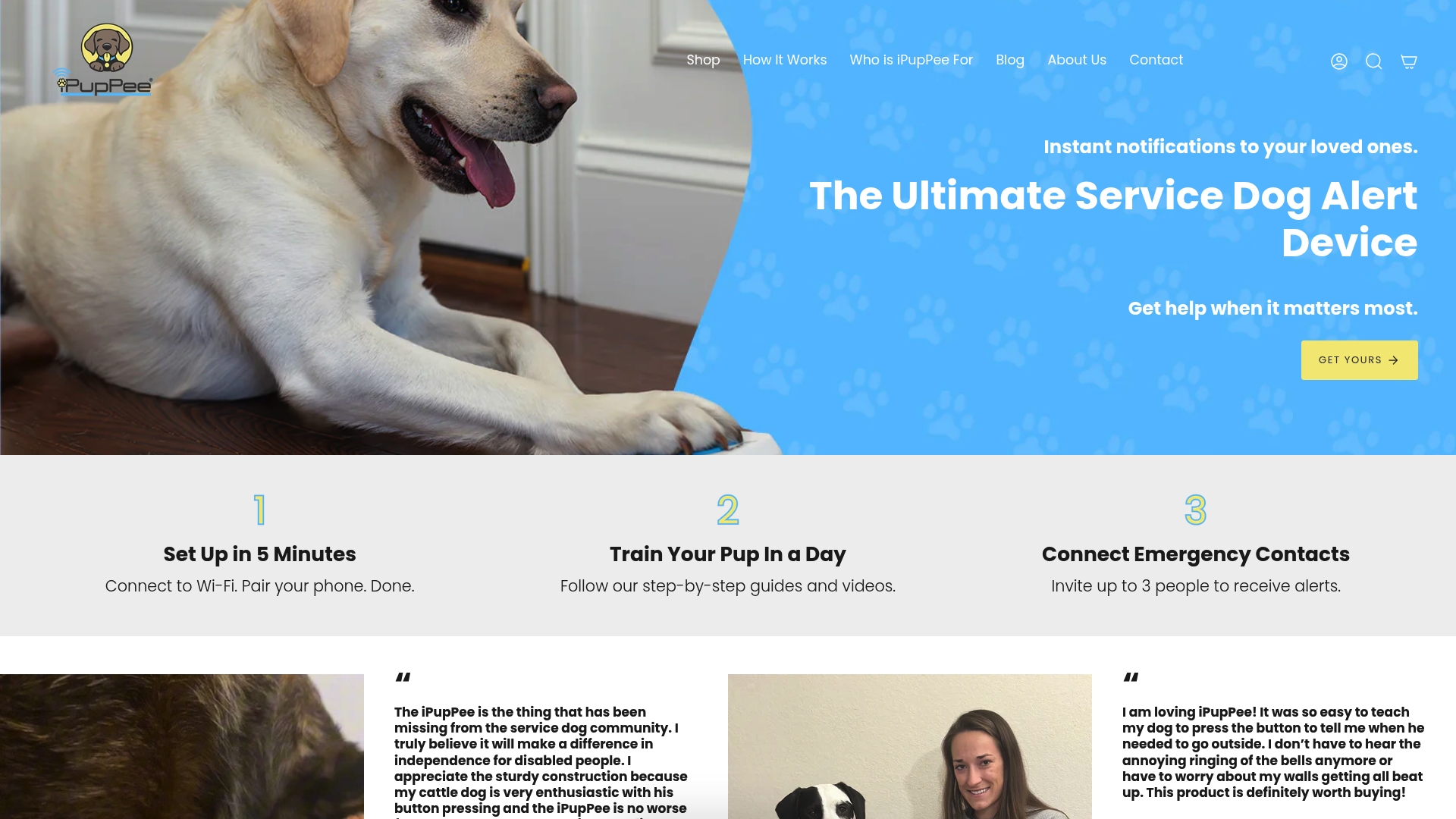
Discover the innovative iPupPee device at ipuppee.com, specially designed to transform your dog’s intuitive signals into straightforward messages you can understand instantly. Whether your service dog is alerting you to medical needs or asking for a bathroom break, the iPupPee gives both of you independence and peace of mind. Visit ipuppee.com now to explore training guides, real user stories, and how simple button presses can enhance everyday safety and communication with your service dog.
Frequently Asked Questions
How can I tell what my dog is trying to communicate?
You can understand your dog’s communication by observing their body language, vocalizations, facial expressions, and tactile signals. Each of these communication channels offers insight into your dog’s emotions and needs.
What are common signs of stress in dogs?
Common signs of stress in dogs include excessive yawning, lip licking, panting without exercise, pacing, and a tucked tail. Recognizing these signals early can help you address your dog’s needs more effectively.
How can I improve my dog’s communication skills?
You can improve your dog’s communication skills by using training techniques like teaching them to use soundboards or buttons to express specific needs. Start with a few essential buttons and reinforce their usage through positive association and repetition.
Why is it important to understand my dog’s communication signals?
Understanding your dog’s communication signals is crucial for creating a strong partnership. It allows you to respond effectively to their needs, reduces stress for both of you, and enhances your dog’s ability to assist you in daily life.