

Voice-free pet alerts are silent, tactile, or visual systems that deliver pet-specific notifications without sound, and for disabled or special-needs owners, they often make the difference between timely awareness and a missed signal. Here is why they matter:
- Accessibility first. Owners who are deaf, hard of hearing, or managing sensory processing conditions cannot rely on audible chimes or verbal alerts. Silent vibration, light pulses, or push notifications reach them where sound cannot.
- Preventive health monitoring. Continuous, quiet sensors build a behavioral baseline that can surface slow-onset illness before visible symptoms appear, a shift veterinary data scientists increasingly advocate.
- Silent emergency location. Visual strobe beacons help first responders find pets during a fire without replacing standard smoke alarms.
- Reduced anxiety. A dog that never hears a jarring alert tone stays calmer, which matters especially for service dogs whose focus is their handler’s safety.
Ipuppee’s pet alert system overview covers how these tools fit into a broader household safety plan.
Table of Contents
- How voice-free alert systems actually deliver notifications
- Concrete benefits for disabled owners and service-dog handlers
- What voice-free alerts cannot do, and when to be careful
- How to choose the right silent alert for your situation
- Setting up your system and training your dog
- What the evidence says about preventive monitoring and fire safety
- Key Takeaways
- The case for going voice-free is stronger than most owners realize
- Ipuppee makes voice-free pet alerts accessible for every owner
- Useful sources
How voice-free alert systems actually deliver notifications
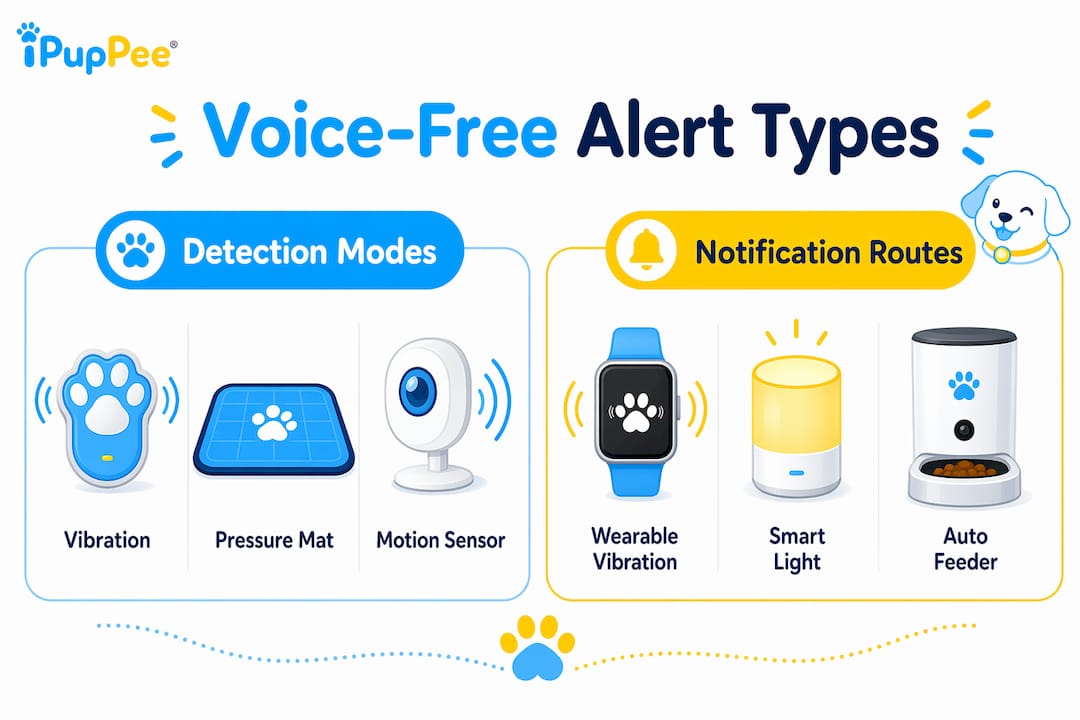
Four device categories cover most use cases, and each routes information differently.
| Device type | What it detects | How it notifies | Best accessibility fit |
|---|---|---|---|
| Vibration/light wearable | Proximity breach, handler-defined zone exit | Haptic buzz or LED flash on handler’s wrist/receiver | Deaf, hard-of-hearing, low-vision owners |
| Proximity/geofence collar | Dog leaving a preset range | Push notification, vibration alert on paired receiver | Mobility-limited owners, service-dog handlers |
| Floor pressure mat | Feeding visits, rest patterns, doorway crossings | App log, timestamped push alert, smart-home trigger | Privacy-sensitive owners; no collar required |
| Silent strobe beacon | Smoke alarm activation | Flashing visual beacon for first responders | All owners; fire-safety supplement |
Pressure mats detect presence via weight and log visit timestamps, sleep patterns, and activity without any camera or wearable hardware. That matters for owners who want health data without putting a device on their dog.
Smart-home integration extends every category. A mat trigger can flip a smart light, activate an auto-feeder, or write a timestamped entry to a health log. Proximity collars pair with smartphone apps and can forward alerts to a caregiver’s phone in real time. For service-dog handlers, wearable tech for dogs that combines vibration and light cues keeps communication discreet in public settings where an audible alert would be disruptive or embarrassing.
Concrete benefits for disabled owners and service-dog handlers
Silent alerts remove the auditory bottleneck that makes standard pet monitoring inaccessible to a large share of the population.
- Sensory overload prevention. Owners with autism spectrum conditions, PTSD, or migraines often find sudden sound alerts destabilizing. A wrist vibration or a light pulse delivers the same information without the spike.
- Public discretion. A service-dog handler in a meeting or medical appointment can receive a proximity alert silently, without drawing attention.
- Overnight monitoring. A floor mat near a water bowl logs nocturnal drinking patterns. A spike in nighttime visits can flag early kidney issues or diabetes before a vet visit would catch it.
- Caregiver forwarding. Push notifications route to a family member or personal care attendant, so a non-verbal owner is never the only person who knows something is wrong.
AI-driven monitoring platforms log eating, drinking, litter-box visits, and movement to surface slow changes that may indicate illness before visible symptoms appear. For companion-pet owners who cannot easily read their dog’s body language due to a visual impairment, that automated pattern recognition fills a real gap.
On the emergency side, silent strobe beacons guide firefighters directly to where a pet is sheltering. When first responders know a pet is inside, they will attempt a rescue. When they do not, the outcome is far less predictable.
“Currently, there is nothing for fire emergencies when it comes to pets. If the dog doesn’t like strangers, the pet profile would show that, so they know how to safeguard themselves. By doing that, it helps them, but it also saves the pet’s life.” — Laika Family founder, via Prolific North
What voice-free alerts cannot do, and when to be careful
No silent alert system is a standalone safety solution. Each category has real limits.
- False positives. Travel, a visitor’s footstep on a pressure mat, or a second pet crossing a proximity zone can all trigger alerts that have nothing to do with your dog.
- Battery and connectivity failure. A dead battery or dropped Wi-Fi connection means no alert. There is no audible backup.
- Multi-pet attribution errors. In a home with two dogs, a mat cannot always tell which animal triggered it without an AI identification layer.
- Privacy tradeoffs. Cloud-connected systems store behavioral data on external servers. Owners should review data-retention policies before setup.
On fire safety specifically: silent strobe pet detectors guide rescue teams to pets, but they are not smoke alarms. A paw-shaped silent strobe device highlighted at CES 2026 reinforced the same point: it complements, not replace, standard audible evacuation alarms. Keep your smoke alarms tested and your carbon monoxide detectors current.
Fire-safety professionals are consistent on this point: visual pet-location beacons help search-and-rescue teams, but audible alarms remain the primary evacuation signal for human occupants.
Pro Tip: Enable “travel mode” or reduce proximity sensitivity before any car trip or vet visit. Running a 48–72 hour live test after initial setup lets you tune thresholds before relying on the system in a real situation.
For owners making adaptive home upgrades, integrating a silent pet alert system alongside other accessibility modifications is worth planning at the same time.
How to choose the right silent alert for your situation
Run through this checklist before buying:
- Notification type. Does it offer vibration, light, or push notification? Confirm it matches your sensory profile.
- Sensitivity settings. Can you adjust tight, medium, or wide range? Configurable sensitivity cuts false alerts.
- Multi-pet attribution. If you have more than one pet, look for AI-based individual identification.
- Caregiver forwarding. Can alerts route to a second phone or caregiver app automatically?
- Battery life and backup. How long does it run between charges, and does it warn you before dying?
- Smart-home compatibility. Does it work with your existing hub (Home Assistant, Apple HomeKit, Google Home)?
On cost: entry-level pressure mats typically run under $50, while integrated monitoring systems with AI identification and app connectivity range higher. Setup time is generally a few hours for hardware placement and app pairing, with dog habituation taking days to a few weeks depending on the individual animal.
Setting up your system and training your dog
Hardware setup (numbered steps):
- Place pressure mats near food and water bowls, and at the primary exit door.
- Mount any silent strobe beacon near the pet’s main resting area, at a height visible to a standing adult.
- Pair the device to its app and add caregiver contacts for forwarding.
- Set a smart-home rule: mat trigger → flash a specific light in your bedroom or living room.
- Run a multi-day baseline before relying on alerts, and adjust sensitivity if false triggers appear.
Dog habituation checklist:
- Introduce the vibration or light cue at low intensity during a calm, positive session.
- Pair each cue with a high-value treat immediately.
- Gradually increase intensity over several short sessions across multiple days.
- For service-dog handlers: coordinate new cues with your trainer to avoid conflicting with existing task signals.
- Expected timeline: most dogs habituate within one to three weeks with consistent reward-based sessions.
Troubleshooting quick hits:
- Missed triggers: check mat placement; a dog that steps around the edge won’t register.
- Duplicate notifications: set a minimum interval between alerts in the app settings.
- Multi-pet errors: retrain the AI identification layer with fresh video or sensor samples.
- Connectivity resets: assign a static IP to the device on your router to prevent drop-outs.
Ipuppee’s training guide on dog safety communication walks through progressive habituation steps in more detail.
What the evidence says about preventive monitoring and fire safety
Continuous behavioral monitoring builds a long-term baseline for each pet that episodic vet visits simply cannot replicate. Veterinary data scientists point to the shift from reactive to preventive care as the core value: quiet, ongoing data collection catches slow-onset conditions like early kidney disease or mobility decline before they become clinical emergencies.
Smart monitoring systems combine sensors and AI to flag patterns like frequent litter-box use, limping, or decreased eating volume as alerts. Some vendors report individual pet identification accuracy above 95% after an adaptation period, which reduces false alerts and keeps health records meaningful in multi-pet homes. Correct attribution is the precondition for useful health data: a system that cannot tell which pet triggered an event produces records that mislead rather than inform.
“AI monitoring in devices achieves high accuracy, but alerts should always be followed by professional veterinary advice.” — SiiPet
On fire safety, the evidence is consistent: silent strobe beacons help search-and-rescue teams locate pets, but they do not replace audible smoke alarms for human evacuation. The Rescue Retriever product line and the CES 2026 paw-shaped strobe both carry the same explicit guidance.
| Evidence area | Key finding | Source |
|---|---|---|
| Preventive monitoring | Continuous logging surfaces slow-onset illness before visible symptoms | PETKIT behavioral AI research |
| Multi-pet attribution | >95% individual ID accuracy reported after training period | SiiPet smart monitoring review |
| Fire-safety strobes | Visual beacons guide rescue teams; audible alarms remain primary evacuation signal | Rescue Retriever product documentation |
Key Takeaways
Voice-free pet alerts give disabled and special-needs owners reliable, non-auditory pet notifications that standard sound-based systems cannot deliver.
| Point | Details |
|---|---|
| Accessibility is the core case | Silent, tactile, or visual alerts reach owners who cannot rely on sound. |
| Preventive monitoring adds health value | Continuous quiet sensors build baselines that flag slow-onset illness early. |
| Strobes supplement, never replace, alarms | Silent rescue beacons help first responders; keep audible smoke alarms active. |
| Configure before you rely on it | Run a 48–72 hour live test and tune sensitivity to reduce false alerts. |
| Ipuppee offers purpose-built solutions | Ipuppee’s devices and training guides are designed specifically for disabled owners and service-dog handlers. |
The case for going voice-free is stronger than most owners realize
The conventional wisdom treats silent pet alerts as a niche accommodation for a small group of users. That framing undersells the technology. Any owner who has ever been startled awake by a false alarm at 2 AM, or watched a service dog flinch at a sudden notification chime, understands intuitively why removing sound from the alert loop is not a compromise. It is often the better design.
What gets overlooked is the preventive health angle. Most owners think of pet monitoring as a security tool, something that tells you where your dog is or whether it got into the trash. The more compelling use is longitudinal: a pressure mat that quietly logs your dog’s water intake every night for six months gives your vet something no single appointment can, a behavioral baseline. That data has caught early kidney disease and diabetes in dogs whose owners had no idea anything was wrong.
The fire-safety case is narrower but urgent. Tens of thousands of pets die in house fires annually in the United States, and the single biggest factor is whether first responders know an animal is inside. A silent strobe does not need to replace your smoke alarm. It just needs to tell a firefighter where to look.
For disabled owners, the independence argument is the most personal. A system that routes a silent alert to your wrist or your caregiver’s phone means you are not dependent on someone else being in the room to know your dog needs you. That is not a small thing.
Ipuppee makes voice-free pet alerts accessible for every owner
If you are a disabled owner, a service-dog handler, or someone who simply needs reliable pet notifications without the noise, Ipuppee builds devices and training resources specifically for that situation. The iPupPee device lets your dog communicate through a simple button press, routing a silent alert to you or a caregiver without any audible chime. Training guides walk you through habituation step by step, and the product page includes real customer testimonials from handlers who rely on it daily.
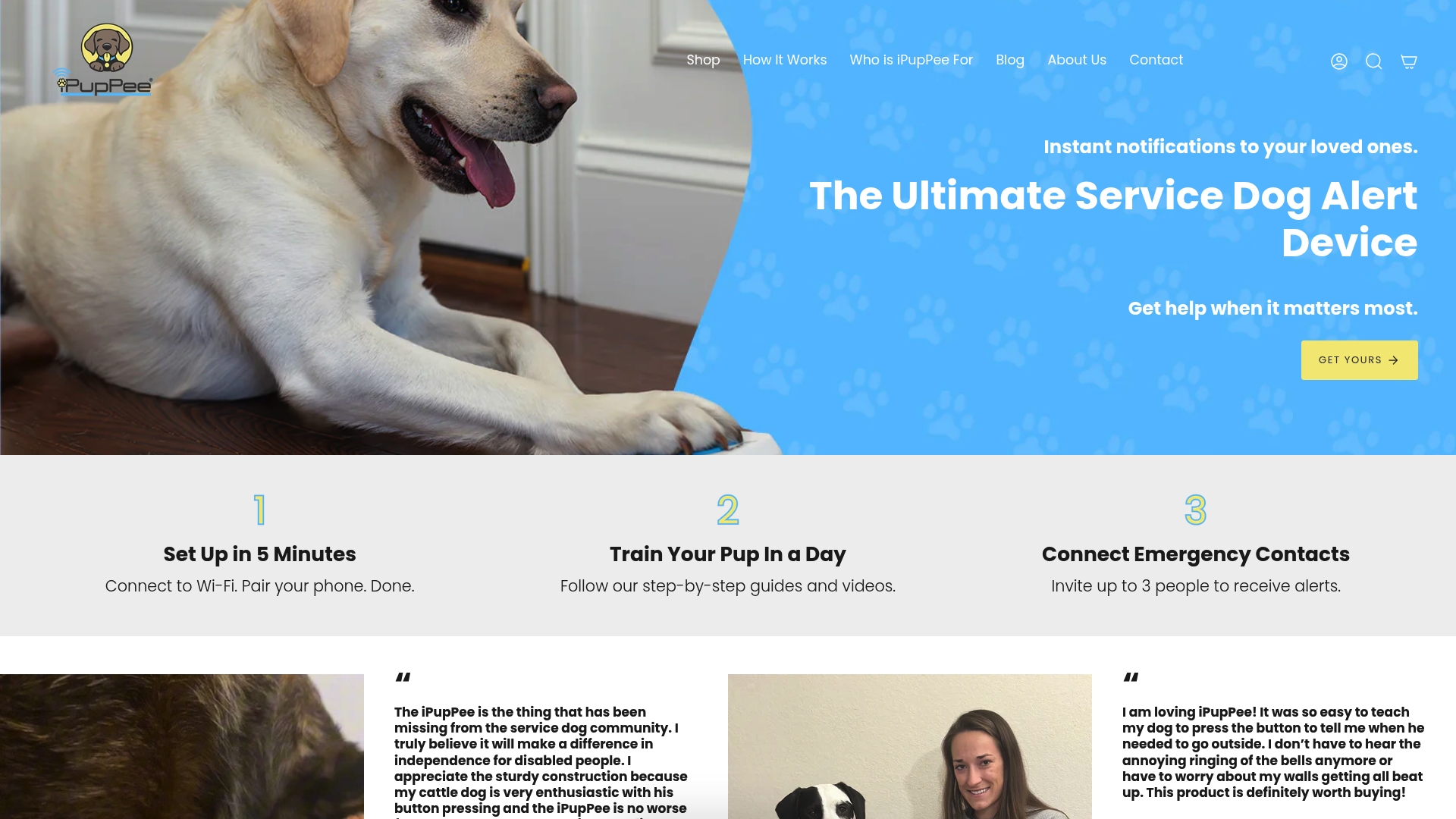
Visit ipuppee.com to explore the device, download training materials, and see how other service-dog handlers have integrated it into their routines.
Useful sources
- iPupPee — Pet Alert System Overview: covers how voice-free alerts fit into household safety and clarifies the smoke-alarm supplement rule.
- iPupPee — How to Increase Dog Safety with Advanced Communication Devices: progressive habituation training steps and caregiver workflow guidance.
- iPupPee — Wearable Tech for Dogs: vibration and light wearable overview with accessibility considerations.
- iPupPee — Why Automate Pet Alerts: framing for automation benefits and caregiver integrations.
- ASC TrampleTek Blue (pets): floor-based pressure mat technical detail; supports how-it-works and smart-home integration sections.
- PETKIT AI behavioral monitoring blog: preventive monitoring rationale and continuous baseline methodology.
- SiiPet — Are Smart Pet Monitoring Systems Worth It?: multi-pet attribution accuracy figures and AI identification discussion.
- Rescue Retriever product page: silent strobe fire-safety guidance; confirms supplementary role.
- Interesting Engineering — CES 2026 paw-shaped strobe: public-facing example of visual pet beacon design intent.
- Prolific North — Laika Family founder interview: real-world fire-safety context and first-responder perspective on pet rescue.