

Interspecies signaling, in the dog owner’s sense, is the set of trained behaviors and device-assisted methods that let a dog reliably send messages or alerts to people, from simple button presses to trained medical alerts. Dogs can and do signal with intent, but reliability varies by dog, training, and context. Research on soundboard-trained dogs and devices like iPupPee show that structured training and the right hardware make these signals more consistent.
TL;DR:
- Dogs demonstrate deliberate use of buttons with recurring two-button combinations that exceed chance levels, indicating intentional messaging.
- They respond appropriately to both button-produced words and spoken words, regardless of speaker, suggesting genuine comprehension.
- Medical alert dogs show variable sensitivity to conditions like hypoglycemia, often below 70%, so pairing them with continuous monitors improves safety.
- Training should involve demonstration, reinforcement, and generalization practices, with expectations for consistency set at several weeks of practice.
- Device choice should prioritize ease of pressing, multiple contact notifications, and durability, with Wi-Fi-enabled options offering live alerts and video.
Table of Contents
- What does interspecies signaling look like in practice?
- What does the research say about dog signaling?
- How do dogs actually produce these signals?
- How do you train a dog to use buttons or give alerts?
- How reliable are dog alerts, really?
- What devices exist, and how do you choose between them?
- How do you decide what to try first?
- A practical note on expectations
- Where iPupPee fits if you want a ready-made option
- FAQ
- Sources
What does interspecies signaling look like in practice?
Most owners encounter this idea through one of three channels: soundboards, trained medical alerts, or voice prosody. Each works differently, and each fits a different goal.
AIC soundboards use recordable buttons arranged on a mat or wall panel, each one playing back a word when pressed. Owners typically start with concrete words such as “outside,” “play,” or “help,” then expand the vocabulary as the dog shows consistent use.

Trained alert behaviors cover a wider range, from a diabetes alert dog pawing at an owner’s leg to a simple “ring the bell” request to go out. These alerts are shaped through repetition and reward rather than instinct alone.
Voice prosody is subtler: handlers change pitch and rhythm, not words, to guide a response.
- Soundboards let dogs select specific concepts from a fixed vocabulary.
- Trained alerts (medical or behavioral) use a single, consistent physical cue tied to a specific event.
- Prosodic cues rely on tone and pitch rather than words or buttons.
What does the research say about dog signaling?
The strongest evidence for deliberate signaling comes from large-scale analyses of soundboard use. A population-level study found that owner-trained dogs using soundboards press buttons in non-random, non-imitative patterns, producing recurring two-button combinations more often than chance would predict. That pattern suggests many dogs are using buttons with some intent rather than pressing at random.
Reporting from UC San Diego on related work describes dogs responding to recorded button words even without visible cues from their owners, pointing to comprehension rather than simple cue-following.
Soundboard-trained dogs produce non-random, recurring button combinations more often than would be expected by chance, according to population-level analysis, supporting the idea of deliberate, differentiated button use rather than accidental pressing.
A separate PLOS One study on word comprehension found dogs behaved appropriately to button-produced words and spoken words alike, whether an owner or a stranger produced them. That consistency across speaker and format suggests dogs attend to the word itself, not just who is talking.
- Population studies support deliberate, non-random button use across many dogs.
- Word-comprehension experiments show dogs respond similarly to spoken and button-produced words.
- Clinical alert-dog studies (discussed below) show much wider variability than soundboard research.
What we know with confidence: dogs can learn to associate specific presses or behaviors with specific outcomes, and many do so with more consistency than random chance would allow. What remains open: how well any individual dog generalizes a signal to new people, settings, or stress levels.
How do dogs actually produce these signals?
Different signal types rely on different underlying mechanisms, which is why method choice matters.
Medical alert behaviors are often hypothesized to rely on scent detection, picking up biochemical changes in breath or sweat tied to blood sugar shifts, though the exact compounds dogs key on are not fully mapped. Behavioral alerts like pawing, nudging, or fetching an object are trained through shaping: the dog is rewarded for an approximation of the target behavior, then for closer and closer versions of it.
Prosody works through sound symbolism. A 2025 study in Nature found handlers used higher pitch for “stand” and lower pitch for “down,” and dogs responded faster when pitch matched direction, suggesting tone itself carries meaning dogs pick up on.
- Olfactory cues underlie many hypothesized medical alerts but are not fully characterized.
- Behavioral alerts (pawing, nudging) are trained through shaping and repetition.
- Prosodic pitch cues speed response time when matched to meaning.
- Device-mediated signals (buttons, Wi-Fi alerts) bypass the need to read body language at all, which is part of their appeal for handlers who can’t always watch their dog.
How do you train a dog to use buttons or give alerts?
Most successful button and alert training follows a similar arc, whether the goal is “outside” on a soundboard or a seizure-alert behavior.
- Demonstrate the outcome by pressing the button or performing the target cue yourself, then immediately deliver what it represents (treat, door open, play).
- Reward any press or approximation of the target behavior, then narrow rewards to only the correct, specific action as the dog improves.
- Introduce a marker, such as a clicker, to bridge the gap between the action and the reward, which speeds learning when a treat can’t arrive instantly. Marker training has been shown to improve acquisition speed and resistance to extinction, in detection-style tasks where delayed rewards are common.
- Practice with different people, rooms, and times of day so the behavior generalizes beyond one context.
Pro Tip: Reward the press itself before worrying about accuracy, then tighten your criteria once the dog is pressing confidently and often.
Common mistakes include over-modeling (pressing the button so often the dog never initiates on its own), inconsistent rewards (sometimes reinforcing, sometimes not), and accidental cueing, like glancing at the button before the dog presses it. Fixing these usually means stepping back, rewarding smaller steps, and limiting how much you prompt.
How reliable are dog alerts, really?
Reliability depends heavily on the task. For medical alerts, one agency-based study found median sensitivity to out-of-range glucose episodes around 70%, and about 83% for hypoglycemia specifically in some accredited cohorts, but individual dogs varied widely around those figures.

Sensitivity for trained glycemia alert dogs can run as low as 36% or as high as 83% depending on the study and dog, which is why clinical reviews recommend pairing a dog’s alerts with a continuous glucose monitor rather than relying on the dog alone.
Variability comes from the dog’s individual aptitude, the consistency of training and reinforcement, and the context (a distracted or stressed dog alerts less reliably).
- Log every alert and whether it was accurate, so patterns are visible over weeks, not guesses.
- Keep a clinical backup, like a CGM, for any medical-use case.
- Retrain or consult a professional if alert accuracy drops noticeably.
What devices exist, and how do you choose between them?
Two broad categories cover most of the market. Simple soundboards are local and offline: a set of recordable buttons that play back words when pressed, with no connectivity required. Smart Wi-Fi alert devices add a layer soundboards don’t have: the ability to send a notification, or even live video and two-way audio, to a person who isn’t in the room.
When comparing options, a few features matter most:
- Ease of press for the dog’s size and paw dexterity.
- Whether the device can alert multiple contacts, not just one phone.
- Durability and power source, especially for dogs who paw hard or chew.
- Whether training guides or a structured course come with the purchase.
- Whether there’s a recurring subscription fee or a one-time cost.
The iPupPee blog covers these tradeoffs in more depth, including device overviews and setup basics for different household needs. As one example of a Wi-Fi-enabled device, iPupPee is built specifically to send alerts and live audio/video to a phone when a dog presses it, which is a different job than a local soundboard performs.
How do you decide what to try first?
Start with your primary goal. If you want convenience, like requesting a walk, a basic soundboard may be enough. If safety is the priority, for a service dog handler, senior living alone, or someone managing a medical condition, a connected alert device with redundancy matters more.
- Match the tool to the goal: convenience signaling versus safety-critical alerting.
- Budget for both the device and any training course or trainer support you’ll need.
- Try one method for 4 to 8 weeks, logging presses or alerts before judging reliability.
- Add a second layer (a CGM, a second contact, a backup sensor) for any medical application.
- Bring in a certified positive-reinforcement trainer if progress stalls after a few weeks.
Our guide to button training walks through this starter plan in more detail, including what a realistic first month looks like.
A practical note on expectations
What strikes me most in this space is how often people expect instant reliability from a dog that’s had two weeks of practice. The dogs in the strongest studies had months of consistent, rewarded repetition behind them. Document every alert, reward generously and consistently, and treat any medical alert as a supplement to real monitoring, never a replacement for it.
— Andrew
Where iPupPee fits if you want a ready-made option
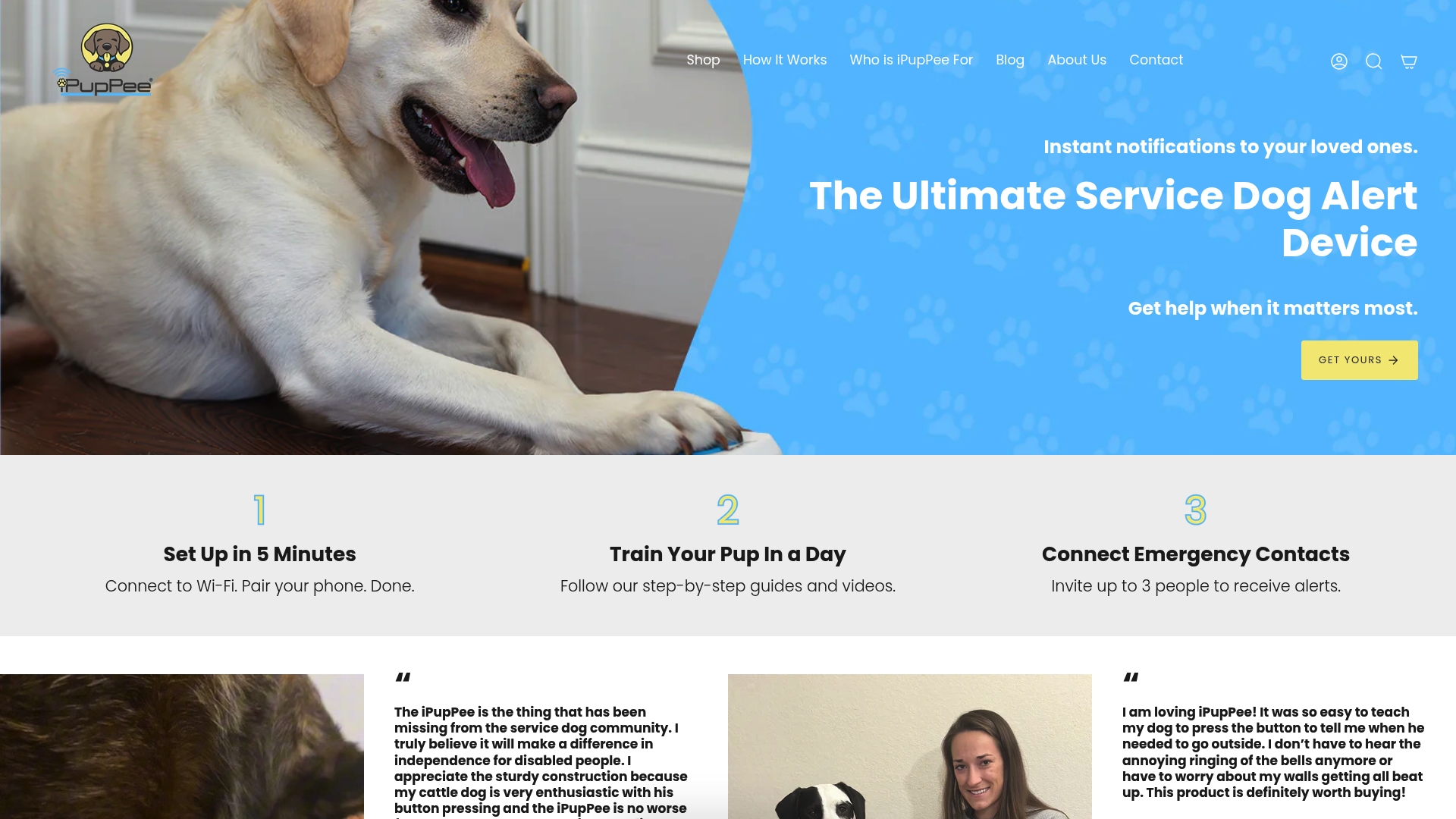
We built a Wi-Fi alert device that lets a dog send a direct notification, along with live video and two-way audio, to an owner or emergency contact with one press, no monthly subscription required. It’s designed for dogs of all sizes and paired with accessible training guides, making it suitable for various dog owners and caregivers who need to know what’s happening even when they’re in another room.
If you want structured support beyond the device itself, the offered Psychology & Training Course teaches the same shaping and marker techniques covered above, applied specifically to alert training. Good nutrition also supports training consistency, as covered in this piece on nutrition and training outcomes. Start with the iPupPee device page to see specs and setup details before you buy.
FAQ
What is interspecies signaling in dogs?
Interspecies signaling is the set of trained behaviors, sounds, or device presses that let a dog communicate a specific message to a person, ranging from a paw tap requesting the door to a button press naming a concept. It depends on consistent training and, often, hardware designed to carry the signal to someone who isn’t watching.
How do dogs communicate with humans without words?
Dogs rely on trained behaviors, scent cues, and prosodic tone rather than spoken language. Research on soundboard-trained dogs shows many produce non-random, recurring button presses that function as a learned vocabulary.
Are soundboard buttons scientifically proven to work?
Population-level research has found that soundboard-trained dogs press buttons in non-random, non-imitative patterns more often than chance predicts, which supports deliberate use rather than proving full language comprehension. A related PLOS One study found dogs behave appropriately to button-produced words and spoken words alike.
How reliable are medical alert dogs compared to devices like a CGM?
Reliability varies widely: one study found sensitivity to hypoglycemia ranging from 36% to 83% across different dogs and programs, with continuous glucose monitors often detecting episodes earlier. Clinical guidance favors using a trained dog alongside a CGM rather than relying on either alone.
What should I look for in a dog alert device?
Look for ease of press for your dog’s size, the ability to notify multiple contacts, durability, and whether training guides are included. Devices like iPupPee add live video and two-way audio on top of a basic alert, which matters most for safety-focused use rather than simple convenience requests.
Sources
- Soundboard-trained dogs produce non-accidental, non-random and non-imitative two-button combinations - PMC
- How do soundboard-trained dogs respond to human button presses? An investigation into word comprehension | PLOS One
- Marker training benefits in detection dog learning - Frontiers in Veterinary Science
- Dogs understand words from soundboard buttons, study reveals - UCSD Today