

Remote monitoring for pets means using cameras, GPS trackers, and wearable sensors to watch behavior and physiological trends from a distance, so you get early warnings and real data instead of guesswork. The main tech families are video cameras, location trackers, wearable sensors, and smart feeders. Most owners who adopt these tools report fewer worried moments at work and faster conversations with a veterinarian when something looks off.
TL;DR:
- Remote pet monitoring devices mainly track location, activity, and vital signs, but they vary in accuracy and suitability for different health conditions.
- Veterinarians prioritize trend analysis over single readings from sensors, emphasizing the importance of baseline data and pattern recognition.
- Device choice should align with your primary goal, whether it is reassurance, medical tracking, or lost-pet recovery, and depend on home size and Wi-Fi coverage.
- Setting up and testing equipment thoroughly for 7 to 14 days ensures reliable alerts and prevents false alarms, with a focus on establishing normal behavior patterns.
- Communication-enhanced systems like iPupPee offer direct, subscription-free alerts for service dogs or vulnerable pets, with immediate video and audio response capabilities.
Table of Contents
- What remote pet monitoring includes: core features and data types
- Practical use cases: everyday and clinical scenarios where monitoring helps
- Types of devices and how they differ
- What the research says: accuracy, limits, and how vets use remote data
- How to pick the right remote-monitoring approach for your pet
- How to set up and test remote monitoring with your pet
- Privacy, security, and ethical considerations
- Why communication-first design matters for service-dog teams
- How iPupPee supports remote monitoring and communication
- FAQ
- Sources
What remote pet monitoring includes: core features and data types
Every system on the market falls into a few functional buckets, and knowing what each one actually records helps you avoid paying for features you will never use.
Cameras handle the visual side: live video, two-way audio, short event clips triggered by motion or sound, and push alerts when your pet approaches a forbidden zone. GPS trackers report location on a map and can send geofencing alerts if your dog leaves the yard. Wearable sensors go further, logging activity levels, heart rate, resting respiratory rate, and in newer models, scratching or licking behavior tied to skin irritation. Smart feeders and water stations round out the category, tracking consumption patterns rather than movement.
- Cameras capture video, audio, and motion-triggered clips with instant alerts.
- GPS trackers show real-time location and flag geofence breaches.
- Wearables log activity, heart rate, resting respiratory rate, and pruritus signals.
- Feeders and water stations record intake timing and volume.
Most apps turn raw readings into trend lines rather than single numbers, which matters because one odd reading rarely means anything on its own. Some systems also generate shareable reports you can forward to a veterinarian, a feature increasingly built into wearable tech for dogs aimed at everyday health tracking rather than emergency response.
Practical use cases: everyday and clinical scenarios where monitoring helps
The appeal of remote monitoring is rarely about a single dramatic rescue. It is about catching small problems early and getting reassurance during ordinary absences.
- Checking in on separation anxiety during the workday to confirm your dog settles down after you leave.
- Using video for postoperative rechecks instead of driving back to the clinic.
- Tracking resting respiratory rate trends in a dog with early heart disease.
- Following a lost pet’s GPS trail the moment a collar alert fires.
- Watching for new scratching patterns that might signal a skin condition flaring up.
Telemedicine has moved from novelty to practical tool for selected follow-ups. A JAVMA study on videoconferencing rechecks found that owners using home-based video calls for postoperative checks reported satisfaction similar to in-clinic visits, with no increase in complications in the study sample.
The study also found owners avoided a median of 50 minutes of travel time per telemedicine recheck, a practical benefit for anyone juggling a work schedule around a pet’s recovery.
For chronic conditions, the value comes from pattern recognition rather than any one alert. A dog with early kidney or heart disease might show subtle drift in activity or breathing rate weeks before symptoms become obvious, which is the entire argument for wearing a collar sensor long enough to establish what normal looks like.
Types of devices and how they differ
Picking a category starts with being honest about what you actually need to know.
Consumer pet cameras offer pan-tilt-zoom lenses, night vision, and treat-tossing mechanisms, and they are the easiest entry point. Their main limits are mechanical: treat dispensers jam, night vision washes out in bright rooms, and AI activity labels can mislabel a stretch as “distress.” Smart feeders add convenience for multi-pet households or irregular schedules, but a jammed hopper or a dead battery means a missed meal, so a backup plan matters.
GPS trackers trade accuracy for battery life. A tracker checking in every few seconds drains faster than one pinging every few minutes, and most require an ongoing subscription for live tracking, which changes the long-term cost picture.
Wearable collars with accelerometers and heart rate sensors sit in a different tier. Consumer wearables estimate activity and sleep; medical-grade monitors validated for resting respiratory rate and pruritus detection are built for clinical trend tracking, not casual step counting.
- Consumer cams: strong for live viewing and basic alerts, weaker on nuanced behavior detection.
- Smart feeders: convenient but mechanically vulnerable, so a battery backup helps.
- GPS trackers: accuracy and subscription cost scale together.
- Wearables: consumer models track activity; validated medical-grade sensors track vitals clinicians trust.
Consider a clinical-grade sensor when a veterinarian has flagged a specific condition, such as early heart disease or a chronic skin issue, that benefits from continuous trend data rather than a snapshot at a single appointment. Our guide to lifestyle monitoring breaks down which category fits different everyday goals.
What the research says: accuracy, limits, and how vets use remote data
The honest answer is that remote sensors are good at specific, narrow tasks and should not be trusted for everything the marketing implies.
Collar-mounted accelerometers have been validated for detecting pruritic behavior like scratching and licking. A large AJVR study of 1,803 dogs tracked between 2019 and 2023 found sensitivity between 76.9% and 87.0% and specificity between 99.7% and 99.8% for detecting these behaviors, which supports using accelerometers for objective trend monitoring rather than one-off alerts.

Sensitivity for scratching detection reached up to 87.0% in that AJVR accelerometer study, meaning the sensor caught most true scratching episodes but still missed some, which is why clinicians look at patterns over days, not single flags.
Resting respiratory rate tracking tells a similar story. A study of the Maven Pet Smart Collar found automated measurements closely agreed with manual counts in healthy dogs, though the limits of agreement meant a single automated reading could still drift from a manual count taken at the same moment.
Clinicians interpreting remote monitoring data tend to prioritize trends over isolated readings, because any one measurement carries more noise than a week of consistent data.
This caution matters because accelerometer classifiers depend on training data, and performance can shift across breeds, coat types, and activity contexts. A VCA Animal Hospitals overview of home monitoring systems notes that device capability ranges from simple cameras to medical-grade sensors, and owners should match the tool to the goal rather than assume every wearable catches every problem. In-person exams remain necessary whenever a trend looks concerning.
How to pick the right remote-monitoring approach for your pet
Start by naming your actual goal, because peace of mind, clinical tracking, and lost-pet recovery call for different tools entirely.
- Decide whether you need reassurance, medical trend data, or location recovery, since few devices do all three well.
- Check coverage area and Wi-Fi range before buying a camera for a large home.
- Confirm battery life matches your routine, especially for GPS collars used on long hikes.
- Ask whether the device exports data your veterinarian can actually review.
- Check if multiple household members can access alerts without sharing one login.
- Review the subscription structure, since some platforms charge per device.
Pro Tip: Ask any vendor exactly what their alert accuracy is based on, and ask your veterinarian whether they can use exported data during an appointment.
Red flags include vague privacy policies, subscriptions that multiply with each additional pet or camera, and marketing claims around AI detection with no mention of validation. A pet safety devices overview covers additional warning signs worth checking before you commit to a system.
How to set up and test remote monitoring with your pet
Buying the device is the easy part. Testing it properly before you rely on it is what prevents false alarms and wasted money.
- Place cameras and base stations where your pet naturally spends time, and confirm Wi-Fi signal reaches that spot before mounting anything permanently.
- Introduce interactive features like two-way audio gradually, starting with short sessions while you watch how your pet reacts.
- Collect baseline data for 7 to 14 days to establish what normal activity, feeding, or respiratory rate looks like for your specific pet.
- Log anything unusual, including the time, duration, and what triggered the alert, so you can spot real patterns versus noise.
- Escalate to a veterinarian when a trend persists for several days rather than reacting to a single alert.
Our hydration monitoring log offers a simple template for the kind of baseline tracking that makes alerts meaningful instead of alarming.
Privacy, security, and ethical considerations
Cloud storage is convenient but means your pet’s video lives on someone else’s server, often with a retention window you should check before signing up. Local storage avoids that tradeoff but usually costs more upfront and lacks remote access unless you set up your own network configuration.
Manage account permissions carefully in multi-person households, since not everyone needs full control over alerts or camera settings. Ask any vendor whether video and audio are encrypted in transit and at rest.
- Review retention policies before choosing cloud storage over local storage.
- Set separate permission levels for each household member with app access.
- Confirm encryption standards directly with the vendor rather than assuming them.
- Test two-way audio carefully, since some pets become agitated hearing a voice with no visible source.
Why communication-first design matters for service-dog teams
Working with service-dog handlers and owners who depend on reliable alerts taught us that a monitoring device is only as good as its weakest communication link. A missed notification or a confusing app is not an inconvenience for a senior living alone or a handler relying on a service dog. It is a safety gap.
Training matters as much as hardware. A dog that understands exactly how to trigger an alert, and an owner who trusts the system because they tested it themselves, is what makes any device reliable in a real emergency rather than just a demo at the store.
— Andrew
How iPupPee supports remote monitoring and communication
We built iPupPee around a simple idea: a dog should be able to tell you directly when something is wrong, not rely on you noticing a camera alert in time.
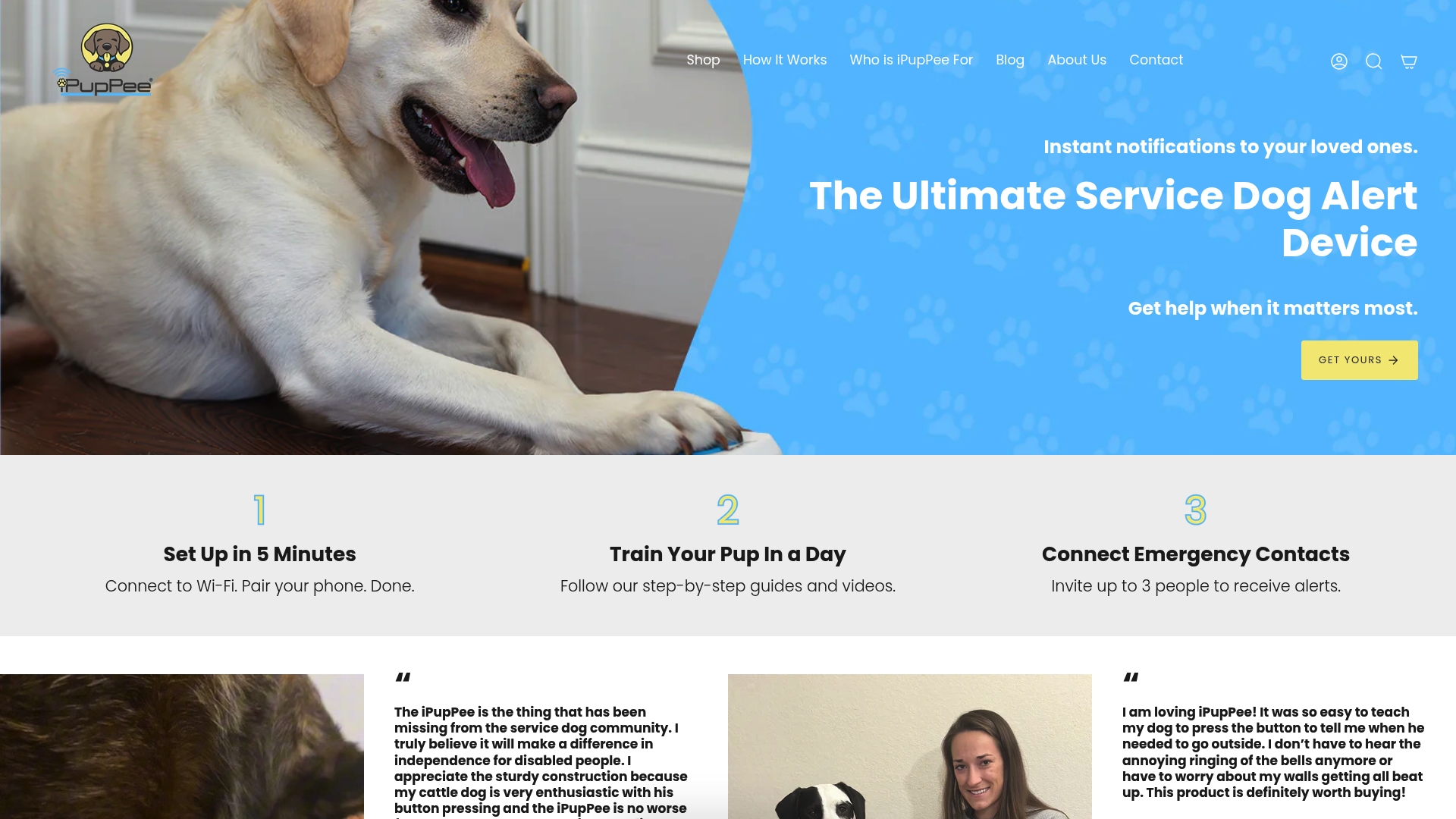
Our device sends instant Wi-Fi notifications with real-time video and two-way audio to multiple contacts at once, so a caregiver, family member, or emergency contact can respond without delay. There is no monthly subscription fee, and the button design works for dogs of any size once trained.
- Service-dog handlers get a direct communication channel that does not depend on interpreting behavior on a screen.
- Seniors and people with mobility or sensory limitations gain a backup alert system beyond a single caregiver.
- Our Psychology & Training Course helps any dog learn the button reliably, priced at $119 one time.
The iPupPee device itself is $129.99 one time, and you can add shipping protection for $5.00 at checkout if you want coverage against damage or loss in transit.
FAQ
Are pet cameras always recording?
Most consumer pet cameras record continuously only while actively streaming or when motion and sound trigger a clip, rather than storing nonstop footage by default. Check each device’s settings, since continuous recording options exist but usually require more cloud storage and often an added subscription.
Can I access a pet camera remotely?
Yes, nearly all current pet cameras connect through a mobile app that lets you view live video and receive alerts from anywhere with an internet connection. Access depends on a stable home Wi-Fi connection and, for some brands, an active subscription for full remote features.
What is the best camera to monitor pets at home?
There is no single best camera for every household, since the right choice depends on home size, Wi-Fi coverage, and whether you need two-way audio or treat dispensing. Buyer guides recommend prioritizing reliable app connectivity and clear privacy policies over flashy extras when comparing pet cams.
How does pet telehealth work?
Pet telehealth typically uses video calls for consultations or postoperative rechecks instead of an in-person clinic visit, supplemented by data from monitoring devices when available. A JAVMA study found owners using home-based video calls for postoperative checks reported satisfaction similar to in-clinic visits.
How do alert devices like iPupPee fit into pet communication?
Alert devices let a trained dog trigger a direct notification with live video and audio to a chosen contact, rather than relying on a caregiver watching a camera feed. The iPupPee system is designed specifically for service-dog handlers and owners who need a dependable, subscription-free alert path.
Sources
These sources informed the research-backed claims throughout this explainer, covering telemedicine outcomes, sensor validation, and buyer guidance for home monitoring systems.
- Owner satisfaction with videoconferencing for recheck exams | JAVMA
- Watching Your Watch Dog: Home pet monitoring systems | VCA Animal Hospitals