

Why pet data matters more than most owners realize
Pet data covers everything collected about an animal’s health, behavior, nutrition, and environment, and right now it sits at the center of a genuine shift in how veterinary medicine works. The short version: more data means earlier detection, more personalized care, and measurably better outcomes for pets and the businesses that serve them.
Here is what that looks like in practice:
- For pet owners: Continuous monitoring catches problems weeks or months before a routine checkup would. AI tools can flag behavioral changes, like a spike in daily water intake, that often signal kidney disease or diabetes before symptoms become obvious.
- For veterinarians: Longitudinal data replaces the single-visit snapshot with a running health story, making it far easier to spot trends and intervene early.
- For pet-care businesses: Analytics on pet profiles, purchase history, and service patterns drive personalized marketing, stronger loyalty, and new revenue streams.
- For the industry: The global pet industry is very large, and companies that integrate diverse data streams are positioned to capture significant market share as personalized, preventive care becomes the standard.
The enabling technologies, AI diagnostics, wearable biometrics, and emerging data interoperability standards, are maturing fast. The challenge is connecting them.
How pet data improves health and care outcomes
The clearest proof of what pet data can do is Mars Petcare’s RenalTech, an AI diagnostic tool trained on data from more than 150,000 cats and 750,000 veterinary visits over 20 years. It predicts chronic kidney disease in cats up to two years before traditional clinical diagnosis. Chronic kidney disease is the leading cause of death for cats over five, affecting 30% to 40% of all cats over age 10. Two extra years of lead time changes the entire care equation.
Statistic to know: Mars Petcare’s machine learning models, built on 2.2 million X-rays, can identify 42 distinct findings in thorax and abdominal X-rays of cats and dogs, serving as an initial assessment tool where trained veterinary radiologists are scarce.
Wearables add a different dimension. Smart collars and activity trackers generate continuous biometric data, including vital signs, sleep quality, and movement patterns, that match clinical accuracy and give veterinarians a trusted data stream between visits. If a dog’s resting respiratory rate climbs 15% over three consecutive nights, an integrated system flags it directly in the clinic’s electronic medical record before the owner even notices anything is wrong.
The practical benefits of connected health data include:
- Earlier disease detection across chronic conditions like congestive heart failure, asthma, and osteoarthritis
- Proactive care plans built on individual baselines rather than breed averages
- Remote diagnostics where owners live-stream real-time biometrics during video consultations
- Post-surgical monitoring via smart bandages and mobility-tracking collars that alert surgical teams to early complications
Pro Tip: Connect your pet’s wearable to your veterinary clinic’s system before the next appointment. Even a few weeks of baseline data gives your vet a meaningful reference point for spotting deviations.
The shift from reactive to preventive medicine is the core value here. A wearable tech guide from Ipuppee walks through how continuous monitoring translates into real health gains for dogs, including early alerts that owners can act on before a condition escalates.
How pet-care businesses use data to grow revenue and loyalty
Pet data is not just a clinical tool. For groomers, trainers, boarding facilities, and veterinary practices, it is a business asset that drives personalized service and repeat revenue. Pet-care businesses that use data analytics see growth in revenue and stronger customer relationships through targeted content, timely service reminders, and offers matched to each pet’s actual profile.
The business case breaks down into a few concrete levers:
- Personalized marketing: Knowing a dog’s breed, age, weight, and health history lets a business send the right offer at the right time, a joint supplement promotion to a seven-year-old Labrador owner, not a puppy training package.
- Loyalty through relevance: Owners who receive genuinely useful, pet-specific communication stay longer and spend more than those who get generic newsletters.
- Operational efficiency: Automated health reminders, appointment scheduling tied to vaccination records, and integrated service histories reduce staff time spent on manual follow-up.
- New revenue streams: Grooming observations, daycare activity logs, and retail purchase histories are often overlooked data sources that, when analyzed, reveal health patterns and upsell opportunities.
Pro Tip: Start small. Collect breed, age, and visit history for every client, then use that data to segment your email list before investing in a full analytics platform. The segmentation alone typically lifts engagement before you spend a dollar on new software.
The challenge for most small and mid-size pet businesses is adoption. Practice management systems, communication tools, and consumer pet devices often run in parallel rather than together, creating more administrative work instead of less. The businesses that close that gap first tend to build the most durable client relationships.

What pet ownership demographics reveal about data adoption
Pet ownership in the United States has grown steadily, and the profile of who owns pets, and how they spend, shapes which data tools gain traction fastest. Younger generations, particularly millennials and Gen Z, are driving premium spending on pet health technology, treating pets as family members and expecting the same quality of care they would want for themselves.
| Demographic factor | Trend | Impact on pet data adoption |
|---|---|---|
| Millennial and Gen Z ownership | Rising share of total pet owners | Higher demand for apps, wearables, and telehealth |
| Single-person households | Growing segment of pet owners | Greater reliance on remote monitoring and alert devices |
| Higher-income households | Disproportionate premium spending | Early adopters of AI diagnostics and genetic testing |
| Urban pet owners | Dense concentration in metro areas | Drive demand for on-demand, data-connected services |
The generational shift matters because younger owners are comfortable sharing pet data with apps and platforms, which accelerates the volume of data available for AI training. At the same time, they are also more likely to question how that data is used, making transparency a competitive differentiator for businesses that get it right.
Single-person households represent a particularly important segment. Owners living alone rely more heavily on remote monitoring, alert devices, and communication tools because they cannot always be physically present to observe their pet. Products like Ipuppee’s iPupPee device address exactly this need, giving dogs a way to signal their owners directly and giving owners peace of mind when they are away.
Challenges in collecting and integrating pet data
The biggest barrier to realizing the full value of pet data is not a lack of sensors. It is fragmented data silos that prevent individual data streams from combining into a complete health picture. A pet’s smart feeder knows its eating patterns, the activity tracker logs movement, the camera records behavior, and the veterinary clinic holds medical records, but these systems rarely talk to each other.
The core problem: Disconnected systems cause veterinarians to make decisions with incomplete information, while pet owners struggle to compile data from multiple sources manually. Potentially life-saving insights remain hidden in disconnected datasets.
Key challenges and the innovations addressing them:
- Proprietary ecosystems: Device manufacturers lock data inside closed platforms to protect market position. The emerging answer is interoperability standards like Matter 1.5, which create pathways for secure longitudinal data sharing between home devices and clinic systems.
- Unstructured, noisy data: Much home-generated pet data arrives at clinics in formats that are hard to interpret quickly, adding friction for already-stretched veterinary teams.
- Privacy and consent: Pet wearables can collect substantial data about owners as well as pets. A 2025 viewpoint in Frontiers in Digital Health specifically called for standardized formats, informed consent, and transparent data-use policies as prerequisites for trust and adoption.
- Veterinary system gaps: Many clinic practice management systems predate API integration and cannot easily accept external data feeds.
- Digital twins as a bridge: Verifiable Digital Credentials and pet Digital Twins, portable health profiles stored on an owner’s phone and shareable via NFC or QR code, are emerging as a practical workaround until full interoperability standards become routine.
The analogy to human healthcare is instructive. The U.S. Office of the National Coordinator for Health IT spent 15 years building toward healthcare interoperability, and the lesson was clear: technical solutions alone are not enough. Industry collaboration, regulatory pressure, and consumer demand all have to align.
Expert perspectives on pet data and AI in veterinary care
The people building pet health AI are candid about how hard the problem is. Pet health models face a challenge human healthcare AI does not: biological diversity at a scale that requires exponentially more training data. A single diagnostic model must account for animals ranging from 4-pound Chihuahuas to 200-pound Great Danes, across more than 470 dog breeds and 60 cat breeds, each with distinct health profiles.
Pets also age five to eight times faster than humans. A six-month gap between data points can represent a meaningful portion of a pet’s life stage, potentially missing critical health transitions entirely. That compressed timeline is exactly why continuous biometric monitoring matters so much more for animals than for people.
The direction the field is moving is clear: from reactive care triggered by visible symptoms to preventive care driven by continuous data. Video consultations in 2026 already allow owners to live-stream their pet’s real-time biometrics while a veterinarian watches heart and respiratory rates respond to a physical demonstration. AI pre-analyzes historical wearable data before the vet joins the call, so the appointment starts at diagnosis rather than data gathering.
Pro Tip: Before your next vet appointment, export a week of data from your pet’s wearable or health app and email it to the clinic in advance. Most veterinary teams will flag anything worth discussing before you even walk in the door.
For pet owners interested in how AI tools are reshaping day-to-day care, Ipuppee’s overview of pet AI tools covers the practical applications worth knowing about in 2026.
How pet data is regulated in the United States
Pet data does not yet have a dedicated federal regulatory framework in the United States. Instead, it sits at the intersection of several existing laws, and the gaps are real.
The Federal Trade Commission Act covers deceptive data practices broadly, which means pet tech companies that misrepresent how they collect or use owner and pet data face enforcement risk. The California Consumer Privacy Act and similar state-level laws apply when pet data is linked to an identifiable person, which it almost always is, since the owner’s account ties to the device. That means pet wearable companies operating in California must provide disclosure, opt-out rights, and data deletion options.
The more specific concern flagged by University of Bristol researchers is that pet wearables often collect more data about owners than about pets, including location, home routines, and behavioral patterns. That owner-level data falls squarely under existing privacy law, even when the product is marketed purely as a pet health tool.
For veterinary records specifically, there is no HIPAA equivalent for animals. Veterinary patient data is governed primarily by state veterinary practice acts and individual clinic privacy policies, which vary widely. The American Veterinary Medical Association provides guidance, but compliance is not federally mandated.
The practical implication for pet owners: read the privacy policy of any pet health app or wearable before connecting it to your home network or sharing it with a third-party platform. For businesses, the safest path is to treat pet owner data with the same care as human health data, even where the law does not yet require it.
Where pet data is headed in the next few years
The near-term future of pet data is integration. The technologies exist; the work now is connecting them into systems that reduce friction rather than add to it.
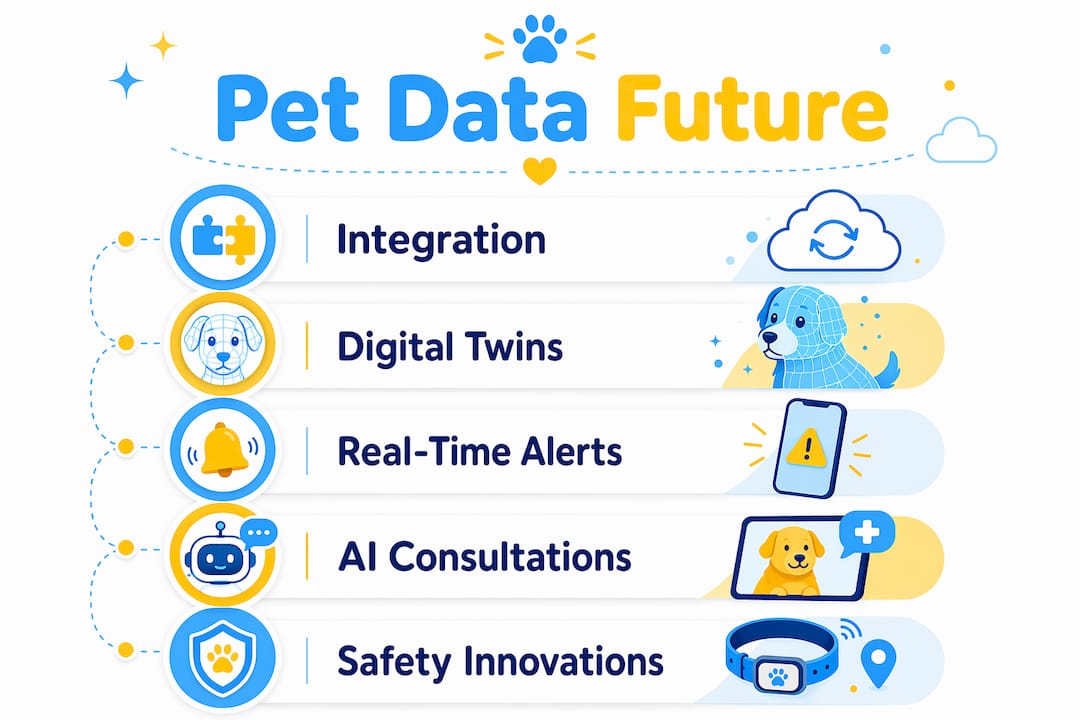
Digital twins for pets, portable, verifiable health profiles that travel with the animal from clinic to clinic, are moving from concept to early deployment. Verifiable Digital Credentials stored on an owner’s phone and shared via NFC or QR code give any veterinarian immediate access to a complete health history, vaccination records, and biometric baselines, regardless of which practice management system the clinic uses.
Real-time biometric alerts are becoming more clinically meaningful as wearable accuracy improves. The gap between a consumer-grade smart collar and a clinical-grade monitor is narrowing, and as that gap closes, the data generated at home becomes genuinely useful for remote diagnosis and chronic condition management.
AI-assisted consultations will become standard rather than exceptional. Pre-visit data analysis, automated anomaly detection, and AI-generated summaries already exist in early-adopter clinics. Within a few years, arriving at a vet appointment without a data history will feel like showing up without an insurance card.
The pet safety innovations emerging in 2026 reflect this trajectory, with communication devices, health monitors, and alert systems converging into connected ecosystems that serve both pet health and owner peace of mind. Ipuppee sits squarely in that space, building tools that close the communication gap between dogs and their owners, one data point at a time.
Key Takeaways
Pet data’s primary value is the shift from reactive to preventive care, and that shift depends entirely on connecting fragmented data streams into a coherent health picture.
| Point | Details |
|---|---|
| Early detection saves lives | AI trained on 150,000+ cats predicts chronic kidney disease up to two years before traditional diagnosis. |
| Wearables match clinical accuracy | Continuous biometric data from smart collars provides trusted streams for remote diagnosis and chronic condition management. |
| Fragmentation is the core barrier | Disconnected systems prevent comprehensive health profiles and limit AI’s ability to deliver its full clinical value. |
| Business value is real | Personalized data-driven marketing drives loyalty and operational efficiency for pet-care businesses of all sizes. |
| Regulation is catching up | No federal pet data law exists yet, but state privacy laws and FTC oversight already apply to owner-linked pet data. |