

Button-based and dog-activated communication devices genuinely help — they give dogs a reliable, repeatable way to signal needs, and they give caregivers clearer, faster information. That’s not marketing. A controlled PLOS One study confirmed that dogs can learn to associate recorded words on soundboard buttons with specific outcomes and respond appropriately even when human body-language cues are removed.
Here’s the short version of why they work:
- Autonomy: Dogs gain a way to initiate communication rather than waiting for owners to guess.
- Safety: A single button press can alert a handler to a potty need, pain signal, or environmental trigger.
- Reduced frustration: Clearer signals mean less barking, pawing, and guesswork on both sides.
- Bonding and enrichment: Learning to use a button is mentally stimulating and strengthens the feedback loop between dog and owner.
- Accessibility: For seniors, people living alone, or handlers with limited mobility, a wireless alert button can function as a practical safety tool.
One honest caveat up front: these devices don’t give dogs human language. What they build is a set of learned associations. Individual results vary, and some dogs take to buttons quickly while others never engage.
Key Takeaways
Button-based communication devices help dogs and caregivers most when training is consistent, vocabulary starts small, and the primary goal is safety and welfare rather than human-like speech.
| Point | Details |
|---|---|
| Evidence is real but bounded | A PLOS One controlled study confirms dogs learn button-word associations; full conversational language is not established. |
| Start with one concrete word | “Outside” or “water” with an immediate, consistent consequence builds reliable signals faster than a large vocabulary. |
| Safety and autonomy are the core gains | Potty alerts, distress signals, and appliance control are where these devices deliver the clearest, most practical value. |
| Not every dog will engage | Monitor stress signals; if a dog avoids the button or shows anxiety, simplify or stop. Body language remains a valid channel. |
| Ipuppee for safety-first use | Ipuppee offers single-button and wireless alert devices with training guides suited to seniors, handlers, and families. |
Table of Contents
- How communication devices help dogs and caregivers in real life
- What the science actually shows about dogs and soundboard buttons
- Who benefits most from dog communication devices?
- How to train your dog to use a communication button
- What features matter when choosing a device?
- Realistic limits and common myths about dog communication buttons
- An honest take on what buttons can and can’t do
- Ipuppee’s devices and training guides for your dog
- Sources
How communication devices help dogs and caregivers in real life
The most immediate benefit is autonomy. A dog that can press a button labeled “outside” and get a consistent response has something most dogs lack: a reliable way to initiate an outcome. That matters for welfare. When animals have control over their environment, even in small ways, it reduces what behaviorists call learned helplessness — the passive, anxious state that develops when a dog’s signals are routinely ignored or misread.
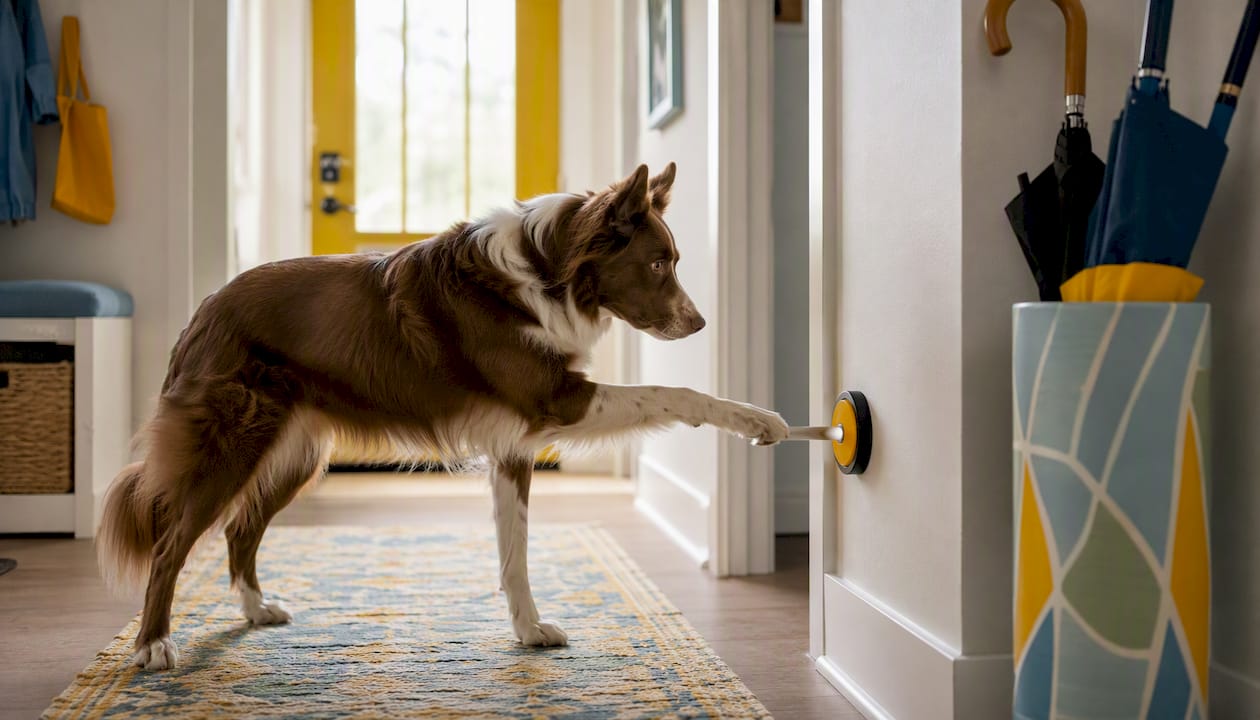
Safety is the second major gain, and for some owners it’s the primary one. A potty-alert button placed near the door gives a clear, timed signal instead of a dog circling or whining ambiguously. For service-dog handlers, the stakes are higher: a dog trained to press a wireless switch can trigger an alert, control a light, or signal distress. Seniors living alone report that a simple button alert for bathroom needs reduces accidents and the anxiety that comes with them.
Daily convenience compounds over time. Caregivers who used to interpret vague signals — a stare, a nudge, a bark — describe the shift to button communication as genuinely clarifying. Frustration drops on both ends when the signal is specific and the consequence is immediate.
Enrichment is the benefit people underestimate most. Teaching a dog to use a button requires problem-solving, attention, and memory. That cognitive load is tiring in the best way, especially for high-drive breeds or dogs recovering from anxiety. AKC coverage of soundboard research notes that owners frequently report improved bonding alongside reduced stress for dogs engaged in button training.
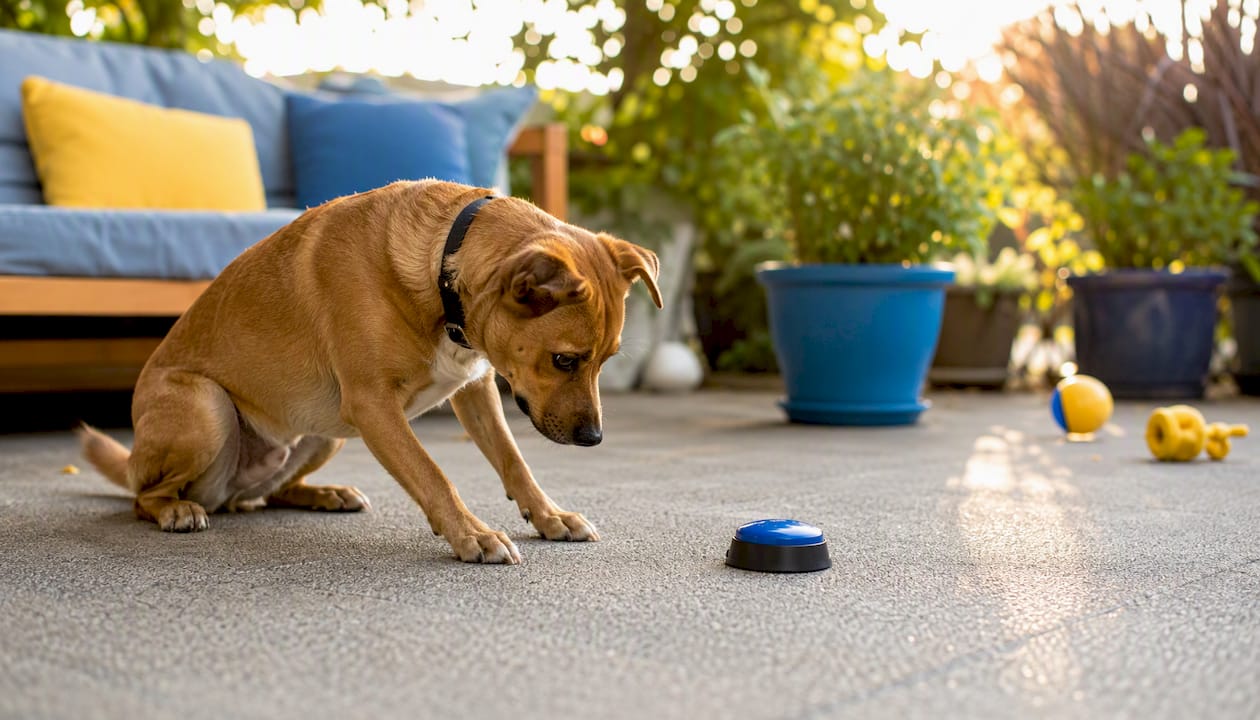
Pro Tip: Start with words that already have strong, immediate consequences in your dog’s life — “outside,” “water,” or “play.” Avoid abstract words like “love” or “good.” The button only works if the outcome follows within seconds, every time.
What the science actually shows about dogs and soundboard buttons
The strongest evidence comes from a PLOS One controlled study by Rossano and colleagues. Researchers trained pet dogs to associate recorded words on soundboard buttons with specific outcomes, then tested whether dogs could respond correctly when human body-language cues were deliberately removed. They could. That’s a meaningful finding: it rules out the simplest alternative explanation, which is that dogs are just reading their owners rather than the button.
PBS NewsHour reporting on Rossano’s larger dataset describes a picture that’s promising but still contested. Many dogs in the dataset produce contextually appropriate button presses — pressing “outside” before the door opens, pressing “play” before initiating a game. Researchers are careful, though: contextually appropriate doesn’t automatically mean intentional language. The debate about whether dogs understand words the way humans do remains open.
Clive Wynne, a canine cognition researcher at Arizona State University, has noted publicly that dogs are extraordinarily sensitive to human social cues, which means owners need to be careful about inadvertent cueing. That’s not a reason to avoid buttons; it’s a reason to test them carefully.
| Study / Source | Scale | Headline Finding |
|---|---|---|
| Rossano et al., PLOS One | Controlled lab study | Dogs learned button-word associations and responded without body-language cues |
| Rossano large-scale dataset (PBS) | Hundreds of dogs, ongoing | Many dogs produce contextually appropriate presses; intentional language not yet proven |
| AKC expert summary | Expert review | Dogs can learn specific words; owners report reduced stress and improved bonding |
The practical takeaway: dogs learn associations reliably. Words like “outside” and “play” carry enough consistent consequence to become meaningful signals. Multi-word syntax or anything resembling grammar is not established by current research.
Who benefits most from dog communication devices?
Not every dog or household is an equally good fit. Here’s where these tools tend to deliver the most:
- Service-dog handlers with limited mobility: A wireless button lets a dog trigger an alert or control a device without the handler needing to move. The Dogosophy Button, developed at an Open University ACI Lab, was built specifically for nose- and paw-friendly appliance control with wireless pairing.
- Seniors and people living alone: A potty-alert or distress button provides a safety layer that’s genuinely useful when no one else is home to interpret subtle signals.
- Families with young children: Buttons give kids a concrete, visual way to understand what the dog is communicating, which builds empathy and reduces misread interactions.
- Anxious or newly adopted dogs: A reliable signal that gets a consistent response can reduce anxiety-driven behaviors. Ipuppee’s rescue dog communication guide covers this in detail.
- High-drive or bored dogs: The cognitive challenge of learning button use provides structured mental stimulation.
Where buttons are less likely to help: dogs with physical limitations that prevent button activation, owners who can’t commit to consistent follow-through, or dogs that already have reliable, well-understood signaling behaviors that meet their needs.
Placement matters as much as the device itself. Put the “outside” button directly beside the door. Keep the “water” button near the bowl. Accessibility and predictability are what make the signal reliable.
How to train your dog to use a communication button
Whole Dog Journal’s training primer outlines three methods that practitioners use most: Aided Language Input (you model the button press yourself before acting on it), Focused Language Stimulation (short, repeated sessions pairing the button sound with the outcome), and Increased Wait Time (you pause and wait for the dog to offer the press rather than prompting it).
A practical sequence:
- Choose one word. Pick something with an immediate, reliable consequence — “outside” is the classic first choice.
- Model it. Press the button yourself, say the word, and immediately take the dog outside. Repeat this at every natural opportunity for several days.
- Shape the touch. When the dog sniffs or paws near the button, reward that. Gradually require an actual press before the consequence follows.
- Pair and fade. Once the dog presses reliably, stop modeling the button yourself. Wait. Let the dog initiate.
- Add a second word only when the first is solid — meaning the dog presses it in the right context at least 80% of the time across several days.
Common problems and fixes:
- Dog ignores the button: Move it closer to the relevant location; make the consequence faster and more exciting.
- Inconsistent follow-through by the owner: The button loses meaning if the consequence doesn’t follow. Set a rule: the button press always gets a response, even if the answer is “not right now” communicated by a calm redirect.
- Accidental cueing: If you always reach for the leash right before pressing “outside,” the dog is reading you, not the button. Vary your body position and timing.
Measure success by tracking reliable, context-appropriate presses over two weeks. A decrease in attention-seeking barking or pawing is a strong secondary signal that the button is doing its job. The IAABC Foundation Journal documents trainer case reports showing that consistent button use can clarify requests and reduce frustration-driven behaviors.
Pro Tip: Keep a simple tally on your phone — date, word pressed, context, and whether it was appropriate. Two weeks of data tells you far more than gut feeling about whether training is working.
What features matter when choosing a device?
| Device Type | Best For | Key Features |
|---|---|---|
| Single-record button | Beginners, one-word alerts | Recordable owner voice, durable casing, large surface |
| Multi-button board | Expanding vocabulary | Modular layout, consistent activation force, cleanable |
| Large paw/nose pad | Physical accessibility, service dogs | Low activation force, wide surface, wireless option |
| Wireless switch/receiver | Handlers with mobility needs, remote alerts | Range, pairing simplicity, battery life |
Features worth prioritizing:
- Recordability: Your voice, not a generic tone, creates the word-outcome association.
- Large activation surface: Easier for dogs with less precise targeting, and for nose-press use.
- Durability and cleanability: Buttons live on floors. They get wet, chewed, and stepped on.
- Wireless range: For alert systems where the handler may be in another room, range and receiver reliability matter more than vocabulary size.
- Low activation force: Especially important for small dogs, puppies, or dogs with joint issues.
For handlers with limited mobility, accessibility-focused device options that integrate into daily routines and predictable contexts tend to produce the most reliable results. A button placed inconveniently gets ignored; one placed at the dog’s natural decision point gets used.
Realistic limits and common myths about dog communication buttons
The biggest myth is that button training teaches dogs to talk. It doesn’t. What it teaches is a conditioned association: press this, get that. That’s genuinely useful, but it’s different from language.
Good Housekeeping’s expert roundup makes the point clearly: owners can inadvertently cue their dogs, and the most honest frame for button training is enrichment and clearer signaling, not proof of speech. That framing isn’t a demotion. Enrichment and clearer signaling are exactly what most dogs and caregivers need.
A few ethical checkpoints:
- Watch for stress signals. If a dog avoids the button, yawns excessively during sessions, or shows displacement behaviors, the training may be aversive. Stop and simplify.
- Keep sessions short. Five minutes of focused training beats thirty minutes of confusion.
- Use social and play rewards early. Food works, but social rewards (play, praise, the actual activity the button represents) build stronger, more durable associations.
- Don’t over-interpret ambiguous presses. A dog pressing “outside” at 2 AM might mean potty need, or might mean the button is in a high-traffic spot and got bumped. Context matters.
- Not every dog will engage. Individual differences in motivation, physical ability, and prior learning history mean some dogs simply won’t take to buttons. That’s fine. Body language remains a rich, valid communication channel.
An honest take on what buttons can and can’t do
The research on dog communication devices is genuinely exciting, and the welfare argument for giving dogs a reliable signaling tool is strong. But the most common mistake people make is starting with too many buttons and too little consistency. One button, one word, one immediate consequence — that’s the whole game for the first month.
Track button presses for two weeks before adding anything. If the dog is pressing “outside” in the right context reliably, you have something real. If the presses are random, the training needs work before you expand. The science supports the concept; the execution is what determines whether it helps your specific dog.
For readers who want structured guidance, Ipuppee’s training resources are a practical starting point.
Ipuppee’s devices and training guides for your dog
Ipuppee builds alert and communication devices designed specifically for the use-cases this article covers: potty alerts for people living alone, accessible wireless switches for service-dog handlers, and single-button options for owners just starting out. The training guides walk through Aided Language Input and first-word selection in plain language, with video support.
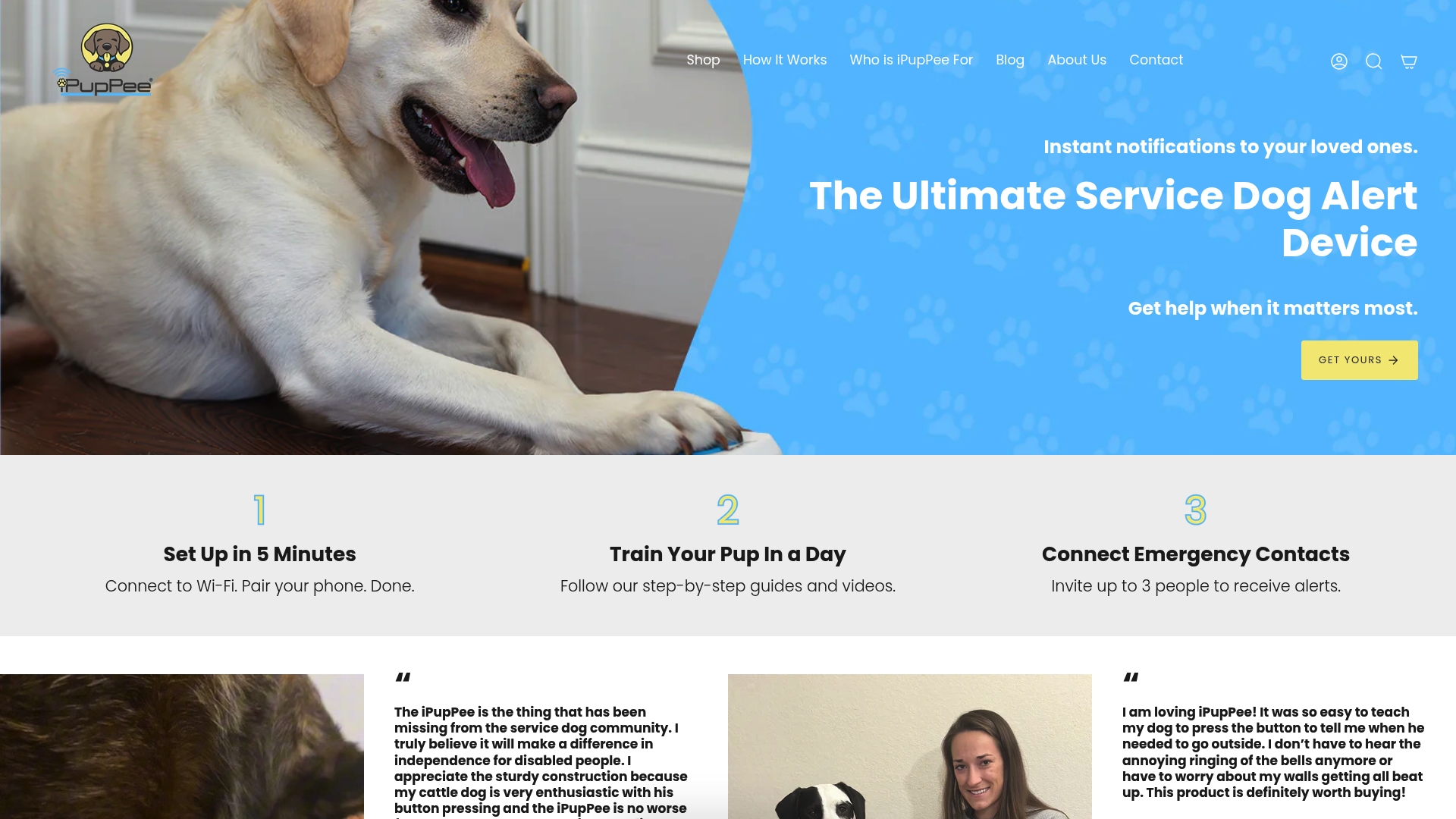
The expectation is realistic: Ipuppee’s tools are built for safety-first, welfare-focused communication, not viral talking-dog content. If you’re a senior, a handler with limited mobility, or a caregiver who needs a clearer signal from your dog, the product line maps directly to those needs. Customer support and training guides are included.
Visit Ipuppee to see the full device range and download the training guide for your dog’s situation.
Sources
- PLOS One study (Rossano et al.) on dogs and soundboard word recognition
- Can Dogs Talk With Buttons? Using Soundboards to Communicate — AKC
- How button boards are changing human-canine communication — PBS NewsHour
- Service dogs control devices with new big blue button — New Atlas
- Talking buttons for dogs — Whole Dog Journal