

TL;DR:
- Canine interactive learning involves dogs actively engaging with humans through attention, memory, and impulse control to acquire skills. It relies on reward timing, social cues, and individual motivators, leading to faster, more durable behavior changes. Proper use of novelty, precise reinforcement, and social imitation techniques enhance training efficiency and cognitive health.
Canine interactive learning is defined as a two-way training process where dogs actively engage with humans through attention, memory, and impulse control to acquire new skills. Unlike passive obedience drills, this method treats the dog as a cognitive participant, not just a subject. Research confirms that gifted dogs show sociocognitive skills comparable to an 18-month-old child, including the ability to learn object labels by overhearing human conversation. That finding reframes how dog owners and trainers should approach every session. The standard industry term for this field is canine cognitive training, and understanding it changes everything about how you teach your dog.
What is canine interactive learning, and how does it work?
Canine interactive learning is the structured use of cognitive engagement, reward timing, and social cues to build durable behaviors in dogs. It draws from two foundational frameworks in animal behavior science: classical conditioning and operant conditioning. Classical conditioning pairs a neutral stimulus with a meaningful one to create an automatic response, while operant conditioning shapes behavior through consequences. Both operate simultaneously in every well-designed training session.
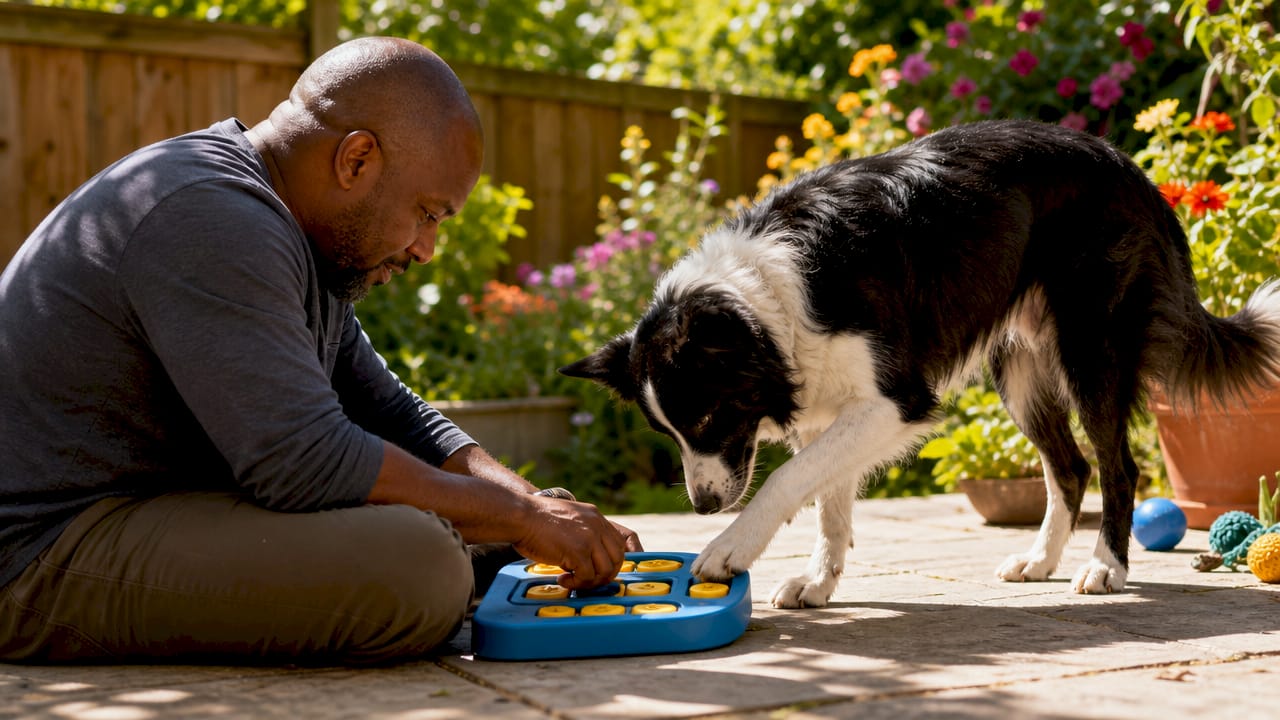
The cognitive processes involved go beyond simple repetition. Interactive learning activates attention, memory, and impulse control, and dogs can form strong associations with new tasks in as few as 1–3 salient trials. That speed is significant. It means a single well-timed, high-value interaction can anchor a behavior far more effectively than dozens of low-engagement repetitions.
Reinforcement schedules determine how long a behavior lasts. Continuous reinforcement, where every correct response earns a reward, builds the behavior quickly. Transitioning to a variable schedule, where rewards come unpredictably, makes the behavior more resistant to extinction. This mirrors how slot machines keep people engaged. The unpredictability itself becomes motivating.
Pro Tip: Start every new behavior on a continuous reinforcement schedule, then shift to variable reinforcement once the dog performs the behavior reliably in three different environments.
How do individual motivators shape a dog’s learning style?
Every dog has a dominant motivator, and misidentifying that motivator is the most common reason training stalls. The failure is rarely about the dog’s ability. It is almost always about a mismatch between what the trainer offers and what the dog actually wants.
Common motivators include:
- Prey drive: The urge to chase, grab, and shake. Terriers and herding breeds often rank this highest.
- Scent: Hounds and working breeds frequently respond better to nose-based games than food rewards.
- Food: The most widely used motivator, effective across most breeds when the treat value is calibrated correctly.
- Play and social attention: Many companion breeds prioritize interaction with their owner over any food reward.
- Movement-based tasks: High-energy breeds like Border Collies show better outcomes with movement rewards than static treat puzzles.
Identifying your dog’s motivator requires observation, not assumption. Run a simple preference test: offer a toy, a treat, and physical praise simultaneously, then step back. Watch which one your dog pursues first. Repeat this across three sessions to confirm the pattern. Once you know the dominant motivator, every training activity becomes more efficient because the reward itself becomes part of the engagement.
Training aligned with natural motivators also reduces stress and anxiety during sessions. A dog working toward something it genuinely wants shows lower cortisol-related behaviors, stays focused longer, and retains learned behaviors more reliably. That is not a minor benefit. It is the difference between a dog that performs in your living room and one that performs at the vet’s office.
What are the benefits and limits of interactive toys and enrichment?
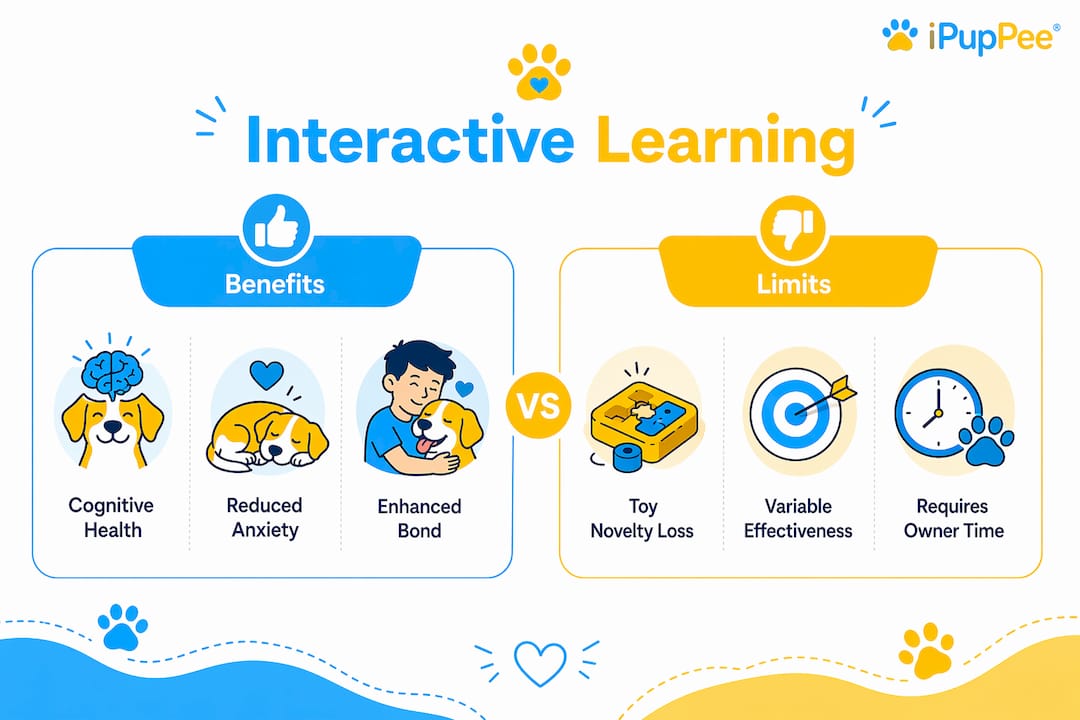
Interactive toys and problem-solving activities contribute to canine cognitive health, but their benefits depend entirely on how they are used. A puzzle feeder used the same way every day quickly becomes a routine, not a challenge. Novelty is the key driver of cognitive enrichment. Repeated toys without new problem-solving demands provide only passive engagement, which is insufficient for neuroplastic benefits.
The distinction between passive enrichment and active cognitive demand matters. Passive enrichment, such as a chew toy or a filled Kong, occupies a dog without requiring decision-making. Active cognitive demand, such as a novel puzzle with a hidden reward, requires the dog to test hypotheses, remember outcomes, and adjust behavior. Active problem-solving builds cognitive reserve in a way that passive enrichment simply does not.
| Activity type | Cognitive demand | Primary benefit |
|---|---|---|
| Chew toys and filled Kongs | Low (passive) | Stress relief and oral stimulation |
| Snuffle mats | Moderate | Scent engagement and focus |
| Novel puzzle feeders | High (active) | Problem-solving and cognitive reserve |
| Interactive play with owner | High (active) | Bond reinforcement and social learning |
| Obedience training sessions | Very high | Behavior acquisition and impulse control |
Interactive play with you, the owner, sits at the top of the cognitive demand scale because it combines problem-solving with social learning. Cognitive enrichment improves brain health and quality of life but does not work in isolation. It must be paired with physical exercise and social interaction to produce the best outcomes.
Pro Tip: Rotate puzzle toys on a weekly schedule and introduce at least one completely new problem-solving challenge each month to maintain genuine cognitive engagement.
How do reward timing and social cues speed up interactive training?
Timing is the most underestimated variable in dog behavior training. A reward delay of even two seconds can reinforce an unintended behavior, slowing learning by a significant margin in novice trainers. The dog does not know you are rewarding the sit. It knows you rewarded whatever it was doing when the treat arrived.
A marker, either a clicker or a consistent verbal cue like “yes,” solves this problem. The marker fires at the exact moment of correct behavior and bridges the gap between the action and the reward delivery. This precision is what separates trainers who get fast results from those who spend months on the same command.
Social learning adds another layer of speed. Dogs imitate human and canine behaviors with a natural aptitude that reduces training time compared to trial-and-error methods. The “Do as I Do” technique, where a trainer performs an action and then cues the dog to copy it, allows dogs to reproduce novel behaviors they have never performed before. That capability is remarkable and largely underused by everyday owners.
Best practices for feedback and cue clarity:
- Mark the correct behavior within one second using a clicker or verbal marker.
- Deliver the reward within three seconds of the marker to maintain the association.
- Use one consistent cue word per behavior. Never alternate “sit,” “sit down,” and “park it” for the same command.
- Keep your body language consistent. Dogs read posture as readily as they read verbal cues.
- End every session on a successful repetition to reinforce a positive association with training.
Social learning through demonstration works especially well for complex behaviors that are difficult to shape through reward alone. If your dog watches another trained dog perform a behavior, the learning curve shortens considerably. You can use this to your advantage in group classes or by training alongside a friend’s well-trained dog.
Understanding cognitive differences in dogs also explains why some dogs pick up new commands in one session while others need ten. Dogs with stronger inhibitory control and greater interest in novelty outperform their peers on complex tasks. This is not a fixed trait. You can build inhibitory control through games like “wait,” “leave it,” and controlled tug sessions with clear release cues.
Key Takeaways
Canine interactive learning works because it aligns reward timing, social cues, and individual motivators with a dog’s natural cognitive architecture to produce fast, durable behavior change.
| Point | Details |
|---|---|
| Cognitive processes drive learning | Attention, memory, and impulse control determine how quickly a dog acquires new behaviors. |
| Motivator alignment is critical | Identifying your dog’s dominant motivator reduces training failures and speeds retention. |
| Novelty sustains cognitive health | Rotating new challenges prevents passive engagement and builds genuine cognitive reserve. |
| Marker timing prevents confusion | A clicker or verbal marker fired within one second of correct behavior eliminates reward delay errors. |
| Social learning cuts training time | Imitation-based techniques like “Do as I Do” allow dogs to learn complex behaviors faster than trial-and-error. |
What I’ve learned from watching dogs actually think
Most trainers talk about motivation. Fewer talk about inhibitory control, and that gap explains a lot of frustrating training plateaus. The dogs I’ve seen struggle most are not unmotivated. They are impulsive. They know what you want, but they cannot hold themselves back long enough to execute it cleanly. Once I started treating impulse control as a trainable skill rather than a personality trait, results improved across the board.
The research on label-learning dogs confirmed something I had observed anecdotally for years. The dogs who learn fastest are not necessarily the most food-motivated or the most obedient. They are the ones most interested in novelty. They want to figure things out. That curiosity is the real engine of fast learning, and you can cultivate it by consistently introducing new challenges rather than drilling the same five commands.
The other thing I would tell every owner is this: the bond you build during interactive training is not a side effect. It is the mechanism. Dogs who trust their owners pay more attention, tolerate confusion longer, and recover faster from mistakes. Every session where you stay patient and end on a win deposits into that account. The cognitive training resources at Ipuppee do a good job of framing this, and I recommend them as a starting point for owners who want the science without the academic jargon.
— Andrew
Ipuppee’s tools for putting interactive learning into practice
Ipuppee builds products and educational content specifically for dog owners who want communication and safety built into their training, not bolted on afterward.
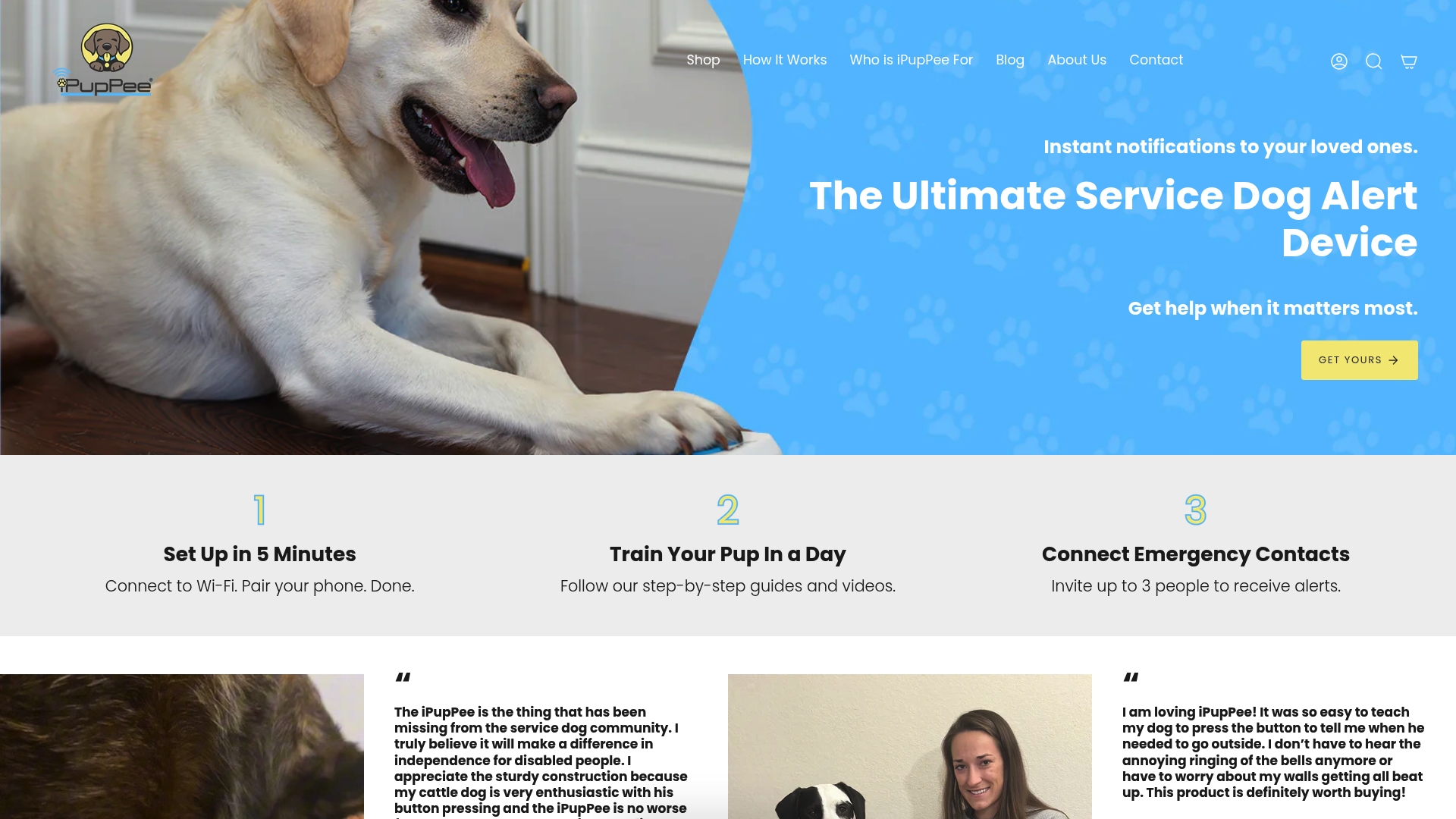
The iPupPee alert device teaches dogs to signal their needs with a single button press, which is a direct application of the operant conditioning and marker-based feedback principles covered here. For service dog handlers, seniors, and owners with disabilities, that communication loop is not a convenience. It is a safety feature. Ipuppee’s blog covers interactive devices and canine cognition in depth, and the main Ipuppee site gives you a full view of available training aids and resources. If you are ready to apply what you have read here, that is the right next step.
FAQ
What is canine interactive learning in simple terms?
Canine interactive learning is a training method where dogs use attention, memory, and impulse control to acquire new skills through rewards, social cues, and problem-solving activities. It treats the dog as an active participant rather than a passive subject.
How do dogs learn new behaviors most efficiently?
Dogs learn fastest when new behaviors are marked precisely at the moment of correct performance and rewarded within three seconds. Strong associations can form in as few as 1–3 salient trials when the reward matches the dog’s dominant motivator.
Are puzzle toys enough for canine cognitive enrichment?
Puzzle toys contribute to cognitive health only when they present genuine novelty and problem-solving demand. Repeated use of the same toy without new challenges produces passive engagement, which does not build cognitive reserve.
What role does social learning play in dog training?
Dogs naturally imitate human and canine behaviors, and techniques like “Do as I Do” allow them to reproduce novel actions faster than trial-and-error methods. Social learning is one of the most underused tools in everyday dog training.
Why does reward timing matter so much in dog training?
A delay of even two seconds between a correct behavior and its reward can reinforce an unintended action. Using a clicker or verbal marker at the exact moment of correct behavior eliminates this gap and significantly speeds learning.