

TL;DR:
- Dogs communicate through body language, vocalizations, scent, and touch, requiring full-body interpretation for accuracy.
- Structured tools, like soundboard buttons and scent alerts, enhance understanding, especially for caregivers with disabilities.
Most dog owners assume they understand their pets well enough. A wagging tail means happy. A growl means danger. But what is accessible dog communication really, and how much are you missing? The answer might surprise you. Recent research shows dogs are capable of expressing far more than basic emotions, and the methods caregivers use to read and respond to those signals can mean the difference between a safe, connected relationship and a frustrating, even dangerous one. This guide breaks down the tools, science, and practical steps to close that gap.
Key takeaways
| Point | Details |
|---|---|
| Dogs communicate through multiple channels | Body language, vocalizations, scent, and touch all work together to carry meaning. |
| Soundboards expand what dogs can express | Research confirms dogs press buttons deliberately, including two-word combinations, to make requests. |
| Single signals mislead caregivers | Tail wagging alone cannot confirm a dog is happy; whole-body reading is required for accuracy. |
| Trust builds better communication | Technology supports but does not replace consistent training and a strong dog-handler relationship. |
| Accessibility matters for all owners | Caregivers with disabilities, seniors, and new owners all benefit from structured, device-assisted communication methods. |
What is accessible dog communication
Accessible dog communication refers to the practice of using structured, low-barrier methods to understand and respond to what your dog is expressing, and to give your dog reliable ways to express needs back to you. The term “accessible” does double duty here. It describes communication that is easier for people with sensory, cognitive, or physical differences to use, and it also describes approaches that work for any owner who wants more clarity in their relationship with their pet.
The formal term professionals use is “multimodal canine communication,” recognizing that dogs do not rely on one channel to get their point across. They use body posture, ear position, eye contact, tail movement, vocalizations, and scent simultaneously. Understanding canine communication at this level is not reserved for trainers or animal behaviorists. With the right tools and a bit of structured practice, any caregiver can build this skill.
What makes this conversation especially relevant now is the growth of technology designed to give dogs a more direct voice. Alert buttons, soundboard devices, and trained signal systems have moved from niche research labs into everyday homes. For caregivers who may struggle to read subtle body cues due to visual impairments, cognitive differences, or simply inexperience, these tools can genuinely change the relationship.
How dogs actually express themselves
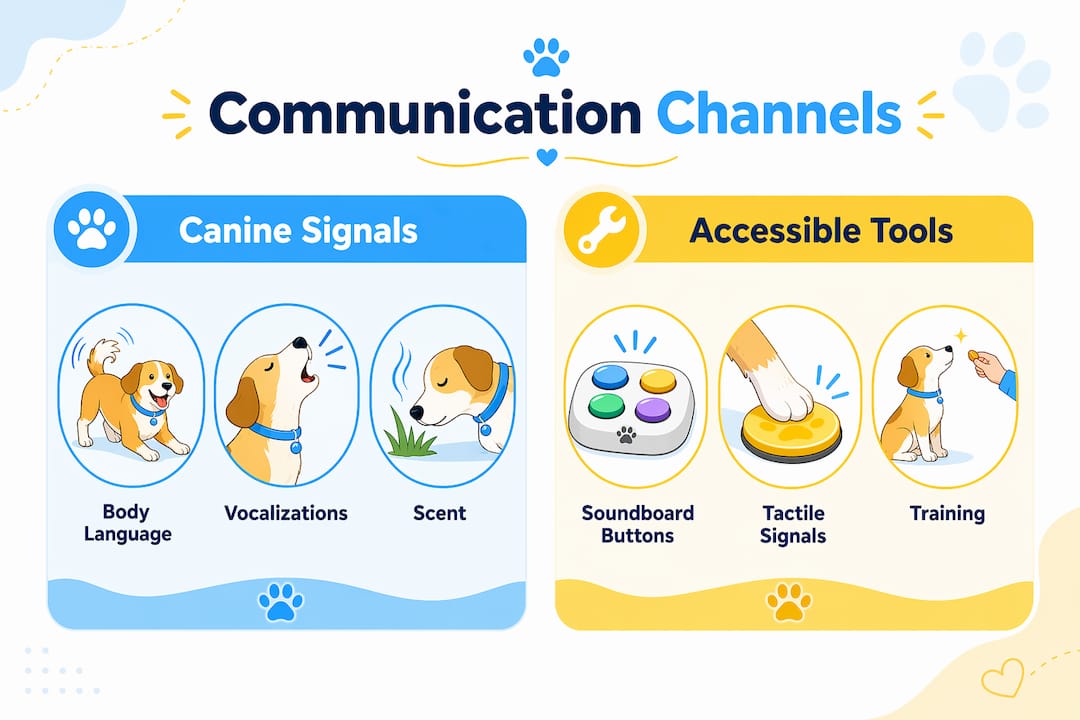
Dogs rely on four overlapping channels to share information, and reading any one of them in isolation gives you an incomplete picture.
Visual signals are the most studied. These include:
- Posture: A dog standing tall and stiff is communicating differently than one who is low and loose. Weight distribution matters.
- Tail signals: The height of the tail, its speed of movement, and whether it is stiff or relaxed all carry distinct meanings.
- Ear position: Ears pinned flat signal fear or submission. Ears forward and alert signal focus or arousal.
- Facial expressions: Lip licking, yawning, and whale eye (showing the whites of the eyes) are stress signals many owners miss entirely.
Vocalizations are more nuanced than most people realize. A bark during play sounds and feels different from a bark at a stranger. Whining can signal excitement, anxiety, or physical pain, depending on context. Growling is almost always a communication of discomfort, not aggression, and suppressing it removes an important warning signal from your dog’s vocabulary.
Scent-based communication is the least accessible for human caregivers but the most powerful for dogs. This channel matters most in service dog contexts, where dogs are trained to detect chemical changes in a person’s body related to conditions like low blood sugar or the onset of a seizure.
Tactile signals are the simplest. A dog leaning against your leg, pawing at your arm, or nudging your hand is asking for something. These signals are among the first that owners with visual impairments learn to rely on, and they are remarkably clear once you know what to feel for.
You can go deeper on reading these cues with this body language guide that breaks down each signal in detail.
Soundboard buttons and what science says
The most widely discussed dog communication method right now is the soundboard button system, where dogs press pre-recorded buttons to request actions, people, or experiences. What started as a speech-language therapy experiment has become one of the most studied areas of animal cognition.
The evidence is not anecdotal. A study analyzing 194,901 button presses from 152 dogs over 21 months found that 29.08% of interactions were deliberate two-button combinations. These were not random sequences. They were purposeful requests.
Here is how to start using soundboards effectively with your dog:
- Start with one button. Choose a word your dog already connects to a real event, like “outside” or “play.” Record it and place the button near the relevant context.
- Model the behavior yourself. Press the button before the event every time. Your dog learns by watching cause and effect in action.
- Reward immediately. The button press must be followed by the correct response within seconds. Consistent cause-and-effect training is what makes this work, not the button itself.
- Add buttons gradually. Once your dog reliably uses one button, introduce a second. Placing related buttons near each other helps dogs form associations.
- Log the presses. Keep a simple record of what button was pressed and what followed. Patterns emerge quickly and help you refine your response accuracy.
Dogs also demonstrate genuine comprehension, not imitation. Research shows dogs display contextually appropriate playful behavior when the “play” button is activated, whether pressed by the owner or a stranger. That rules out mimicry as the explanation.
Pro Tip: Place soundboard buttons at a consistent height your dog can reach without straining. Uncomfortable reaching discourages use, and you want the button to feel like an easy choice, not a physical task.
For a structured approach to training communication buttons, Ipuppee has a dedicated resource that walks through the process step by step.
Reading signals safely and avoiding common mistakes
Misreading a dog’s signals is not just frustrating. It can create real safety risks, especially for caregivers who interact with unfamiliar dogs or who have sensory differences that make subtle cues harder to catch.
The most common misread? The tail wag. Many people assume any wag means a happy dog. A stiff, high tail wagging rapidly can actually signal high arousal and potential aggression. A low, loose wag between the legs signals submission or fear. Neither one means the same thing.
Here is a comparison of common misread signals and their actual meaning in context:
| Signal observed | Common assumption | What it can actually mean |
|---|---|---|
| Tail wagging | Happy, friendly | Arousal, anxiety, or fear depending on tail height and stiffness |
| Yawning | Tired | Stress signal, calming behavior |
| Lip licking | Hungry or content | Anxiety or discomfort |
| Rolling over | Wants belly rub | Appeasement, requesting space |
| Growling | Aggression | Communication of discomfort, warning signal |
A whole-body reading practice changes everything. The MSPCA guidance on dog language stresses that a structured protocol, observing posture, ears, tail, and facial signs together, significantly reduces misinterpretation risks.
For caregivers managing disabilities or cognitive differences, this is where accessible dog training tips become genuinely life-changing. Building a checklist-style observation habit takes the guesswork out of interpretation and replaces it with a repeatable process.
Pro Tip: Create a simple mental checklist you run through every time you read your dog: ears, tail height, tail movement, posture, and facial tension. Five data points in three seconds becomes second nature within a week.
This stress detection guide from Ipuppee offers a practical framework for building that observational habit at home.
- Observe the whole dog, never one signal in isolation.
- Note the environment. A stiff tail indoors is different from a stiff tail at the dog park.
- Track patterns over time. Your dog’s personal baseline matters more than general charts.
- If unsure, give space. Hesitation in your read is a signal to pause, not push.
Service dog communication and medical alerts
Service dogs represent the most sophisticated example of accessible dog communication in practice. These dogs do not just respond to commands. They initiate communication, alerting their handlers to physiological changes before the handler is even aware something is wrong.
Training programs at organizations like Guardian Angels Medical Service Dogs use scent samples from handlers during medical events, such as a low blood sugar episode, to teach dogs to recognize and respond to those chemical signatures. The dog then communicates the alert through trained behaviors like a paw tap, nose nudge, or persistent circling.
What makes this especially relevant to the broader conversation about inclusive dog training techniques is the individualization involved. Service dogs do not use a standard alert. Trainers observe each dog’s natural tendencies and build the alert behavior around what that dog already does instinctively. This creates genuine, recognizable signals rather than forced performances.
Common service dog communication behaviors include:
- Pawing at the handler’s leg or arm to indicate a detected change
- Applying deep pressure by lying across a person during anxiety or panic
- Retrieving medication, a phone, or an alert device on command
- Circling or blocking movement to interrupt self-harm behaviors
- Guiding a person with a mobility limitation to a seated position safely
“The relationship between a service dog and handler is built on a two-way trust that no device can fully replicate. The dog communicates. The handler listens. That loop is the foundation of everything.” — Guardian Angels Medical Service Dogs
Relationship-building is identified by service dog organizations as the core factor in whether communication succeeds, more than any training method or tool.
My take on what actually makes this work
I’ve spent years watching people try to improve how they communicate with their dogs, and the pattern I keep seeing is the same. Someone brings in a tool, whether it’s a soundboard, a clicker, or an alert device, and expects the tool to do the work. It never does.
What actually works is building a relationship where your dog trusts that pressing a button, pawing at your arm, or holding a certain posture will consistently get a real response from you. That consistency is the mechanism. The tool is just the interface.
I’ve seen caregivers with significant physical disabilities develop extraordinary communication with their dogs by simply paying closer attention to what the dog already does naturally, and then building a response protocol around it. They did not need fancy technology. They needed structure and follow-through.
That said, I’ve also seen soundboard buttons genuinely open up communication in ways that surprised me. Watching a dog combine button words to make a request is not a parlor trick. It is evidence that these animals have more to say than we give them credit for. The dogs that do best with these tools are the ones whose owners show up every single day and respond.
My honest advice: start with your dog’s body language. Get fluent in that before you add any device. Once you can read the whole dog accurately, adding tools becomes genuinely additive rather than a substitute for the relationship you haven’t built yet.
— Andrew
How Ipuppee can help you communicate better
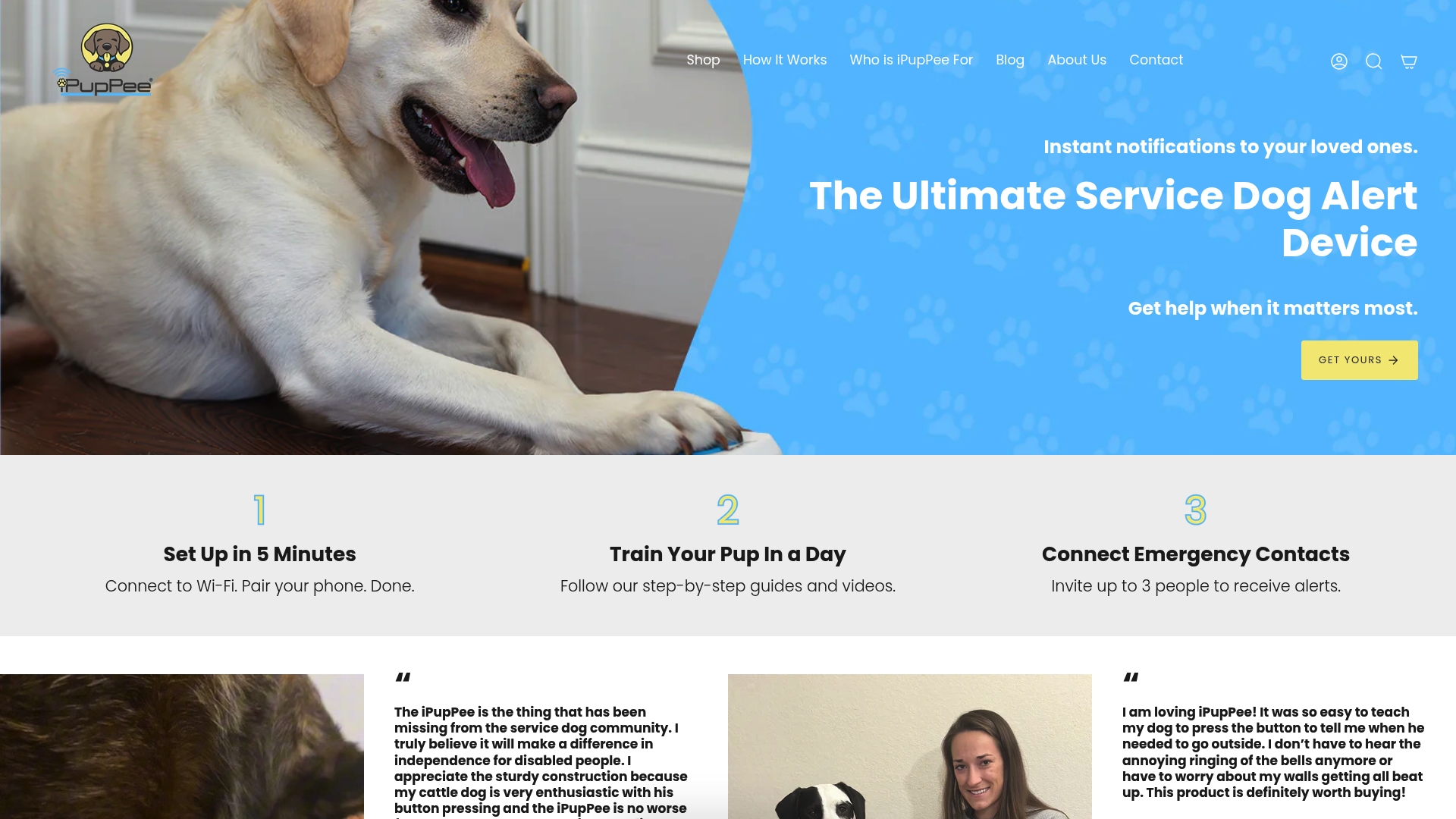
If you’re ready to move from guesswork to genuine connection with your dog, Ipuppee has tools and resources designed specifically for this. The iPupPee alert device gives dogs a simple, reliable way to signal caregivers, making it especially valuable for seniors, people with disabilities, and anyone who needs a clearer communication system at home.
Beyond the device itself, the Ipuppee blog covers everything from interpreting body language to training communication devices safely. Whether you’re working with a new puppy, a rescue dog, or a trained service animal, there’s practical guidance built around real communication challenges. For caregivers looking for accessible communication tools designed for their specific needs, Ipuppee is worth exploring as a starting point for building a safer, more connected relationship with your dog.
FAQ
What does accessible dog communication mean?
Accessible dog communication refers to structured methods that make it easier for any caregiver, including those with disabilities or sensory differences, to understand what their dog is expressing and to give their dog reliable ways to signal needs. It covers body language reading, soundboard devices, and trained alert behaviors.
Do soundboard buttons really work for dogs?
Yes. A 2024 study of 152 dogs found that nearly 30% of button presses were deliberate two-word combinations, confirming dogs use buttons purposefully rather than randomly.
Why is tail wagging not enough to read a dog’s mood?
A tail wag alone cannot tell you whether a dog is happy, anxious, or aroused. The height of the tail, its stiffness, and the dog’s overall posture all need to be observed together for an accurate read.
How do service dogs communicate medical alerts?
Service dogs are trained to detect scent changes related to medical events and then perform a specific behavior, like a paw tap or nose nudge, that the handler recognizes as an alert. Alert styles are individualized to each dog’s natural tendencies.
Can caregivers with disabilities improve dog communication skills?
Absolutely. Structured observation checklists, communication devices, and training programs built around each dog’s natural signals make it possible for caregivers with diverse needs to develop strong, reliable communication with their dogs.