

TL;DR:
- Many “no-pull” harnesses can actually increase pulling force and pose safety risks for service dogs and handlers.
- Effective safety tools include layered solutions like GPS trackers, sensor collars, and physical barriers tested in real environments, not just marketed devices.
Most pet owners assume that popular “no-pull” harnesses make walks safer. The research tells a different story. Back-clip harnesses actually produce greater pulling force (mean 60.5N versus 37.8N for collars), which means a device marketed as a safety tool can quietly increase strain and risk. For service dog handlers and owners with mobility, communication, or independence needs, understanding the real difference between a helpful device and a harmful assumption is everything. This guide cuts through the noise and gives you clear, practical answers.
Table of Contents
- Core types of safety devices for service dogs and pets
- Comparing key features: Smart collars, GPS trackers, and harnesses
- Physical barriers and home safety: Choosing gates and ramps
- Critical tips for maximizing safety: Training, testing, and device limitations
- A fresh perspective: Why no device replaces training and teamwork
- Discover more safety solutions for your service dog
- Frequently asked questions
Key Takeaways
| Point | Details |
|---|---|
| Evidence beats assumptions | Not all popular safety devices provide the protection owners expect. |
| Technology enables independence | Smart collars and GPS trackers are powerful when backed by training and correct use. |
| Combine devices for results | Physical barriers, alert tech, and handler training together maximize pet safety. |
| No device is perfect | Every safety tool has limitations—regular testing and backup plans are important. |
| Teamwork is essential | True safety for service dogs comes from strong handler-dog partnership, not tech alone. |
Core types of safety devices for service dogs and pets
Having established that some safety tools have hidden risks, let’s define the main options available to you.
The world of dog safety technology has expanded well beyond basic collars and leashes. Today, you can choose from wearable alert systems, GPS trackers, communication devices, vests, physical barriers, and sensor-based collars. Each category addresses a different need, and knowing which one fits your situation matters far more than simply buying the most expensive option.
Alert devices are designed to communicate specific signals between a dog and its handler or a third party. A dog trained to detect a medical event (like a seizure or low blood sugar) needs a reliable way to signal. Older methods relied entirely on trained behavior. Newer sensor collars add a technology layer that can detect and confirm alert postures with striking reliability.
IMU (Inertial Measurement Unit) sensor collars represent one of the most significant advances in this space. These collars use accelerometers and gyroscopes to measure motion data in real time. Machine learning algorithms trained on this motion data can detect trained alert behaviors in service dogs with up to 92% accuracy. That kind of reliability is meaningful when you need to know whether your dog is actually signaling or just moving around.
“92% accuracy in motion-detecting alert collars means your dog’s trained behaviors can be confirmed by technology, not just interpreted by bystanders.”
Vests and identification deserve a separate mention. There is a common misconception that service dogs must wear a vest or carry certification to be recognized under the law. That is not accurate. The ADA does not require vests or ID for service dogs. Dogs must simply perform a disability-related task. No documentation or uniform is required. That said, many handlers choose to use vests voluntarily because they reduce public challenges and signal clearly that this is a working dog. In crowded environments or unfamiliar locations, that visual cue can reduce friction significantly.
Physical barriers such as safety gates and ramps play a more structural role in safety. For handlers with mobility limitations, a well-placed gate can prevent a dog from entering dangerous areas during medical episodes, keep pathways clear, and reduce fall risk.
Communication devices like the iPupPee work differently from all the above. Rather than monitoring a dog’s behavior, they give dogs a way to initiate contact. The dog presses a button, and the handler or caregiver receives an alert. This simple mechanism, when paired with consistent training, can dramatically increase independence for owners who live alone or who have difficulty recognizing subtle behavioral cues.
Here are the key device categories and their primary use cases:
- Sensor alert collars: Detect trained behaviors, confirm service dog signals, support medical alert tasks
- GPS trackers: Real-time location monitoring, escape prevention, geofencing alerts
- Vests and ID patches: Reduce public friction, not legally required
- Safety gates: Block dangerous areas, create safe zones at home
- Communication devices: Enable dog-initiated alerts, increase handler independence
Pro Tip: Test every device in your real environment before relying on it. A GPS tracker with strong reviews may perform poorly in your specific building layout. A gate that works on a flat floor may wobble on uneven surfaces. Real-world testing is not optional.
Comparing key features: Smart collars, GPS trackers, and harnesses
Once you know the main categories, you can weigh how the most common devices stack up for different needs.
The practical differences between smart collars, GPS trackers, and harnesses come down to a few key dimensions: battery life, accuracy, durability, and what happens in edge cases. This is where dog alert device safety becomes especially relevant, because a device that fails in a critical moment is worse than no device at all.
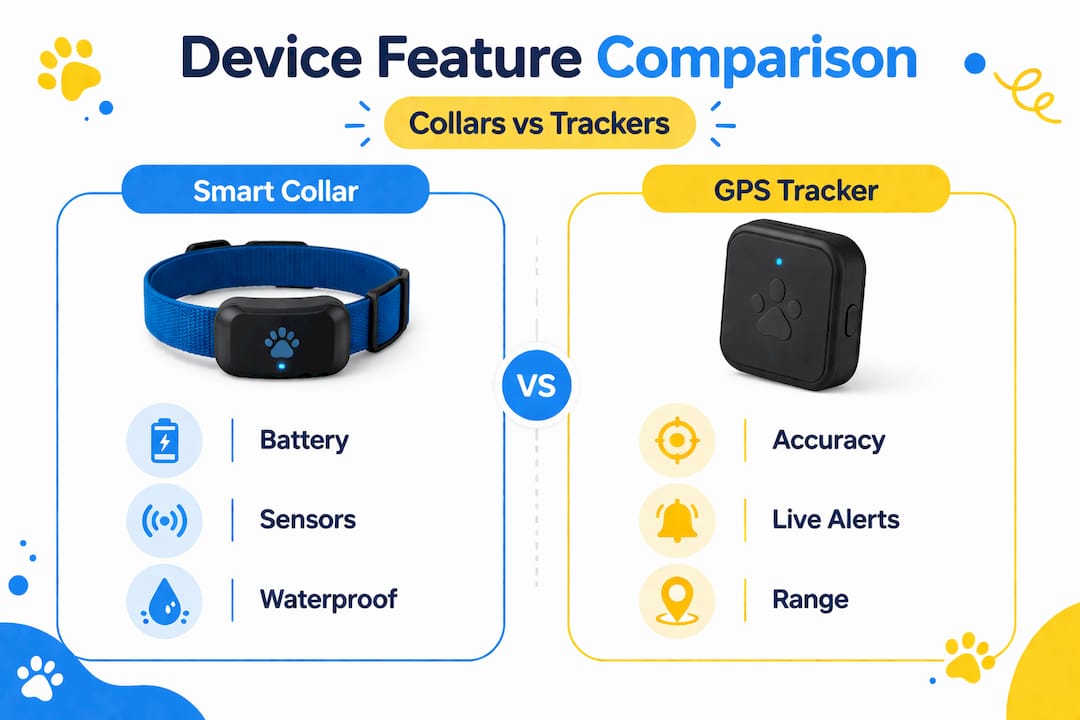
| Device type | Battery life | Accuracy | Waterproofing | Best use case |
|---|---|---|---|---|
| IMU sensor collar | 7 to 14 days (varies) | Up to 92% for alerts | Varies by brand | Medical alert confirmation |
| GPS tracker (Fi Series 3) | Up to 3 months | Within 15 feet | IP68 rated | Real-time location, escape alerts |
| Back-clip harness | N/A | N/A | N/A | General walking (with caveats) |
| Front-clip harness | N/A | N/A | N/A | Reduced directional pulling |
| Communication button device | Varies | Button-press triggered | Varies | Dog-initiated alerts, independence |
The Fi Series 3 GPS collar stands out in its category. With up to three months of battery life, IP68 waterproofing, real-time LTE tracking, geofencing capability, and escape alerts, it handles most real-world demands. PCMag and Treeline Review both rate it highly for accuracy and reliability. For a handler who relies on knowing where a service dog is at all times, that combination of features is hard to beat.
The harness comparison is where things get counterintuitive. Research shows that back-clip harnesses increase pulling force to a mean of 60.5N, compared to 37.8N for standard collars. Peak forces also increase significantly (198N versus 163N). This directly contradicts the assumption that harnesses make walks easier and safer. For service dog handlers with limited grip strength or balance issues, that extra pulling force is not a minor inconvenience. It can be a genuine safety hazard.
Front-clip harnesses change the mechanics. By redirecting force toward the dog’s body centerline when it pulls, front-clip designs tend to reduce forward momentum more effectively. If you need a harness for walking comfort and control, front-clip is the better starting point.
Reviewing alert devices for safety and independence reveals a consistent pattern: no single device category covers every need. GPS trackers excel at location but don’t detect alert behaviors. Sensor collars detect behaviors but don’t communicate location. A layered approach, using two or more device types together, almost always outperforms any single solution.
Pro Tip: Training matters as much as any device you choose. When introducing a new collar, harness, or tracker to your dog, use positive reinforcement from the very first session. A dog that resists wearing a device is a dog that won’t deliver reliable signals when it counts.
Physical barriers and home safety: Choosing gates and ramps
Beyond wearable safety, your home can set the stage for reliable protection with the right barriers.
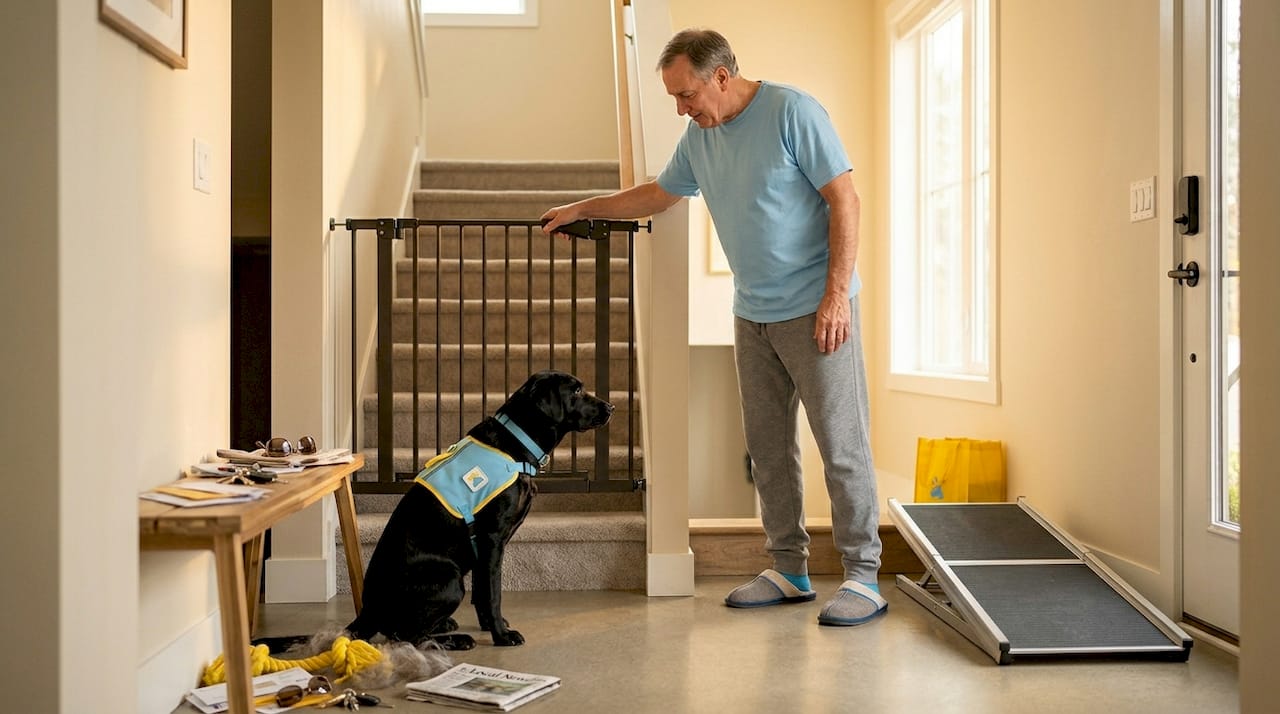
Gates and ramps are often overlooked in conversations about service dog safety, but for handlers with mobility limitations, they can be as important as any wearable device. A gate that fails near a staircase or a ramp that shifts underfoot creates exactly the kind of unpredictable environment that leads to falls.
| Gate type | Best placement | Key feature | Mounting style |
|---|---|---|---|
| Cumbor (30.5 inch) | Doorways, hallways | Auto-close latch, ramp included | Pressure-mounted |
| Hardware-mounted gate | Stairs, high-risk areas | Fixed anchoring, resists pushing | Hardware-mounted |
| Richell freestanding | Large open areas | Wide coverage, no mounting needed | Freestanding |
Gate selection criteria matter enormously when you’re choosing for a real safety need. Pressure-mounted gates like the Cumbor are quick to install and easy to move, and the built-in ramp design helps prevent tripping for handlers who are navigating in low-light conditions or with mobility aids. Hardware-mounted gates are the correct choice for stairs. They anchor into the wall frame and resist being pushed, which is critical for a large, strong service dog that might lean against a gate during an alert or rest period.
Here are the core features to check before buying any gate:
- Minimum height: At least 30 inches for dogs that jump or rear up
- Latch mechanism: One-handed operation (important for handlers with limited hand function)
- Trip prevention: Rounded threshold or integrated ramp for nighttime or low-visibility use
- Mounting style: Hardware-mount for stairs, pressure-mount for interior doorways
- Width adjustability: Expandable panels for non-standard openings
Ramps serve a related but distinct function. For service dogs that work alongside seniors or individuals recovering from injury, a ramp at furniture height or a vehicle step can reduce the dog’s physical strain over time, especially in larger breeds prone to joint issues.
For devices for independence to work reliably, the physical environment needs to be as carefully designed as the wearable technology. A dog alert button placed in a room with a poorly secured gate is a system with a weak link built right into it.
Pro Tip: For stairs, always choose hardware-mounted gates rather than pressure-mounted ones, even if installation takes a little more time. A gate that can be pushed aside by a large dog near a staircase is not a safety device. It’s a liability.
Critical tips for maximizing safety: Training, testing, and device limitations
With your main devices and home barriers chosen, mastering them in practice is the final layer of true safety.
No device works in isolation. The technology around service dog safety is genuinely impressive, but every piece of research in this space points to the same conclusion: the best results for communication come when devices are paired with consistent training, realistic testing, and clear awareness of limitations.
Here is a practical sequence for introducing any new safety device to your service dog team:
- Introduce the device without activating it first. Let your dog sniff and investigate the collar, button, or gate. Reward calm curiosity with treats and praise. Never force the device onto a reluctant dog.
- Begin in a low-distraction environment. A quiet room at home is the right starting point, not a busy park or crowded hallway.
- Run short, positive sessions. Ten minutes of focused training followed by a break is more effective than a single long session.
- Test for false signals. A GPS tracker may alert you to a “fence break” that didn’t happen. A sensor collar may flag normal behavior as an alert. Document these instances and adjust settings accordingly.
- Simulate real-world conditions gradually. Once your dog is comfortable, introduce the environment where the device will actually be used. A different acoustic or visual context can change a dog’s behavior.
- Build in a backup plan. Always have a low-tech option ready. A mobile phone, a second caregiver contact, or a simple trained recall command can bridge a gap if a device fails.
“No device is failproof. Test all tools in your real environment before depending on them in a genuine emergency.”
Battery limitations are a bigger issue than most buyers expect. A GPS tracker with a three-month battery life is impressive on paper, but if you forget to charge it once, you lose that coverage entirely. Build regular charging and maintenance into your weekly routine the same way you would refill a medication or check smoke detector batteries.
Small dogs present a specific edge case. Research shows that small dogs pull harder relative to their body weight than large dogs. That means a small service dog wearing a back-clip harness is actually generating proportionally more pulling force, which can strain a handler with limited grip or upper body strength even more than a large dog would.
Service dogs may also behave unexpectedly in emergencies. A dog trained to alert its handler may respond to the handler’s own distress by guarding, circling, or vocalizing. In those moments, calm handler behavior is what keeps the situation manageable. Devices can confirm that an alert is happening. They cannot substitute for the training and trust built between handler and dog over months or years.
A fresh perspective: Why no device replaces training and teamwork
We’ve covered a lot of ground on what devices can do. Now let’s talk honestly about what they can’t.
There is genuine marketing pressure in the pet safety space to present technology as a complete solution. Buy this smart collar, install this app, set up geofencing, and your service dog experience is handled. That framing is misleading, and in some cases it actively reduces safety by giving handlers false confidence.
The uncomfortable truth is that anxiety or confusion in the handler makes every device less effective. A disoriented handler who can’t interpret an alert notification in time has not been saved by their device. A dog trained to press a communication button but never actually rewarded for it will stop pressing. The technology confirms and extends what the human-dog team already does well. It does not create that capability from scratch.
Essential pet safety tips consistently return to one theme: the relationship between handler and dog is the actual safety system. Technology is a confirmation layer, not a replacement. The research on IMU collars that achieves 92% accuracy does so because it was trained on dogs that already performed reliable, well-trained alert behaviors. Remove the training foundation, and the accuracy drops dramatically.
We have seen owners invest in premium GPS trackers, sensor collars, and communication buttons, and then be surprised when outcomes don’t improve. In almost every case, the gap was not in the technology. It was in the consistency of real-world practice. Devices are powerful when they extend a strong foundation. They reveal their limits quickly when that foundation isn’t there.
Treat every device you choose as a support structure, not a substitute. The most reliable safety outcome still comes from a well-trained dog, a confident and consistent handler, and an environment that has been tested and adapted for real conditions.
Discover more safety solutions for your service dog
If this guide has given you a clearer picture of what devices can genuinely offer, the next step is finding the right combination for your specific situation.
At iPupPee, we focus on practical, evidence-informed solutions for service dog handlers, seniors, and owners with communication and independence needs. Whether you’re evaluating communication buttons, comparing alert devices, or looking for guidance on building a layered safety approach, our resource hub brings it all together. Explore dog alert device advantages to see how the right device, paired with the right training, can meaningfully increase both safety and independence. Because the best safety strategy is one you actually use consistently, every single day.
Frequently asked questions
Are service dog vests or identification tags required by law in the US?
No, the ADA does not require service dogs to wear vests or ID, but using them voluntarily can significantly reduce public challenges and confusion.
How accurate are smart alert collars for detecting service dog behaviors?
IMU sensor collars can detect trained alert behaviors with up to 92% accuracy, using machine learning trained on real-time motion data from accelerometers and gyroscopes.
Which GPS dog tracker is best for battery life and location accuracy?
The Fi Series 3 offers up to three months of battery life with IP68 waterproofing and location accuracy within 15 feet, making it a top-rated option for reliability.
Do “no-pull” harnesses reduce or increase pulling force in dogs?
Contrary to popular belief, back-clip harnesses increase average pulling force to 60.5N compared to 37.8N for standard collars, which can pose a real challenge for handlers with limited strength.
What is the safest type of gate for blocking stairs with a service dog?
A hardware-mounted gate is the safest option for stairs because it anchors directly to the wall frame and resists being pushed by a large or determined dog, reducing fall risk significantly.
Recommended
- How Service Dogs Work: Complete Guide for Owners – iPupPee
- Dog Safety Best Practices: Protecting Loved Ones – iPupPee
- How to Choose Service Dog: A 2025 Guide for Owners & Handlers – iPupPee
- Introducing Service Dogs Home: Step-by-Step Success Guide – iPupPee
- Holiday dog toy guide: Stay safe and have fun – Ascencion Gear