

TL;DR:
- Hands-free dog alert systems automatically detect trained behaviors and notify caregivers without human input, crucial when handlers are incapacitated. They rely on sensors, behavior algorithms, and real-time alerts, but their accuracy depends on proper collar fit, consistent training, and environmental conditions. While highly beneficial, these systems should complement manual alerts, as current models still have limitations due to small training datasets and potential false negatives.
Service dogs are trained to signal dozens of medical and behavioral cues, from detecting a blood sugar drop to sensing an oncoming seizure before the handler even feels it. But what happens when the handler is already incapacitated, asleep, or simply misses the dog’s signal? That recognition gap is exactly where hands-free alert technology steps in. IMU-based smart collars can now detect a trained alert behavior automatically and notify caregivers or emergency contacts without any human input required. This guide covers everything you need to know about how these systems work, what they can and can’t do, and how to choose the right approach for your dog and situation.
Table of Contents
- What are hands-free dog alerts?
- How do hands-free dog alert systems work?
- Comparing hands-free alerts and manual (button) systems
- Real-world challenges and best practices for hands-free alerts
- Why hands-free dog alerts are powerful but not a silver bullet
- Explore hands-free safety solutions with iPupPee
- Frequently asked questions
Key Takeaways
| Point | Details |
|---|---|
| Automated alerts enhance safety | Hands-free dog alert systems use smart technology to recognize and notify handlers of important behaviors with minimal manual input. |
| Training and fit matter | Device effectiveness depends on clear, trained signal behaviors and collars that stay securely and comfortably in place. |
| Manual vs automatic options | Both hands-free and manual (button) systems offer unique advantages, so the best solution fits the owner’s and dog’s needs. |
| No tech is error-proof | Even advanced automated systems can miss signals or generate false alarms, so ongoing observation and training remain important. |
What are hands-free dog alerts?
Hands-free dog alerts are technology-driven systems designed to detect a trained dog behavior and immediately send a notification to a handler, caregiver, or emergency contact, all without requiring a person to press a button or issue a command. Instead of relying on a human to notice the dog’s visual signal, the system handles that recognition step automatically.
These systems matter most in scenarios where the handler may be physically unable to respond. Think about a person with epilepsy who loses consciousness before a seizure. Or a senior living alone whose diabetic alert dog starts spinning and pawing but no one is watching. Traditional visual signals from a dog are only as useful as a person’s ability to see and interpret them in the moment.
The foundation of most hands-free alert systems includes three core components:
- Wearable sensors worn on the dog, typically in a collar or vest, that capture movement data continuously
- A behavior recognition algorithm trained to identify specific movement patterns that match the dog’s alert behavior
- A notification mechanism that sends an alert to a phone, smart device, or monitoring service the moment the behavior is confirmed
“Wearable behavior-alert collars for trained assistance dogs can be automated with inertial measurement units (IMUs) plus machine learning. A proof-of-concept study used an IMU-based smart collar to detect a specific trained seizure-alert behavior: two rapid clockwise spins.”
As explained in our dog alerts explained guide, the underlying idea is simple: the dog still does the work of sensing and signaling, but the technology ensures the alert reaches the right person at the right time, even if no one was watching.
How do hands-free dog alert systems work?
Understanding the mechanics behind these systems helps you set realistic expectations and troubleshoot problems. The process follows a consistent path from movement to notification.
Here’s how an alert travels from dog to handler:
- Sensor captures motion. The IMU inside the collar records accelerometer and gyroscope data. These sensors measure movement in all directions, dozens or even hundreds of times per second.
- Data is segmented. Raw movement data is divided into short time windows, typically around 2 to 3 seconds each. Each window is analyzed independently.
- Algorithm classifies the behavior. A machine learning model, trained on examples of the dog’s specific alert behavior versus normal activity, labels each segment as “alert” or “not alert.”
- Event confirmation. Most systems require at least one segment within a defined window to be classified as a positive alert before triggering a notification. This reduces false alarms from random movement spikes.
- Notification is sent. Once confirmed, the system pushes an alert to the handler’s phone, a caregiver’s device, or a monitoring dashboard in near real time.
The key technologies powering this process are IMUs and supervised machine learning. An IMU is a small chip that combines an accelerometer (measures linear movement) and a gyroscope (measures rotation). Together, they create a detailed digital fingerprint of any physical movement.
| Machine learning model | F1-score | Accuracy |
|---|---|---|
| Random Forest | 0.65 | 92% |
| Support Vector Machine | 0.58 | 88% |
| k-Nearest Neighbors | 0.52 | 85% |
| Neural Network | 0.61 | 90% |
In research testing four supervised models, the Random Forest algorithm achieved the highest performance with an F1-score of 0.65 and an accuracy of 92% under a Leave-One-DOG-Out (LODO) testing protocol, meaning the model was tested on data from dogs it had never seen before. That’s a meaningful benchmark for real-world reliability.
Understanding dog communication devices gives important context here: no system is flawless, and an F1-score of 0.65 means the model still misses some alert events. That’s why event-level frameworks and alert confirmation steps are built in as safeguards.
Pro Tip: Collar fit is one of the single biggest factors in sensor accuracy. A loose collar slides and rotates, introducing noise into the data stream that the algorithm may misclassify. Always check that the collar sits snugly and consistently before relying on your hands-free system. Research into dog wearable tech consistently shows that sensor placement stability directly impacts detection reliability.
Comparing hands-free alerts and manual (button) systems
Not all alert systems work the same way, and choosing between automated wearable detection and a manual button-based system really comes down to your dog’s training, your environment, and your specific safety needs.
| Feature | Hands-free wearable system | Manual button system |
|---|---|---|
| Requires human trigger | No | Yes (dog or handler presses) |
| Works if handler is incapacitated | Yes | Limited |
| Training complexity | High (precise behavior shaping) | Moderate |
| False alarm risk | Moderate (algorithm errors) | Low (intentional action) |
| Best for | Medical emergencies, seizure alerts | Communication, routine cues |
| Cost and setup | Higher | Lower |
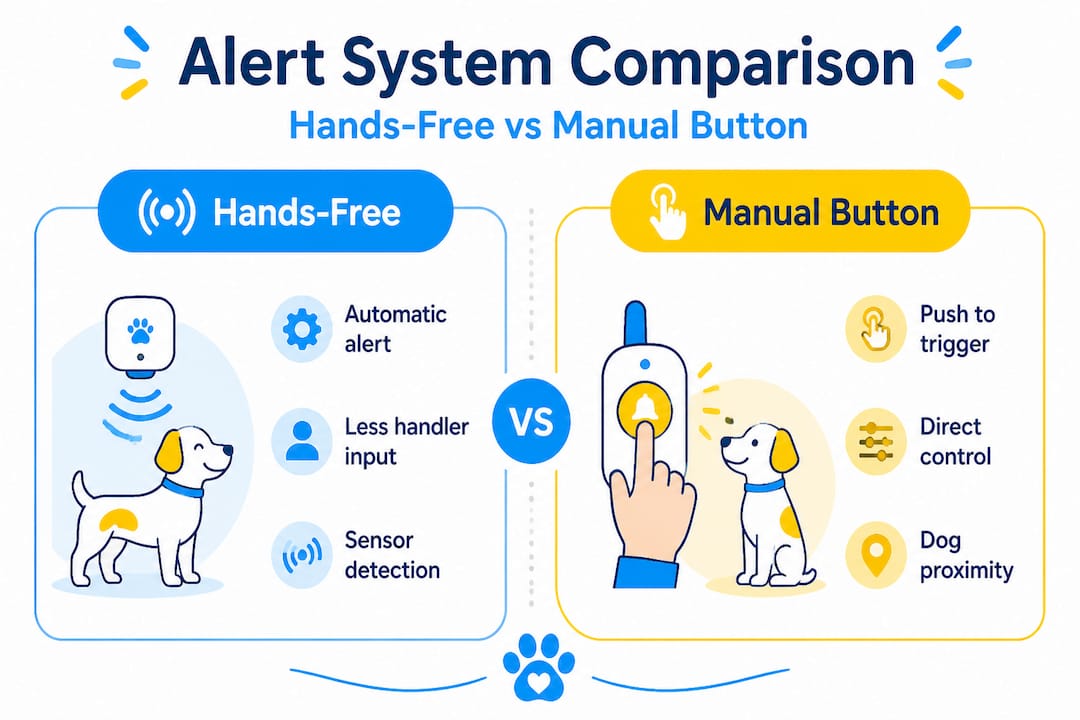
Manual systems, like the iPupPee device, rely on the dog physically pressing a button at the right moment or the handler activating it. This approach requires intentional, cue-mapped actions. The dog must understand that pressing the button produces a result, and that training process is actually very teachable for most dogs. You can read more about it in our pet alert system overview.
Hands-free systems, on the other hand, monitor the dog passively and aim to recognize a trained alert behavior without any deliberate press. This is powerful but introduces algorithmic uncertainty.
“Button-based communication and wearable behavior-detection solve different problems. Buttons rely on intentional dog-initiated action under the handler’s planned cue mapping. Wearable detection aims for automated recognition of trained alert behavior but must be benchmarked for false negatives and false alarms in real-world conditions.”
Key strengths and limitations to keep in mind:
- Hands-free systems shine when the handler cannot initiate or observe any interaction, such as during a seizure, medical episode, or deep sleep
- Button systems shine for routine daily communication, training new behaviors, and situations where the dog can reliably perform a clear deliberate action
- Hands-free systems struggle in noisy environments, with poorly fitted collars, or when the alert behavior is ambiguous in motion data
- Button systems struggle when the dog hasn’t been reliably trained to press during the actual emergency rather than for play or attention
Our guide to comparing dog alert device uses goes deeper into which scenarios suit each approach. The honest answer for most owners? Both systems can complement each other rather than compete.
Real-world challenges and best practices for hands-free alerts
Knowing how these systems work in theory is one thing. Making them work reliably in your home or daily life is another challenge entirely.
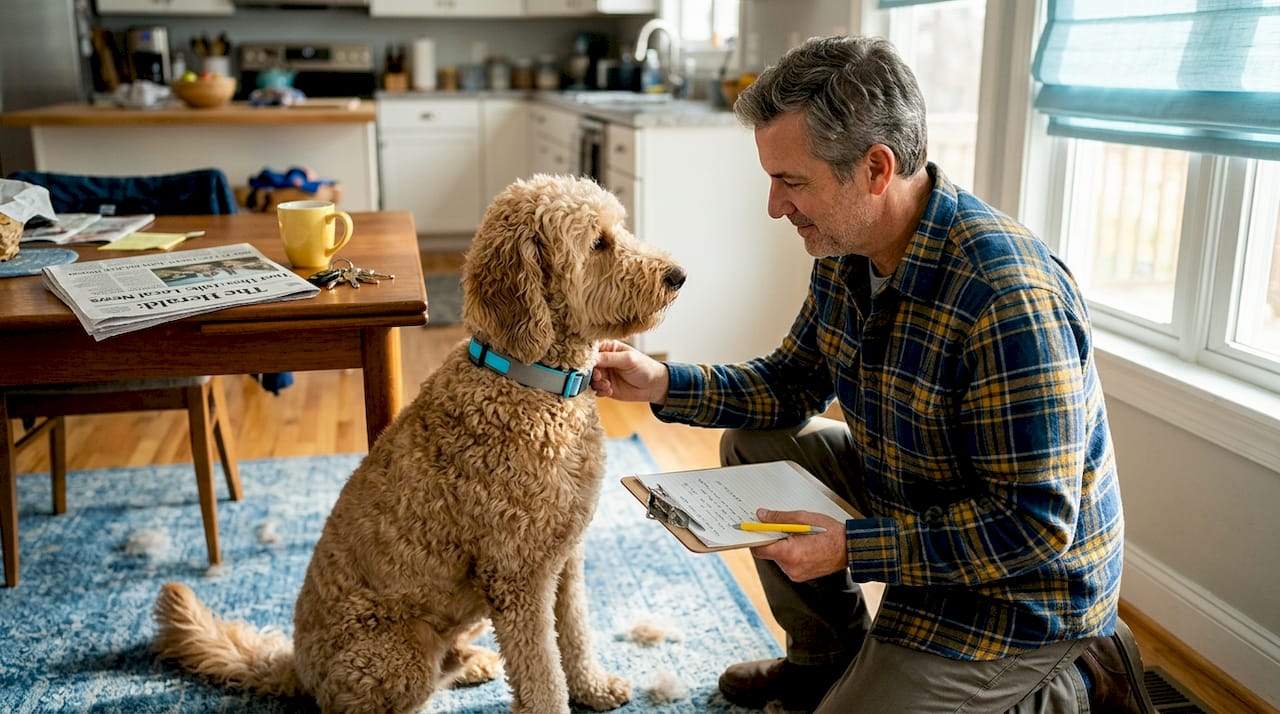
The MDPI study’s proof-of-concept findings are honest about the current limitations: the dataset included only six trained dogs with a limited number of labeled alert samples. Real-world performance depends heavily on training consistency, environment, and collar stability.
Statistic to know: The study’s model was trained on just six dogs. More diverse training datasets, covering different breeds, body shapes, and movement styles, are needed before these systems can be considered broadly reliable across all dogs and environments.
Here are the most important factors that determine whether a hands-free alert system will work for you:
- Behavior clarity. The more distinct and consistent the alert behavior, the easier it is for a machine learning model to recognize it. A crisp two-spin sequence is much easier to detect than a subtle nose nudge
- Collar security. Consistent placement on the same part of the neck, with the same snugness every time, keeps sensor data clean
- Training reinforcement. The dog must perform the behavior reliably even when the handler is not visually engaged or responsive
- Environmental conditions. Active environments with lots of movement, like busy households or outdoor settings, create more background noise in the sensor data
- Regular system calibration. If the dog’s movement patterns change due to age, injury, or weight, the algorithm may need retraining
Pro Tip: Before relying on your hands-free system in a real emergency scenario, run structured test sessions where you record whether the alert fires correctly. Log false positives and missed alerts over two to three weeks. This gives you a real-world accuracy baseline for your specific dog and home environment.
The step-by-step guidance in our training dog alerts resource is a practical starting point for shaping the precise, repeatable behaviors these systems depend on. Without strong foundational training, no amount of technology will close the recognition gap.
False positives are particularly worth managing carefully. A system that alerts too frequently conditions handlers to ignore or mute notifications, which defeats the entire purpose. Aim for a confirmation threshold that balances sensitivity with specificity for your dog’s specific alert pattern.
Why hands-free dog alerts are powerful but not a silver bullet
We think hands-free dog alert technology is one of the most genuinely meaningful advances in service animal safety in the past decade. For people living alone with serious medical conditions, the idea that a trained dog’s alert behavior can automatically trigger a caregiver notification without any human involvement is not just convenient. It can be life-saving.
But we also think the field oversells the “set it and forget it” promise. The research is honest: event-level detection frameworks discuss the cost sensitivity of false negatives explicitly. A false negative in a medical alert context is not just an inconvenience. It’s a missed emergency. The models currently available, even the best-performing ones at 92% accuracy, still miss alert events under certain conditions.
The uncomfortable reality is that automated systems are trained on historical data from a small number of dogs, in controlled conditions, with carefully labeled behaviors. Your dog, your home, and your specific emergency look nothing like that controlled environment. That mismatch creates failure modes that no marketing copy will tell you about.
What we consistently recommend is a layered approach. Use hands-free technology as one layer of protection, not the only layer. Pair it with a well-trained dog who also knows how to use a manual alert device like a button system. Build in regular checks on system performance. Keep the dog’s alert behavior sharp through ongoing reinforcement. And make sure caregivers or household members know the dog’s signal behaviors visually, not just through app notifications.
The handlers who get the most out of hands-free alert systems are not the ones who trust the technology blindly. They’re the ones who train their dogs rigorously, test the system regularly, and treat the technology as a force multiplier for an already reliable dog. Explore more on how to develop that foundation in our guide to train alert dogs for communication.
Hands-free does not mean effort-free. It means your effort is rewarded with a safety net that works even when you can’t.
Explore hands-free safety solutions with iPupPee
If this guide has you thinking about how to bring better alert technology into your daily life, you’re in the right place. iPupPee was built specifically for pet owners who want their dogs to be more than companions but active safety partners.
Whether you’re exploring hands-free alert solutions for the first time or looking to layer a button-based system on top of existing wearable tech, iPupPee offers devices, training resources, and practical guidance designed for real-world use. Our dog alert device benefits resource breaks down exactly how these tools support safety and independence for seniors, disabled individuals, and anyone living with a medical condition. Take the next step toward a safer, more connected life with your dog.
Frequently asked questions
How accurate are hands-free dog alert systems?
Recent testing shows accuracies up to 92% for specific trained behaviors, but real-world performance varies depending on collar fit, training quality, and environment.
What types of behaviors can be detected by hands-free alert collars?
These systems work best with clearly defined, repeatable trained behaviors like rapid spinning sequences, since ambiguous or subtle movements are harder for algorithms to classify reliably.
Are hands-free alerts suitable for all dogs and environments?
Performance depends on proper training, consistent collar fit, and environmental conditions, and current proof-of-concept research was conducted on only six dogs, meaning broader reliability across breeds and settings still needs validation.
What is the main advantage of a hands-free system over a manual dog alert button?
Hands-free systems can recognize a dog’s alert behavior automatically without requiring any button press, which is critical when the handler is already incapacitated and cannot initiate or observe the alert interaction.