

Finding reliable ways to manage your working relationship with a service dog can feel overwhelming. For American and Canadian handlers living with disabilities, the line between independence and frustration often rests on clear task definitions, strong communication, and public readiness. This guide highlights what sets service dog handlers apart from pet owners and offers practical solutions that increase confidence, safety, and freedom in everyday life.
Table of Contents
- Defining Service Dog Handler Essentials
- Types of Service Dogs and Handler Roles
- Core Communication, Training, and Safety Standards
- Legal Rights, Handler Obligations, and Public Access
- Common Challenges and Mistakes to Avoid
Key Takeaways
| Point | Details |
|---|---|
| Service Dog Handler Distinction | Service dog handlers are partners managing a working relationship with their dogs, separate from pet ownership. |
| Legal Rights and Responsibilities | Handlers have robust legal protections under the ADA, FHA, and ACAA, but must maintain their dog’s good behavior to uphold these rights. |
| Training and Communication | Consistent training and clear communication are essential for effective service dog performance and handler independence. |
| Common Challenges | Avoid misunderstandings regarding training, public behavior, and health care as these can jeopardize access rights and independence. |
Defining Service Dog Handler Essentials
Service dog handlers aren’t pet owners—they’re partners in a working relationship with a highly trained animal. Understanding what makes this role distinct shapes everything about how you approach independence and daily management.
A service dog is defined by the task it performs rather than official registration or appearance. Your dog works specifically to mitigate tasks related to your disability—guiding you, alerting you, or assisting during medical events. This direct task-performance relationship separates service dogs from emotional support animals.
Three foundational elements define your role as a service dog handler:
- You have a qualifying disability recognized under relevant laws
- Your dog performs specific, trained tasks directly tied to that disability
- Your dog demonstrates reliability and appropriate behavior in public settings
Your legal rights extend across federal frameworks. The ADA (Americans with Disabilities Act), FHA (Fair Housing Act), and ACAA (Air Carrier Access Act) collectively protect your access to public spaces with your service dog. These laws recognize handlers as responsible managers of working animals, not pet owners.
The distinction matters practically. You’re accountable for your dog’s behavior, training consistency, and public presentation. Your dog must remain under control via leash, voice command, or signal at all times. This responsibility is inseparable from your independence—a well-managed service dog amplifies your capability, while inadequate management limits it.
Handler essentials include:
- Maintaining current task training and obedience skills
- Monitoring your dog’s health and fitness for work
- Managing public access situations with confidence
- Understanding your legal protections and obligations
- Developing reliable communication systems with your dog
Most handlers use either organization-trained or owner-trained service dogs. Both paths require the same outcome: a dog whose public reliability is verifiable and consistent. The Public Access Test measures whether your dog can perform reliably in everyday settings.
Your independence relies directly on clarity about these fundamentals. Confusion about definitions, rights, or responsibilities creates friction in public spaces and weakens your training foundation.
Your role transforms when you truly see yourself as a handler managing a working partner, not a pet owner enjoying companionship.
Pro tip: Document your dog’s trained tasks in writing and practice them weekly—this creates the clarity you need when explaining your dog’s purpose to skeptics or public access inquirers.
Types of Service Dogs and Handler Roles
Service dogs aren’t a one-size-fits-all solution. Different disabilities require different skill sets, and your handler role shifts based on what your dog does. Understanding these distinctions helps you communicate your needs clearly and set realistic expectations for training.
Service dogs perform tasks tailored specifically to your disability—some guide, some alert, some interrupt harmful behaviors. Your role adapts accordingly, but your core responsibility remains constant: maintaining control and ensuring your dog behaves appropriately in all public settings.
Common service dog types include:
- Guide dogs for visual impairments, navigating obstacles and traffic
- Hearing dogs for deaf handlers, alerting to environmental sounds
- Medical alert dogs for seizures, diabetes, or other conditions requiring early warning
- Mobility assistance dogs providing physical support and retrieving items
- Autism service dogs managing sensory overload and preventing elopement
- Psychiatric service dogs interrupting panic attacks, nightmares, or dissociation
Your handler role depends on your dog’s specialty. If you use a guide dog, you’re managing navigation and trust-building in unfamiliar spaces. With a medical alert dog, you’re tracking patterns and reinforcing alert recognition. Psychiatric service dog handlers focus on behavior interruption and grounding techniques.
Daily handler responsibilities span all dog types:
- Maintaining physical control via leash, harness, or voice command
- Reinforcing trained tasks through consistent practice
- Monitoring your dog’s health and work readiness
- Managing public access interactions with confidence
- Responding quickly when your dog alerts or performs a task
The handler-dog partnership strengthens when you understand exactly what your dog is trained to do. Vague expectations create confusion during critical moments. Clear task definitions let you advocate effectively when questioned in public spaces.
Your handler role isn’t passive oversight—it’s active partnership where you manage training consistency, public behavior, and task reliability.
Owner-trained and organization-trained dogs require identical handler standards. Both must behave reliably in public, respond to commands, and perform their specific tasks on cue. Your dog’s training source matters less than your ability to manage the working relationship.
Pro tip: Record video of your dog performing each trained task, then review weekly to catch skill decline early—this prevents task degradation before it affects your independence.
Compare common service dog types and related handler focus areas:
| Service Dog Type | Primary Handler Focus | Typical Training Emphasis |
|---|---|---|
| Guide Dog | Navigating public spaces | Obstacle avoidance, route finding |
| Medical Alert Dog | Monitoring health changes | Detecting symptoms, alert signals |
| Psychiatric Service Dog | Intervening during episodes | Interrupting panic or dissociation |
| Mobility Assistance Dog | Managing physical tasks | Retrieving, steadying, opening doors |
Core Communication, Training, and Safety Standards
Your service dog responds to signals you send—verbal commands, hand gestures, body language. The clearer your communication, the more reliably your dog performs when you need it most. This is where independence truly lives.
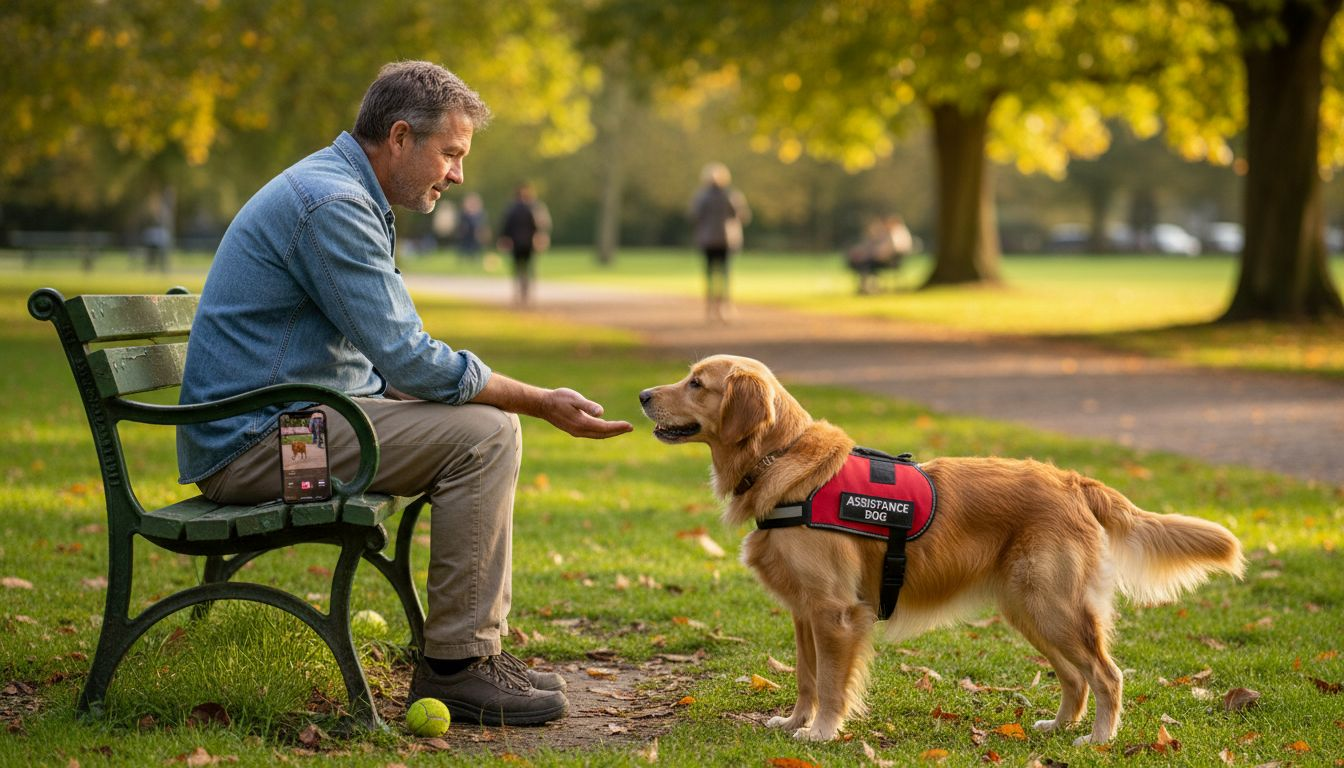
Effective communication requires consistency across all interactions. Your dog learns specific cues tied to specific tasks. When you say “alert” one day and use a different signal the next, your dog’s reliability suffers. Effective communication between handler and dog involves both verbal commands and non-verbal cues such as hand signals, creating a shared language that functions reliably in all environments.
Core communication elements include:
- Verbal commands paired with consistent hand signals
- Clear task initiation cues distinct from everyday interactions
- Immediate reinforcement when your dog responds correctly
- Gentle redirection when performance drifts
Training standards focus on task reliability and public behavior. Your dog must perform its trained tasks on command, remain calm in crowded spaces, and never disrupt public activities. Training focuses on precise task performance, socialization, and environmental adaptation to reduce stress and increase responsiveness.
These standards span:
- Proper housebreaking and bladder control
- Reliable response to commands despite distractions
- Calm demeanor around unfamiliar people and animals
- Ability to work for extended periods without stress
Your dog’s safety and health directly impact its working capacity. Regular veterinary care, appropriate exercise, and mental stimulation aren’t extras—they’re maintenance requirements. A stressed or unhealthy dog performs poorly and puts your independence at risk.
Clear communication, consistent training, and proper health management transform a trained dog into a reliable partner.
Public safety standards protect both you and your community. Your dog must remain under control via leash, harness, or voice command at all times. It should never approach strangers without your permission, bark excessively, or show aggression. These standards exist because public trust directly affects your legal access rights.
Continuous reinforcement prevents skill degradation. Training doesn’t end at certification—it continues throughout your dog’s working life. Monthly refresher sessions catch performance drifts before they become problems.
Pro tip: Create a simple checklist of your dog’s core commands and practice each one daily for five minutes—this keeps communication sharp and identifies any training gaps before they affect your real-world safety.
Legal Rights, Handler Obligations, and Public Access
Your legal rights as a service dog handler are stronger than most people realize. Misconceptions about access rules create unnecessary conflict. Understanding what the law actually requires protects both your independence and your dog’s working status.
Under the ADA, service dogs must be allowed access to all public spaces where the public is permitted, regardless of “no pets” policies. This includes hospitals, restaurants, stores, government buildings, and housing covered under the Fair Housing Act. Your right to access isn’t negotiable—it’s legally protected.
Your legal protections span multiple contexts:
- Public accommodations like stores, restaurants, and transportation
- Employment settings with reasonable workplace accommodations
- Housing under Fair Housing Act requirements
- Hospitals and medical facilities during appointments and stays
- Government buildings and public services
Businesses cannot demand documentation, registration, or identification vests. They can only ask two questions: Is this a service dog required because of a disability, and what tasks does it perform? That’s it. Anything else violates your rights.
Your handler obligations directly support your legal access. Businesses can deny access only if your dog is out of control or not housebroken. This means maintaining behavioral standards isn’t optional—it’s the condition that preserves your access rights.
Core obligations include:
- Keeping your dog under control via leash, harness, or voice command
- Ensuring your dog is housebroken and doesn’t have accidents
- Managing your dog’s behavior so it doesn’t disrupt public activities
- Supervising your dog at all times in public spaces
- Ensuring your dog doesn’t pose safety risks in sensitive environments
Violating these standards creates documented reasons for access denial. One incident of aggression or poor control gives businesses legitimate grounds to exclude your dog. Your independence depends on your dog’s reliability.
Your legal rights are powerful only when paired with genuine behavioral standards and handler responsibility.
Legal protections for service dog handlers include reasonable accommodations in employment, transportation, housing, and public accommodations. However, these protections exist within bounds—handlers must comply with behavioral standards to retain access rights.
Know what you can’t be asked and what you can be questioned about. Prepare factual, brief answers about your dog’s tasks. If access is denied, ask for the specific reason. Document the interaction. Patterns of denial create grounds for legal action.
Pro tip: Carry a simple one-page statement of your dog’s trained tasks and your disability—this gives you a professional response when questioned, reducing conflict and establishing credibility immediately.
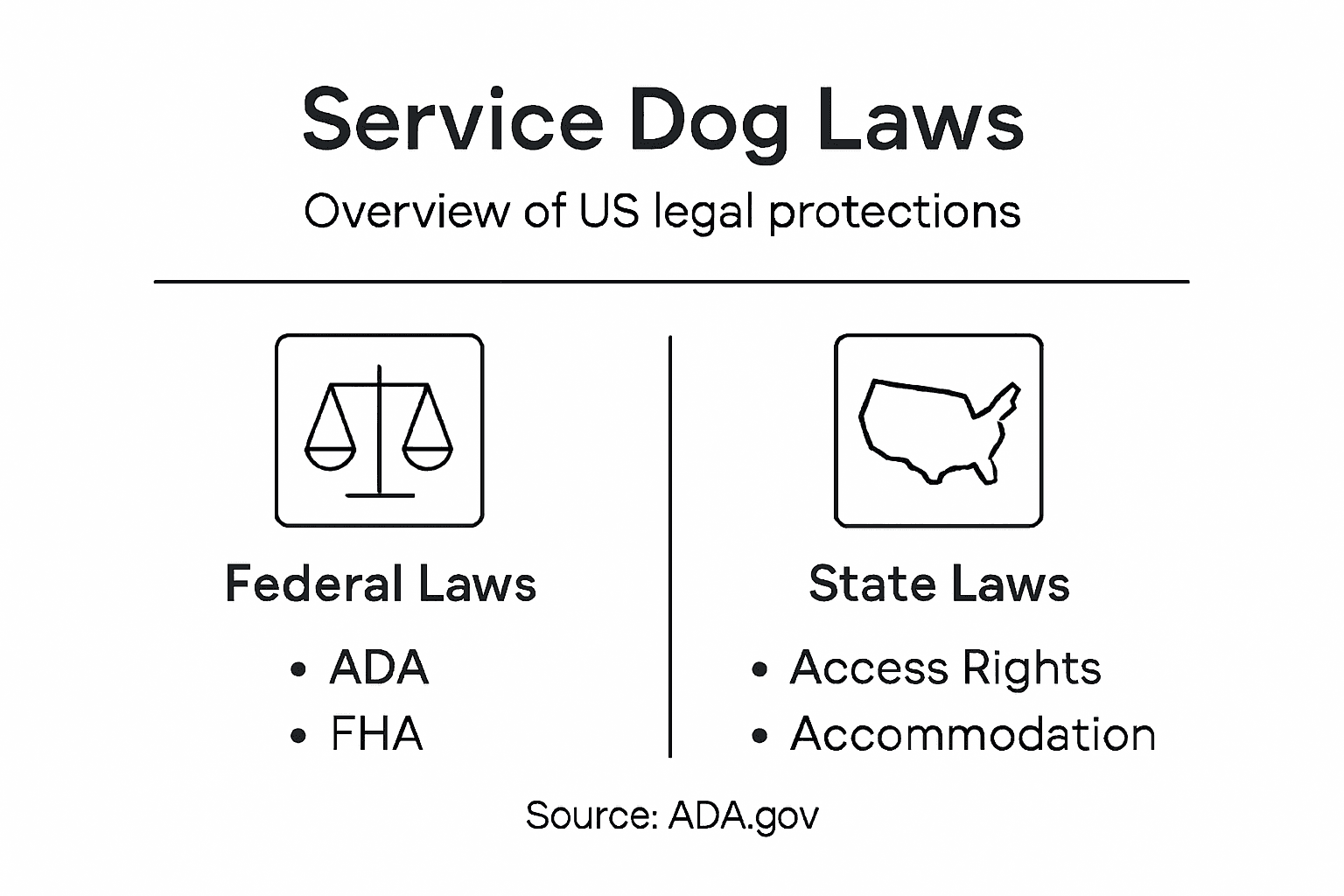
Here’s how key federal laws compare for service dog handlers:
| Law | Protected Context | What is Protected | Who Enforces |
|---|---|---|---|
| ADA (Americans with Disabilities Act) | Public spaces | Access rights, no pet fees | Department of Justice |
| FHA (Fair Housing Act) | Housing | Reasonable accommodations, no pet policies | HUD (Housing and Urban Development) |
| ACAA (Air Carrier Access Act) | Air travel | Travel with service dog in cabin | Department of Transportation |
Common Challenges and Mistakes to Avoid
Most handler mistakes aren’t malicious—they’re misunderstandings about what consistency actually requires and how public perception affects your access rights. Awareness prevents problems before they damage your independence.
Inadequate training tops the list. Many handlers assume their dog’s initial training is sufficient. It isn’t. Common challenges for handlers include ensuring consistent training and managing social interactions in public without conflicts. Your dog’s skills degrade without reinforcement. Monthly practice sessions catch performance drift before it becomes a public incident.
Critical training mistakes include:
- Skipping daily command practice and task reinforcement
- Assuming your dog will perform reliably without regular refreshers
- Not preparing your dog for new public environments
- Failing to address early signs of behavior deterioration
Poor public behavior is the second major issue. One bad incident—your dog lunging at another animal, jumping on a stranger, or having an accident in a store—creates a documented reason for access denial. Mistakes often involve poor public behavior of dogs, allowing the dog to behave disruptively in public, not maintaining leash or control, and being unprepared to answer permitted questions from staff.
Common behavioral mistakes:
- Letting your dog approach strangers without permission
- Failing to maintain control in crowded or high-stress environments
- Not redirecting attention when your dog fixates on other animals
- Ignoring early signs of stress or reactivity
Health and care neglect weakens your dog’s work capacity. An unhealthy dog performs poorly. Skipped veterinary appointments, inadequate exercise, or poor nutrition directly impact your independence. Your dog can’t alert reliably if it’s stressed or unwell.
Misrepresenting your dog’s status destroys credibility. Never claim emotional support animals are service dogs. Never exaggerate your dog’s tasks or capabilities. Honesty establishes trust with businesses and public access staff.
One incident of poor behavior or misrepresentation can create access barriers that take months or years to overcome.
Being unprepared for permitted questions compounds problems. Businesses ask two questions—know your answers cold. Hesitation or vague responses make staff skeptical. Prepare a 30-second explanation of your disability and your dog’s specific tasks.
Skipping the Public Access Test creates ongoing vulnerability. This test verifies your dog’s reliability in real environments. Without documented proof of public readiness, disputes become difficult to resolve.
Pro tip: Schedule quarterly mock access situations—restaurants, stores, crowded spaces—to test your dog’s reliability and your response to challenging public scenarios before they become real problems.
Enhance Your Service Dog Handler Independence with Innovative Communication Tools
Mastering service dog handler essentials requires clear communication and consistent control over your working partner. The challenges of maintaining task reliability, managing public behavior, and reinforcing training daily can feel overwhelming. That is why incorporating the right tools, like those found in our Shipping Protection category, makes a powerful difference. These products are designed to support handlers in strengthening communication and ensuring safety for both handler and dog.
Experience the confidence that comes from using the iPupPee device and related safety innovations available at https://ipuppee.com. Invest in tools that promote clarity and rapid response, empowering you to uphold your handler obligations and maintain your independence. Take control today by exploring our carefully selected solutions crafted to enhance every handler’s partnership. Visit Shipping Protection now and discover how simple communication upgrades create lasting impact.
Frequently Asked Questions
What is the definition of a service dog and its handler?
A service dog is trained to perform specific tasks related to a handler’s disability. The handler is responsible for managing the dog’s behavior and ensuring it is trained to perform tasks reliably in public settings.
What are my legal rights as a service dog handler?
Under the ADA, service dogs must be allowed in all public spaces where the public is permitted. Handlers have legal protections for access, but must ensure their dogs are well-trained and under control to maintain these rights.
How can I maintain and improve my service dog’s task performance?
Regular practice of trained tasks, monitoring your dog’s health, and consistent communication will help maintain and improve task performance. It’s also beneficial to conduct monthly refreshers and practice in public settings.
What common mistakes should I avoid as a service dog handler?
Common mistakes include inadequate training, poor public behavior of the dog, neglecting your dog’s health and care, and being unprepared to answer questions about the dog’s functions. Consistent training and management strategies can help avoid these challenges.
Recommended
- Service Dog Handler Challenges – Boosting Independence – iPupPee
- Service Dog Care Essentials: Must-Know Tips for 2025 – iPupPee
- Independence With Service Dogs: Complete Guide – iPupPee
- Top Service Dog Handler Tips for Success and Bonding – iPupPee
- Role of Leash Training: Ensuring Safe Urban Walks – Pawfect Picks