

Create pet-friendly tech because it measurably improves safety, communication, and long-term welfare while unlocking clear value for owners and the people building these products. A connected harness trial with working dogs recovered 84% of transmitted field data across remote tasks, showing that well-designed sensing can deliver practical payoffs rather than just novelty features.
TL;DR:
- Pet tech products must be tested with animals present to accurately measure stress, startle responses, and comfort, not just with owners alone.
- Devices should minimize sudden noises and motions, use safe materials, and have behavior-aware interfaces to improve pet tolerance and reduce stress.
- AI-driven features require validation, transparency, and a veterinarian in the loop to prevent misdiagnosis and ensure responsible use.
- The most effective pet tech solutions focus on safety, reliable sensing, and clear communication, especially for service dogs, seniors, and disabled owners.
- Interoperable data formats and an emphasis on owner education are crucial to safeguard user data and support pet welfare over device lifespan.
Table of Contents
- How pet-friendly tech delivers value: core benefits
- Concrete categories and current examples of pet tech
- [A product only earns the “pet-friendly” label when it has been tested with pets in the room, not just with their owners, following key scientific explanations and product evidence.](#a-product-only-earns-the-pet-friendly-label-when-it-has-been-tested-with-pets-in-the-room-not-just-with-their-owners-following-key-scientific-explanations-and-product-evidencehttpspetgevcompagesscience)
- Validation, responsible AI, and data stewardship
- Feature-prioritization checklist for builders and early-stage teams
- Client expertise and real-world proof points
- Author’s perspective: why pet-centered design matters now
- How iPupPee helps: an ethical product option for communication and safety
- Sources
- FAQ
How pet-friendly tech delivers value: core benefits
Good pet tech earns its place in a home or a service-dog team by solving a problem that used to require guesswork. Lost-pet recovery, perimeter alerts, and emergency notifications turn a frantic phone call into a location ping. Health monitoring built into collars and harnesses can flag changes in activity or rest long before a checkup, giving owners and veterinarians a longitudinal record instead of a single office visit. For service dog handlers, seniors living alone, and disabled users, assistive communication tools close a real gap: a dog that can signal a need directly to a phone or an emergency contact extends independence in a way that barking at a closed door cannot.
The benefits break down into a few clear categories:
- Safety: faster lost-pet recovery and real-time alerts when something goes wrong.
- Health insight: longitudinal activity and rest data that can prompt an earlier vet visit.
- Communication: direct signals from dog to owner or caregiver, useful for service and companion animals alike.
- Convenience: automated feeding, remote monitoring, and fewer missed cues during a workday.
Market behavior backs this up. Industry reporting tied to pet humanization describes increased spend on premium pet products, a trend that includes smart wearables and connected devices as owners treat their animals more like family members than property.
Concrete categories and current examples of pet tech
Pet tech splits into a handful of practical categories, each with its own strengths and blind spots.
- Wearables: collars and harnesses that track activity, rest, and sometimes heart rate or temperature. They tend to agree well with human observation on total activity and sleep, but a validation study comparing collar output with focal sampling found real differences on specific behavior measures, so treat the numbers as a trend line, not a diagnosis.
- Home monitoring and interactive cameras: two-way audio and video, sometimes paired with a treat dispenser, let an owner check in and respond in real time rather than just watching a static feed.
- Automated feeders and pet-access doors: scheduling and pet-aware unlocking (recognizing a specific animal by tag or chip) cut down on feeding conflicts in multi-pet homes and keep unwanted visitors out.
- Robotics and environmental devices: vacuums and other home robots built with quiet motors and obstacle recognition avoid startling animals or causing collisions, a design choice that pays off directly in reduced pet stress and better adoption.
- Integrated systems versus single-purpose devices: an all-in-one platform offers convenience and one dashboard, but a single-purpose alert device is often simpler to train around and less likely to fail across unrelated features.
The right mix depends on the problem you are solving. A service dog team usually needs reliable alerting over data richness, while a multi-pet household might prioritize feeding automation and camera coverage instead.
A product only earns the “pet-friendly” label when it has been tested with pets in the room, not just with their owners, following key scientific explanations and product evidence.
A product only earns the “pet-friendly” label when it has been tested with pets in the room, not just with their owners. Practitioner experience in usability testing for pet technology shows that tests need explicit measures for stress, startle response, and object avoidance, because owner-only testing tends to miss the failures that matter most to the animal.
Five rules consistently separate tech that pets tolerate from tech that pets fight:
- Test with pets, not just owners. Measure behavioral response, not just whether the feature works on paper.
- Minimize sudden noise and motion. Predictable cues beat loud alarms or jerky movement every time.
- Choose safe materials and secure fastenings. Hypoallergenic fabric and a fit that cannot slip or pinch matter more than extra sensors.
- Build behavior-aware interfaces. Avoid feedback patterns (random beeps, inconsistent vibration) that confuse an animal trying to learn what a signal means.
- Keep owner controls simple. A caregiver under stress needs a clear alert and an obvious next step, not a settings menu.
Pro Tip: Run a short trial where the pet wears or interacts with the device for a few days before any formal test; many startle reactions and chafing problems only show up after repeated use, not on day one.
Accessibility applies to the human side of the product too. Training materials, plain-language instructions, and a short learning curve matter as much as the hardware, especially for seniors or new dog owners who are not going to read a technical manual.
Validation, responsible AI, and data stewardship
Most of the hype around AI-powered pet tech outruns the evidence. A 2026 systematic review covering 115 studies on AI in companion-animal care found the technology strongest in diagnostic imaging and clinical decision support, while behavioral monitoring and home-welfare assessment remain limited by data quality, validation gaps, and ethical questions.
Behavioral AI claims deserve more skepticism than diagnostic imaging claims, based on where the current evidence is strongest according to that review.
Veterinary bodies have started drawing lines around how this technology should be used. The AVMA has pushed for transparency, explainable outputs, and a veterinarian in the loop to avoid automation bias in clinical settings, and a 2025 ACVR and ECVDI position statement echoes that call, recommending validation, third-party evaluation, and clinician involvement for AI diagnostic tools.
Practical rules follow directly from that guidance:
- Never let a device present an autonomous diagnosis. Alerts should communicate uncertainty and suggest a next step, not a verdict.
- Publish clear data ownership and export policies so an owner is never locked out of their own pet’s history.
- Plan for end-of-service scenarios. Digital pet ID and connected tags speed up reunification but carry risks if a vendor shuts down without a data-export path.
- Favor interoperable, exportable data formats over closed dashboards that trap information inside one app.
Feature-prioritization checklist for builders and early-stage teams
Early-stage teams waste time building features nobody tested. A tighter sequence works better.
- Start with safety and core sensing. Build the alert or monitoring function the owner actually needs before adding extras.
- Pilot with a real observer protocol. Even a small trial with a clear comparison method and a veterinary reviewer beats guesswork.
- Plan for data resilience. Offline fallback, export options, and a clear ownership policy protect users if connectivity or the company itself fails.
- Design for every stakeholder. Owner, veterinarian, and trainer often need different views of the same data.
- Hold off on AI-driven diagnostic claims until a device has real validation behind it rather than a marketing deadline.
Client expertise and real-world proof points
This company offers a Wi-Fi alert device paired with training materials and an on-demand psychology and training course, aimed at service dog teams, seniors, and disabled pet owners who need direct, reliable communication rather than guesswork. The product line centers on training-backed usability: a dog’s communication signal only works if the training behind it is clear, which lines up with the design and validation points above. Resources describing how tech and training support service-dog independence reflect the same priority this article makes: safety and communication come first, features come second.

Author’s perspective: why pet-centered design matters now
Pet tech only earns trust when it is built around the animal first, not around a feature list. The strongest products in this space come from teams that work directly with veterinarians and real pet users rather than assuming what owners want. Get that collaboration right and the payoff is straightforward: safer pets, clearer communication, and fewer surprises for the humans responsible for them.
— Andrew
How iPupPee helps: an ethical product option for communication and safety
If you want a communication device built around training rather than guesswork, the iPupPee alert device lets a dog send a direct Wi-Fi notification with live video and two-way audio, without a monthly subscription.
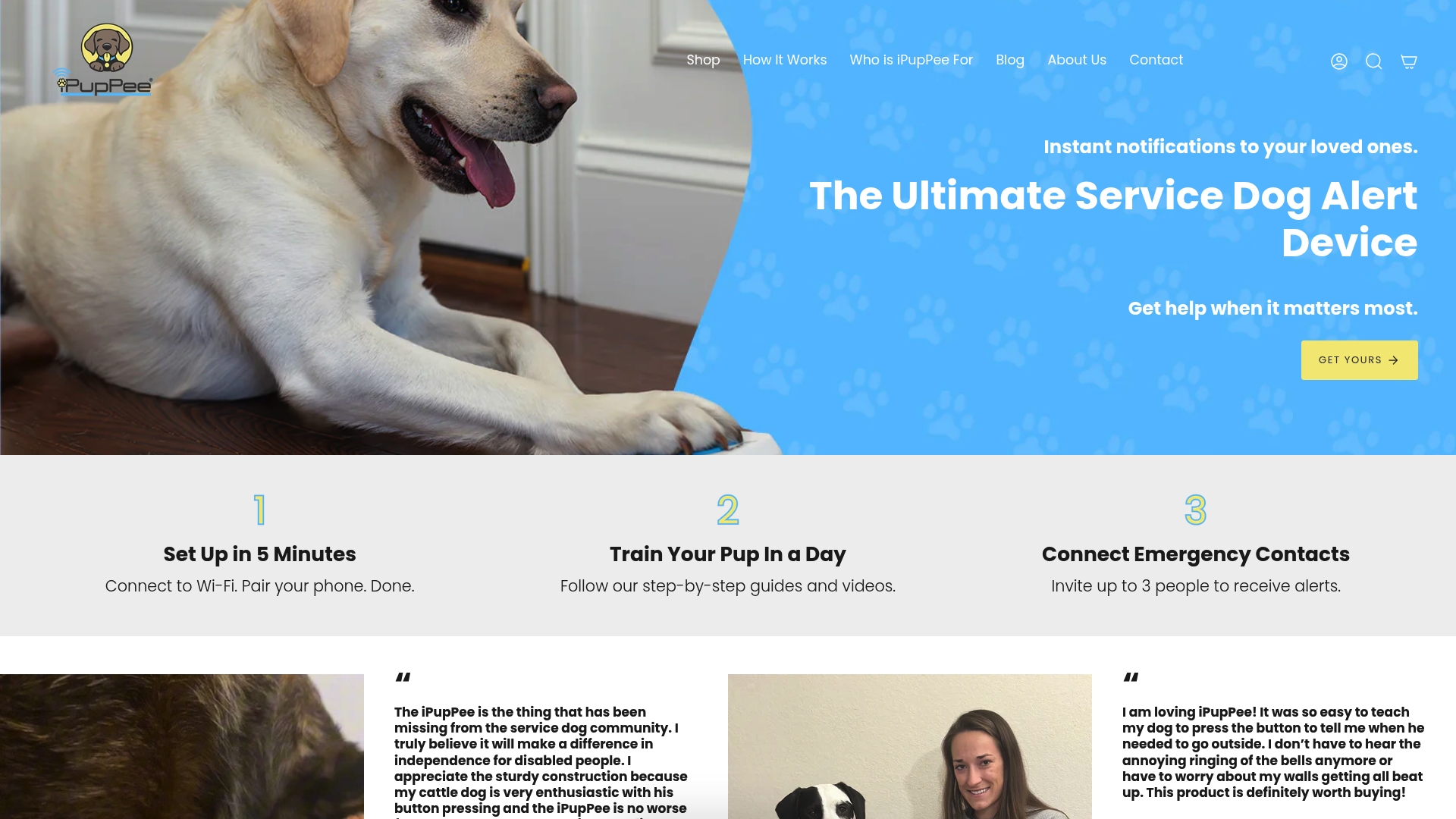
Pairing the device with the Psychology & Training Course gives owners the behavior-aware foundation this article recommends: a signal only helps if the dog and owner both understand it. Shipping protection is available at checkout for anyone concerned about damage or loss in transit.
Sources
- Frontiers in Digital Health — connected sensing for working dogs (2025)
- AVMA — Building a framework for responsible AI in veterinary medicine
- ACVR & ECVDI position on AI in veterinary diagnostic imaging (JAVMA 2025)
- Animals (MDPI) — testing accuracy of wearables to assess sleep in domestic dogs (2023)
FAQ
What are the downsides of pet tech?
The main downsides are unvalidated behavioral claims, data lock-in if a vendor shuts down, and devices that cause stress when they were not tested with real pets. A systematic review of AI in companion-animal care found behavioral monitoring tools particularly limited by data and validation gaps compared to diagnostic imaging tools.
What are the best tech gadgets for pet owners?
The right gadget depends on the need: wearables for activity and rest tracking, interactive cameras for remote check-ins, automated feeders for scheduling, and direct alert devices like iPupPee for owners who need a dog to signal a specific need. Communication-focused devices tend to matter most for service dog handlers, seniors, and disabled owners who rely on clear, direct signals.
What does “pet friendly” mean?
A pet-friendly product is one designed and tested around the animal’s comfort and safety, not just the owner’s convenience, covering noise levels, materials, fit, and predictable feedback. It also means the product supports the pet’s well-being through features like safe alerts, comfortable wear, and clear training support.
What’s the latest in pet tech?
Recent development has focused on connected sensing for working and service dogs, with one 2025 field trial recovering 84% of transmitted sensor data during remote tasks. Veterinary bodies are also setting new guidance for AI oversight, with the AVMA calling for explainable outputs and a veterinarian in the loop rather than fully autonomous diagnostic tools.