

Did you know that consistent pet training reduces the risk of dog bites and injuries by up to 50%? This statistic alone reveals why training matters far beyond simple obedience. Training builds a foundation of communication, trust, and safety that transforms your relationship with your dog. Whether you’re a new puppy owner, service dog handler, or rescue dog adopter, understanding puppy training benefits can dramatically improve your dog’s behavior and your peace of mind.
Table of Contents
- How Pet Training Improves Safety And Behavior
- Enhancing Communication Between Dogs And Owners
- Special Benefits For Service Dogs And Rescue Dogs
- Common Misconceptions About Pet Training
- Comparing Training Methods: Positive Reinforcement Versus Others
- Practical Training Tips For New Puppy Owners
- Incorporating Technology To Enhance Training Outcomes
- Conclusion And Next Steps For Dog Owners
- Enhance Pet Training With iPupPee Technology
- Frequently Asked Questions
Key takeaways
| Point | Details |
|---|---|
| Training cuts dog bite incidents by 50% | Consistent training significantly reduces aggressive behaviors and injuries. |
| Improves dog-owner communication and trust | Training teaches dogs to understand commands and respond reliably. |
| Critically supports service and rescue dog success | Trained service dogs perform tasks accurately while rescue dogs achieve 40% higher adoption rates. |
| Older dogs benefit significantly from training | Around 75% of older dogs show positive behavior improvements with proper training. |
| Positive reinforcement is safer and more effective | Reduces aggression by over 30% compared to punishment-based methods. |
How pet training improves safety and behavior
Training creates a safer environment for everyone in your home and community. Consistent pet training reduces the risk of dog bites and injuries by up to 50%, according to the American Veterinary Medical Association. This dramatic reduction happens because trained dogs respond predictably to commands, reducing impulsive reactions that lead to dangerous situations.
Behavior problems are the leading reason dogs get relinquished to shelters. Training prevents these issues by teaching appropriate responses to everyday situations. Dogs learn boundaries, reducing destructive behaviors and stress-induced aggression that put family members at risk.
Safety benefits extend beyond the home. Trained dogs navigate public spaces confidently without lunging at strangers or other animals. They respond to recall commands, preventing them from running into traffic or dangerous situations. These dog training safety tips become especially critical in urban environments.
Key safety improvements from training include:
- Reduced bite incidents and aggressive responses
- Lower anxiety and stress-induced behaviors
- Improved impulse control in stimulating environments
- Reliable recall preventing escape-related dangers
Pro Tip: Start safety training early by exposing puppies to various environments during their critical socialization period between 3 and 14 weeks. This foundation reduces fear-based aggression later in life.
Enhancing communication between dogs and owners
Clear communication forms the cornerstone of a healthy dog-owner relationship. Training teaches dogs to understand specific commands and cues, creating a shared language that reduces confusion. When your dog reliably responds to sit, stay, or come commands, you’ve established predictable communication patterns.
Research shows that training lowers stress hormones in both dogs and owners. This happens because consistent signals eliminate the frustration of miscommunication. Your dog understands what you expect, and you can predict their behavior accurately.
Miscommunication often leads to dangerous situations. A dog that doesn’t understand recall commands might chase wildlife into traffic. One that hasn’t learned boundaries might jump on elderly visitors, causing falls. Training prevents these scenarios by establishing clear behavioral expectations.
Communication benefits include:
- Reliable command responses in various situations
- Reduced stress and cortisol levels in dogs
- Stronger emotional bonding through positive interactions
- Increased confidence in both dog and owner
Effective communication strategies help you train dogs to communicate faster for emergency response. This becomes particularly important for service dogs and dogs living with disabled owners who depend on quick, accurate responses.
Pro Tip: Use consistent verbal cues and hand signals together when teaching dog commands. This dual approach helps dogs understand faster and provides backup communication if one method fails in noisy or distracting environments.
Special benefits for service dogs and rescue dogs
Service dogs require precision training to perform life-saving tasks accurately. Their handlers depend on them for independence and safety, making training literally critical. Proper training ensures service dogs can retrieve medications, alert to medical emergencies, and navigate public spaces reliably.
Task accuracy directly impacts a disabled person’s quality of life. A service dog that performs tasks correctly 95% of the time versus 75% of the time makes an enormous difference in daily independence. These service dog training essentials create the foundation for reliable assistance.
Rescue dogs face unique challenges adapting to new homes. Training dramatically improves their adoption success, with trained rescue dogs achieving 40% higher adoption rates than untrained counterparts. This happens because training reduces problem behaviors that make dogs seem unadoptable.
Behavior modification through training helps rescue dogs overcome trauma-related responses. Dogs that have experienced neglect or abuse often display fear-based aggression or anxiety. Systematic training rebuilds their confidence and teaches appropriate responses to triggers.
Specific benefits for special populations include:
- Improved task accuracy for service dog handlers
- Enhanced independence for disabled owners
- Reduced relapse into problem behaviors for rescue dogs
- Higher adoption rates and longer placement success
The principles used in training therapy dogs apply equally well to rescue and service dogs, focusing on positive reinforcement and consistent practice.
Common misconceptions about pet training
Many owners believe older dogs can’t learn new behaviors, but this myth costs dogs opportunities for improvement. Research shows that approximately 75% of older dogs demonstrate positive behavioral changes with appropriate training. Their learning might require more repetition, but older dogs absolutely respond to consistent training methods.
Another widespread misconception suggests that training alone solves all behavior problems. Environment and genetics play critical roles in behavior outcomes, accounting for 40-60% of behavioral traits. Training maximizes a dog’s potential within their genetic and environmental constraints but can’t override every influence.
Punishment-based training methods persist despite evidence showing their harmful effects. Some owners believe harsh corrections produce faster results, but research proves the opposite. Punishment increases stress hormones and can worsen aggression and anxiety over time.
Positive reinforcement consistently outperforms punishment in creating lasting behavioral changes. Dogs trained with rewards show better long-term obedience and lower aggression levels than those trained with corrections or physical punishment.
Common training myths to avoid:
- Older dogs can’t learn new behaviors (75% show improvement)
- Training fixes all problems regardless of genetics
- Punishment produces better obedience than rewards
- Alpha dominance theory requires physical corrections
Training works best when owners understand realistic expectations. Genetics and environment influence 40-60% of behavior, while training optimizes the remaining potential through consistent positive reinforcement.
Comparing training methods: positive reinforcement versus others
Positive reinforcement training rewards desired behaviors, making dogs eager to repeat them. This method reduces aggression by over 30% compared to punishment-based approaches. Dogs learn faster and retain behaviors longer when training feels rewarding rather than threatening.

Punishment-based methods rely on corrections, physical force, or intimidation to stop unwanted behaviors. While these approaches might produce immediate compliance, they create long-term problems. Dogs trained with punishment show higher stress levels and increased aggression toward family members.
| Training Method | Aggression Reduction | Long-Term Obedience | Stress Impact | Bond Quality |
|---|---|---|---|---|
| Positive Reinforcement | 30%+ reduction | High retention | Decreased stress | Strong emotional bond |
| Punishment-Based | May increase aggression | Poor retention | Elevated stress | Weakened trust |
| Balanced (Mixed) | Moderate results | Variable retention | Moderate stress | Inconsistent bonding |
The data clearly favors positive reinforcement for both effectiveness and dog welfare. Dogs trained with rewards demonstrate better problem-solving skills and more confident behavior in new situations. They also recover faster from setbacks because training remains a positive experience.
Benefits of positive reinforcement:
- Higher success rates for complex behaviors
- Reduced anxiety during training sessions
- Stronger handler-dog relationships
- More reliable performance under stress
These positive reinforcement methods work across all dog breeds, ages, and temperaments. The approach adapts easily to individual learning styles without compromising welfare.
Pro Tip: Use high-value treats like small pieces of chicken or cheese during initial training sessions. Once your dog reliably performs a behavior, gradually transition to variable reinforcement schedules where rewards come unpredictably. This creates stronger, more persistent behaviors than constant rewards.
Practical training tips for new puppy owners
Start socialization during the critical window between 3 and 14 weeks of age. Expose your puppy to various people, animals, sounds, and environments during this period. Proper early socialization reduces anxiety and fear-based behaviors throughout your dog’s life.
Teach basic commands using clear, consistent cues paired with immediate rewards. Begin with simple behaviors like sit and stay before progressing to more complex commands. Short training sessions of 5-10 minutes work better than lengthy sessions that tire puppies mentally.
Consistency matters more than perfection. Use the same verbal cues and hand signals every time. Ensure all family members follow identical training protocols to prevent confusion. Mixed messages delay learning and frustrate both puppies and owners.
Step-by-step training approach:
- Establish a consistent daily routine for feeding, walks, and training sessions
- Start with basic commands in low-distraction environments
- Gradually increase difficulty by adding distractions as skills improve
- Practice commands in multiple locations to ensure generalization
- Reinforce training throughout daily activities, not just during formal sessions
Avoid common mistakes that undermine training progress. Never use punishment for mistakes during early learning. Skip inconsistent schedules that confuse puppies about expectations. Don’t progress too quickly before foundational behaviors become reliable.
This new puppy training guide provides detailed strategies for different training stages. Combine it with specific techniques for challenges like puppy potty training to build comprehensive skills.
Pro Tip: Keep training treats small, about the size of a pea. This lets you reward frequently without overfeeding. Use part of your puppy’s daily food allowance as training rewards to maintain healthy weight.
Incorporating technology to enhance training outcomes
Training devices create new communication channels between dogs and owners. Technology like iPupPee enables dogs to signal specific needs by pressing buttons, facilitating clearer two-way communication. This proves especially valuable for service dogs and handlers with disabilities who need reliable alert systems.
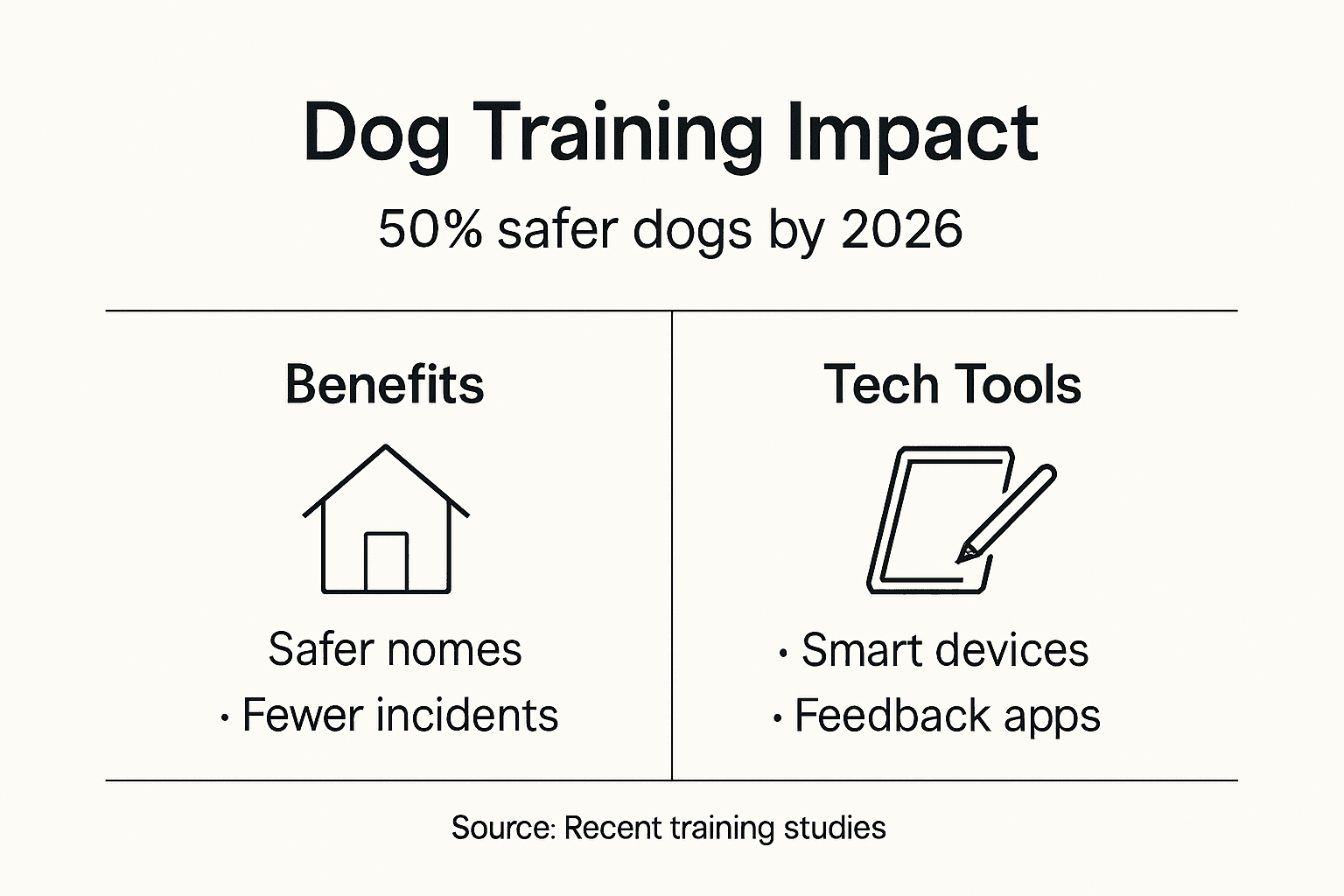
Interactive devices provide immediate feedback that accelerates learning. Dogs receive consistent signals without human error in timing or delivery. This consistency improves training outcomes by eliminating the confusion caused by inconsistent human responses.
Safety and independence improve dramatically for disabled dog handlers using communication technology. Service dogs can alert to medical emergencies, request assistance, or indicate task completion through device-based communication. These capabilities enhance handler independence while providing peace of mind.
User reports indicate noticeable improvements in communication speed and accuracy when technology supplements traditional training. Dogs learn to use devices within days, creating reliable communication patterns that reduce frustration on both ends.
Technology benefits for training:
- Faster, clearer command delivery and responses
- Consistent feedback without human timing errors
- Enhanced independence for service and disabled dog handlers
- Objective tracking of training progress and patterns
Learn how to teach a dog communication with iPupPee to integrate technology into your training routine. The iPupPee technology complements traditional methods rather than replacing them.
Pro Tip: Introduce training devices gradually using the same positive reinforcement principles. Let your dog explore the device without pressure, then reward any interaction. Build complexity slowly until your dog reliably uses the device for communication.
Conclusion and next steps for dog owners
Pet training transforms safety, communication, and behavior outcomes for dogs and owners alike. The 50% reduction in bite incidents alone justifies the time investment, but benefits extend far beyond safety. Training builds trust, reduces stress, and creates confident dogs that enhance your quality of life.
Consistent positive reinforcement yields the best long-term results across all dog populations. Whether you’re training a new puppy, rescue dog, or service animal, the principles remain constant. Start early, stay consistent, and reward desired behaviors generously.
Utilize available resources and technology to maximize training success. Combine traditional methods with modern tools for comprehensive skill development. Access top dog training resources to continue your education and refine your techniques.
Your commitment to training pays dividends throughout your dog’s lifetime. Start today with simple commands and build complexity gradually. The investment of time and effort creates a safer, happier partnership that benefits everyone involved.
Enhance pet training with iPupPee technology
Transform your training approach with iPupPee’s innovative communication devices designed specifically for dog owners. Our technology bridges the gap between traditional training methods and modern communication needs, particularly benefiting service dog handlers and disabled owners who depend on clear, reliable signals.

Explore how dog communication technology enhances safety and independence for you and your dog. Our expert guides show you exactly how to teach a dog communication using positive reinforcement principles combined with cutting-edge tools. Visit the iPupPee official website to discover solutions that complement your training efforts and strengthen your bond with your dog.
Frequently asked questions
Can older dogs still benefit from training?
Absolutely. Research shows approximately 75% of older dogs demonstrate positive behavioral improvements with appropriate training. While they might require more repetition than puppies, older dogs possess focus and maturity that can actually accelerate certain aspects of learning. Training remains worthwhile at any age.
What are the best methods for effective pet training?
Positive reinforcement consistently produces superior results, reducing aggression by over 30% while improving long-term obedience. This approach rewards desired behaviors rather than punishing mistakes, creating confident dogs eager to learn. Avoid punishment-based methods that increase stress and can worsen behavioral problems over time.
How does training help service dogs specifically?
Training ensures service dogs perform life-saving tasks with the accuracy their handlers depend on for independence and safety. Precision matters enormously when dogs must retrieve medications, alert to medical emergencies, or provide mobility assistance. Proper training creates reliable task performance that dramatically improves disabled handlers’ quality of life.
How can technology improve pet training?
Training devices facilitate faster, clearer communication by providing consistent feedback without human timing errors. Technology like iPupPee enables dogs to signal specific needs through button presses, creating reliable two-way communication channels. This proves especially valuable for service dogs and disabled handlers who need dependable alert systems for safety and independence.
Recommended
- Top Benefits of Dog Training for All Pet Owners in 2025 – iPupPee
- Dog Behavioral Training in 2025: Guide for Owners & Handlers – iPupPee
- Why Train Rescue Dogs: Essential Benefits for Owners in 2025 – iPupPee
- Understanding Dog Training Trends 2025 for Better Care – iPupPee
- Book Pet Grooming in Dubai: 30% More Satisfaction in 2026