

TL;DR:
- Effective dog training relies on precise timing and clear feedback signals to maximize learning and emotional trust. Using markers like clickers or consistent verbal cues accelerates skill acquisition, especially in complex tasks like service work. Ethically, reward-based feedback promotes welfare and reliable behavior, while inconsistent communication hinders progress.
A small shift in how you time a reward can cut your dog’s learning curve in half. Most owners pour energy into choosing the right treat or perfecting a hand signal, never realizing the real variable is the feedback itself. How you signal to your dog that a behavior was correct or incorrect shapes everything from basic obedience to life-saving alerts. This guide breaks down the science of feedback in dog training, covering timing, clarity, ethical considerations, and practical steps so you can build a more effective and rewarding relationship with your dog.
Table of Contents
- Why feedback matters in dog learning
- Timing and clarity: The science behind effective dog feedback
- Marker versus reward-only training: What does the science say?
- Ethical feedback: Welfare, behavior, and the ‘balanced training’ debate
- Building feedback into your training routine: Practical steps
- The truth most trainers miss about feedback and dog learning
- Enhance your dog’s learning with proven feedback methods
- Frequently asked questions
Key Takeaways
| Point | Details |
|---|---|
| Timing is critical | Delivering feedback immediately after desired behavior helps your dog learn faster and more accurately. |
| Markers boost learning | Using clear markers like clickers paired with rewards outperforms reward-only methods in efficiency and precision. |
| Reward-based methods support welfare | Positive reinforcement leads to better behavior and emotional well-being compared to punishment-based techniques. |
| Consistency breeds reliability | Being consistent with feedback signals and routines makes training outcomes more predictable and reliable. |
| Your role is communication | Effective dog learning depends on your ability to communicate feedback clearly, not just on the methods you use. |
Why feedback matters in dog learning
Feedback is your dog’s primary source of information. Every time your dog performs a behavior, they scan the environment for signals that tell them whether to repeat it. That signal is feedback, and it comes in four basic forms rooted in operant conditioning:
- Positive reinforcement: Adding something desirable (like a treat) to increase a behavior
- Negative reinforcement: Removing something unpleasant to increase a behavior (e.g., releasing leash pressure when a dog heels)
- Positive punishment: Adding something unpleasant to decrease a behavior
- Negative punishment: Removing something desirable to decrease a behavior (e.g., turning away when a dog jumps)
Each type communicates something different to your dog, and each has very different welfare implications. Clear, early feedback builds trust between you and your dog, because your dog learns that their behavior has predictable consequences. When feedback is muddled or inconsistent, dogs often become anxious, confused, or they simply stop trying. Positive reinforcement methods reduce this confusion while supporting your dog’s emotional health.
“Positive reinforcement is associated with fewer behavioral issues and improved welfare in dogs compared to punishment or negative reinforcement.”
This matters enormously if you are working with a service dog, where reliability and emotional stability are non-negotiable. A dog that trusts its feedback environment learns faster and performs more accurately when it matters most.
Timing and clarity: The science behind effective dog feedback
With feedback’s importance established, it’s essential to understand how the timing and clarity of your feedback influence your dog’s ability to learn. Dogs are not naturally wired to connect events that are separated by more than a second or two. That narrow window is why timing is arguably the single most powerful variable in feedback.
A landmark finding in neuroscience shows that learning rate in dogs depends on the timing interval between rewards, with shorter intervals enabling faster learning. When you reward a sit three seconds after your dog’s rear hits the floor, you may accidentally be reinforcing the moment your dog started to stand back up. That three-second gap matters more than most people realize.
Marker signals solve this problem elegantly. A clicker or a verbal marker like “yes” acts as a bridge between the exact moment of the correct behavior and the delivery of the reward. Immediate, unambiguous feedback using markers results in faster and more reliable learning in dogs, which is especially critical for service dog communication where precision is everything.
| Feedback delay | Likely learning effect | Common mistake |
|---|---|---|
| Under 1 second | Strong, accurate association | Rare; requires practice |
| 1 to 2 seconds | Moderate association | Rewarding during position change |
| 2 to 4 seconds | Weak association | Reinforcing a different behavior |
| Over 4 seconds | Minimal association | Dog does not connect reward to action |
Clarity works hand in hand with timing. An ambiguous signal, like enthusiastic praise that you also use for petting and play, gives your dog too little information to work with. A marker, whether auditory or visual, is neutral and consistent. It always means the same thing: “That exact behavior just earned you a reward.”

Pro Tip: If you are just getting started with marker training, spend two or three sessions charging the marker before you attach it to any behavior. Click and immediately deliver a treat 20 to 30 times so your dog learns that the sound itself predicts reward. Only then start marking specific behaviors.
Marker versus reward-only training: What does the science say?
Understanding why timing and clarity matter sets the stage for a central decision in modern training. Should you use marker signals in addition to rewards, or are rewards alone enough? The research increasingly favors markers, particularly in precision tasks.
A Frontiers study on marker training found that marker training improves learning efficiency and alert accuracy compared to reward-only methods in detection dogs. Detection and service dogs were able to learn complex scent and alert behaviors in fewer trials when a marker signal was consistently used. Reward-only training, while still positive and effective for many tasks, creates a blurrier picture for the dog because the signal delivered is the reward itself, which takes time to reach the dog and occupies attention during delivery.
Here is a quick comparison of outcomes across both approaches:
| Feature | Marker training | Reward-only training |
|---|---|---|
| Timing precision | High (marks exact moment) | Lower (limited by delivery speed) |
| Number of trials needed | Fewer | More |
| Behavioral precision | Higher | Moderate |
| Resistance to extinction | Stronger | Moderate |
| Suitability for complex tasks | Excellent | Good for simple behaviors |
The practical steps to introduce marker training effectively are straightforward:
- Choose your marker. A clicker is the most precise because it produces a consistent sound. A verbal marker like “yes” works well if you deliver it with consistent tone and timing.
- Charge the marker. Before training any behavior, pair your marker with treats 20 to 30 times so your dog understands its meaning.
- Mark at peak behavior. Click or say “yes” at the exact moment the behavior is complete, not before or after.
- Deliver the reward within 1 to 2 seconds. The marker bridges the gap, but the reward still needs to follow promptly.
- Be consistent. Every marked behavior should result in a reward, especially in the early learning phase.
For service dog behavior cues, this level of precision is not optional. A dog that alerts its handler to a medical event needs to perform that behavior reliably every single time, under stress, in unfamiliar environments. Marker training builds that reliability from the ground up.
Ethical feedback: Welfare, behavior, and the ‘balanced training’ debate
Once you choose your tools and methods for feedback, it’s vital to consider the ethical implications for your dog’s well-being. This is where the conversation gets complicated, because not all trainers agree.
“Balanced training” refers to an approach that uses all four operant conditioning quadrants, meaning trainers using this method may correct unwanted behaviors with positive punishment (like a leash correction or electronic stimulus) alongside rewarding correct ones. Proponents argue this mirrors how dogs naturally communicate. Critics point to a growing body of research showing measurable welfare costs.
Here is what the evidence supports:
- Dogs trained with punishment-based methods show higher rates of fear, stress, and aggression than those trained with reward-based approaches
- Punitive feedback can cause a dog to associate stress with the training environment itself, eroding motivation
- Even subtle punishments, like a sharp “no” delivered with frustration, can suppress behavior broadly rather than targeting the specific behavior you want to eliminate
- Reward-based feedback promotes voluntary engagement, which is essential for service and safety tasks where a dog must actively choose to alert rather than comply out of fear
Most professional organizations recommend reward-based methods for best welfare and reliable learning outcomes, though the debate about balanced approaches continues in professional circles.
For anyone working with service dogs or dogs that perform safety functions, the welfare argument is also a performance argument. A stressed dog makes more errors. A dog that trusts its handler is more likely to perform critical behaviors when you need them most. Building a solid connection through handler bonding strategies is not separate from training quality. It is part of it.
Building feedback into your training routine: Practical steps
With the ethical and practical principles in mind, let’s break down how to apply effective feedback every day, whether at home or in challenging environments. Consistency and precise timing in training maximize learning and help establish strong handler-dog communication.
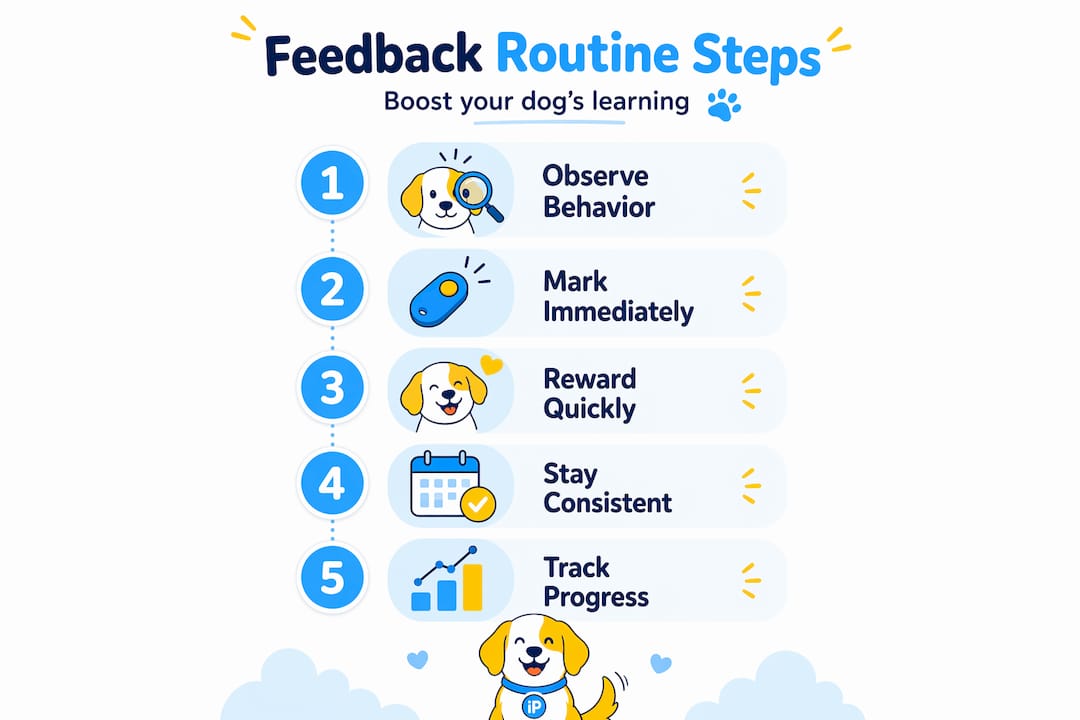
Here is how to build a daily feedback practice that actually works:
- Set a clear session structure. Keep training sessions short, ideally 5 to 10 minutes, and end on a successful repetition. Fatigue reduces learning and introduces errors into the feedback loop.
- Use one primary marker. Mixing a clicker with “yes” and “good girl” at different times confuses the signal. Pick one and use it consistently.
- Log your timing. Record video of training sessions and review them. You will often find your marker is arriving 1 to 2 seconds later than you think. This is one of the most common and correctable errors in dog training.
- Vary your reward, not your marker. Keep the marker constant but vary the size and type of reward. Sometimes a jackpot of five treats follows the mark. Sometimes it is just one. This actually increases motivation because the dog never quite knows how big the payoff will be.
- Practice in new environments early. Dogs do not generalize behavior automatically. Feedback needs to happen in every context where you expect reliability, including public settings, outdoor spaces, and around distractions.
- Address ambiguous behaviors immediately. If your dog offers a behavior that looks similar to what you want but is not quite right, withhold the marker. Silence is information too. Let the dog problem-solve and mark the next correct attempt.
Pro Tip: Train yourself before you train your dog. Practice clicking a clicker in rhythm with a video of dog behaviors, or use a metronome app to develop faster hand-eye coordination. Many timing errors are a handler skill issue, not a dog learning issue.
Incorporating service dog daily routines with these feedback principles reinforces reliability. When your dog experiences the same high-quality feedback structure across multiple contexts every single day, behaviors become automatic and robust.
The truth most trainers miss about feedback and dog learning
Here is something that years of working with service dogs and their handlers makes undeniably clear: most feedback failures are not the dog’s problem. They are a human communication problem dressed up as a training plateau.
When a dog fails to learn or starts making inconsistent errors, the instinct is to assume the dog is stubborn, distracted, or not motivated enough. The data tells a different story. Dogs are extraordinarily sensitive to pattern and prediction. If your feedback is even slightly inconsistent, your dog reads that inconsistency and responds to it, not to the behavior you are trying to teach.
The emotional layer of feedback is another piece that rarely gets discussed seriously. When you feel frustrated and say “good” with a tight jaw, your dog reads the tension in your body, your tone of voice, and the speed of your movements. They get two pieces of feedback: the word “good,” and the emotional signal that something is wrong. Those two signals contradict each other, and dogs, being highly social animals, tend to prioritize the emotional signal over the verbal one.
This is why the most effective trainers are relentlessly neutral during marking. The click or the “yes” handles the emotional communication. The reward handles the motivation. The human’s job is to be a precise, predictable information-delivery system, which is harder than it sounds.
Understanding service dog behavior at this level changes how you see every training session. Your dog is not failing. Your dog is accurately reading the signals you are sending and responding to the training environment you have actually built, not the one you intended to build. That reframe is uncomfortable, but it is also empowering because it means the solution is always within your control.
Enhance your dog’s learning with proven feedback methods
Whether you’re training a service dog for critical alerts or helping a new puppy build good habits from day one, the quality of your feedback system determines everything.
At iPupPee, we specialize in tools and resources designed around exactly these principles. Our iPupPee alert device gives dogs a precise, learnable way to communicate with their handlers using marker-compatible training methods, making the feedback loop work in both directions. Explore our full library of training guides, product resources, and expert advice built specifically for service dog handlers, seniors, and pet owners who want reliable communication with their dogs. When your feedback methods are solid, your dog’s learning follows.
Frequently asked questions
How fast can dogs learn with proper feedback?
With immediate and clear feedback, dogs can learn new cues in fewer training trials and show greater reliability, especially in service tasks. Marker training leads to fewer trials and more precise responses than reward-only approaches.
What is the best type of feedback for dog welfare?
Reward-based positive reinforcement feedback is linked to better welfare and fewer behavioral issues than punishment-based methods. Research consistently shows reward-based methods correlate with improved welfare across multiple studies.
Why is timing important in dog training feedback?
Timing affects how quickly and accurately dogs connect actions with rewards, directly impacting the speed and strength of learning. Shorter inter-reward intervals yield faster learning rates according to neuroscience research.
Can feedback methods be harmful if used incorrectly?
Yes, poorly timed or punitive feedback can increase fear, stress, and problematic behaviors in dogs according to multiple studies. Punitive training correlates with more behavioral problems compared to reward-based approaches.
Do all trainers agree on the best type of feedback?
Most experts agree on reward-based methods, but some still debate balanced approaches that include punishment. Evidence consistently supports the welfare and reliability benefits of rewards, though the balanced training debate continues in professional training communities.