

TL;DR:
- Nighttime dog walks pose serious risks due to reduced visibility and wildlife encounters.
- Proper gear, route planning, and owner awareness significantly enhance safety during dark walks.
- Most accidents happen despite good equipment, emphasizing the importance of attentiveness and deliberate habits.
Most dog owners assume their evening walks are low-risk. But the numbers tell a different story. Dog-car collisions spike sharply in the darker months of the year, with over one-third of 168 reported incidents in Denmark occurring between October and December alone. And that’s just traffic. Wildlife encounters, uneven ground, and disorientation in senior dogs add layers of risk that most owners never think about until something goes wrong. This guide covers the real dangers, the right gear, proven habits, and edge-case scenarios so you can protect your dog every time the sun goes down.
Table of Contents
- Why is nighttime dangerous for dogs?
- Essential gear for nighttime dog safety
- Best walking habits for nighttime safety
- Handling wildlife, hazards, and special scenarios
- Our perspective: The most overlooked factor in dog night safety
- Ready to upgrade your dog’s nighttime safety?
- Frequently asked questions
Key Takeaways
| Point | Details |
|---|---|
| Nighttime increases risks | Visibility drops and wildlife are more active, so safety measures are critical. |
| Use both lights and reflectors | Pair reflective gear with LED lights to keep your dog visible from all angles. |
| Stick to safe routines | Always use a sturdy leash, walk on well-lit paths, and never let dogs roam at night. |
| Special rules for seniors | Older dogs need extra attention to avoid confusion, tripping, and overexertion after dark. |
Why is nighttime dangerous for dogs?
Night walks feel routine. You grab the leash, step outside, and follow the same path you always do. But the environment around your dog changes dramatically after dark, and most owners don’t fully account for that shift.
The primary risks for dogs at night include reduced visibility that leads to traffic accidents, encounters with nocturnal wildlife, tripping hazards on uneven surfaces, and for senior dogs, cognitive dysfunction that causes restlessness or disorientation. These aren’t rare edge cases. They’re the predictable result of walking in low-light conditions without adequate preparation.
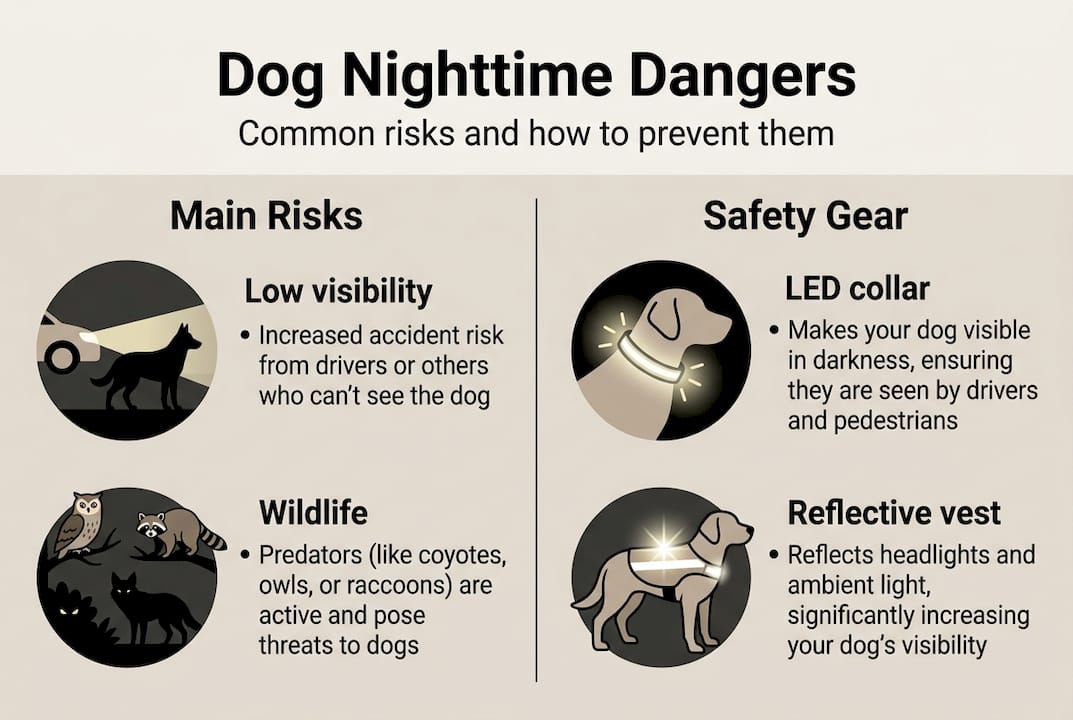
Traffic is the most immediate threat. Drivers have shorter reaction times when they can’t see your dog clearly, and dark-colored dogs are nearly invisible on unlit roads. The accident spike in dark months confirms this is a real, measurable pattern, not just a theoretical concern.
Here’s a quick breakdown of the most common nighttime risks:
- Traffic: Drivers can’t see what they can’t detect. Dark coats and no reflective gear make dogs invisible from 50 feet or less.
- Wildlife: Coyotes, raccoons, and skunks are most active after dark and may approach or provoke your dog.
- Uneven surfaces: Roots, curbs, and potholes are harder to spot at night, increasing the risk of sprains or falls for both you and your dog.
- Cognitive dysfunction in senior dogs: Older dogs with canine cognitive dysfunction (similar to dementia in humans) often become more disoriented at night, a condition called “sundowning.”
- Loose or panicked dogs: Startled by sudden noises or animals, dogs can bolt into traffic or disappear into the dark.
| Risk factor | Who is most affected | Why it increases at night |
|---|---|---|
| Traffic visibility | All dogs | Reduced light, dark coats |
| Wildlife encounters | Rural and suburban dogs | Nocturnal animal activity |
| Tripping hazards | Senior dogs, handlers | Poor depth perception in dark |
| Disorientation | Senior dogs | Cognitive dysfunction worsens |
| Panic and bolting | High-energy breeds | Sudden noises, unfamiliar shadows |
“Most owners underestimate nighttime risks because nothing has gone wrong yet. But the environment is objectively more dangerous after dark, and preparation is the only reliable buffer.”
Improving your approach to dog safety at night starts with accepting that familiar routes become unfamiliar in the dark. The good news is that improving dog safety doesn’t require a complete overhaul. It starts with awareness and a few smart upgrades.
Essential gear for nighttime dog safety
Knowing the risks leads us to solutions. The right gear doesn’t just make your dog look safer. It actually changes how visible and protected they are in real conditions.
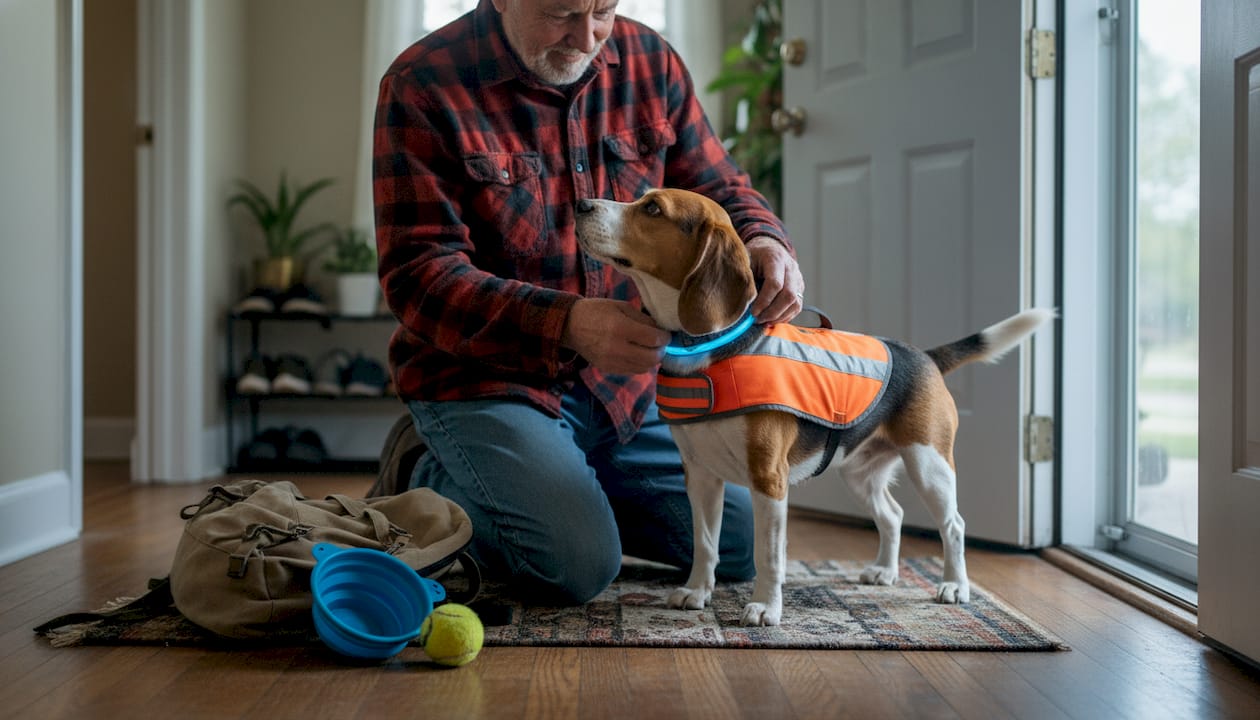
The most important distinction to understand is reflective vs. active LED lighting. Reflective collars and vests work by bouncing light back toward its source, which means they only activate when a car’s headlights hit them directly. Active LED lights, on the other hand, emit their own light and are visible from much farther away, in any direction, even when no headlights are present.
Experts emphasize 360-degree visibility over single-side reflectors for exactly this reason. A reflective strip on the back of a harness does nothing for a driver approaching from the side.
| Gear type | How it works | Best for | Limitation |
|---|---|---|---|
| Reflective collar/vest | Bounces headlights | Budget-friendly baseline | Requires external light source |
| LED clip-on light | Emits own light | Maximum visibility | Needs charging/battery |
| Combined LED + reflective | Both methods | All conditions | Slightly higher cost |
| Retractable leash | Variable length | Not recommended at night | Reduces control significantly |
| Standard 6-foot leash | Fixed length | All night walks | None |
For complete coverage, key safety methodologies include using reflective collars or vests paired with active LED lights like the Nite Dawg or Ruffwear Beacon, carrying a flashlight or wearing a headlamp yourself, and sticking to lit paths. This layered approach ensures your dog is seen from every angle.
Here’s what we recommend as a minimum setup for any night walk:
- A reflective vest or collar as your baseline layer
- An active LED light clipped to the collar or harness
- A standard 6-foot leash (never retractable at night)
- A headlamp or flashlight for the owner
- Updated ID tags and a microchip registration on file
For service dog handlers and senior pet owners, fit matters as much as function. Gear should be snug enough to stay in place if your dog moves quickly, but not so tight it causes discomfort. Vests with belly straps tend to stay better positioned than collar-only attachments.
Pro Tip: Attach an LED light to both the collar and the harness if your dog wears both. Double coverage means you’re protected even if one light shifts out of position during the walk.
Check out our safety gear tips for a curated breakdown of what works across different dog sizes and breeds. If you’re working on leash behavior alongside gear upgrades, our guide on training for leash safety covers the behavioral side of night walking.
Best walking habits for nighttime safety
Great equipment means little without safe habits. The most well-lit dog in the neighborhood is still at risk if the owner isn’t paying attention or chooses a dangerous route.
Here’s a step-by-step routine to follow before and during every night walk:
- Check your gear before leaving. Confirm LED lights are charged, reflective gear is secure, and ID tags are attached.
- Plan your route in daylight first. Know where the uneven patches, blind corners, and poorly lit stretches are before you encounter them in the dark.
- Tell someone your route. If you walk alone, a quick text to a family member or neighbor adds a safety layer for you and your dog.
- Keep your phone accessible. Not in a bag. In your pocket or armband. You need it instantly if something goes wrong.
- Stay on a standard leash. Never use retractable leashes at night; always keep your dog on a standard leash, stick to well-lit paths, and walk with a buddy when possible.
- Slow your pace on unfamiliar or uneven ground. Your dog can’t always see hazards either, especially older dogs with declining vision.
- Take rest breaks for senior dogs. Older dogs tire faster and may become confused if overstimulated. Short, calm walks work better than long ones.
Route selection is one of the most underrated safety decisions you make. Well-lit streets with consistent pavement are always preferable to scenic paths through parks or wooded areas after dark. Save the nature trails for daytime.
Pro Tip: Build a “night walk checklist” on your phone and run through it before every evening outing. It takes 30 seconds and eliminates the most common oversights.
For a deeper look at building consistent routines, our guide on night walk routines walks through how to structure outings for both safety and your dog’s wellbeing.
Handling wildlife, hazards, and special scenarios
Night walks can present surprises. Even in suburban neighborhoods, the unexpected happens more often after dark, and knowing how to respond is just as important as knowing how to prepare.
Wildlife encounters are more likely at night. Coyotes, skunks, raccoons, and in some regions, larger animals, are most active between dusk and dawn. An off-leash dog is vulnerable in ways that a leashed dog simply isn’t. Keep your dog close and make your presence known by talking, using a flashlight, or wearing a light that signals movement.
For rural dog owners, hunting season adds another layer of risk. Bright orange vests for both owner and dog are a smart addition in these months. Traps and snares set for other animals can injure dogs who wander off-trail, which is another reason to keep walks on established, familiar paths.
Here are the key behaviors to adopt for unpredictable scenarios:
- Keep your dog leashed at all times. A startled dog can disappear into darkness in seconds.
- Make noise on trails. Clapping, talking, or using a whistle signals your presence to wildlife before you get close.
- Carry a deterrent. A small air horn or citronella spray can interrupt a wildlife encounter without harming the animal.
- Know the signs of disorientation in senior dogs. Circling, freezing, or sudden unresponsiveness during a walk may signal cognitive distress. End the walk calmly and consult your vet.
- Have an emergency contact ready. If your dog is injured, know the nearest 24-hour veterinary clinic and have the number saved.
“The biggest mistake in a wildlife encounter is panicking. Stay calm, keep your dog close, make yourself large, and back away slowly. Running triggers a chase response in most predatory animals.”
Service dog handlers face a unique version of these challenges. A working dog in a vest may attract attention from other animals or people at night. Maintaining a clear, controlled path and avoiding crowded or unpredictable environments after dark protects both handler and dog.
For more scenario-specific guidance, our outdoor safety tips and urban safety routines cover both rural and city-specific challenges in detail.
Our perspective: The most overlooked factor in dog night safety
Here’s something we’ve learned from years of feedback from dog owners, service dog handlers, and senior pet owners: most people who have a close call at night already had the right gear. What they were missing was situational awareness.
It’s easy to buy a reflective vest and feel like the problem is solved. But a dog wearing an LED collar while its owner is looking at a phone is still a dog in danger. The gear creates the conditions for safety. The owner’s attention is what actually delivers it.
The owners who consistently avoid incidents aren’t the ones with the most expensive equipment. They’re the ones who treat every night walk as a deliberate activity, not a routine errand. They notice when their dog tenses up. They cross the street before a situation develops. They choose routes based on conditions, not habit.
Building this kind of awareness doesn’t take long. It just takes intention. Start by putting your phone away for the first and last five minutes of every walk. That simple shift changes everything about how you read your environment.
For more on how communication and attentiveness support safety outcomes, our guide on communication for safety is a useful next read.
Ready to upgrade your dog’s nighttime safety?
You now have a clear picture of the risks, the right gear, and the habits that actually make a difference after dark. The next step is putting it all into practice.

At iPupPee, we’ve built our resources around one goal: helping dog owners, service dog handlers, and senior pet owners feel confident and prepared in every situation. From product guides to training walkthroughs, our blog covers the full spectrum of dog safety. Start with our dog safety best practices guide for a structured overview of everything covered here and more. Your dog depends on you most when visibility is lowest. Make sure you’re ready.
Frequently asked questions
What is the best type of light for dog safety at night?
A combination of reflective gear and active LED lights ensures your dog is visible in all lighting conditions. Reflective gear requires headlights to activate, so pairing it with an LED light covers every scenario.
Should dogs ever be off-leash at night?
No. Even in well-known areas, dogs should stay leashed for maximum safety after dark. Standard leashes at night give you immediate control if something unexpected happens.
How can I protect my senior dog during night walks?
Use well-lit, even paths, monitor for confusion, and take rest breaks as needed. Cognitive dysfunction in seniors can cause disorientation, so shorter, familiar routes work best.
What should I do if I encounter wildlife while walking my dog at night?
Stay calm, make noise to deter the animal, and keep your dog close on a secure leash. Wildlife encounters at night are most common with coyotes and skunks, so backing away slowly is always the right move.
Recommended
- Dog Safety Outdoors: Essential Tips for 2025 – iPupPee
- Top Safety Tips for Dog Owners: Essential Guidance for 2025 – iPupPee
- How to Keep Pets Safe Indoors: 5 Essential Steps – iPupPee
- 7 Essential Pet Safety Tips for Smarter Dog Owners – iPupPee
- Unlock the role of moisturizer in pet care for healthy paws – Moose’s Tallow