

TL;DR:
- Teaching a dog to wait at doors enhances safety by preventing escapes and accidents in daily life. Proper setup, consistent cues, and gradual progression are essential for effective training, which should be practiced in low-distraction environments before being generalized to new locations. Patience, attention to body language, and reinforcement of a clear release word are key to building reliable door-waiting behavior.
Teaching a dog to wait at doors is one of the most practical safety skills any owner can build into daily life. The “wait” command stops your dog from bolting through open doorways, which prevents escapes, collisions with traffic, and injuries to guests. Unlike the formal “stay” command, wait allows flexible posture — your dog can sit, stand, or shift weight — but must not cross the threshold until you give a release cue. That single distinction makes door waiting easier to teach and far more practical for real-world use.
How to teach a dog to wait at doors: setup and tools
The right setup cuts your training time in half. Before your dog ever sees a door open, you need the correct equipment and environment in place.
What you need before the first session:
- A low-distraction interior door. The American Kennel Club recommends starting at interior doors like a bathroom or bedroom, where excitement is low and distractions are minimal. The front door is the hardest door to train at, so save it for last.
- A leash and harness. Use the leash as a safety net, not a correction tool. It prevents bolting while you build the behavior, not as a punishment for breaking it.
- High-value treats. Small, soft pieces of chicken, cheese, or commercial training treats work best. The reward needs to be worth more to your dog than the thrill of running through the door.
- A consistent release word. Choose one word and stick to it. Common options are “OK,” “free,” or “go.” Without a clear release word, dogs guess when the exercise ends, which creates unreliable behavior over time.
- A quiet environment. No kids running around, no other pets loose, and no doorbell ringing. Distractions come later, after the behavior is solid.
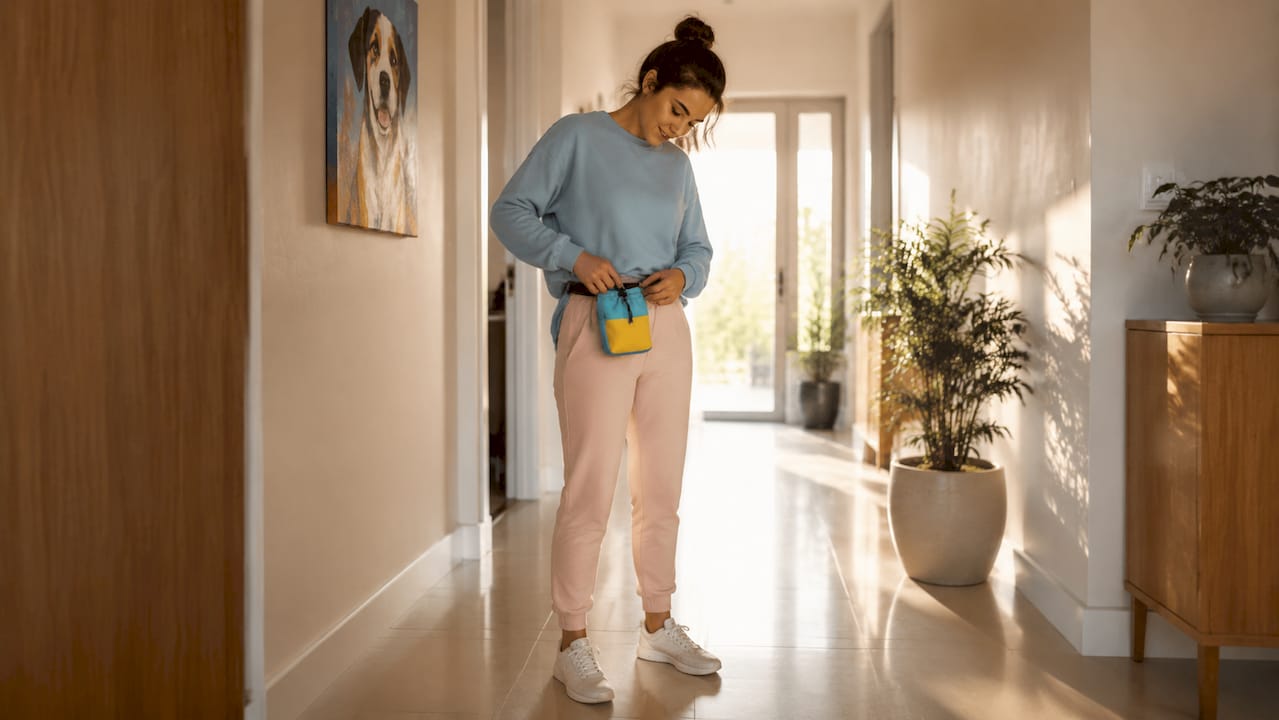
Pro Tip: Keep your treat pouch clipped and ready before you approach the door. Fumbling for rewards after your dog holds the wait breaks the timing and weakens the reinforcement.
Short sessions matter more than long ones. Experts recommend capping sessions at 5–10 minutes to keep your dog engaged and always end on a successful repetition. Ending with your dog walking calmly through the door on your release word builds a positive association with the whole routine.
What are the step-by-step training stages for door waiting?
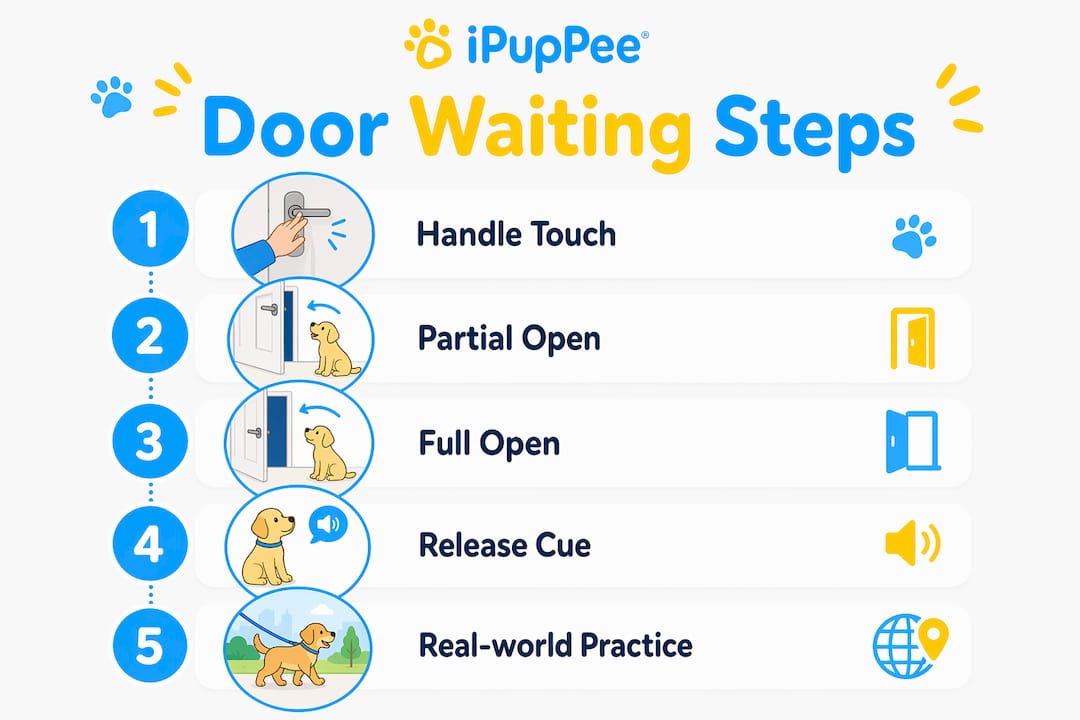
Door waiting training works in progressive stages. Each stage builds on the last, and you only move forward when your dog is succeeding at the current level.
-
Reach for the handle without opening. Walk your dog to the door on leash. Reach toward the handle. The moment your dog stays still, mark the behavior with a clicker or a verbal “yes,” then reward. Repeat this five to ten times per session until your dog is calm and expectant when you approach the door.
-
Say the wait cue before touching the handle. Once your dog is calm at the approach, add your verbal cue. Say “wait” in a calm, clear voice, then reach for the handle. Mark and reward stillness. The word comes before the action so your dog learns the cue predicts what is expected.
-
Open the door one inch. Say “wait,” open the door just a crack, then immediately close it. If your dog holds position, mark and reward. If your dog moves forward, calmly close the door, reset, and try again with a smaller movement. Do not scold. Simply restart.
-
Gradually increase the door opening. Over multiple sessions, open the door wider: two inches, then six inches, then halfway, then fully. Most dogs master this behavior within one to two weeks of practicing one to two minutes daily. Progress is not linear. Some days your dog will regress, and that is normal.
-
Introduce the release word. Once your dog holds a fully open door for three to five seconds, add your release word. Say “OK” or “free,” then step through the door yourself first, then invite your dog through. The door opening is background context. The release word is the true signal to cross the threshold. This distinction prevents accidental dashes when a door swings open unexpectedly.
-
Extend the duration. Build up to ten, twenty, then thirty seconds of waiting with the door fully open before releasing. Vary the duration so your dog cannot predict exactly when the release is coming.
| Training stage | Door position | Duration goal |
|---|---|---|
| Handle touch only | Closed | Immediate reward |
| Cue introduction | Closed | 2–3 seconds |
| Crack open | 1–2 inches | 3–5 seconds |
| Partial open | Halfway | 5–10 seconds |
| Full open with release | Fully open | 10–30 seconds |
Pro Tip: Toss a treat behind your dog to physically reset their position after each repetition. Backward treat tosses prevent “door crawling,” where dogs inch forward between repetitions without technically breaking the wait.
How do you fix common door-waiting problems?
Even well-planned training hits walls. Here is how to handle the most common problems without losing progress.
When your dog rushes the door: Close the door the instant your dog moves forward. Do not say anything. Do not correct. The closed door is the consequence. Reset and try again at a smaller increment. Rushing usually means you progressed too fast. Impatient owners who push forward too quickly actually increase their dog’s excitement and worsen the behavior. Drop back to the last step where your dog was succeeding.
When your dog ignores the wait cue: Check your treat value first. If your dog is blowing past the cue, the reward is not worth the effort. Switch to something higher value. Also check your own energy. A tense or hurried owner raises a dog’s arousal level, which makes impulse control harder.
When your dog confuses “wait” and “stay”: Keep the definitions clear in your own mind and your handling. “Stay” means hold position until I return to you. “Wait” means hold position until I release you to move. Wait is a flexible pause that does not require a specific body position. If you use both commands, practice them in separate sessions so your dog builds distinct associations.
When sessions fall apart: End the session. A dog that is over-threshold or overstimulated cannot learn. Walk away, give your dog a few minutes to settle, and return to an easier version of the exercise. Reviewing common dog training mistakes can also help you spot patterns in what is going wrong before frustration sets in.
The goal is not perfection in every session. The goal is one more successful repetition than last time. Progress compounds when you keep sessions short, positive, and consistent.
Training impulse control at doors follows the same principle as all behavior work: the three D’s of duration, distance, and distraction must be built one at a time. Never increase all three at once.
How do you generalize door waiting to real-world situations?
A dog that waits perfectly at the bathroom door but bolts through the front door has not generalized the behavior. Generalization requires deliberate practice at each new location.
How to expand door waiting to new environments:
- Treat every new door as a fresh start. When you move to the back door, the car door, or the front entrance, begin at stage one again. Your dog understands the concept, so progress will be faster, but the new location carries new smells, sounds, and excitement levels that require re-teaching.
- Add distractions in layers. Once your dog holds the wait at a new door with no distractions, add one distraction at a time. Start with mild ones: a toy on the floor nearby, then another person walking past, then the sound of the doorbell.
- Practice when visitors arrive. Ask a friend to ring the doorbell while you practice the wait at the front door. Reward heavily for calm behavior. This is the highest-stakes scenario for most dogs, so it needs the most repetition.
- Integrate wait into daily routines. Ask your dog to wait before every meal, before getting in the car, and before going outside. Daily repetition across contexts is what turns a trained behavior into a reliable habit.
- Use consistent cues across all doors. The same verbal cue, the same hand signal, and the same release word should apply everywhere. Consistency is what makes the behavior transfer across environments without confusion.
Pro Tip: Car doors are often overlooked but carry real safety risk. Teach your dog to wait at the car door before jumping in or out, using the exact same stages you used at interior doors. A dog that launches out of a car in a parking lot is in serious danger.
Key takeaways
Teaching a dog to wait at doors requires a clear release word, gradual progression through door-opening stages, and consistent practice across multiple locations before the behavior becomes reliable.
| Point | Details |
|---|---|
| “Wait” differs from “stay” | Wait allows any posture but prohibits crossing the threshold, making it easier to teach. |
| Start at interior doors | Low-distraction doors like bathrooms build the habit before tackling high-arousal front entrances. |
| Release word is non-negotiable | Without a consistent release cue, dogs guess when to move and break the wait unpredictably. |
| Progress one variable at a time | Increase duration, distance, or distraction separately, never all three in the same session. |
| Generalize deliberately | Treat every new door as a fresh training scenario and rebuild from stage one at each location. |
What I’ve learned from watching owners train door waiting
Most owners underestimate how much their own body language drives the outcome. I have watched dozens of training sessions where the dog was perfectly capable of holding a wait, but the owner’s rushed movements, tight leash grip, or anxious energy telegraphed that something exciting was about to happen. Dogs read us constantly. When you approach a door with calm, deliberate movement, your dog’s arousal stays lower and the behavior holds longer.
The second thing I see consistently is owners skipping the release word entirely. They open the door and just let the dog walk through whenever. That works until it doesn’t. The moment a door opens unexpectedly, a dog without a clear release word has no reason to pause. The release word is not a formality. It is the entire architecture of the behavior.
I also think owners give up too early when a dog regresses. Regression is not failure. It is information. If your dog suddenly starts rushing again after weeks of clean behavior, something changed: a new distraction, a change in your routine, or simply a dog having a bad day. Drop back one stage, rebuild confidence, and move forward again. The proven training techniques that work for complex behaviors all share one trait: they treat setbacks as data, not defeat.
— Andrew
Build on your dog’s training with Ipuppee
Door waiting is one piece of a larger communication system between you and your dog. Ipuppee supports dog owners with training resources, expert guides, and tools designed to make that communication clearer and more reliable. Whether you are working through basic obedience or building advanced door manners, the Ipuppee blog covers the techniques that actually work in real homes with real dogs. Visit ipuppee.com to explore training guides, product resources, and practical advice built for owners who want a dog that listens, waits, and responds with confidence every time.
FAQ
What is the difference between “wait” and “stay” for dogs?
“Wait” tells a dog to pause but allows any body position, while “stay” requires the dog to hold a specific position until the owner returns. Wait is more flexible and better suited for door manners.
How long does it take to train a dog to wait at doors?
Most dogs learn the wait behavior within one to two weeks when owners practice one to two minutes daily with consistent cues and high-value rewards.
What release word should I use for door waiting?
Choose any short, distinct word such as “OK,” “free,” or “go,” and use it exclusively as the release cue. Consistency matters more than the specific word you choose.
How do I stop my dog from rushing the door?
Close the door the instant your dog moves forward, reset, and repeat at a smaller door-opening increment. Reverting to the last successful step is more effective than corrections and prevents reinforcing the rushing behavior.
Should I use a leash when teaching door waiting?
Yes, use a leash as a safety net during early training stages to prevent bolting. Remove it gradually as your dog demonstrates reliable waiting behavior across multiple sessions.