

TL;DR:
- Hybrid dog training combines reward-based methods with minimal, precise corrections to improve reliability and safety.
- Research links aversive tools to stress and aggression, while hybrid approaches promote better welfare and obedience.
- Proper execution and trainer mindset are crucial for hybrid training to effectively enhance a dog’s understanding and trust.
Most dog owners are told to pick a side: go fully positive or use balanced corrections. That framing leaves out a growing body of evidence showing that a thoughtfully blended approach, often called hybrid training, can outperform either extreme for reliability, safety, and real-world communication. For service dog handlers, families with high-energy breeds, and owners managing special needs, this distinction is not academic. It changes how your dog responds in a crisis, how quickly they generalize new skills, and how much stress they carry day to day. This guide breaks down what hybrid training actually is, what the research says, and how to decide if it fits your dog.
Table of Contents
- What is hybrid dog training?
- Why owners choose hybrid training: Key advantages
- Safety, welfare, and stress: What the evidence shows
- Is hybrid training right for your dog?
- A trainer’s perspective on hybrid methods: What most owners miss
- Take the next step with your dog’s training
- Frequently asked questions
Key Takeaways
| Point | Details |
|---|---|
| Hybrid training defined | A hybrid approach blends positive reinforcement with thoughtful boundaries for safe, reliable results. |
| Proven owner benefits | Owners report more reliable behavior and improved communication, especially in complex situations. |
| Safety through evidence | Multiple studies show hybrid methods maintain welfare without the higher risks of aversive-only training. |
| Tailored for special needs | Hybrid training is especially effective for service dogs, high-needs pets, and families needing extra control. |
| Success relies on skill | Success depends on using rewards well and avoiding over-correction—mindset matters more than just the methods. |
What is hybrid dog training?
The debate in dog training has long been framed as a binary: you either use reward-based methods or you use corrections. Positive-only trainers argue that any aversive undermines trust. Aversive-heavy trainers claim that treats alone produce soft, unreliable dogs. Neither camp fully describes how most skilled trainers actually work.
Hybrid dog training blends positive reinforcement as the primary tool with selective, minimal corrective feedback when a behavior requires a clear boundary. The key word is selective. This is not a license to layer punishments on top of rewards. It is a structured philosophy where proven training techniques anchor every session, and corrections are used sparingly, with precise timing, only when the dog already understands what is being asked.
Hybrid is often confused with “balanced” training, but they are not the same. Balanced training, as commonly practiced, frequently relies on prong collars, e-collars, and leash corrections as standard tools. Hybrid training treats those tools as last resorts, not defaults. Mixed trainers use reward-based techniques most often, and research consistently points to safer long-term welfare outcomes when that priority is maintained.
Here is how the main approaches compare:
| Method | Primary tool | Correction use | Best for | Key risk |
|---|---|---|---|---|
| Positive-only | Rewards, shaping | None | Puppies, fearful dogs | Lower reliability in high-distraction settings |
| Aversive/balanced | Corrections, e-collar | Frequent | Quick suppression | Increased stress, aggression risk |
| Hybrid | Rewards first, minimal correction | Rare, precise | Service dogs, complex behaviors | Poor execution negates benefits |
For dog training for beginners, hybrid can feel overwhelming at first. The practical starting point is simple: reward heavily, correct rarely, and always make sure your dog understands the behavior before any corrective feedback is introduced.
Key features that define a true hybrid approach:
- Positive reinforcement drives at least 80% of all training interactions
- Corrections are low-intensity, non-painful, and immediately followed by a redirect to the correct behavior
- The trainer adjusts the ratio based on the individual dog’s stress signals and learning pace
- Tools are chosen to support communication, not to intimidate
- Progress is measured by the dog’s attentiveness and enthusiasm, not just compliance
This structure matters because it preserves the dog’s motivation to engage while still providing the clarity that high-stakes environments demand.

Why owners choose hybrid training: Key advantages
Understanding the structure of hybrid training, let’s dig into why owners gravitate toward this approach, especially those managing service animals or dogs with complex behavioral histories.
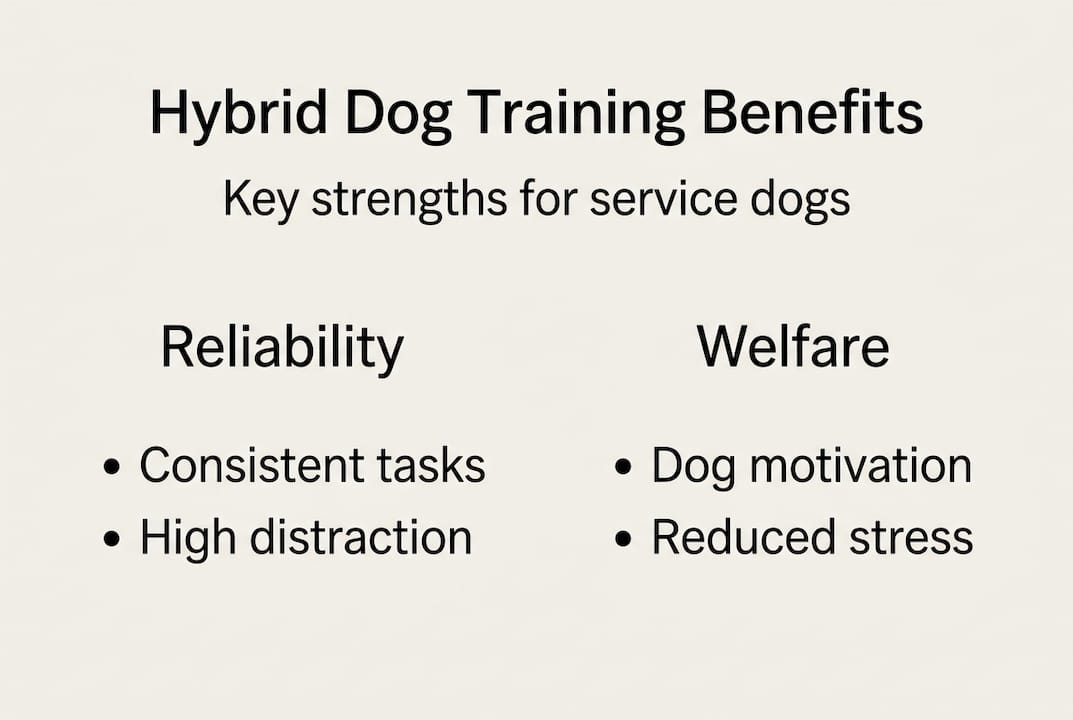
The single biggest reason is reliability. A dog trained exclusively with rewards can sometimes struggle when the stakes are high, when distractions are intense, or when the reward is not immediately available. For a service dog alerting a diabetic owner to a blood sugar drop, or a mobility assistance dog bracing on a crowded subway platform, a two-second delay in response is not acceptable. Reward-based methods provide safer welfare and fewer aggression risks, and hybrid approaches build on that foundation by adding the behavioral clarity that working dogs need.
Here is how outcomes compare across methods in real training programs:
| Method | Task reliability (high distraction) | Reported welfare concerns | Owner satisfaction |
|---|---|---|---|
| Positive-only | Moderate | Low | High for pet dogs |
| Aversive/balanced | High short-term | Elevated | Mixed |
| Hybrid | High, sustained | Low to moderate | High for service/working dogs |
For everyday family dogs, the dog training benefits of hybrid methods show up in a different way. Dogs learn faster when they get clear feedback in both directions. They understand not just what earns a reward, but also what crosses a boundary. This reduces the frustration that builds when a dog keeps testing limits and gets no clear answer.
Here is a practical sequence for integrating positive reinforcement with structured boundaries:
- Teach the behavior fully using rewards before any corrective element is introduced
- Confirm the dog understands the cue by testing it in three different low-distraction environments
- Introduce mild, non-painful feedback only when the dog performs a known behavior incorrectly
- Immediately redirect to the correct behavior and reward the follow-through
- Track how often corrections are needed. If frequency is not dropping over time, revisit your reward rate
Specific problems where hybrid training consistently outperforms single-method approaches include leash reactivity, door bolting, recall in off-leash parks, and task precision for assistance dogs.
Pro Tip: If you find yourself correcting more than rewarding in any session, stop. Reset with easier versions of the behavior and rebuild confidence before raising criteria again. Check out these smart training tips for more on keeping sessions productive.
Safety, welfare, and stress: What the evidence shows
Many owners worry about safety and emotional cost, so what does the science actually say?
The research is clearer than the online debate suggests. Aversive techniques are linked to increased cortisol levels, higher rates of stress-related behavior, and a measurable uptick in aggression. Reward-based and hybrid methods, by contrast, are associated with better long-term welfare outcomes and lower rates of fear-based reactivity.
“Dogs trained with aversive methods show significantly higher cortisol responses and are more likely to display stress signals, including yawning, lip licking, and avoidance, compared to dogs trained with reward-based approaches.”
This is not just a welfare argument. Stress directly impairs learning. A dog operating in a chronic state of low-grade fear retains less, generalizes less, and is more likely to make errors in novel situations. For service dogs, that is a serious operational problem.
Here is a plain breakdown of the risks and rewards across methods:
- Positive-only: Low stress risk, excellent trust-building, but may struggle with proofing in high-stakes environments
- Aversive/balanced: Fast suppression of unwanted behavior, but elevated cortisol, increased aggression risk, and potential for learned helplessness
- Hybrid (well-applied): Maintains low stress baseline, builds reliable responses, requires skilled timing to avoid tipping into aversive territory
- Hybrid (poorly applied): Corrections without clarity create confusion and can produce the same stress profile as full aversive training
The misconception most owners carry is that corrections are neutral, that a quick leash pop or a firm “no” has no emotional cost. Research does not support that view. Even mild aversives, applied inconsistently or without the dog understanding why, register as stressors. The pet training importance conversation has shifted significantly in recent years because of this evidence.
The takeaway is not that corrections are always wrong. It is that they carry a cost, and that cost must be weighed carefully against the benefit, especially for dogs with any history of fear or anxiety.
Is hybrid training right for your dog?
You know the research and the benefits, but is hybrid really a fit for your unique dog?
The honest answer is: it depends on execution more than method label. Here is a step-by-step way to assess whether hybrid training is a good fit and how to apply it responsibly:
- Assess your dog’s baseline temperament. Confident, food-motivated dogs adapt well to hybrid methods. Dogs with significant fear histories or trauma need a longer purely reward-based foundation before any corrective element is introduced.
- Identify the specific behaviors you are targeting. Hybrid shines for precision tasks, impulse control, and reliability under distraction. For basic manners in a low-stakes home, positive-only may be entirely sufficient.
- Choose corrective tools carefully. A verbal marker for an incorrect response is very different from a leash correction. Start with the least intrusive feedback possible and only escalate if the dog is clearly not responding and already understands the behavior.
- Monitor stress signals in every session. Yawning, shaking off, sniffing the ground, and avoiding eye contact are all signs that the pressure is too high. These are not stubbornness. They are communication.
- Track your correction-to-reward ratio. In a healthy hybrid session, rewards should outnumber corrections by at least five to one.
Red flags that hybrid may not be appropriate right now include extreme fear responses, a dog with a history of trauma from prior aversive training, or an owner who has not yet built a strong reinforcement history with their dog. In those cases, training problems solutions often start with rebuilding trust through pure positive reinforcement before any hybrid element is introduced.
Professional programs using hybrid methods report strong success rates, but poor use of aversives consistently produces stress and aggression. That gap is almost always about timing and clarity, not the method itself. Reviewing training fundamentals before adding corrective elements is strongly recommended.
Pro Tip: The clearest sign hybrid is working is that your dog starts offering correct behaviors without being asked. That spontaneous compliance means they understand the rules and feel safe enough to try.
A trainer’s perspective on hybrid methods: What most owners miss
After working with hundreds of dogs across every training philosophy, the pattern that stands out most is not about method. It is about mindset.
Owners who struggle with hybrid training almost always make the same two mistakes. First, they obsess over the tools and forget about timing. A perfectly chosen correction delivered half a second late teaches the dog nothing useful. Second, they treat the hybrid label as permission to correct more freely, which defeats the entire purpose.
The owners who see the best results are the ones who stay curious about their dog’s feedback. They notice when their dog is confused versus defiant. They reward generously and correct sparingly. They do not need a perfect system. They need consistency.
Something else that rarely gets said: not every dog needs hybrid training. Some dogs thrive on pure positive reinforcement their entire lives, and adding any corrective element would only introduce noise into a system that is already working. Exploring easy training methods first is often the smartest move before layering in complexity.
The method label matters far less than the relationship you build and the clarity you provide. That is the part no training philosophy can hand you.
Take the next step with your dog’s training
You now have a solid foundation for understanding hybrid training, its real benefits, and where it fits in a responsible training plan. Putting that knowledge into practice is where the real work begins.

At iPupPee, we support dog owners at every stage, from first-time puppy handlers to experienced service dog teams looking to refine their approach. Whether you are just starting out or troubleshooting a specific challenge, our proven training guide gives you practical, evidence-backed steps you can apply today. Training is not a one-time event. It is an ongoing conversation between you and your dog, and we are here to help you keep that conversation clear, consistent, and rewarding.
Frequently asked questions
Is hybrid dog training safe for all breeds?
When done correctly, hybrid training is safe and effective for most breeds, but the approach must be adjusted for sensitive or fearful dogs. Poorly applied corrections can cause stress and aggression, making individual adaptation essential.
Do hybrid methods work for puppies?
Yes, using mostly reward-based training with minimal structured correction helps puppies learn quickly and safely. Positive reinforcement is linked to better welfare outcomes, and gentle structure supports confidence as they grow.
Can hybrid training help with aggression or anxiety?
Hybrid training may support mild cases, but severe aggression or extreme fear requires professional guidance. Aversives can worsen fear and aggressive responses when applied without expert oversight.
How do I know if my trainer uses a true hybrid approach?
Look for programs that lead with rewards, use corrections sparingly and transparently, and measure success by the dog’s engagement. True hybrid programs emphasize positive reinforcement with minimal, thoughtful corrections as the defining standard.