

The three moves that prevent most wheelchair-and-pet accidents are a short or hands-free leash, a pre-movement visual scan, and a trained “clear the wheels” cue your dog actually responds to under pressure. Add a dog-activated alert device as a backup communication layer, not a replacement of those habits. Everything below walks through the checklist, the training, and the gear that make those three moves stick.
TL;DR:
- A fixed, short leash of about 2 to 3 feet attached to a waist belt significantly reduces the risk of entanglement injuries with wheelchair wheels.
- Training pets to stay clear of wheelchair wheels takes several weeks of short, consistent sessions focusing on staged exposure and positive reinforcement.
- An alert device like iPupPee provides real-time notifications and communication but should supplement, not replace, physical safety checks and trained cues.
- Dogs tend to stay close to their handler and are more at risk of paw entrapment, while cats often hide or wedge into gaps, requiring different safety strategies.
- Regularly inspecting wheelchair components for wear and maintaining proper gear installation are essential to prevent sudden mechanical failures that could injure pets.
Table of Contents
- Pet Safety Measures for Wheelchairs: The Full Checklist
- How Do You Train a Pet to Avoid Wheelchair Wheels?
- Gear That Cuts Entanglement and Fall Risk
- Can an Alert Device Like iPupPee Improve Pet Safety?
- Emergency Response If Your Pet Gets Caught Near the Wheels
- Do Cats and Dogs Face Different Wheelchair Risks?
- Recognizing Stress From Wheelchair Movement
- Socializing Pets Around Wheelchairs in Public
- Maintenance Checks That Prevent Pet Injuries
- Training for Powered vs. Manual Wheelchairs
- What Handlers Learn the Hard Way
- Where iPupPee Fits Into Your Safety Plan
- Sources
- FAQ
Pet Safety Measures for Wheelchairs: The Full Checklist
Before you touch the joystick or push the rims, run a quick scan. This habit takes ten seconds and prevents the majority of paw and tail injuries handlers report.
- Look in all directions. Check front, both sides, and behind before you move an inch.
- Call your pet by name and wait for a response or visual confirmation they’re clear.
- Listen for a collar bell. A cheap bell tells you where a cat or small dog is even when you can’t see them.
- Check your blind spot with a mirror or wide-angle camera mounted on the chair’s rear.
- Clear the floor path. Remove loose rugs, toys, and cords that cause pets to freeze or trip near your wheels.
- Add reflective gear if you’re moving through low light, so pets and people both see you coming.
- Pause and ask for help if your pet is anxious, underfoot, or you can’t get a clear line of sight.
On the leash side, skip retractable leashes entirely. They give pets too much room to loop around axles and footrests, and the cord itself can snap taut around a paw or ankle in a way a short leash never will. A fixed leash of about 2 to 3 feet, clipped to a hands-free waist attachment, keeps your dog or cat close enough to see and far enough from the wheels to stay out of trouble.
Pro Tip: Keep a small bell on your pet’s collar even indoors. Handlers who’ve dealt with near-misses consistently point to bells and mirrors as the cheapest, fastest fixes that actually change outcomes.
How Do You Train a Pet to Avoid Wheelchair Wheels?
Training happens in layers, and rushing the first layer is why most attempts fail. Start with the chair parked and silent. Let your pet sniff it, walk around it, and get bored of it on their own schedule.
Once your pet is neutral around a stationary chair, move to the next stage.
- Stage the chair moving without you in it. Have a second person roll it slowly across the room while your pet watches from a distance. This single step reduces fear-based reactions far more effectively than jumping straight to full interaction, according to wheelchair acclimation guidance from Karman Healthcare.
- Introduce yourself in the chair, moving slowly, rewarding calm behavior at a distance before asking your pet to come closer.
- Shape a “clear the wheels” cue using a marker word or clicker, rewarding the moment your pet steps back from the wheel path, then gradually raise the bar until they move away on command alone.
- Proof the behavior everywhere. A cue that works in your living room needs practice on carpet, tile, ramps, and outdoor pavement before you trust it in a hallway crowded with people.
- Layer in a trained alert. Marker training that pairs a nose touch or paw press with a consistent reward builds the foundation for a reliable alert behavior, the same shaping method used in service-dog task training.
If you’re working toward anything resembling a mobility-assist task, like pulling or bracing, stop and bring in a professional. Task training resources are consistent on this point: mobility-related tasks should be evaluated by a physical or occupational therapist first, because the wrong task can strain a dog’s body or put you at risk.
Pro Tip: Keep training sessions under five minutes. Dogs and cats both learn wheel-avoidance faster from five short, upbeat sessions than one long, frustrating one.
Gear That Cuts Entanglement and Fall Risk
Your leash, harness, and attachment points do more safety work than most handlers realize. A few adjustments matter more than the price tag of the gear itself.
- Ditch retractable leashes. The thin cord and the slack it allows are the two most common ingredients in a wheel entanglement.
- Use a hands-free bungee leash clipped to a waist belt instead of the chair frame; it absorbs sudden pulls without yanking your arm or tipping a lightweight chair.
- If you clip to the chair frame, mount the attachment low and central, never near a spoke or caster wheel, and check the clip weekly for wear.
- For limited grip, skip wrapping the leash around your hand. A wrist loop with the excess webbing folded into your palm lets the leash release under a hard pull instead of dragging or injuring your hand.
- Add a collar bell and a reflective harness. Both give you an early warning before your pet is close enough to matter.
- Mount a small convex mirror or a wide-angle camera on the rear of the chair to kill the blind spot behind your footrests.
None of this is expensive. It’s mostly a matter of choosing the right hardware and habits over convenience.
Can an Alert Device Like iPupPee Improve Pet Safety?
A dog-activated alert device adds a communication layer that physical checks alone can’t provide. A press-to-notify alert device works by letting your dog press a button to send a live alert with video and two-way audio, whether you’re in the next room or across the house.
- What it does: sends a real-time notification with sound and vibration cues, so a trained press reaches you even if you’re not looking at your pet.
- How to train it: mark the button press the same way you’d mark any behavior, reward every clean press, then generalize the skill to different rooms, times of day, and distraction levels before you rely on it.
- Where to put it: near doorways, ramps, or feeding areas, anywhere your pet spends unsupervised time close to a path your chair regularly travels.
- What it isn’t: a substitute for your pre-movement scan or your trained “clear the wheels” cue.
Alert and response training research backs this layered approach directly. Reliable alert behaviors need to be proofed gradually, moving from a single quiet room to doorways, ramps, and the busier paths of daily life, with distractions added before you trust the behavior in a real emergency. A button press means nothing if your dog only performs it in a silent kitchen with no distractions.
Treat any alert device as one leg of a three-legged stool: training, physical checklist, and device. Remove one leg and the other two carry more weight than they should.
Emergency Response If Your Pet Gets Caught Near the Wheels
Speed matters, but so does staying calm enough to check your pet properly.
- Stop immediately and lock or power off the chair so it can’t roll or drift further.
- Assess your pet. Check breathing, look for obvious bleeding, and watch how they’re bearing weight on each leg.
- Apply basic first aid. Apply gentle pressure to any bleeding, avoid moving an injured limb unnecessarily, and keep your pet as calm and still as you can.
- Call your vet or an emergency animal hospital if there’s limping, bleeding that won’t stop, or any sign of shock.
- Loop in your caregiver or household member on what happened, especially if your pet has ongoing medical needs that affect recovery.
Build three habits into your daily routine: a quick rear check before backing up, a verbal call-out before you move at all, and a weekly test of any alert device to confirm it still fires correctly.
Do Cats and Dogs Face Different Wheelchair Risks?
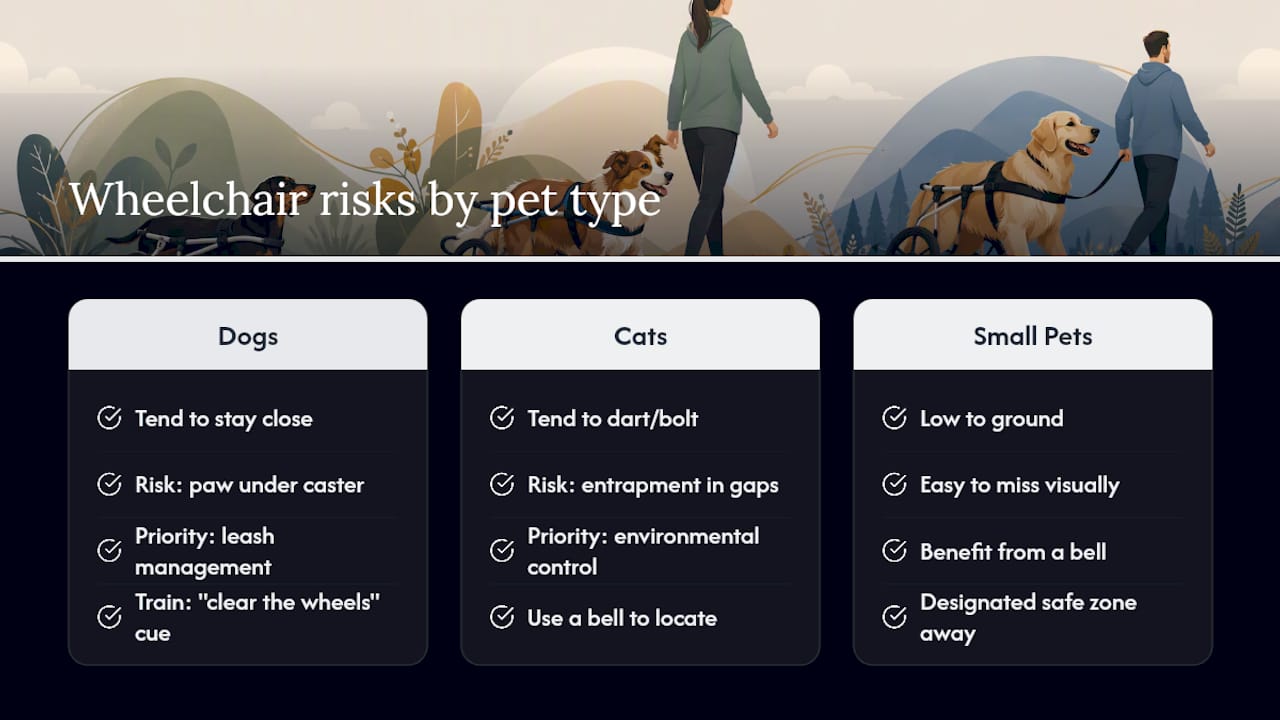
Dogs and cats create almost opposite safety problems, and treating them the same way is a common mistake.
Dogs tend to stay close to their handler out of attachment, which puts them directly in the wheel path during turns and tight hallway maneuvers. A dog that’s learned to heel near your feet is often the dog most likely to get a paw under a caster wheel, because closeness reads as affection, not danger, to them. This is exactly why the “clear the wheels” cue matters more for dogs than almost any other single piece of training.
Cats create a different risk profile. They tend to dart rather than linger, often bolting from a resting spot the moment a chair starts moving, which makes them harder to track visually but generally faster to clear the area once they react. The bigger risk with cats is entrapment: they’ll wedge themselves into narrow gaps, behind furniture near your travel path, or under low ramps where you can’t see them until you’re already moving.
For dogs, invest more heavily in leash management and the wheel-avoidance cue. For cats, invest more in environmental control: keep favorite resting spots away from doorways and hallway pinch points, and use a bell so you can hear a cat’s location even when you can’t see it. Small pets like rabbits or small dog breeds split the difference. They’re low to the ground, easy to miss, and benefit from both a bell and a designated safe zone away from your main travel routes.
Recognizing Stress From Wheelchair Movement
A pet that flinches, freezes, or bolts every time your chair moves isn’t being difficult. They’re telling you the training moved faster than their comfort level.
Watch for these signs: flattened ears, a tucked tail, excessive panting when the chair hasn’t moved far, refusing to enter rooms where the chair is present, or hiding when you power on a motorized wheelchair. Cats show stress more subtly, usually through hiding, reduced appetite, or over-grooming after a stressful encounter with the chair.
If you spot these signs, go back a step. Return to the stationary-chair phase and let your pet re-acclimate at their own pace, even if you’d already moved past it. Rushing a stressed pet back into proximity almost always backfires and can create a lasting negative association with the chair itself.
Short, low-pressure sessions work better than one long exposure. Five minutes of calm, chair-nearby time with treats and praise beats twenty minutes that ends in a bolt. Powered wheelchairs deserve extra patience here. The motor noise and unpredictable acceleration are genuinely more startling to a nervous dog or cat than the steady, human-powered motion of a manual chair, so budget more sessions before you expect calm behavior around one.
Socializing Pets Around Wheelchairs in Public
A dog that’s calm in your living room can still panic the first time a stranger’s motorized wheelchair rolls past at the dog park. Public exposure is a different skill from home training, and it needs its own practice.
Start with controlled distance. Take your pet somewhere wheelchairs are common but not overwhelming, like the entrance of a grocery store or a wide sidewalk, and reward calm observation from far enough away that your pet doesn’t react. Gradually shrink that distance over multiple outings rather than one long session.
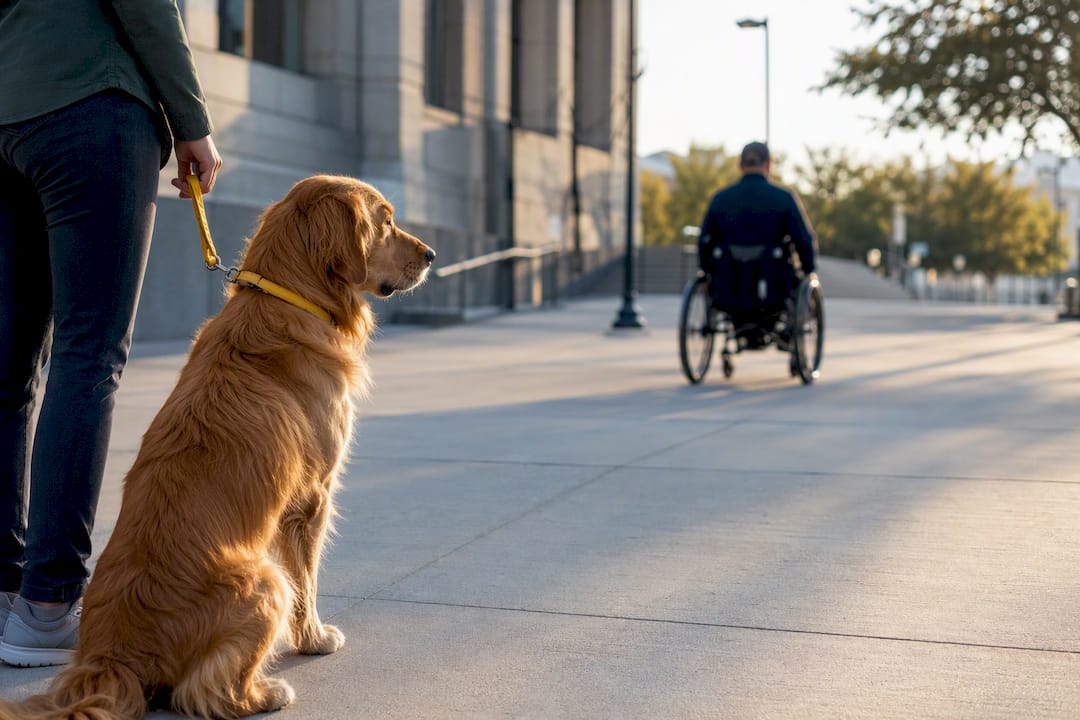
Avoid letting strangers rush up to pet your dog while a wheelchair is nearby. Sudden attention plus an unfamiliar mobility device is a common recipe for a startled reaction. Ask people to wait until your pet is settled, or skip the greeting altogether if your pet still looks tense.
If your dog is a service dog, public acclimation carries higher stakes, since the dog needs to stay task-focused around other people’s wheelchairs, carts, and mobility scooters, not just your own equipment. Practice in low-distraction public settings first, then build up to busier environments like transit stations or shopping centers once the dog’s baseline response stays calm.
Maintenance Checks That Prevent Pet Injuries
A wheelchair that’s mechanically sound is quieter, more predictable, and far less likely to surprise a pet or catch a paw.
Check these regularly:
- Wheel bearings and axles for looseness, which can cause sudden jerky movement your pet won’t have time to react to.
- Footrest height and stability, since a loose or low footrest is a common source of pinched paws.
- Brake function, so you can stop instantly if a pet darts into your path.
- Caster wheel housings for debris, fur, or string wrapped around the axle, which is a frequent, invisible entanglement risk.
- Tire pressure and tread, since underinflated tires change how predictably the chair moves and stops.
A monthly hands-on check, plus a quick listen for new rattles or grinding sounds, catches most of these before they become a safety issue. Mechanical unpredictability is exactly what pets react to worst, so a well-maintained chair is quieter and easier for your dog or cat to read and avoid.
Training for Powered vs. Manual Wheelchairs
Manual and powered chairs create different training challenges, and treating them identically skips a step most handlers regret later.
Manual wheelchairs move at the pace your arms set, which gives pets time to read your body language and anticipate direction changes. Training focuses mainly on wheel proximity: teaching your pet to respect the rim path and stay clear during turns, since manual chairs turn tighter and faster than most pets expect.
Powered wheelchairs remove that predictability. The motor can accelerate faster than a pet expects, and the sound itself, often a low hum or click, is a cue that needs its own dedicated training phase. Some handlers report success teaching dogs to associate that specific motor sound with the wheel-avoidance cue, essentially turning the chair’s own noise into an early warning system the dog responds to automatically, a pattern documented in firsthand accounts from wheelchair users managing pets.
For both chair types, proof the training on varied terrain: carpet, hardwood, ramps, and outdoor pavement all change how the chair sounds and moves, and a cue trained only on one surface won’t reliably transfer to another.
What Handlers Learn the Hard Way
Most near-misses I’ve come across in handler accounts share a common thread: they happened during a routine moment, not a chaotic one. A dog underfoot during a normal turn. A cat asleep somewhere no one checked. The fix in nearly every case was something cheap and unglamorous, a bell, a mirror, a shorter leash, not a major equipment overhaul.
Training and physical redundancy do more together than either does alone. A trained cue can fail on a bad day; a scan habit backed by a bell rarely fails twice in a row. Give your pet room to be a pet, but build the habits that catch the moments their instincts and your wheels disagree.
— Andrew
Where iPupPee Fits Into Your Safety Plan
Every measure covered here, the scan, the leash, the training, works better with a communication layer that doesn’t depend on you being in the room. That’s the gap iPupPee fills. It’s a Wi-Fi enabled alert device your dog presses to send you a real-time notification with live video and two-way audio, backed by training materials and an on-demand dog psychology and training course to help you build the behavior properly.
Think of it as one layer, not the whole system. Your pre-movement scan, your trained “clear the wheels” cue, and your leash setup still do the daily heavy lifting; the device is the backup that catches what happens when you’re not looking. For more on integrating devices like this into a broader care routine, see this guide on dog safety devices for disabled owners.
If you’re ready to add that layer, check device specs, training videos, and current pricing on the iPupPee product page and start the setup this week rather than after the next near-miss.
Sources
- Wheelchairs and pets: Be careful where you roll - New Mobility
- Getting dogs comfortable around wheelchairs - Karman Healthcare
- Wheelchairs, safety and toys - Cooperative Paws
FAQ
What’s the single most effective pet safety measure for wheelchairs?
A short, fixed-length leash of about 2 to 3 feet on a hands-free attachment prevents more entanglement injuries than any other single change, especially compared to retractable leashes.
How long does it take to train a dog to avoid wheelchair wheels?
It varies by dog, but most handlers see reliable avoidance within a few weeks of short, five-minute daily sessions using staged exposure and consistent reward timing.
Can a device like iPupPee replace physical safety checks?
No. iPupPee’s alert device adds a useful communication layer for moments you’re not watching, but it works alongside, not instead of, your pre-movement scan and trained cues.
Are cats or dogs at higher risk around wheelchairs?
Both face real but different risks: dogs are more likely to stay close and end up near the wheel path, while cats tend to hide in gaps near your travel route where they’re harder to spot.
Should I consult a professional before training mobility tasks?
Yes. Any task involving pulling, bracing, or physical mobility assistance should be reviewed by a physical or occupational therapist before you train it, since the wrong task can harm the dog or the handler.