

Pets genuinely support mental health for many people, and the evidence behind that claim is more nuanced than the headlines suggest. The most consistent findings point to three mechanisms: reduced loneliness through social connection, short-term biological calming from tactile contact, and the structure that daily pet care provides.
- Social connection: Pets reduce isolation and can act as conversation starters, expanding owners’ social networks in ways that compound over time.
- Biological regulation: Stroking or interacting with a pet increases oxytocin and dopamine while reducing cortisol, producing measurable short-term calming effects.
The caveats matter, though. Benefits vary considerably by person, pet type, relationship quality, and study design. Population-level research often shows weaker or mixed effects than the feel-good headlines imply, and ownership alone is not a mental-health treatment.
Key Takeaways
Pets support mental health through specific, evidence-backed mechanisms, but benefits depend on the person, the pet, and whether professional care is also in place.
| Point | Details |
|---|---|
| Mechanisms are real but bounded | Pets reduce loneliness, provide routine, and trigger calming hormonal responses, but do not reliably buffer acute stress. |
| Dogs show the strongest evidence | Dogs drive social contact and physical activity in ways cats and other pets typically don’t, though individual fit matters more than species alone. |
| Ownership studies are mixed | A meta-analysis of 21 studies found no overall significant association between pet ownership and depression risk at the population level. |
| Structured interventions outperform ownership | Animal-assisted therapy in clinical settings consistently shows stronger effects on anxiety and distress than general pet ownership. |
| Plan before you adopt | Assess daily care capacity, financial readiness, housing rules, and have a written crisis-care plan before bringing a pet home. |
Table of Contents
- How does mental health and pet care connect? The main mechanisms
- Which people and which pets are most likely to benefit?
- Is owning a pet the right choice for you?
- You can get many of the same benefits without owning a pet
- What the research really says: limitations and key nuances
- References and where to read more
- A measured view on what the evidence actually means
- Sources
How does mental health and pet care connect? The main mechanisms
The benefits of pet companionship on mental health run through several distinct channels, and understanding which one applies to you matters more than the general claim that “pets help.”
Biological effects: hormones and the nervous system
Physical contact with a dog or cat triggers a measurable hormonal response. Oxytocin rises, cortisol drops, and dopamine and serotonin activity shifts in ways associated with improved mood and reduced stress. These effects appear quickly, sometimes within minutes of interaction, which is why even brief contact with a therapy animal in a clinical setting can reduce self-reported anxiety. The NIH’s public health summary on pets describes this calming response as one of the most consistently replicated findings in the human-animal interaction literature.

What’s less clear is how long these effects last and whether they accumulate meaningfully over months of ownership. Short-term calming in a structured setting is not the same as a sustained reduction in depression or anxiety disorder symptoms.
Social mechanisms: loneliness and community
The 2023 U.S. Surgeon General report on loneliness identified chronic social isolation as a public-health crisis comparable in harm to smoking heavily. Pets, particularly dogs, function as social lubricants: dog owners report more spontaneous conversations with strangers, more neighborhood connections, and lower rates of perceived loneliness than non-owners in several survey studies. The AMA’s review of pet and mental health evidence frames this social dimension as one of the more robust pathways, especially for people who live alone.

Dogs specifically drive this effect more than other species, largely because walking a dog creates repeated, low-stakes social encounters that other pets don’t generate. For people who struggle to initiate social contact, a dog can make connection feel incidental rather than effortful. Ipuppee’s resource on how pets help loneliness explores this dynamic in practical detail.
Routine, purpose, and behavioral activation
Caring for a pet imposes structure on the day. Feeding schedules, walks, and grooming create a rhythm that can be genuinely protective for people with depression, where loss of routine is both a symptom and a driver of worsening mood. This is behavioral activation by another name: doing something, even when motivation is low, tends to improve mood more reliably than waiting to feel motivated first.
A narrative synthesis published in Frontiers in Psychiatry identified routine and felt purpose as two of the core therapeutic mechanisms through which companion animals support people with mental-health difficulties, alongside emotional co-regulation and nonjudgmental presence.
Emotional co-regulation and tactile soothing
Pets don’t judge, argue, or withdraw affection based on your mood. That nonjudgmental presence turns out to be therapeutically significant. The same Frontiers in Psychiatry synthesis describes this as a “relational process” where the animal’s consistent responsiveness helps regulate the owner’s emotional state, particularly during periods of distress.
Ecological momentary assessment (EMA) research, which tracks mood in real time rather than relying on retrospective surveys, confirms that interacting with a companion animal is associated with higher positive affect and lower negative affect in daily life. The same research also shows this effect does not reliably buffer the emotional impact of acute stress, meaning pets lift baseline mood but don’t necessarily blunt a bad day.
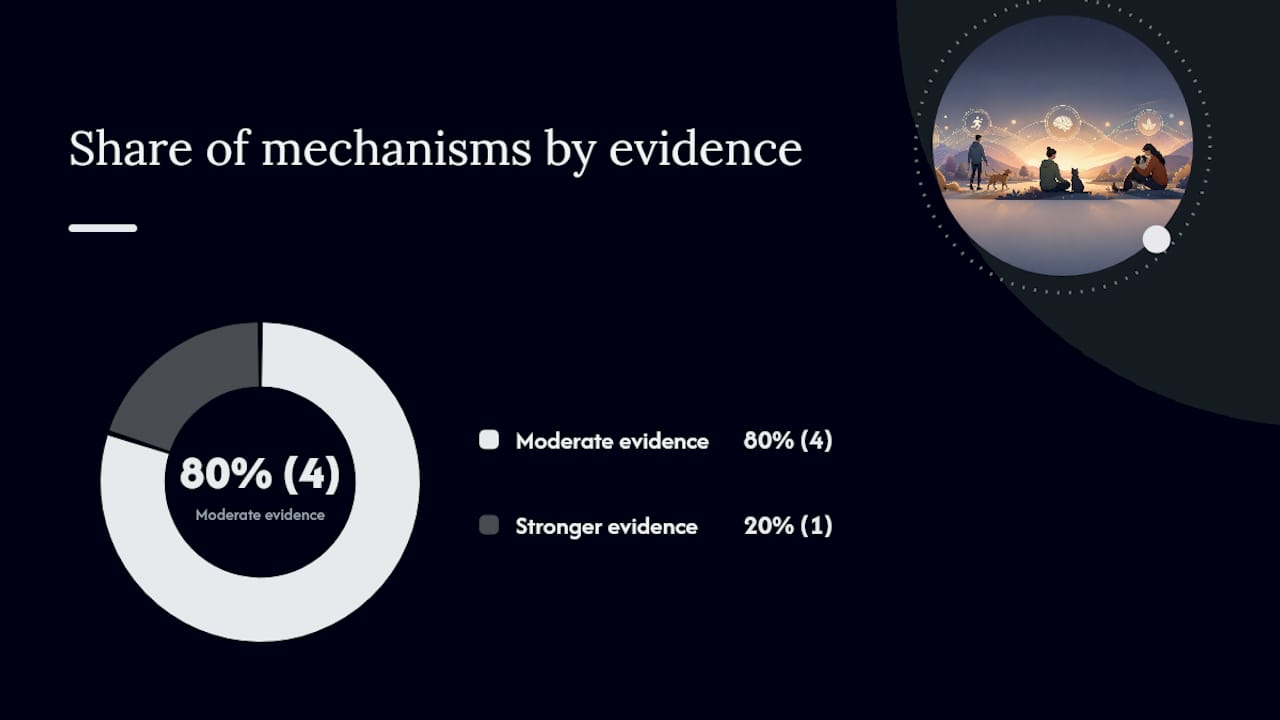
| Mechanism | Strength of evidence | Key caveat |
|---|---|---|
| Biological (oxytocin/cortisol) | Moderate, consistent in short-term studies | Duration of effect unclear |
| Social connection / reduced loneliness | Moderate, stronger for dog owners | Less clear for cats and other species |
| Routine and behavioral activation | Moderate, qualitative evidence | Depends on owner’s ability to maintain care |
| Emotional co-regulation | Moderate, EMA-supported | Does not reliably buffer acute stress |
| Reduced anxiety (structured AAI) | Stronger, intervention studies | Applies to therapy settings, not general ownership |
Which people and which pets are most likely to benefit?
Not everyone benefits equally, and the type of pet matters more than most people assume.
Groups with the strongest evidence for benefit:
- People living alone, particularly seniors, where a pet provides daily social contact and purpose. The senior health and pet companionship research consistently shows reduced loneliness and improved self-reported wellbeing in older adults with pets.
- People with PTSD or trauma histories, when paired with a trained service or therapy dog through a structured program rather than general ownership.
- People with depression who struggle with routine and motivation, where a pet’s care needs provide external structure.
- Children and adolescents in some studies, though the evidence here is more mixed and context-dependent.
Dogs vs. cats vs. other animals:
Dogs carry the strongest and most consistent evidence for mental-health benefit, primarily because they drive physical activity, social interaction, and routine simultaneously. The systematic review of 116 studies on pet attachment and mental health found that associations between pet ownership and wellbeing varied significantly by outcome type, age group, and attachment style, with no single clean answer.
Cats are a more complicated picture. A meta-analysis of 21 studies found no overall significant association between pet ownership and depression risk at the population level, and subgroup analyses suggested a modestly increased depression risk associated with cat ownership in pooled data. That finding is counterintuitive and contested, and researchers point to selection effects as a likely explanation: people who are already struggling may be more likely to adopt cats, which are lower-maintenance companions.
Small animals, fish, and birds can provide comfort and routine but generate fewer of the social and physical activity benefits that drive the strongest outcomes.
Pro Tip: Before adopting any pet, spend time with that species through fostering or pet-sitting. Attachment quality predicts outcomes more than species alone, and a poor fit between owner temperament and pet personality can increase stress rather than reduce it.
Is owning a pet the right choice for you?
This is the question most articles skip, and it’s the one that matters most. Owning a pet is a long-term commitment with real financial, time, and emotional costs. Getting it wrong can worsen mental health rather than improve it.
Practical checklist before adopting:
- Daily care capacity: Can you reliably provide feeding, exercise, and attention every day, including during low-functioning periods?
- Financial readiness: First-year costs for a dog in the U.S. typically run several thousand dollars when you include adoption or purchase fees, spay/neuter, vaccinations, supplies, and food. Ongoing annual costs average several hundred to a few thousand dollars depending on size and health needs.
- Housing and lease terms: Many rental properties restrict pet ownership or charge substantial deposits. Confirm your lease before adopting.
- Allergy screening: Allergies to pet dander are common and can develop after prolonged exposure even in people with no prior history.
- Time commitment: Dogs need multiple daily walks and social interaction. A dog left alone for 10-hour workdays is a welfare problem and a behavioral risk.
- Lifespan planning: A dog may live 10–15 years. A cat, 15–20. Adopting means committing through life changes: moves, relationships, health crises.
Risks that often go unmentioned:
Pet behavioral problems are strongly linked to owner stress and poorer mental-health outcomes. Research published in PLOS ONE found that compatibility between owner and pet, along with perceived pet welfare and behavioral issues, significantly predicted owner mental-health outcomes. A dog that pulls, barks excessively, or destroys furniture is not a calming presence. Early, consistent training is a mental-health protective strategy, not just a pet-welfare nicety.
Grief after pet loss is also underestimated. Losing a pet can trigger a grief response comparable in intensity to losing a close human relationship, and that grief is often socially minimized, which compounds the distress.
Pro Tip: Create a written pet-care plan for mental-health crisis periods before you need it. Mental Health America recommends pre-arranging temporary care with a trusted friend, family member, or local foster contact so that a crisis doesn’t also become a pet-care emergency. Having that plan in place reduces guilt and protects the bond. A resource like this pet care plan guide for people living alone can help you think through the logistics.
You can get many of the same benefits without owning a pet
Full pet ownership isn’t the only path to the mental-health benefits animals provide. Several alternatives deliver meaningful contact without the long-term commitment.
Options worth considering:
- Foster a pet: Short-term fostering through a local shelter gives you the daily routine and companionship of pet ownership without the permanent commitment. Most shelters actively need fosters and provide food and vet care.
- Volunteer at an animal shelter: Regular shelter shifts provide animal contact, social connection with other volunteers, and a sense of purpose. Search Petfinder or your local ASPCA chapter to find opportunities.
- Pet-sit or dog-walk for neighbors: Apps like Rover and Wag connect you with pet owners who need help. You get the benefits of dog interaction and physical activity without the ownership costs.
- Animal-assisted therapy (AAT): Structured programs where trained therapy animals are incorporated into clinical treatment. The evidence for AAT is stronger than for general ownership because the intervention is designed and supervised. Ask your therapist or psychiatrist whether a referral to an AAT program is appropriate for your situation.
- Pet visitation programs: Hospitals, nursing homes, and college campuses often run certified therapy-dog visitation programs. Contact your local hospital’s volunteer services or search through Pet Partners (petpartners.org) for certified teams near you.
- Robotic and virtual pets: The evidence here is limited but emerging, particularly for older adults in care settings where live animals aren’t feasible. Robotic companions like PARO (a therapeutic robot seal used in dementia care) have shown modest mood benefits in small studies, though this is far from the effect size seen with live animals.
How to start today: Search “[your city] + therapy dog volunteer” or “[your city] + animal shelter foster program” to find vetted local options within the week.
What the research really says: limitations and key nuances
The honest summary is that the evidence for pets and mental health is promising, real in some contexts, and frequently overstated.
Where the evidence is strongest:
Structured animal-assisted interventions (AAI), including therapy dog programs in hospitals, schools, and clinical settings, consistently show reduced anxiety and distress in short-term studies. The PMC review of human-animal interaction evidence notes that intervention studies generally show stronger effects than ownership surveys, because the contact is intentional, structured, and combined with professional support.
Where the evidence is mixed or weak:
General pet ownership studies are plagued by methodological problems. Most are cross-sectional, meaning they measure pet ownership and mental health at one point in time and cannot establish causality. Selection effects are a serious concern: people who are already struggling may be more likely to acquire pets for comfort, which can make ownership look associated with worse outcomes even when pets are genuinely helping. The systematic review of 116 studies on pet attachment and mental health found that associations varied substantially by outcome type, age group, and attachment style, with no consistent direction of effect.
The meta-analysis of 21 studies on pet ownership and depression found no overall significant association at the population level. The cat-ownership subgroup finding (a modestly elevated depression risk in pooled data) illustrates how species, context, and sample composition can flip the direction of an association entirely.
EMA research adds an important layer. Momentary studies confirm that pet interactions are associated with better mood in the moment, but they also show that pets do not reliably buffer the emotional impact of stressful events. The effect is real but bounded.
| Study type | Typical finding | Confidence level |
|---|---|---|
| Structured AAI / therapy dog interventions | Reduced anxiety and distress | Moderate to strong |
| EMA (momentary mood tracking) | Higher positive affect during interactions | Moderate |
| Cross-sectional ownership surveys | Mixed; often no significant effect | Low to moderate |
| Meta-analyses on depression | No overall significant association | Moderate |
| Qualitative synthesis (mechanisms) | Identifies co-regulation, routine, social connection | Moderate (mechanism evidence) |
The Frontiers in Psychiatry narrative synthesis frames companion animals as a “relational process” that complements formal care rather than replacing it. That framing is probably the most accurate summary of where the science stands: pets can be a meaningful part of a mental-health support system, but they work best alongside, not instead of, professional treatment.
References and where to read more
The sources below represent the strongest available evidence on this topic. Each is publicly accessible and worth reading if you want to evaluate the evidence yourself.
- NIH News in Health: The Power of Pets — A plain-language public-health summary from the National Institutes of Health covering the evidence on pets, loneliness, physical activity, and mood. Accessible and well-sourced.
- AMA: Why Pets May Help Your Mental Health — The American Medical Association’s summary of biological and social mechanisms, including the Surgeon General’s loneliness framing.
- PMC / NIH: Human-Animal Interaction and Health — A peer-reviewed review of the HAI literature distinguishing intervention studies from ownership surveys. Useful for understanding why study design matters so much in this field.
- Frontiers in Psychiatry: Companion Animals and Mental Health — A 2026 narrative synthesis identifying the specific mechanisms through which companion animals support people with mental-health difficulties.
- MDPI Animals: Systematic Review of Pet Attachment and Mental Health — A 2025 systematic review of 116 studies. The most comprehensive overview of the attachment-outcome literature, with honest reporting of mixed findings.
- Mental Health America: Pet Care During Mental Health Struggles — Practical guidance on contingency planning for pet owners experiencing mental-health crises.
A measured view on what the evidence actually means
The research on pets and mental health is genuinely encouraging, and I think it’s also genuinely misread, in both directions. Some people dismiss it as soft science. Others treat “pets help mental health” as a settled fact that justifies skipping therapy or medication. Neither reading is fair to the evidence.
What strikes me most about the stronger studies is how consistently they point to mechanism rather than ownership as the active ingredient. It’s not having a pet that helps. It’s the daily routine a pet creates, the physical contact that shifts your hormonal state, the social encounters a dog generates on a walk, the felt sense of being needed by something that doesn’t judge you. Those mechanisms are real. They’re also available, in varying degrees, through fostering, volunteering, or structured therapy programs, which matters enormously for people who can’t own a pet.
The other thing I’d push back on is the implicit assumption that mental-health benefits from pets are passive. They’re not. A poorly matched pet, an undertrained dog, or a care burden you can’t sustain will add stress, not subtract it. The connection between pet behavioral problems and owner mental health is one of the most underreported findings in this literature, and it has direct practical implications: investing in training and compatibility is investing in your own wellbeing.
Pets can be a meaningful part of a mental-health support system. They work best when they complement professional care, not when they replace it. If you’re in crisis right now, please contact the 988 Suicide and Crisis Lifeline by calling or texting 988.
Sources
- Why pets may help your mental health | American Medical Association
- Companion animals and mental health: a narrative synthesis of how pets deliver therapeutic mechanisms outside formal provision — Frontiers in Psychiatry
- Human–animal interaction and health: a review of the evidence — PMC (NIH / PubMed Central)
This article provides general information and is not a substitute for professional mental-health advice. If you are experiencing a mental-health crisis, contact a qualified clinician or call/text 988.