

TL;DR:
- Training dogs to greet calmly enhances safety, reduces stress, and fosters trust between dogs and people.
- Using management tools, consistent commands, and short positive sessions accelerates progress and prevents unwanted behaviors.
Your dog charges the door the second someone knocks, jumps on your guests, and turns every hello into chaos. You are not alone. Learning how to teach dog gentle greetings is one of the most requested skills among dog owners, and for good reason. A dog that greets people calmly is safer, less stressful to live with, and frankly, just more enjoyable to be around. This guide covers everything from setting up your training space to troubleshooting the moments when guests undo all your hard work.
Table of Contents
- Key takeaways
- How to teach dog gentle greetings: what you need first
- The step-by-step training process
- Troubleshooting common challenges
- Generalizing polite greetings beyond home
- Why calm greetings matter more than you think
- My take on what actually works
- Take your dog training further with Ipuppee
- FAQ
Key takeaways
| Point | Details |
|---|---|
| Start with management tools | Use leashes, gates, and mats before training begins to stop your dog from practicing jumping. |
| Reward the right behavior | Treat and praise calm, four-paws-on-floor behavior within 1-2 seconds for fastest results. |
| Keep sessions short | Five to ten minute training sessions prevent overstimulation and hold your dog’s attention longer. |
| Consistency is non-negotiable | Every person in your household must follow the same rules, or your dog will stay confused. |
| Generalize slowly | Practice polite greetings in new locations and with new people only after home training is solid. |
How to teach dog gentle greetings: what you need first
Before you run a single training repetition, spend a few minutes getting your setup right. Walking into a session unprepared is the fastest way to get frustrated and quit.
The tools that actually matter
You do not need a lot of gear, but the right gear makes a real difference. Here is what to have on hand:
- High-value treats: Small, soft pieces of chicken, cheese, or commercial training treats. The treat needs to be something your dog would not get any other time.
- Training leash: A standard four to six foot leash you can hold or step on to prevent jumping without yanking.
- Baby gate or exercise pen: Physical barriers that buy you time to get your dog into position before guests enter.
- A designated mat or place board: A specific spot your dog learns to go to during arrivals. Management tools like these prevent jumping and make training faster by stopping bad habits from forming in the first place.
- Treat pouch: Keep rewards easily accessible so you can reward quickly.
Prerequisite commands
Your dog should know a reliable “sit” and “stay” before you move into greeting training. These do not need to be competition-level, but your dog should be able to hold a sit for at least five seconds with mild distraction. If those foundations are shaky, spend one week reinforcing them before layering in guests.
Managing energy before sessions
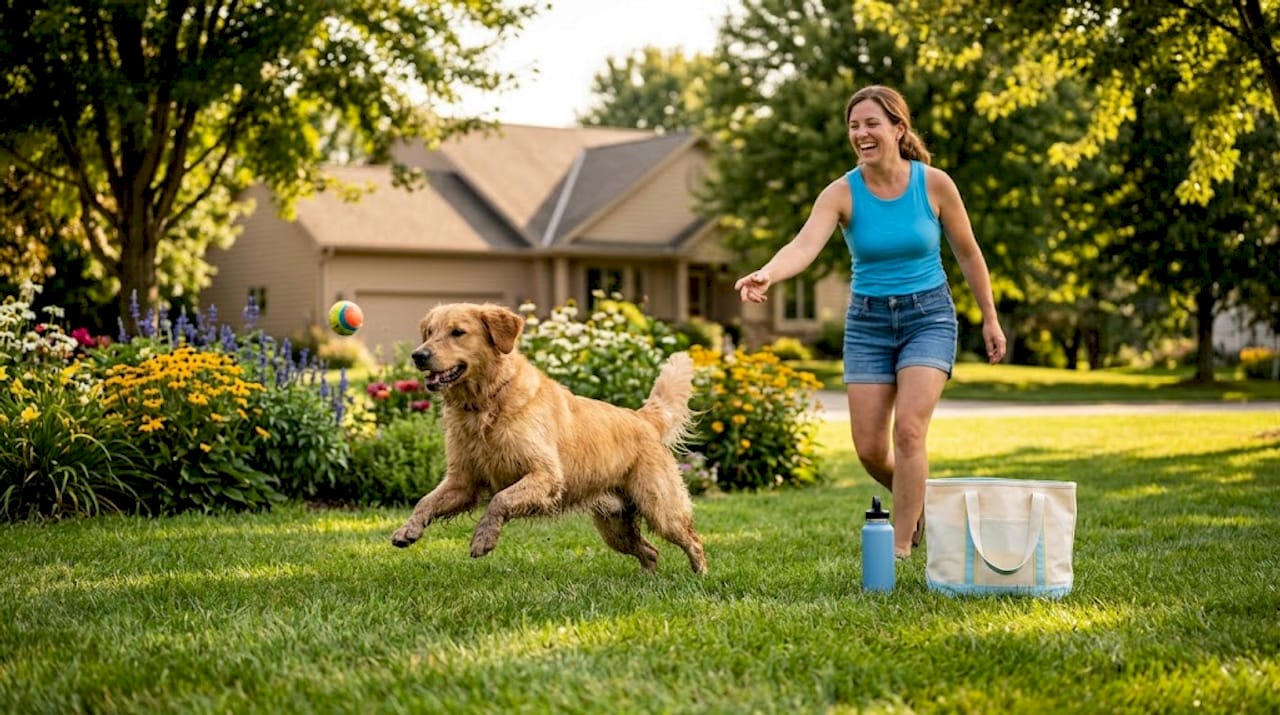
Pre-session exercise reduces overexcitement significantly. A 15-minute walk or a quick game of fetch before training cuts your dog’s arousal level and makes focus much easier. Do not train after a long nap or right before a meal when your dog is at peak energy or hunger-distracted.
Pro Tip: Always set up your mat and prep your treats before the “guest” arrives, even during practice runs. Your dog should see the setup as the cue that calm behavior is expected.
| Setup element | Why it matters |
|---|---|
| High-value treats | Motivates faster behavior change than kibble |
| Designated mat | Creates a clear, repeatable spot for calm behavior |
| Baby gate | Prevents jumping before training even starts |
| Training leash | Allows gentle redirection without physical force |
| Pre-session exercise | Lowers arousal so your dog can actually focus |
The step-by-step training process
Teaching dogs polite greetings works best when you progress through clear stages rather than throwing your dog into full guest scenarios on day one.
-
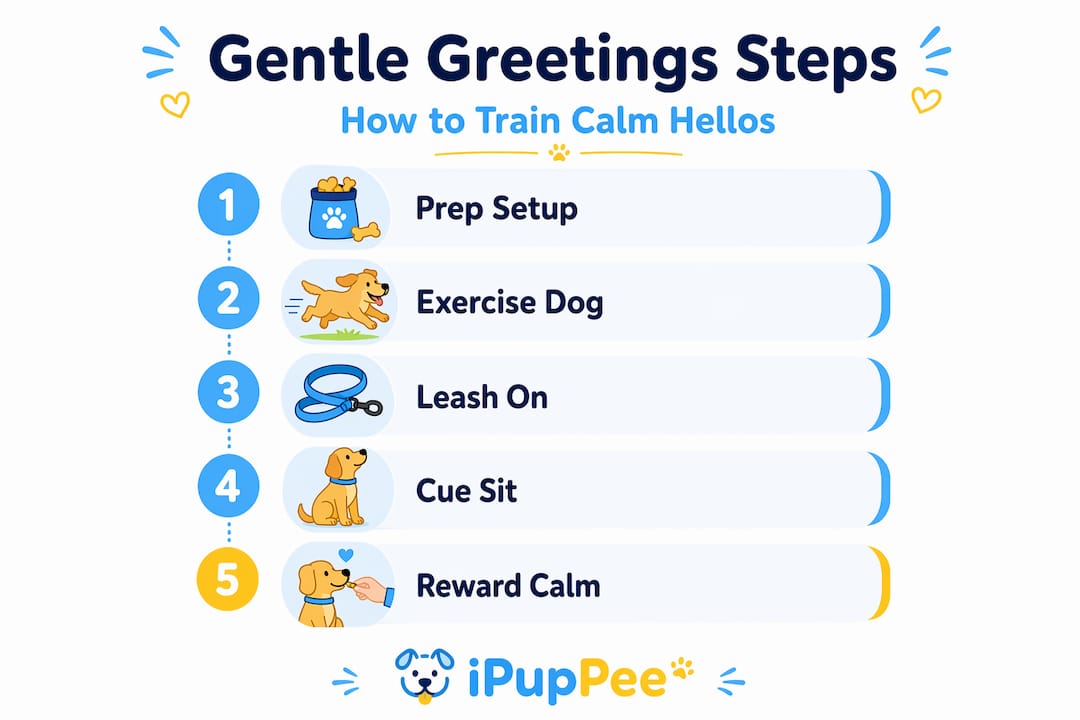
Install management first. Put your dog on a leash or behind a baby gate before any guest walks through the door. This single step stops your dog from practicing unwanted jumping every time someone arrives, which is critical because repetition reinforces behavior in either direction.
-
Introduce the “place” cue. Choose a mat that is different from your dog’s regular bed. Walk your dog to the mat, lure them onto it, and reward them the moment all four paws land on it. Build duration slowly over several sessions. A specific mat for “place” prevents confusion with regular resting spots and makes the behavior more predictable.
-
Teach “four on the floor.” Stand in front of your dog with a treat in your hand. The moment all four paws are on the ground and your dog is not jumping, reward immediately. Turn your back or step away the instant your dog jumps. No eye contact, no verbal correction. Ignore jumping entirely and only reward calm, all-paws-on-floor behavior, marking it with a clear “yes” or a clicker.
-
Introduce a greeting cue. Once your dog can hold a “sit” or stay on their mat reliably for five seconds, add a release word like “go say hi.” This teaches your dog that greetings happen on your schedule, not theirs. The release cue gives them something to look forward to without the chaos.
-
Practice with staged visitors. Ask a friend or family member to role-play as a guest. They approach the door, your dog goes to their mat or holds a sit, and only gets released to greet when calm. Training in stages typically spans two to four weeks per phase, with sessions kept to five to ten minutes to maintain focus and prevent burnout.
-
Gradually increase difficulty. Add more excited visitors, children, or people your dog has not seen in a while. Build in real door sounds, doorbells, and knocking as separate triggers your dog learns to stay calm for.
Pro Tip: Film a few training sessions on your phone. Watching the footage lets you catch moments when you are accidentally rewarding jumping or breaking your dog’s focus without realizing it.
The key here is that short, frequent sessions consistently outperform long marathon attempts. Ten minutes every day beats one hour on the weekend.
Troubleshooting common challenges
Even well-planned training hits walls. Here is how to handle the most common ones.
When your guests undo your work
This is the number one reason greeting training stalls. A guest squeals, reaches down to pet your jumping dog, and your dog just learned that jumping works. Before any guest enters, brief them. Tell them to turn away if the dog jumps and to wait for four paws on the floor before giving any attention. This is not optional.
When family members are inconsistent
Mixed signals from household members delay training more than almost anything else. If one person lets the dog jump while another enforces “sit,” the dog has no idea what the actual rule is. Hold a family meeting. Write the rules on the fridge if you have to.
Behaviors that seem to get worse before better
This is called an extinction burst. When your dog’s jumping stops working, they will often try harder before giving up. This is normal and temporary. Stay the course without reacting. Reviewing common training mistakes at this point can help you identify whether you are accidentally reinforcing the jump without knowing it.
Pro Tip: If your dog is consistently getting worse after two weeks, reassess whether your treat value is high enough. A mediocre reward produces mediocre motivation.
| Challenge | What helps |
|---|---|
| Guests reinforcing jumping | Brief guests before entry; use baby gate as buffer |
| Inconsistent household rules | Align all family members on the same cue and reward system |
| Extinction burst (increased jumping) | Stay completely neutral; reward only calm behavior immediately |
| Dog too excited to focus | More pre-session exercise; lower arousal with a sniff walk first |
Addressing dog greeting issues almost always traces back to one of these four root causes. Fix the environment and the humans first, then refocus on the dog.
Generalizing polite greetings beyond home
Once your dog greets calmly at the front door, that does not automatically transfer to every context. Dogs learn behaviors in the environments where they practice them, so you need to build that behavior in new settings deliberately.
Start with low-intensity scenarios on walks. Ask a calm neighbor or friend to approach and greet your dog while you ask for a sit. Use the same release cue you practiced at home. Keep these greetings brief. Unmanaged greeting excitement can build into stress even when the dog is not showing aggression, so keeping initial greetings short protects your dog as much as your guests.
Learning to read dog body language is a real skill that directly supports greeting training. A dog with a stiff body, whale eye, or rapid panting is telling you the situation needs to slow down before it escalates.
A few things to keep in mind as you generalize:
- Use “watch me” to redirect attention back to you before your dog reaches peak arousal.
- Practice near parks, pet stores, or anywhere you regularly walk your dog.
- Reward heavily in new locations because they are genuinely harder for your dog.
- End every greeting session before your dog gets overstimulated. Two good repetitions beat five poor ones.
As your dog becomes reliable, you can fade treats and shift to real-life rewards like access to the person as the reward itself.
Why calm greetings matter more than you think
The case for teaching dogs polite greetings goes beyond manners. Calm greetings reduce the risk of injury particularly for children and seniors who can be knocked over by an enthusiastic dog. A 50-pound dog jumping at full speed is a genuine safety concern.
There is also a mental wellness angle. Dogs that are allowed to operate at high arousal during greetings often carry that tension into the rest of their day. Lower arousal at the door means a calmer dog overall.
“Reward-based training strengthens the bond between dog and owner and helps build a trusting relationship.” Ask A Vet, 2025
Positive reinforcement greetings also build your dog’s confidence. A dog that knows exactly what is expected at the door is less anxious and more relaxed in social situations. That is a better life for your dog, full stop.
My take on what actually works
I have watched a lot of dog owners go through greeting training. The most common mistake is not what people expect. It is not that they choose the wrong training method. It is that they spend all their energy trying to stop the jumping instead of teaching the dog what to do instead.
Saying “no” or “off” gives your dog nothing to grab onto. Teaching “go to your place” and rewarding a sit gives them a job. Dogs that have a clear job at the door are calmer within days, not weeks, because they finally understand the rules of the game.
The second thing I have seen derail more training than bad technique is inconsistency across the family. One person following through and three people not is worse than nobody following through. At least then the dog gets a consistent message, even if it is the wrong one.
My honest advice: use management tools aggressively in the first two weeks. Gates, leashes, mats. Prevent the jumping entirely so your dog never gets to rehearse it. Pair that with short, daily sessions where calm behavior gets rewarded immediately, and you will see results faster than you think. I have seen anxious and reactive dogs make dramatic progress in two weeks just from consistent management alone. Patience and structure always beat intensity and frustration.
— Andrew
Take your dog training further with Ipuppee
Greeting training is just one piece of the puzzle. If you want to go deeper on the skills that support polite greetings, Ipuppee’s blog is packed with practical, experience-backed guidance.
Check out Ipuppee’s articles on dog behavior signals to understand what your dog is communicating before a greeting goes sideways. If you are dealing with a dog that is reactive or anxious around visitors, the guide on calming techniques walks you through the exact steps to lower arousal before training even begins. And if you have hit a wall with training progress, the post on training mistakes to avoid will likely show you exactly where things went off track. For tools and resources that help you communicate better with your dog every day, visit Ipuppee.
FAQ
How long does it take to teach a dog gentle greetings?
Most dogs show clear progress within two to four weeks of consistent daily training, with five to ten minute sessions recommended per stage to prevent overstimulation and hold attention.
What is the best method for dog greeting manners training?
Positive reinforcement is the most effective approach. Reward calm, four-paws-on-floor behavior immediately and ignore jumping completely so your dog learns which behavior gets them what they want.
Why does my dog keep jumping even after training?
Jumping often persists because someone in the household or a guest is accidentally rewarding it with eye contact, pushing the dog away, or verbal reactions. Verbal corrections can actually reinforce jumping because they still count as attention.
Should I use a leash indoors for greeting training?
Yes. Leashing indoors during early greeting training lets you reposition your dog calmly without physical force, which keeps sessions low-stress and controlled.
When should I get professional help for greeting issues?
If your dog’s excitement at the door crosses into growling, snapping, or genuine fear responses, consult a certified professional dog trainer. These behaviors go beyond standard greeting training and need a personalized assessment.