

TL;DR:
- Adaptive pet aids are specialized devices designed to improve mobility and quality of life for pets with disabilities, injuries, or age-related issues. Selecting the appropriate aid depends on observing your pet’s movement patterns, consulting a veterinarian, and considering the pet’s specific condition, size, and needs. Proper introduction, regular reassessment, and complementary home modifications enhance the effectiveness of these aids and support long-term recovery.
Adaptive pet aids are specialized devices and equipment designed to help pets with disabilities, injuries, or age-related conditions regain function and maintain a good quality of life. Products like Walkin’ Wheels mobility carts, NeoAlly orthopedic braces, and full-body support harnesses address everything from spinal injuries to post-surgical recovery. This guide to adaptive pet aids walks you through every major category, explains how to match the right device to your pet’s specific condition, and covers what it takes to introduce and maintain these tools effectively. Whether your dog has degenerative myelopathy or your cat is recovering from a fracture, the right adaptive pet equipment changes daily life in measurable ways.
What types of adaptive pet aids exist and how do they support pets?
Adaptive pet aids fall into five main categories, each targeting a different type of mobility or health challenge. Understanding these categories before you shop saves time, money, and frustration.
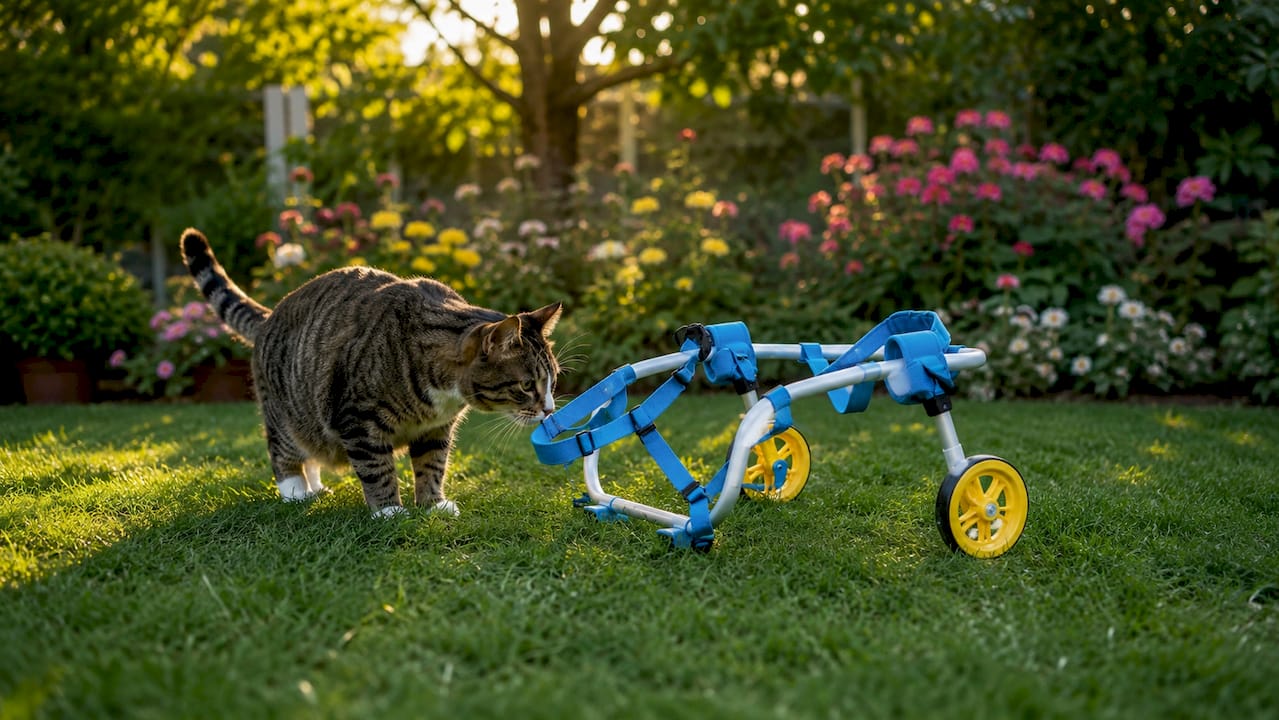
Mobility carts and wheelchairs support pets with hind limb or full-body paralysis. They hold the rear or front of the body off the ground while the pet moves using functional limbs. Walkin’ Wheels is the most recognized brand in this space, offering both rear-support and quad configurations. These devices allow pets to exercise, which prevents muscle atrophy and supports neurological recovery.
Orthopedic braces stabilize joints and the spine. NeoAlly produces medical-grade carpal braces for front leg support and spinal braces for conditions like intervertebral disc disease (IVDD). These are rigid or semi-rigid supports that limit harmful movement while allowing controlled, therapeutic motion. They are particularly useful during the recovery phase following surgery or acute injury.
Support harnesses come in three configurations: rear-only, front-only, and full-body. Rear harnesses like the Help 'Em Up Harness lift the hindquarters during walking. Front harnesses assist pets with forelimb weakness. Full-body harnesses distribute weight across the entire trunk and are suited for pets with generalized weakness or neurological conditions.
Traction aids address a problem that many owners overlook. Slick floors are genuinely dangerous for pets with compromised balance or coordination. Non-slip socks, rubber paw boots, and toe grips (such as Dr. Buzby’s ToeGrips) give pets the grip they need to move confidently without slipping.
Orthopedic and supportive bedding reduces pressure on joints and bony prominences. Memory foam orthopedic beds, like those from Big Barker, are clinically tested to reduce joint pain in dogs with arthritis or hip dysplasia. These are passive aids, but they matter enormously for overnight recovery and rest quality.
| Aid Type | Best For | Cost Range | Adjustability |
|---|---|---|---|
| Mobility cart | Hind limb or full paralysis | $200–$700 | High (adjustable) to custom |
| Orthopedic brace | Joint instability, IVDD, post-surgery | $45–$1,200 | Moderate |
| Support harness | Weakness, balance issues, post-op | $30–$150 | High |
| Traction aids | Slick floor navigation | $10–$60 | N/A |
| Orthopedic bedding | Arthritis, joint pain, pressure sores | $80–$300 | N/A |
How to select the right adaptive pet aid for your pet’s needs
Selecting the correct aid starts with observation, not shopping. Watch your pet move across different surfaces and note exactly where the breakdown occurs. Does the rear end collapse? Does one front leg buckle? Does the pet knuckle under on a paw? Each pattern points toward a different category of supportive pet gear.
Experts advise observing movement patterns before selecting any mobility aid and consulting a veterinarian if you see sudden collapse, non-weight-bearing limping, or loss of bladder control. These signs indicate conditions that require diagnosis before any device is applied. Fitting a brace or harness to an undiagnosed spinal fracture, for example, could cause serious harm.
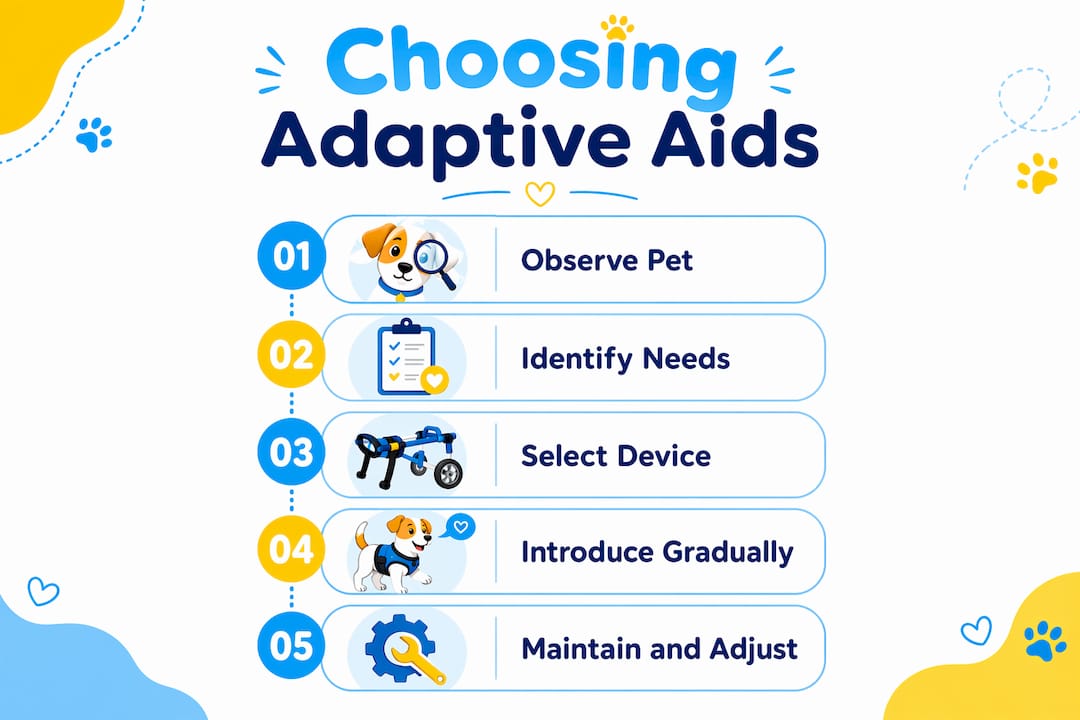
Once your veterinarian has assessed the condition, follow these steps to narrow your selection:
- Identify the affected region. Rear limb weakness points toward a rear-support harness or wheelchair. Front limb instability points toward a carpal or elbow brace. Spinal instability points toward a back brace.
- Determine whether the need is temporary or long-term. Post-surgical recovery typically requires aids for weeks to months. Degenerative myelopathy is progressive and requires aids that can be upgraded over time as the condition evolves.
- Assess your pet’s size and weight. Most harnesses and braces are sized by body weight and specific measurements. Precision measuring of back length and chest girth is critical for medical-grade back braces to function correctly.
- Set a realistic budget. Direct-to-consumer orthopedic braces cost roughly one-tenth of custom-molded orthotics, at $45 to $75 versus $800 to $1,200, with comparable stabilization for most cases. This makes off-the-shelf options a reasonable starting point for most owners.
- Factor in your own physical ability. Some harnesses require two hands and significant strength to apply. If you have limited mobility yourself, look for single-step designs with quick-release buckles.
Pro Tip: Start with the simplest solution first. A folded bath towel used as a sling provides immediate hindquarter support at zero cost during an acute mobility crisis while you wait for specialized equipment to arrive.
Comparing popular adaptive pet aids: braces, wheelchairs, and harnesses
The three most commonly purchased categories of adaptive pet equipment are braces, wheelchairs, and harnesses. Each serves a distinct clinical purpose, and choosing the wrong one wastes money and delays recovery.
Orthopedic braces
NeoAlly’s line of medical-grade braces covers the carpus (wrist), hock (ankle), elbow, and spine. Their back brace for IVDD uses a semi-rigid shell with adjustable straps to limit spinal flexion while still allowing the pet to walk. The fitting process requires home measurement, but the company provides detailed video guides. At $45 to $75, these braces are accessible to most owners. The key limitation is that braces work best for pets who retain some voluntary movement. A fully paralyzed pet gains little from a brace alone.
Adaptive braces support transitional healing by stabilizing the injury site while encouraging muscle rebuilding and controlled movement. This dual function makes them particularly valuable during the weeks immediately following surgery or a disc herniation event.
Wheelchairs and mobility carts
Adjustable mobility carts fit quickly and suit temporary needs well. Custom carts provide a tailored fit for long-term use and are worth the higher cost for pets with permanent paralysis. Walkin’ Wheels offers both configurations, with adjustable models starting around $200 and custom builds reaching $700 or more.
Wheelchairs are often temporary aids that provide independence and exercise while the nervous system heals following events like fibrocartilaginous embolism (FCE) or spinal surgery. This is a point many owners miss. The goal is not permanent dependence on the cart but rather maintaining function and preventing secondary complications while recovery progresses.
Most dogs adapt to wheelchairs within days to weeks using short sessions and reward-based encouragement. Patience during this phase pays off significantly in long-term compliance.
Support harnesses
The Help 'Em Up Harness is the most clinically referenced full-body harness in veterinary rehabilitation settings. It features a rear handle and a front chest piece that can be used together or independently. For dogs recovering from orthopedic surgery, a rear-only harness like the Ruffwear Webmaster provides targeted lift without restricting front limb movement. Full-body options are best for pets with generalized weakness or neurological conditions affecting all four limbs.
- Rear harnesses: best for hind limb paresis, post-TPLO surgery, hip dysplasia
- Front harnesses: best for forelimb weakness, elbow dysplasia, post-amputation
- Full-body harnesses: best for degenerative myelopathy, generalized ataxia, post-spinal surgery
How to implement and care for adaptive pet aids effectively
Introducing a new device to a pet requires patience and a structured approach. Rushing the process leads to refusal, anxiety, and sometimes injury.
Start with short sessions of two to five minutes and pair every interaction with high-value treats. Let your pet sniff and investigate the device before you put it on. The first fitting should happen in a calm, familiar environment, not outside or in a veterinary clinic. Most dogs introduced to a mobility cart begin using it confidently within one week when this gradual approach is followed.
Maintenance matters as much as the initial fit. Check harness straps and brace edges daily for signs of skin irritation, hair loss, or pressure sores. Any redness that persists more than 30 minutes after removing a device signals a fit problem that needs correction before the next use. Wash soft components weekly with unscented detergent to prevent bacterial buildup.
Mobility devices and veterinary physical rehabilitation work together to rebuild muscle and restore range of motion. Using a wheelchair without concurrent rehabilitation therapy limits recovery. Ask your veterinarian about referral to a certified canine rehabilitation practitioner (CCRP) who can design a program that complements your pet’s device use.
Pro Tip: Pair device use with hydrotherapy or controlled walking sessions. These rehabilitation modalities accelerate muscle rebuilding and improve neurological recovery when combined with adaptive aids.
Reassess the fit every four to six weeks, or sooner if your pet’s condition changes. Diseases like degenerative myelopathy require changing adaptive aids over time as the condition progresses. What fits well in month one may be inadequate or inappropriate by month six.
Home modifications that complement adaptive aids
The best adaptive device loses effectiveness if your home environment works against your pet. Slick hardwood and tile floors are the most common hazard for pets with mobility challenges.
Low-profile non-slip runners and paw traction aids prevent slipping and improve confidence on smooth surfaces. Yoga mats, rubber-backed area rugs, and Dr. Buzby’s ToeGrips are all practical, affordable options. Cover the main travel routes your pet uses, particularly the path from sleeping area to food and water.
Additional modifications that make a real difference include:
- Ramps over stairs. PetSafe and DoggoRamps both make adjustable ramps for furniture and vehicles. A pet with rear limb weakness that jumps off a couch risks acute spinal injury with every landing.
- Raised food and water bowls. Pets with cervical spine issues or front limb weakness strain their neck and shoulders when eating from floor-level bowls. Raised feeders from brands like Neater Feeder reduce this stress.
- Safety gating. Block access to stairs, pools, and elevated surfaces using baby gates or pet-specific barriers. This is especially important overnight when you cannot supervise.
- Orthopedic bedding. Place memory foam beds at floor level with low entry points. Avoid beds with raised sides that require the pet to step over an obstacle.
For aging dogs with mobility challenges, these environmental changes often produce visible improvement in confidence and movement within days, even before any device is introduced.
Key takeaways
Adaptive pet aids work best when matched precisely to the pet’s condition, introduced gradually, and combined with veterinary rehabilitation for maximum recovery.
| Point | Details |
|---|---|
| Match aid to specific deficit | Observe movement patterns and get a diagnosis before selecting any device. |
| Start simple, scale up | A bath towel sling costs nothing and provides immediate support in a crisis. |
| Braces are affordable | Medical-grade off-the-shelf braces cost $45 to $75 versus $800-plus for custom orthotics. |
| Combine devices with rehab | Hydrotherapy and controlled walking accelerate recovery when paired with mobility aids. |
| Reassess regularly | Progressive conditions require updating aids as the pet’s needs change over time. |
What I’ve learned from watching pets thrive with adaptive aids
The hardest part of recommending adaptive pet aids is not the product selection. It is convincing owners that choosing a wheelchair or a brace is not giving up on their pet. Every time I see a dog sprint across a yard in a Walkin’ Wheels cart, tail spinning, it reinforces the same truth: mobility aids restore agency. They do not signal defeat. They signal commitment.
What I have also observed is that owners who combine devices with rehabilitation therapy consistently see better outcomes than those who rely on the device alone. The cart keeps the dog moving. The rehab rebuilds what the cart cannot. Neither works as well without the other.
My strongest advice is to resist the urge to find the “perfect” device on the first try. Start with the simplest, most affordable option that addresses the core problem. Reassess in four weeks. Upgrade if needed. Pets are remarkably adaptable, and their needs change faster than most owners expect. The dog disability aids that work best are the ones you actually use consistently, not the most expensive ones sitting in a closet.
— Andrew
Discover adaptive pet solutions at Ipuppee
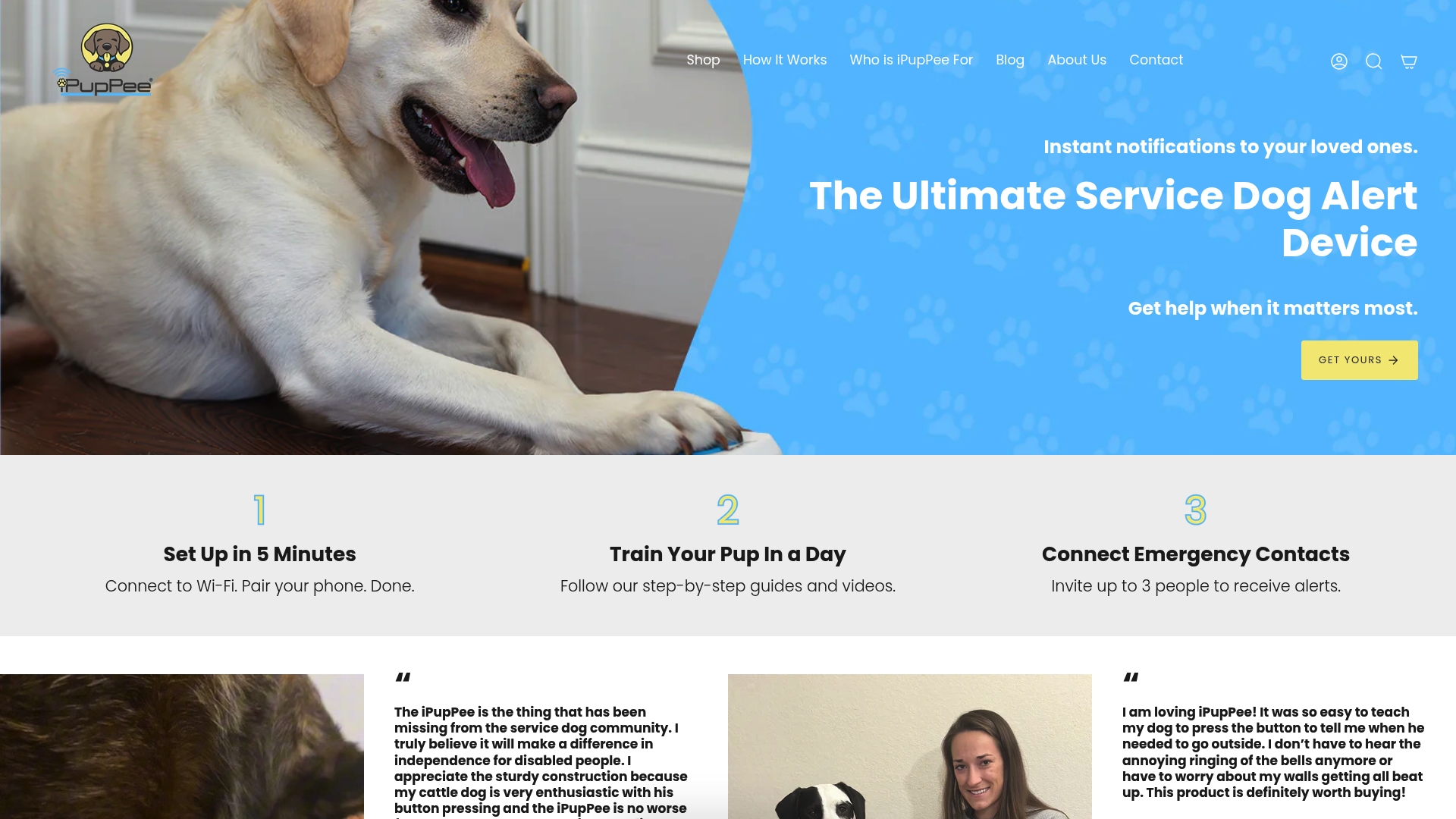
Ipuppee supports pet owners and caregivers who are navigating the real challenges of caring for disabled or mobility-limited pets. Beyond the iPupPee alert device, which helps dogs communicate needs with a single button press, the Ipuppee platform offers educational resources, product guidance, and a curated blog covering everything from senior pet safety to communication tools for special-needs dogs. If you are building a care plan for a pet with mobility challenges, explore the full range of adaptive care resources at Ipuppee to find practical solutions that match your pet’s specific situation.
FAQ
What is the best adaptive aid for a dog with hind limb paralysis?
A rear-support mobility cart, such as the Walkin’ Wheels adjustable model, is the most effective device for hind limb paralysis. Most dogs begin using it confidently within one week with gradual, reward-based introduction.
How do I know if my pet needs a brace or a wheelchair?
Braces suit pets who retain some voluntary movement and need joint or spinal stabilization. Wheelchairs are appropriate when the pet cannot bear weight on affected limbs at all.
Are off-the-shelf orthopedic braces as effective as custom ones?
For most cases, yes. Direct-to-consumer medical-grade braces cost $45 to $75 and provide stabilization comparable to custom-molded orthotics that cost $800 to $1,200, provided the fit measurements are taken accurately.
How long does it take a pet to adapt to a mobility aid?
Most dogs adapt to wheelchairs within days to weeks using short sessions and positive reinforcement. Harnesses and braces typically see acceptance within a few days when introduced calmly and paired with treats.
Should I modify my home before or after getting an adaptive aid?
Before, if possible. Installing non-slip runners, ramps, and safety gates before the device arrives reduces fall risk immediately and makes the transition to using the aid smoother for your pet.